Apologies in advance to all of our non-WoW-playing readers! The World of Warcraft: Dragonflight release is exactly one month away today, so in the weeks ahead we’re likely to talk more about the game than not.
One of the most astounding things to me is that this expansion will fully enable flying, considering how fervent Blizzard’s opposition to giving PCs the ability to fly has been thus far. (Perhaps some of the old guard are out and a new guard is in?)
This week, since the patch, we have started diddling with the UI changes. The larger minimap for sure is nice, but otherwise I’ll just have to see which elements on screen I might want to move. I mean, I’ve tried a few configurations and re-adjusted them multiple times already, but it’ll take a little longer to figure out what really works. The talent trees will take even more time to get used to, and that’s fine.
At the moment I’m more excited about the crafting orders, however. I haven’t found professions very satisfying at all for many years now; it’s about time we get something new.
Soon! 🙂
Image: Dragonflight gardern screencap via Blizzard
Want to add some color to your tabletop role-playing games? Here’s a quick method to roll up a random tavern, complete with name, atmosphere, staff, and even the potential for some side stories to shake up your ongoing plot.
First, to name your tavern, roll a d20 twice to get two numbers between 1 and 20. Apply the following adjustment for the quality of the establishment to each number to get two final results between -2 and 23.
Quality
Adjustment
Squalid
-3
Poor
-2
Common
-1
Average
0
Nice
+1
Fine
+2
Exquisite
+3
Find the result of your two rolls on the table below. You can either name your tavern “The Adjective Noun” or “The Noun and Noun.”
Let’s say you’re making a poor tavern and you roll a 9 and a 2. You subtract 2 from the results to get 7 and 0. That gives you The Grim Snake, The Dead Sailor, or The Snake and Sailor (or Sailor and Snake), whichever one sounds best for your setting. If you’re making a fine tavern and you roll a 6 and a 15, those become 8 and 17, giving you The Lost Hero, The Cheerful Hare, or The Hare and Hero / Hero and Hare. (Of course, reroll or adjust if you’re not happy with any of the results.)
Roll
Adjective
Noun
-2
Hanged
Rat
-1
Drowned
Thief
0
Dead
Snake
1
Drunk
Outlaw
2
Dizzy
Badger
3
Tipsy
Shepherd
4
Lazy
Dog
5
Thirsty
Drover
6
Hungry
Cat
7
Grim
Sailor
8
Lost
Hare
9
Lonely
Tailor
10
Wandering
Lamb
11
Quiet
Rider
12
Stout
Bull
13
Drowsy
Knight
14
Merry
Deer
15
Lucky
Curate
16
Cozy
Stag
17
Cheerful
Hero
18
Dancing
Lion
19
Winsome
Prince / Princess
20
Flying
Peacock
21
Blessed
Sovereign
22
Glorious
Unicorn
23
Regal
Dragon
Now that you have a name, the next thing to do is roll up the atmosphere and staff. For this roll a d6 and apply the same adjustments for quality.
Roll
Atmosphere and staff
-2
A rickety old hovel, half falling down, with rotten floorboards and vermin scuttling just out of sight. The staff is surly and suspicious of outsiders.
-1
A dilapidated shanty with broken windows. The wind whistles through chinks in the walls and rain soaks through the uneven thatch of the roof. The staff is gloomy and unhelpful.
0
A ramshackle place knocked together from an old barn and its outbuildings. The staff is tired and rude.
1
A worn-out house that’s seen better days; the furniture is unsteady, and the curtains are faded. The staff is harried and disagreeable; they respond to the needs of their guests, but slowly and with lots of grumbling.
2
A modest establishment with good ale and decent food, but the furnishings are old and threadbare, the beds are uncomfortable, and the walls are thin. The staff is capable but does not take initiative and is hard to get moving.
3
An old but tidy farmhouse adapted to hosting travelers; everything inside is worn but well cared for. The staff is polite and proud of their inn, but they have limited resources to work with.
4
A plain but cozy little inn; most of the guests are regulars from the local countryside who come here to see old friends and enjoy familiar comforts after a hard day’s work. The staff is cheerful and helpful, but often distracted by conversations with regulars.
5
A comfortable and well-kept place; the furnishings are new and pleasant, but not expensive. The staff is proud of their tavern; they are gracious to guests who appear well-to-do, but brusque with any visitors who seem poor or unkempt.
6
A charming old-fashioned tavern that has been run by the same family for generations; many of the furnishings are heirlooms passed down from the original owners. The staff knows the full history of the inn and will share interesting historical tidbits at the drop of a hat, but doesn’t know much else.
7
A new establishment, recently built with all the modern conveniences, comfortable rooms, and excellent food. The staff is eager to advertise and encourages guests to spread the word.
8
A luxurious retreat, built in the style of distant lands and filled with imported luxuries; exotic spices flavor the food and vintage wines fill the cellars. The staff performs elaborate courtesies with an affected air, but are also expert at discreetly fulfilling guests’ wishes, even the more unusual ones.
9
A palatial lodging built with cut and polished stone, gilded everywhere; the furnishings are immaculate antiques, and the serving wares are the finest porcelain and silver. The staff is highly competent, discreet and unflappable, accustomed to both accommodating the whims of wealthy clients and being handsomely rewarded for their service.
If you want to add a little extra drama to your characters’ stay at the tavern, you can also roll up a little side story with a d6, applying the same modifier for the quality of the place. How your players deal with this added drama is up to them.
Roll
Drama
-2
A gang of brigands is dividing up the loot from their latest raid in a corner of the common room. They suspect the player characters may be hunting them, so they try to look innocent, which only makes them look more suspicious. They are likely to react with violence if challenged.
-1
A young traveler spots the player characters and thinks they recognize the person who killed their parents and against whom they swore vengeance. (They may or may not be correct, depending on your party’s backstories and adventuring habits.)
0
The kitchen catches fire in a cooking accident, and the guests are called upon to help evacuate the inn and fight the blaze.
1
A very large, very drunk patron spills their drink on one of the player characters and gets belligerent demanding the character buy them a new drink.
2
The innkeeper accuses the player characters of trying to pay with counterfeit coins. Depending on the setting, local law enforcement may or may not get involved before everything can be sorted out.
3
A smuggler, on the run from the law, attempts to slip some of their contraband into the player characters’ baggage.
4
A spy in the service of the player characters’ enemies is staying at the same inn. In their haste to get away before the party notices them, they accidentally leave behind some evidence that helps the party on their current quest.
5
Two young nobles from rival houses are staying at the inn under false names, having run away from their families together. They fear that the player characters may recognize them, so they take steps to evade, eliminate, or ingratiate themselves with the party.
6
One of the player characters recognizes a familiar taste in the cooking and discovers that someone from their past is working in the kitchen. Whether the reunion is a happy or tense one is up to you and the player.
7
One of the staff falls into hero worship of one of the player characters and hangs around making starry eyes at them and being generally awkward but harmless. They may be persuaded to do something to help out their newfound hero.
8
The player characters are mistaken for visiting dignitaries from an important neighboring power and find themselves besieged by petitioners and sycophants.
9
A wandering prophet recognizes the player characters and offers to share valuable information about their current quest in exchange for picking up the prophet’s rather hefty bar tab.
Image: Interior of a Tavern, with Cardplayers and a Violin Player, via Wikimedia (currently Royal Collection, UK; c. 1695; oil on canvas; by Jan Steen)
It’s a common misconception that the further you go in history, the poorer the materials and decorations used were. Materials were simpler, yes; complex metal alloys, synthetic textile fibres, or clean rooms, for example, were a long way in the future.
But the more we study extant material remains, the clearer it is that humans have always appreciated beauty in their surroundings and—if they possessed the means—decorated both themselves and their everyday environment. Case in point: Minoan mugs from ca. 1,500 BCE.
Mugs in similar shapes can easily be found in modern tea shops, even if we don’t use exactly the same decorative motifs in the same combinations or colors anymore.
What’s also fascinating is that the handles are exquisitely formed, with just about exactly the same range of variations you can find nowadays. These people clearly knew how to make a practical and pretty mug.
(Phew! I’m growing quite disillusioned with the current fad of making splashy trailers that tell you very little about the story. The cutting is fast, action even faster, and if anything is revealed of the characters it’s piecemeal or prosaic, reducing the characters to a gimmic each. But I digress.)
We do get a little more tidbits in this second trailer. Looks like Wakanda is attacked, but at least I can’t tell if it’s random western soldiers or Namor’s troops. (Or both???) A new character to me is Riri Williams / Ironheart. She’s wearing some sort of a power suit based on the Iron Man suit—which means that the two people in the world wearing those kinds of suits are both black, doesn’t it? Cool!
The former Queen Ramonda seems to be at the U.N. (approx. at the 1:23 mark), but what is she arguing for? Attacking Atlantis??? Finally, we do see the new Black Panther jump from a great height and land (with the kinetic energy of the fall being stored in the suit, of course). Clearly it’s a female figure—Shuri, from the general shape, maybe? And was that Nakia I saw with gorgeous, long hair?
Black Panther: Wakanda Forever releases on November 11, 2022. So soon! 🙂
Hey, look! We found a thing on the internet! We thought it was cool, and wanted to share it with you.
My next dragon-themed transmog is for the bronze dragonflight. Here’s my hunter in mail with a scaly bronze theme and some dragony accessories. You can see the gear here.
You can check out my previous transmogs for the blue and red dragonflights, too.
Image: World of Warcraft screencap
Of Dice and Dragons is an occasional feature about games and gaming.
One of the really creative solutions she came up with is to inexpensively bone the corselet with zip ties. Much easier to get than corset bones! Another trick Cindy uses is to buy solid-color cotton sateen sheets in good condition from the thrift store to use as costuming material. (I’d add thrift store curtains, but in those there’s much more variability of both quality of material and fiber content, so they might require more time to go through to find anything worthwhile. Then again, if you do find good panels, often there’s quite a bit of fabric.)
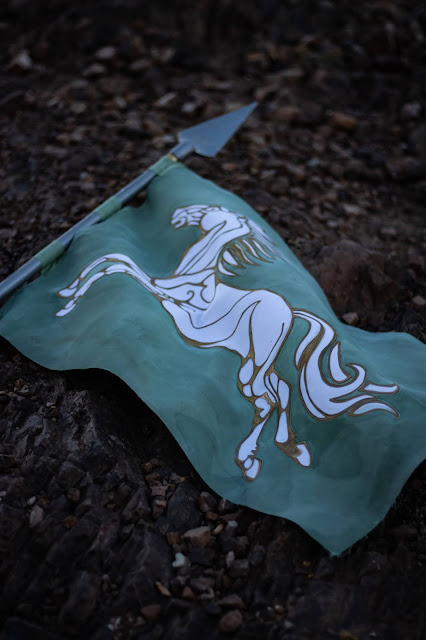
Cindy also made the flag herself from a pillowcase using acrylic paint and gold pens. It’s as staggeringly handsome as the costume. Here’s a closeup:
The spear is made from foam, duct tape, and a wooden dowel, and looks as fantastic as the rest of the outfit. Kudos all round!
We recently rewatched the Star Wars movies. We decided to individually rank the movies from favorite to least favorite, then compare notes. First, our brief thoughts on each movie individually.
Star Wars: Episode I – The Phantom Menace
Erik: Visually beautiful, but the plot drags and the dialogue is ludicrous. Like the other prequel movies, it at least has a clear narrative purpose that operates on two levels: the corruption of Anakin Skywalker and the fall of the Republic.
Eppu: Too messy all round; a travesty of writing not helped by (some of) the acting.
Star Wars: Episode II – Attack of the Clones
Eppu: Least bad of the prequels; only Ewan McGregor and Natalie Portman save the movie.
Erik: Despite its weaknesses (especially in the Anakin/Padme storyline), this film comes the closest to the series’ classic pulp sci-fi inspirations.
Star Wars: Episode III – The Revenge of the Sith
Erik: More weak plot and ridiculous dialogue, but there is an atmosphere to this film that sustains it, a palpable sense of an age of beauty and light coming to an end.
Eppu: An intelligent woman—and playing the Smurfette part to boot—is reduced to a walking womb. Yuck.
Rogue One: A Star Wars Story
Eppu: The learning-to-work-together aspect and found family vibes with a heaping of nostalgia offset the grimdark.
Erik: A love letter to the original trilogy, filled with great characters.
Solo: A Star Wars Story
Erik: An unnecessary, self-indulgent piece of fanfiction with neither the spirit of the original trilogy nor the narrative purpose of the prequels.
Eppu: It’s just weak all round, and Alden Ehrenreich certainly can’t pull off the role of young Han. (Well, except for propping, sets, and CGI, which at least are very professionally done if not always terribly imaginative.)
Star Wars: Episode IV – A New Hope
Eppu: Can’t beat a classic: well edited, scored, acted, with decent if at times very concise writing. Feels a little sparse or basic compared to today’s movie plots, which isn’t necessarily a bad thing.
Erik: There is beauty in how spare the writing and worldbuilding are, giving us just enough that our imaginations can fill in the rest.
Star Wars: Episode V – The Empire Strikes Back
Erik: Some great action sequences and character development, but it doesn’t feel like they all belong in the same movie.
Eppu: Darker and more desperate, again well constructed. Nostalgia helps here, too.
Star Wars: Episode VI – The Return of the Jedi
Eppu: Loved it as a kid, but the present me sees the ridiculousness of Ewoks fighting stormtroopers.
Erik: I love seeing Luke’s growth as a Jedi, both in skills and self-awareness, and I like Ewoks versus stormtroopers.
Star Wars: Episode VII – The Force Awakens
Erik: While the movie is overly focused on being as Star Wars-y as possible, the new characters are all clearly defined and well acted.
Eppu: Tries to hit all of the same spots as the original trilogy, but ends up trying too much.
Star Wars: Episode VIII – The Last Jedi
Eppu: Despite its confusion on what the movie wants to be, General Leia and Vice Admiral Holdo kick ass. The entertaining side plot with Rose is also a plus.
Erik: So much wasted potential. This could have been the best movie in the entire series, but it is too obsessed with its concepts to actually tell a story with them.
Star Wars: Episode IX – The Rise of Skywalker
Erik: An overstuffed mess of contrived events, plot gimmicks, and fanservice for the worst parts of the Internet.
Eppu: I like best the Rey plus Kylo Ren conflict-turns-into-understanding arc. Palpatine and his cronies are comically, hilariously dark and corny, which almost makes me snort my way through those parts.
Here’s our individual rankings.
Erik’s
Eppu’s
1
Star Wars: Episode VI – Return of the Jedi
Rogue One: A Star Wars Story
2
Rogue One: A Star Wars Story
Star Wars: Episode IV – A New Hope
3
Star Wars: Episode IV – A New Hope
Star Wars: Episode V – The Empire Strikes Back
4
Star Wars: Episode VII – The Force Awakens
Star Wars: Episode VI – Return of the Jedi
5
Star Wars: Episode V – The Empire Strikes Back
Star Wars: Episode VII – The Force Awakens
6
Star Wars: Episode II – Attack of the Clones
Star Wars: Episode VIII – The Last Jedi
7
Star Wars: Episode VIII – The Last Jedi
Star Wars: Episode IX – The Rise of Skywalker
8
Star Wars: Episode III – Revenge of the Sith
Star Wars: Episode II – Attack of the Clones
9
Star Wars: Episode I – The Phantom Menace
Star Wars: Episode I – The Phantom Menace
10
Star Wars: Episode IX – The Rise of Skywalker
Star Wars: Episode III – Revenge of the Sith
11
Solo: A Star Wars Story
Solo: A Star Wars Story
Erik’s comments:
I put Return of the Jedi first for a couple of reasons. First, I love the opening act with the rescue of Han from Jabba’s palace. It’s so well structured, gradually reintroducing us to all the heroes and showing us Luke’s growth as a Jedi. Second, I’m a sucker for any fight in which low-tech beats high-tech, and the Endor battle is one of my favorites.
I like The Force Awakens more than The Empire Strikes Back. I’ve never really been a fan of Empire, although I know it’s widely considered the best movie of the original trilogy. I won’t argue about the strengths of Empire or the weaknesses of Force, but I just enjoy watching Rey discover her Jedi powers and Finn find his footing in the Resistance more than I enjoy watching Luke run around a swamp and Han try to kickstart the Falcon.
I didn’t think there could be a Star Wars movie worse than The Phantom Menace, but then came Solo and The Rise of Skywalker. Phantom at least has beautiful sets and costumes, an action hero queen, and a fantastic lightsaber fight. Rise is a jumbled and unnecessary mess, and Solo is just answering questions that didn’t need answers.
Eppu’s comments:
Overall, I found the nods towards the original trilogy in Rogue One an absolute delight the very first time we watched the movie, and I’ve continued to enjoy them a lot despite the fact that many of them are basically direct copies of dialogue or shots. For me, it’s very close to a perfect combination of homage plus original material. Director Krennic is the only acting job that comes close to unbearable ham (but that may have been how Ben Mendelsohn was directed, as he’s great in other productions).
The strength of Empire for me is the exploration of Luke’s, Leia’s, and Han’s characters when they each hit a rough patch, which is why I ranked it higher than Return. Also Lando turns out to have more depth right from the bat than, say, Count Dooku.
Sadly, the sequels are almost as bad a mess storywise as the prequels, but fortunately they picked more talented core actors and did *not* write in an inept, ham-fisted Asian caricature. (Then again, I gather that the production of the sequels was exceptionally convoluted and involved lots of back-end drama.) Cinematographically, though, the sequels are light years ahead of any of the others, I think.
In hindsight, maybe I should’ve bumped Clones a step down and Phantom a step up—Anakin behaves so fecking creepily towards Padme it’s upsetting to watch. At least in Phantom he behaves more maturely, as odd as it is to say about a little kid, and, like Erik said, there’s pretties to see.
There’s a marked difference in quality between the original and prequel trilogies. I’ve often wondered why that is. (Not having really cared to look for an answer online, though, I can only speculate.) I do have a vague impression of having read somewhere that one reason for the success of the original trilogy was that the editing team—if I remember right, especially Marcia Lucas—wove the storylines into a cohesive, tight, smoothly moving arc. In the prequels, the core of the story largely gets lost among the bling. In a way, it feels like once Lucas effectively was the boss, it was to the detriment of the story.
Granted, we finally got the fight scenes worthy of the jedi; that, plus improved effects (including makeup and costuming), are what the prequels did absolutely right. In the end, however, they visuals are not enough in themselves to pull the prequels up from the bottom.
From the point of view of current viewer (i.e., setting aside any past significance from a technological point of view), action scenes and special effects have improved so much in the past few decades that the prequels cannot offer anything memorable. It’s the strength of the story, the characters, and the acting that a movie must stand on now. In that sense, the prequels have very little to offer me. Moreover, it’s actually rather impressive that we both ranked Solo as the absolutely last one, below the prequels—a mark of a true washout. I’m only sad that the tanking of Solo means my fellow Finn Joonas Suotamo likely won’t get hired for more Chewbacca roles.
There’s so much you could say about all of the movies. At times ranking really wasn’t very straightforward. (How do you properly gauge the messiness of the prequels, for instance. I’m sure if you were to ask me two years from now, I’d list some of the movies differently.)
We know other people have different opinions from ours; we’d like to hear yours!
Image by Eppu Jensen
In the Seen on Screen occasional feature, we discuss movies and television shows of interest.
Willow is joining the 1980s franchise reboots. The new incarnation bears the same name as the 1988 movie, but this time it’s going to be an 8-episode series. Here is the official teaser trailer:
At first is looks like the only returning characters are Warwick Davies’ Willow Ufgood and Joanne Whalley’s Sorsha. However, at least one of the two pixies—Rool and Franjean in the original—sounds awfully familiar. Their actors aren’t listed in IMDB, however, but the cast listing is very cursory overall at this writing, so who knows.
I am of the generation who grew up with Willow. In fact, we recently re-watched it for nostalgia’s sake. (Little did I know that there would be more soon!) It’ll be fascinating to see what they’re going to do effects-wise, since the old Willow was already a trailblazer: it was the first time we saw successful, computer-animated morphing on the big screen. (Some other effects looked clumsy now, but the morphing was spot-on.)
Anyway, it’s hard to say anything definite on the basis of the short teaser, except there’s great potential for learning to work together. I saw comments elsewhere to the effect of this series looking like a bargain-basement version of Shannara, or a copy of the new Wheel of Time series. The full teaser looks a lot better, however.
Still, not knowing two of the three listed writers (John Bickerstaff and Hannah Friedman; Jonathan Kasdan I only know from Solo and an episode of Freaks and Geeks) I just don’t know if this is worth investing my time in, 80s nostalgia or not.
Willow the series is scheduled to premiere on November 30, 2022.
Hey, look! We found a thing on the internet! We thought it was cool, and wanted to share it with you.
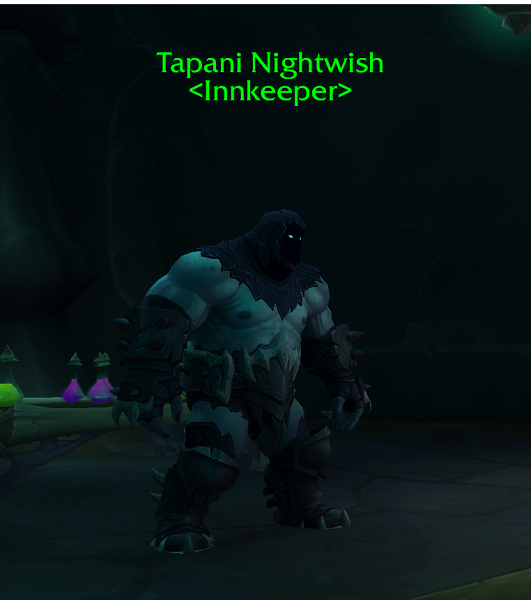
I must’ve been quite absorbed in something—like grinding my last toons through Shadowlands, I think—to not notice until now(!) that at the Seat of the Primus in Maldraxxus there’s an innkeeper called Tapani Nightwish.
It immediately caught my eye because of two things: Tapani is a Finnish male name, and Nightwish is a world-famous Finnish symphonic metal band.
Not being a fan, per se, despite having osmotically absorbed some of their music over the years, I had to immediately look up the band members. It isn’t a case of direct homage, but likely refers to an ex-bassist of theirs, Marko Tapani Hietala.
Woot! LOL! 😀
Image: screencap from World of Warcraft
Of Dice and Dragons is an occasional feature about games and gaming.




 Co-Geeking
_-_Interior_of_a_Tavern,_with_Cardplayers_and_a_Violin_Player_-_RCIN_405825_-_Royal_Collection.jpg)