Grammatically Female Dwarves in Tolkien

Jimtheviking on Tumblr wrote about how the Dwarven names in J.R.R. Tolkien’s The Hobbit connect with Old Norse, especially Dwarf names listed in the poem Völuspá.

According to Jimtheviking, Tolkien chose a number of names from Old Norse and tweaked those names in an interesting way. Namely, Tolkien grasped Old Norse grammar well enough to know that the omission of one n from a name ending in –inn changed it from masculine to feminine. To quote Jimtheviking:

“Well, I give you the names of the Dwarves from the Hobbit, as they appear in Dvergatal (stanzas 14-16) and in the order they appear:

“Dvalins, Dáinn, Bívurr, Bávurr, Bömburr, Nóri, Óinn, Þorinn, Þráinn, Fíli, Kíli, Glóinn, Dóri, Óri

“Now, in the Hobbit, they’re named as follows:

“Dwalin, Dáin, Bifur, Bofur, Bombur, Nori, Óin, Thorin, Thráin, Fíli, Kíli, Glóin, Dori, Ori.

“Now, you notice something with the way those names got changed? That’s right, he changed the masculine -inn definite suffix to -in, which is feminine.

“That means that, at least grammatically, Dwalin, Dáin, Thorin, Thráin, and Glóin are female Dwarves.”


Then, moving on from purely linguistic, Jimtheviking continues with an intriguing argument:

“Since we know Tolkien was meticulous about his grammar, this was done most likely as an in-joke […] [emphasis original]

“But there’s a not-inconceivable chance that the Dwarves were using the masculine pronouns in Westron because that’s what the Men who met them used, despite the fact that a third of the company was female, and hey, it’s kinda neat to think he wrote a bunch of Dwarf-ladies going on an adventure.”

It is really interesting, isn’t it, to posit male and female Dwarves in Tolkien’s adventures?!

500px Alexander Turchanin Thorin Cosplay


Poking around, I found versions of Völuspá that differ from the Dwarf list as given by Jimtheviking*. Not just the list itself, but also spellings differ depending on the edition you’re using (which isn’t rare at all in philology). Nevertheless, the main point stands: Tolkien changed names that had –inn in the original to just –in in English.

Of all Tolkien’s Dwarf names, he seems to have adopted Durin, Dwalin, Náin, Dáin, Bifur, Bofur, Bombur, Nori, Óin, Thorin, Thrór, Thráin, Fíli, Kíli, Fundin, Náli, Oakenshield (Eikinskjaldi, cf. Icelandic ‘oak shield’), Glóin, Dori, and Ori from the Völuspá.

Of them, Durinn, Dvalinn, Náinn, Dáinn, Óinn, Þorinn, Þráinn, Fundinn, and Glóinn are all originally spelled with a double n. (In addition, there’s a change from a double r to a single one in Bívurr / Bívǫrr, Bávurr / Bávǫrr, and Bömburr / Bǫmburr, which Jimtheviking does also comment on.)

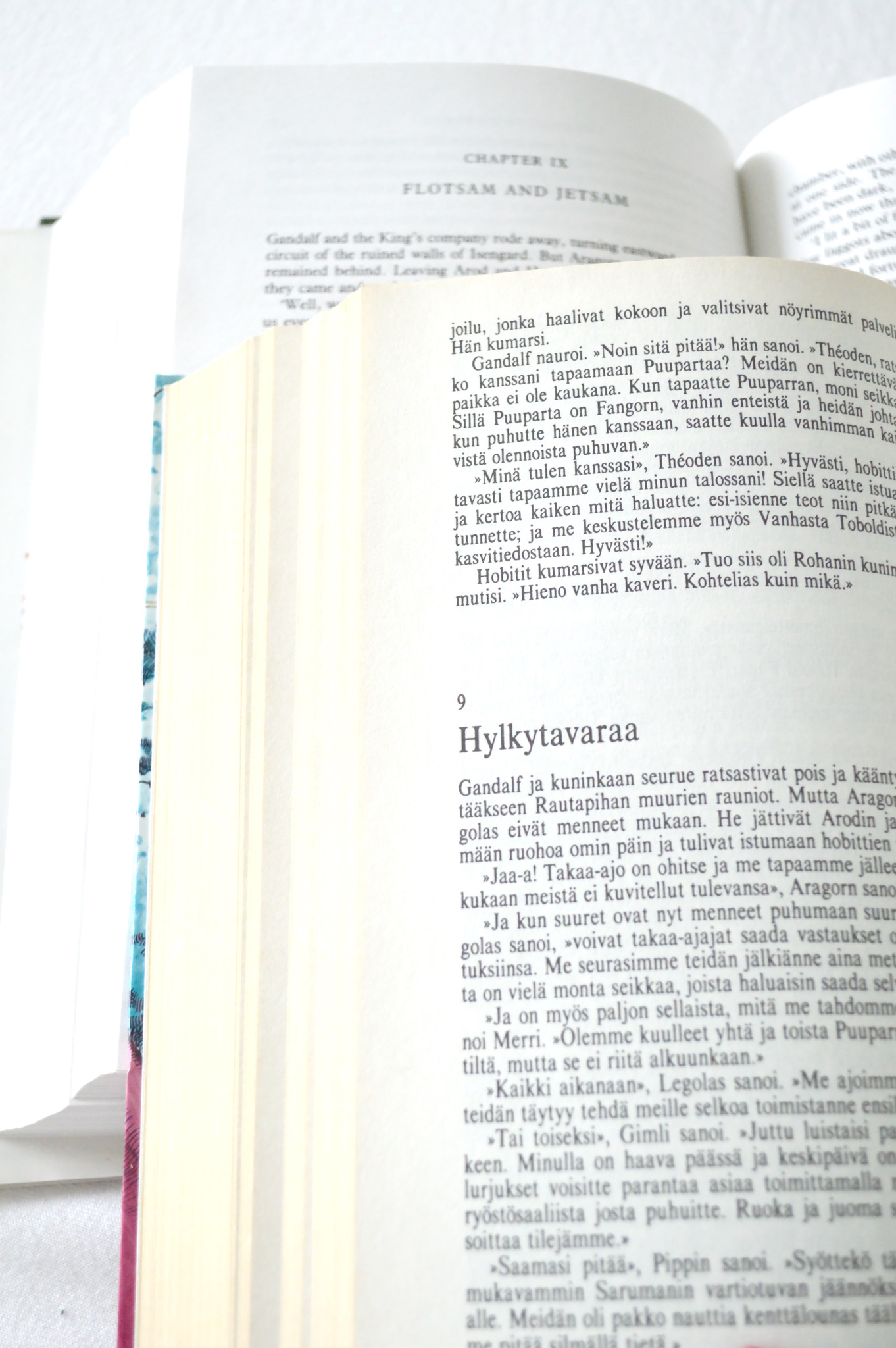
Anyway, the whole thing kinda reminds me of the first time I read The Lord of the Rings, decades ago now. I was young enough that it was in translation, which means the young me ploughing through LotR was quite confused over the gender of some characters. The Finnish language doesn’t have grammatical gender, you see. Instead of he or she, we just have one third-person singular pronoun, hän, which is used of all people regardless of sex, gender, age, kinship, marital status, whatever, just like the English third-person plural they is. Normatively, in Finnish everyone is a hän.

Even at that young age, I knew that (apart from Astrid Lindgren) most of the publications, including those for the younger audience, centered boys and male characters. Contextually, I could tell that Frodo and Sam were male. Same for Legolas and Gimli, Aragorn and Boromir, and Gandalf and Elrond. Arwen, Galadriel, and Eowyn were female.

But Glorfindel? Maybe male, I thought, but there is nothing explicit at all in the Finnish translation. And Merri and Pippin? Somehow at that time I couldn’t make them out at all; indeed, they’re the two characters whose gender confused the young me the most.

Having grown up reading the Moomins, Pippi Longstocking, Ronia the Robber’s Daughter, The Famous Five series, and The Dark Is Rising sequence, I saw nothing odd in girls and women also going on adventures. So I thought it was quite plausible that Merri and Pippin could be female, and was too young to read all of the textual cues that imply they aren’t. (Remember that in Finnish the gender-neutral pronoun hän gives absolutely no clue whatsoever about anyone’s gender.)

The possibility of a linguistic in-joke regarding these Dwarven names really tickles the imagination and would be completely plausible of Tolkien. Interestingly, the name Gandalf also originally comes from the Dvergatal (see e.g. stanza 12 in Pettit’s 2023 edition, which lists the name as Gandálfr). A Dwarven Gandalf would, indeed, give quite a different vibe to LotR.

And now I kinda want new movies of The Hobbit, with the amazing attention to detail that Weta lavished on the effects and props in Peter Jackson’s versions, but with more heedful writing and with half the Dwarves in the party female. That would be a truly intriguing take!

Images: Thorin cosplay by Alexander Turchanin on 500px.

*) Dwarves are named in stanzas 10-16, starting with Mótsognir and Durinn. The undated Völuspá version linked to by Jimtheviking, edited by Guðni Jónsson, includes more rows than the newest edition I found. The extra lines must come from (an)other extant version(s) of the text.

Names in the undated Völuspá version linked to by Jimtheviking (ed. Guðni Jónsson):

Durin (stanza 10: Durinn)

Dwalin (11: Dvalinn)

Náin (11: Náinn)

Dáin (11: Dáinn)

Bifur (11: Bívurr)

Bofur (11: Bávurr)

Bombur (11: Bömburr)

Nori (11: Nóri)

Óin (11: Óinn)

Thorin (12: Þorinn)

Thrór (12: Þrár)

Thráin (12: Þráinn)

Fíli (13)

Kíli (13)

Fundin (13: Fundinn)

Náli (13)

Oakenshield (13, 16: Eikinskjaldi)

Glóin (15: Glóinn)

Dori (15: Dóri)

Ori (15: Óri)

Names in Edward Pettit’s 2023 edition of the Völuspá:

Durin (stanza 10: Durinn)

Dwalin (11: Dvalinn)

Bifur (11: Bívǫrr)

Bofur (11: Bávǫrr)

Bombur (11: Bǫmburr)

Nori (11: Nóri)

Thrain (12: Þráinn)

Thorin (12: Þorinn)

Thrór (12: Þrór)

Fíli (13)

Kíli (13)

Fundin (13: Fundinn)

Náli (13)

Oakenshield (13, 16: Eikinskjaldi)

Gloin (15: Glói)

Note that Pettit’s version doesn’t include Náin, Dáin, Óin, Dori, or Ori.

A Name for an Amazon

Amazons, the bold warrior women who figure in Greek myths, are imaginary, but the myths about them likely had their origin in Greek experiences with actual fighting women in the cultures around the shores of the Black Sea. Ethnographic and archaeological evidence shows that women who trained with weapons and fought in battle were known in many of the cultures in the region, and the association of mythic Greek Amazons with horses and bows also matches the realities of life on the Black Sea steppes.

Greek literature and art records numerous Amazon names. Most of these names are Greek, and they are descriptive of relevant Amazon traits, such as Hippolyta (“She who sets the horses loose”), Melanippe (“Black horse”) or Antiope (“She who confronts”). These names may have been simply invented by Greek writers in the same way that fantasy authors today concoct suitable names for their characters. There is evidence, however, that some of the Amazon names recorded in Greek art might be actual names from languages spoken around the Black Sea.


Greek vase fragment via the J. Paul Getty Museum (made Athens, currently Getty Museum, Malibu; c. 510 BCE; glazed pottery; painted by Oltos)

This Greek pottery fragment shows Amazons riding into battle against the Greek hero Heracles (who appears accompanied by the god Hermes on the other side of the cup). We can recognize the riders as Amazons from their clothing and the bowcases they carry. Text in Greek letters surrounds them, although it is painted in a dark color that is difficult to see. Most of the text is fragmentary and hard to reconstruct, but one word seems to be a complete name. The text PKPUPES can be read by the head of the leftmost rider, evidently her name.

“Pkpupes,” at first glance, may look like mere gibberish. It certainly isn’t Greek. Many scholars in the past dismissed this and similar texts as nonsense words written by semi-literate vase painters. Maybe “pkupupes” was just an attempt at an onomatopoeic for the pounding of a horse’s hooves. It may, however, be something more significant.

Dense clusters of hard consonants like “pkp” are a common feature of languages spoken today in the Caucasus Mountains east of the Black Sea. “Pkpupes” is, in fact, fairly easy to read as an attempt to render a name in Circassian, a cluster of closely related languages of the northwestern Caucasus, with the letters of ancient Greek, which did not perfectly match up to the sounds of the original language. English doesn’t have all the right letters to easily represent the sounds of Circassian either, but a reconstructed Circassian name that would be rendered in English something like “Pqp’upush” is perfectly intelligible. This name is composed of several elements, the first referring to the body, the next to covering, and the final one connoting worthiness. Altogether, the name would mean “Worthy to wear armor,” a suitable name for a warrior woman.

Greeks had extensive contact with peoples around the Black Sea. Many Greeks migrated to the region, and people from the area also settled in Greece. The painter of this vase signed his name “Oltos,” which is not a typical Greek name, and he may have been an immigrant himself. He and other ancient vase painters may well have known people who spoke foreign languages or had ancestors from the Black Sea region who could recommend appropriately authentic names for Amazon characters. It may even be that some of the obviously Greek Amazon names like Hippolyta or Antiope were not invented by Greeks but are Greek translations of authentic names, in the same way that the names of many indigenous Americans in recent history have been translated into English, like Sitting Bull or Red Cloud.

The Amazons of Greek myth remain mythical, but we have evidence for some history behind that myth, maybe even the names of some real warrior women from the edges of the world known to the Greeks.

Source

Adrienne Mayor, John Colarusso, and David Saunders, “Making Sense of Nonsense Inscriptions Associated with Amazons and Scythians on Athenian Vases,” Hesperia 83, no. 3 (July-September 2014): 447-93.

Quotes: Gwladys or Ysobel or Ethyl

Complaining about “kids these days” with strangely-spelled names is a well that never runs dry. It’s also an older habit than many who indulge in it would think. Here’s a bit from a 1930 P. G. Wodehouse story where Bertie Wooster’s Aunt Dahlia chides him for falling in love with a young lady with an eccentrically-spelled name.

‘Yes, Aunt Dahlia,’ I said, ‘you have guessed my secret. I do indeed love.’

‘Who is she?’

‘A Miss Pendlebury. Christian name, Gwladys. She spells it with a “w”.’

‘With a “g”, you mean.’

‘With a “w” and a “g”.’

‘Not Gwladys?’

‘That’s it.’

The relative uttered a yowl.

‘You sit there and tell me you haven’t enough sense to steer clear of a girl who calls herself Gwladys? Listen Bertie,’ said Aunt Dahlia earnestly, ‘I’m an older woman than you are – well, you know what I mean – and I can tell you a thing or two. And one of them is that no good can come of association with anything labelled Gwladys or Ysobel or Ethyl or Mabelle or Kathryn. But particularly Gwladys.’


P. G. Wodehouse, “The Spot of Art”

The next time someone gets in a snit about Kaytlynn, Jaxson, or Alexzandre, you can let them know they’re part of a tradition at least a century old.

Wodehouse, P. G. “The Spot of Art.” Very Good, Jeeves. First published 1930. Reprinted in The Jeeves Omnibus. Vol. 3. London: Hutchinson, 1991, p. 460.

A New Translation to Honor the 50th Anniversary of Tolkien’s Passing

J.R.R. Tolkien died on September 02, 1973, exactly 50 years ago this Saturday. Also 50 years ago this year saw the publication of The Fellowship of the Ring in a Finnish translation. In celebration, a new, improved Finnish translation of the whole trilogy will be published this September.

Often a translation, especially of a fictional work, seems less good—less satisfying, skillful, expressive, vivid, what have you—as the original.

In my experience, however, there is one exception—and perhaps you guess the connection? The Finnish translation of The Lord of the Rings trilogy.

Issuu Screencap WSOY TSH tarkistettu suom lukunayte kansi

The prose for Taru sormusten herrasta is by Kersti Juva and Eila Pennanen; the poems were translated by Panu Pekkanen. It was Juva’s first job as translator. In fact, Juva did most of the work while Pennanen supervised the first two books, and Juva got solo credit for the prose in The Return of the King.

The translation is wondrous. Somehow in the Finnish version, the Hobbits seem more homey, the Dwarves more earthy, and Elves more ethereal than in the original. The desolate areas feel more despondent, and darkness deeper. I’d also say that Pekkanen’s poetry translations wipe the floor with Professor Tolkien’s—having first read the Finnish, I was, frankly, disappointed in the English-language poems in the LotR.

I’m sure some of my appreciation of Taru sormusten herrasta comes down to nostalgia and sense of wonder—I first read the trilogy when I was in my early teens, an impressionable age if there ever was one. Some of it, I’m also sure, comes down to reading my native language.

These days, however, after decade+ of higher ed in and on the language plus daily use with a fellow language nerd, my English is quite as good as my Finnish. I can and do recognize the skill in Tolkien’s writing, plus many of the references and nuances, including some of the Old English. (Though not being a mainstream literature person, I’m sure I also miss other connections—my degree in English is primarily in the language, not lit.)

I’ve been reading in foreign-for-me languages for about 35 years now. Most of my non-native-language reading has been in English, either as original or translations. Some has been in Swedish, German, or Estonian, all translations of works I’ve previously read in the original language. While I can’t boast university education in the field of translating, I’d call myself an educated hobbyist. And as such, I can see the quality of Juva’s work. Erik and I have even read the first 400 pages or so of Fellowship out loud to each other, first a sentence in English and followed by the same passage in Finnish. You really do see Juva and Pekkanen’s skill in the text.

LotR and TSH Side by Side

This new, improved version of Taru sormusten herrasta is also by Kersti Juva. In interviews she’s said the focus of the new version is to polish the language and to weed out the uncertainties a newly-minted translator (herself) wasn’t yet able to see her way past.

Sounds ever so good to me! In fact, I already have a preorder in. 🙂 Also, the celebratory edition looks to be a gorgeous, gorgeous book, with the famous LotR illustrations by Tolkien himself.

Image: screencap from a sample of the newly revised Finnish translation of The Lord of the Rings trilogy by WSOY via Issuu. LotR and TSH side by side by Eppu Jensen.

Earliest Singular They According to the OED

I’ve long been seeing mentions that the use of the plural pronoun they to refer to a singular antecedent is older than the present attempt to introduce it as a gender-neutral option. Here’s a little history I ran across.

Dennis Baron, Professor of English and linguistics at the University of Illinois at Urbana-Champaign, blogs about singular they for The Oxford English Dictionary. According to him, the oldest recorded use within the OED is from 1375, in the medieval romance William and the Werewolf.

BrLib Digital Catalogue Illuminated MSS Royal 10 E IV f12 Detail

Continues Baron:

“Here’s the Middle English version: ‘Hastely hiȝed eche . . . þei neyȝþed so neiȝh . . . þere william & his worþi lef were liand i-fere.’ In modern English, that’s: ‘Each man hurried . . . till they drew near . . . where William and his darling were lying together.’ [original emphasis]

“Since forms may exist in speech long before they’re written down, it’s likely that singular they was common even before the late fourteenth century. That makes an old form even older.”

Since I’m a Finn and we don’t have grammatical gender in our language, singular they seems natural to me. In fact, I fail to see a reason to choose to kick up a major kerfuffle over it; after all, (normative) English already mixes up the numbers with singular and plural you.

I’m pretty sure that within the past decade or so I have spotted multiple examples from non-woke modern English sources, both television series and novels, that do use singular they seemingly unconsciously, very naturally, and entirely unambiguously. I wish I had realized to write them down for my own interest.

Image: Group of men, detail of illuminated manuscript Royal 10 E IV, f. 12, via The British Library Digital Catalogue of Illuminated Manuscripts (France, S. [Toulouse?]; last quarter of the 13th century or 1st quarter of the 14th century; illuminated manuscript)

On, of, and about languages.

How Not to Study Linguistics

The Greek historian Herodotus recounts a tale about a rather dubious experiment in linguistics supposedly carried out by the Egyptian king Psammetichus.

The point of the experiment was to find out what people or nation in the world was the oldest. It was based on the assumption that the oldest culture’s language would be the language that people who had never heard spoken language before would speak. Further, Psammetichus assumed that the invention of this original language could be artificially recreated. The result of these mistaken assumptions is a bit of a comedy of errors. Here’s how Herodotus tells the tale:

When Psammetichus could not find out by inquiry what people were the oldest, he devised the following plan. He took two newborn children at random and gave them to a shepherd to bring up among his flocks, with orders that they be raised in such a way that no one should make any sound in their presence, that they stay in a lonely hut, and that he should regularly bring his goats there so they could drink their fill, and attend to their other needs. He did these things, and Psammetichus commanded him to notify him at once what word first burst forth from the children, once they had left behind the meaningless babble of infants. And it did indeed happen. When the shepherd had been taking care of the children for two years, once when he opened the door of the hut and went in, both of them fell upon him stretching out their hands and crying: “Bekos!” At first, the shepherd took no notice of what he had heard, but when he kept hearing the same word on his repeated visits, he began to pay attention to it. He sent word to the king, and when ordered, brought the children before him. When Psammetichus heard it for himself, he investigated what people called something “bekos,” and from his investigations he learned that it was the Phrygian word for bread. Taking this fact into consideration, the Egyptians acknowledged that the Phrygians are older than they are.

– Herodotus, Histories 2.2

(My own translation)

As should be obvious (and probably was to Herodotus’ audience), the experiment was in fact a failure. When the children exclaimed “bekos” at the shepherd’s arrival, they were not producing an actual word but simply imitating the bleating of his goats, the only sound they had heard another living creature produce. The fact that Psammetichus did not realize this (and had not accounted for it in designing the experiment) makes this whole story a joke at his expense. The punch line of the joke may be a little lost on a modern audience: the Phrygians were a people who lived in inland Anatolia and spoke a language related to Greek. Phrygians were stereotyped by the ancient Greeks as ignorant country bumpkins. For the Egyptians—proud of the antiquity and sophistication of their culture—to be forced to yield the title of “most ancient people” to the Phrygians was a deflation of their cultural pretension.

Although Herodotus claims to have heard this story from Egyptian priests, like more than a few of the stories he tells about Egypt it sounds more Greek than Egyptian. Specifically, it sounds like a Greek joke told at the Egyptians’ expense. Greeks and Egyptians had close and friendly relations in Herodotus’ day, but it was a relationship in which the Greeks were definitely the junior partners. Egyptians liked to celebrate the antiquity and wisdom of their culture, and we can understand if Greeks occasionally got a bit fed up with being looked down on. This story uses language was a way of turning the tables to suggest that not only were the Egyptians not as ancient a culture as they liked to claim, perhaps they were not as wise, either.

On, of, and about languages.

Quotes: Sometimes They Develop Entire Research Articles Around Something They Overheard on the Bus

Idle browsing brought me to CD Covington’s article at Tor.com about linguists and the movie Arrival, which is based on Ted Chiang’s short scifi piece “Stories of Your Life”.

“A linguist’s job is to think about language and how it works. Linguists enjoy that and often have conversations about which dialect features they personally have, or sometimes they develop entire research articles around something they overheard on the bus. This is what we do. Not everyone thinks about how language works or is even interested in the subject. So it’s not surprising that Weber is frustrated because he doesn’t think there’s any progress happening, when Dr. Banks knows she’s made considerable progress.” [original emphases]

– CD Covington

Yup—I can attest. I take such geeky, unabashed pleasure over thinking and talking about my favorite linguistic features…! 🙂

(Find my posts about Arrival here.)

Serving exactly what it sounds like, the Quotes feature excerpts other people’s thoughts.

Behind the Name: Erebor

Erebor, also known as the Lonely Mountain, is a lost kingdom of the Dwarves in Tolkien’s Hobbit, reclaimed from the dragon Smaug by Thorin Oakenshield and his companions, including Bilbo Baggins the Hobbit, at the end of the story. Since Professor Tolkien was a linguist, and his Middle Earth was first inspired by his desire to create a world and history around his invented languages, it makes sense to ask what inspired him to name this important place Erebor.

The Hobbit itself does not make much use of Tolkien’s linguistic experiments. Most of the places named in the novel have descriptions more than names—the Misty Mountains, the Long Lake, Lake Town. Even the few places with proper names are fairly transparent in their meaning: the town that sits in a dale by the Lonely Mountain is called Dale, and Mirkwood is not too hard to understand as a murky wood. The term Erebor did not appear until The Lord of the Rings. By that point, Tolkien’s constructed languages were well developed and he provided a suitable internal etymology for Erebor as an Elvish translation of Lonely Mountain. Nevertheless, there are some clear real-world referents that we cannot ignore.

The obvious place to start is Erebos, a name from Greek Mythology for both a region of the underworld and a primordial god representing darkness. (Erebos is the original Greek spelling; it is often seen Latinized as Erebus.) To name an underground city cut out of the rock of a mountain, this makes sense as a starting point, but Erebos has an interesting etymology of its own.

Erebos derives from a Proto-Indo-European root *hregwos. (In linguistics, the asterisk indicates words that are not recorded anywhere but have been reconstructed based on related words or other forms.) The Proto-Indo-European language had several different consonants corresponding to the letter h, and the exact pronunciation of them all is a matter of debate, but before an r at the beginning of a word, this h regularly became an e in Greek. The gw sound became a b in Greek (for example, the Greek word basileus, meaning “king” comes from an earlier form gwasireu). Thus *hregwos became the ancient Greek Erebos.

In other branches of the Indo-European family, the same root took different paths. In Sanskrit, it became rájas, which means “dark sky.” In Armenian, it became erek, meaning “evening.” In Gothic, it became rikwis, “darkness.” And in Old Norse, it produced the verb røkkva, which means “to become dark.” Clearly, while Ancient Greek adapted the word to a new meaning, the original meaning had to do with darkness in the sky, not under the earth. The name of Erebor captures a suggestion not just of a place under the earth but also its fate to be assailed by the sky-darkening dragon Smaug.

There is one step further we can go, although it is a tentative one. It involves the Norse myth of Ragnarök, the doom of the gods and the destruction of the world. The word Ragnarök is a compound whose first part, ragna, means the power of the gods (congate with the English word reign). The second element is less certain. Linguists today prefer rök, meaning “fate,” but the early twentieth century when Tolkien was studying, some argued for røkkr, the noun for “twilight” derived from the verb røkkva and ultimately going back to the Proto-Indo-European *hregwos. Tolkien may well have been amused to hint at the chaotic, destructive final battle between the Norse gods in naming the site of the chaotic Battle of the Five Armies which brings Bilbo’s adventure to an end.

Image: Erebor as visualized in Peter Jackson’s Hobbit films, via IMDb

On, of, and about languages.

New Find: Most Uralic Speakers Share Siberian Ancestry

(This post is mostly a Note to Self—I don’t want to forget about the study below—but if other people are interested, that’s great.)

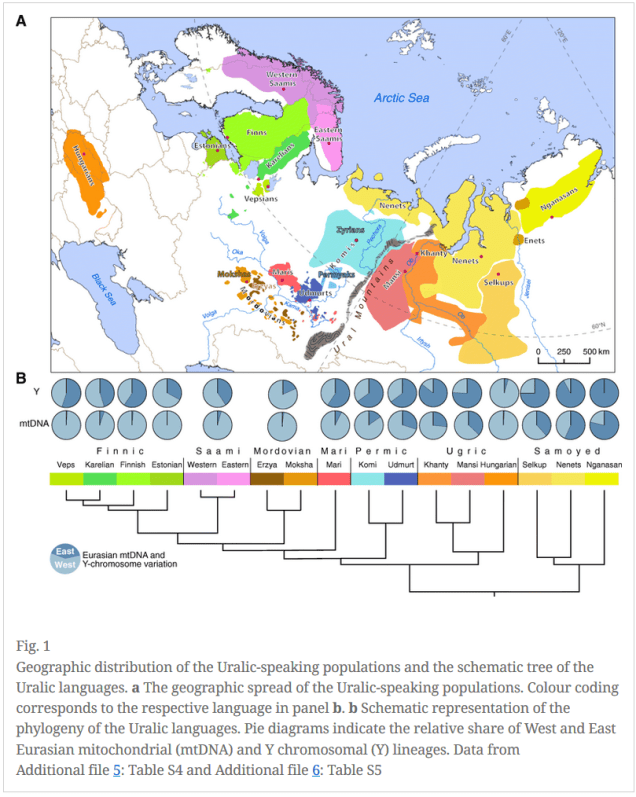
The majority of languages spoken in North Eurasia belong to three language families—Turkic, Indo-European, and Uralic. My native language Finnish is a part of the Uralic languages; the main branches of the family are the Finno-Ugric and the Samoyed.

While there’s rough agreement over where and how Uralic languages developed and spread, and over what types of material cultures were found in the corresponding areas, no-one’s done comprehensive studies on the genetic history of Uralic-speaking peoples before.

This interdisciplinary study, lead by Kristiina Tambets from the University of Tartu, Estonia, compared genome-wide genetic variation of nearly all extant Uralic-speaking populations from Europe and Siberia.

From the abstract:

“The genetic origins of Uralic speakers from across a vast territory in the temperate zone of North Eurasia have remained elusive. Previous studies have shown contrasting proportions of Eastern and Western Eurasian ancestry in their mitochondrial and Y chromosomal gene pools. While the maternal lineages reflect by and large the geographic background of a given Uralic- speaking population, the frequency of Y chromosomes of Eastern Eurasian origin is distinctively high among European Uralic speakers. The autosomal variation of Uralic speakers, however, has not yet been studied comprehensively. […]

“Here, we present a genome-wide analysis of 15 Uralic-speaking populations which cover all main groups of the linguistic family. We show that contemporary Uralic speakers are genetically very similar to their local geographical neighbours. However, when studying relationships among geographically distant populations, we find that most of the Uralic speakers and some of their neighbours share a genetic component of possibly Siberian origin. Additionally, we show that most Uralic speakers share significantly more genomic segments identity-by-descent with each other than with geographically equidistant speakers of other languages. We find that correlated genome-wide genetic and lexical distances among Uralic speakers suggest co- dispersion of genes and languages. Yet, we do not find long-range genetic ties between Estonians and Hungarians with their linguistic sisters that would distinguish them from their non-Uralic-speaking neighbours.”

Tambets et al Geo Distribution Uralic Populations w Lang Tree

And the conclusion:

“Here, we present for the first time the comparison of genome-wide genetic variation of nearly all extant Uralic-speaking populations from Europe and Siberia. We show that (1) the Uralic speakers are genetically most similar to their geographical neighbours; (2) nevertheless, most Uralic speakers along with some of their geographic neighbours share a distinct ancestry component of likely Siberian origin. Furthermore, (3) most geographically distant Uralic speaking populations share more genomic IBD segments with each other than with equidistant populations speaking other languages and (4) there is a positive correlation between linguistic and genetic data of the Uralic speakers. This suggests that the spread of the Uralic languages was at least to some degree associated with movement of people. Moreover, the discovery of the Siberian component shows that the three known major components of genetic diversity in Europe (European hunter-gatherers, early Neolithic farmers and the Early Bronze Age steppe people) are not enough to explain the extant genetic diversity in (northeast) Europe.”

I find the question of which material cultures may have spread together with which languages absolutely fascinating. Having my own small language / culture be a part of a larger study like this makes it even more special.

I was also surprised to learn that only three Uralic languages—Hungarian, Finnish, and Estonian—are not listed as endangered in the UNESCO Atlas of the World’s Languages in Danger. (I did know that several of the tiniest ones like Mari or the Permic languages have been endangered for decades, but I had thought that some of the Samoyed or Ugric languages had more speakers than that.)

While I doubt these three will go extinct very soon, there’s pressure at least in Finland to adopt more and more loanwords from English. Then again, we three may end up being rather rare, all in all, and I’m not quite sure whether to be alarmed over our potential disappearance or proud of our preciousness—or both.

Found via Helsingin Sanomat (NB. Finnish only). (Related article on the Siberian genes of Finns and the Sami in English via University of Helsinki.)

Tambets, Kristiina et al. 2018. “Genes reveal traces of common recent demographic history for most of the Uralic-speaking populations”. Genome Biology 19:139. DOI: https://doi.org/10.1186/s13059-018-1522-1. The article is openly accessible (CC BY 4.0).

Image screencapped from Kristiina Tambets et al.

On, of, and about languages.

Tamias

Let me tell you about the word tamias.

Tamias is a word in Ancient Greek. It was the title of the official in charge of the Athenian state treasury. It is related to the verb temnō, which means to cut something up into pieces, especially used of carving meat.

Now, meat was not always easy to come by in ancient Greece. Most people would not have eaten meat on a regular basis, at least not from land animals—bird and fish meat was probably a little easier to come by, but meat from animals like cattle, sheep, goats, and pigs was a rarity. In fact, meat from these animals was almost always consumed as part of a sacrifice. When the ancient Greeks offered an animal to the gods in sacrifice, only a small representative portion of the animal was usually burned for the gods. The rest of the meat was cooked and consumed by the community.

Since sacrifice was a religious act, there were important rules about the procedure. One was that the portions of meat shared out among the participants had to be of equal size. To do otherwise would be to suggest that the blessings of the gods invoked by the ritual should come down unequally. The carver who prepared the meat for cooking therefore had a job that required both expertise and a solemn devotion to the good of the whole community.

When the Athenians were organizing their state and assigning one official to responsible for managing the state finances, it makes sense that they would invoke the image of the old sacrificial carver for an official who would take on a post of such weighty responsibility, but this is not where the saga of tamias ends.

A treasurer’s job is not just to share out funds equitably but also to store and guard valuable goods so they will be available in the future when needed. This is the idea invoked by the scientific name Tamias striatus (literally ‘stripey treasurer’) for this fellow. The chipmunk carries food in its big cheek pouches and stores it for the winter in its burrow.

From food to gold and back to food again: that’s the history of tamias.

Image: Eastern chipmunk, photograph by Cephas via Wikimedia

On, of, and about languages.