Our Star Wars rewatch concludes with Episode VI – Return of the Jedi.
1. Best Fight
Eppu: The space battle above Endor! Epic! (Even if it’s modeled after aerial dogfights, but nostalgia…)
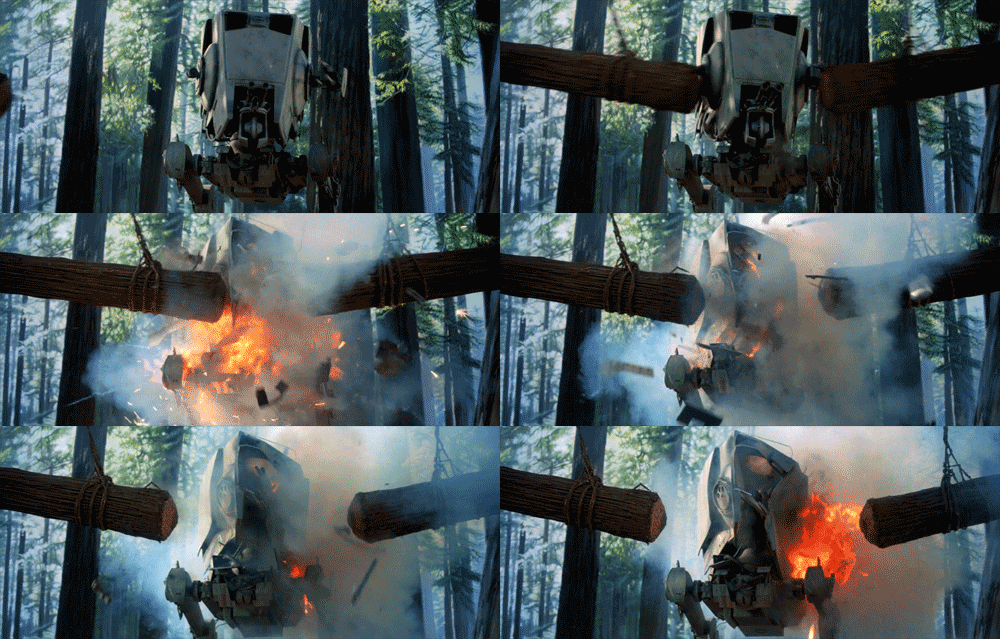 Erik: Ewoks vs. stormtroopers. I know some people think it’s too silly, but I disagree. The rebellion vs. the empire was always a case of guts and inventiveness vs. industry and regimentation. The fact that the empire never even considered that the ewoks could be a threat was their undoing. Besides, there’s nothing like seeing an imperial walker get smushed between two dropping logs.
2. Best Line
Erik: “I don’t know. Fly casual.” Han’s approach to life in five words.
Eppu: “How are we doing?” Luke: “Same as always.” Han: “That bad, huh?”
3. Best Minor Character
Eppu: This may be a little corny, but Admiral Ackbar! (“It’s a trap!”)
Erik: The commander in charge of the Death Star construction. He seems like a well-organized, conscientious leader, just the sort of person you’d want to put in charge of such a huge project. Too bad he works for a genocidal totalitarian dictatorship.
4. Best Reveal
Erik: R2-D2 was carrying Luke’s lightsaber in Jabba’s palace all along. The moment that lightsaber handle pops up out of the droid’s top is the moment when “Luke, you naive idiot!” turns into “Luke, you cunning bastard!”
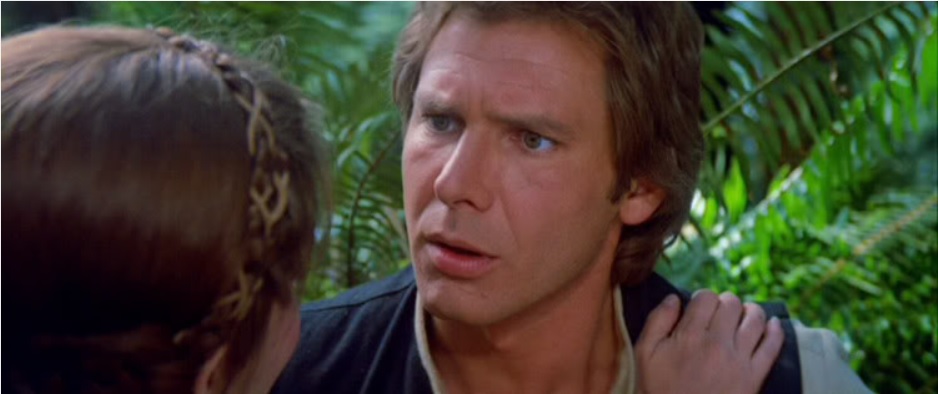
Eppu: A two-parter: Luke finds out on Dagobah that Leia’s his sister, and Leia tells Han that Luke’s her brother. Mostly the latter because of the expression on Han’s face (click, click, click… you can see the wheels turning).
5. Best Save
Eppu: Chewie and ewoks commandeering a walker on Endor and turning its guns against the Imperial troops. Pew pew!
Erik: Luke Force-floating C-3PO in the ewok village to convince the ewoks to let them go. C-3PO’s mid-air freak-out pushes it just far enough over the top to go from ridiculous to hilarious.
6. Best Visual
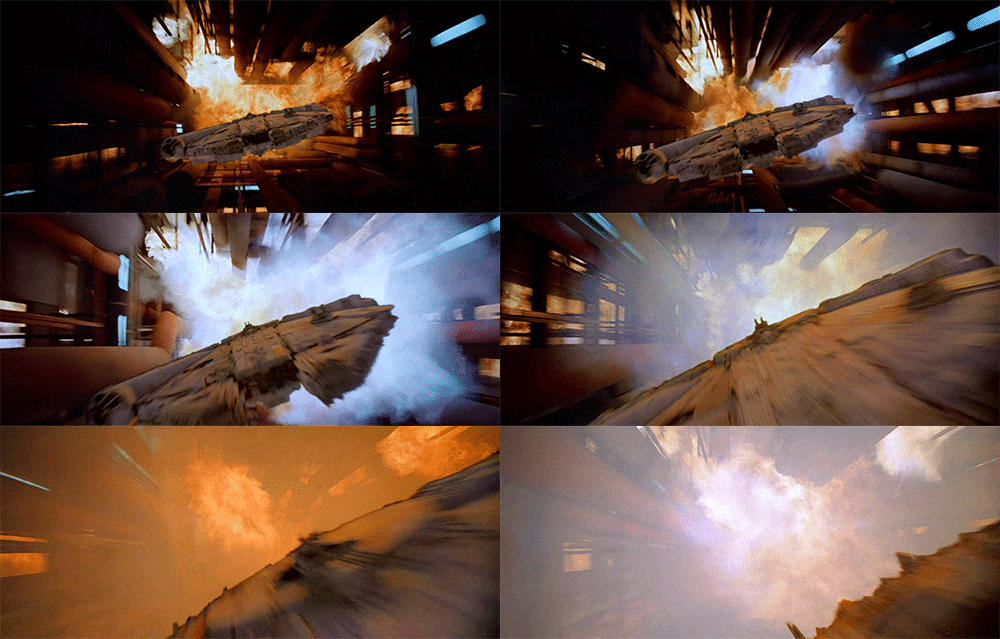 Erik: The Millennium Falcon racing the fireball out of the exploding Death Star. It still gets me on the edge of my seat.
Eppu: The rebel fleet coming out of hyperspace to attack the new Death Star.
Extra: Best Guess for an Episode VII Hook
Eppu: Leia’s become a Jedi. Her title has been revealed to be General, which lines up nicely with her holo-message line to Obi-Wan in Episode IV (“General Kenobi. Years ago, you served my father in the Clone Wars…”).
[And a week after writing the above, the world came crashing down: J.J. Abrams revealed in an interview with IGN (as reported by Moviepilot) that Leia chose to lead the rebellion instead of becoming a Jedi. Ohwell.]
Erik: Palpatine has been pulling the rebellion’s strings all along. He’s a master manipulator who can foresee the future. Did he have a contingency plan for Vader’s betrayal and his own (apparent?) death? Are his dead(?) hands still pulling the strings?
Images: Ewok log trap via History Bomb. Han’s bafflement via lennongirl / LG-CRACK on LiveJournal. Millennium Falcon escaping Death Star via Starscream & Hutch
In the Seen on Screen occasional feature, we discuss movies and television shows of interest.





 Co-Geeking


You must be logged in to post a comment.