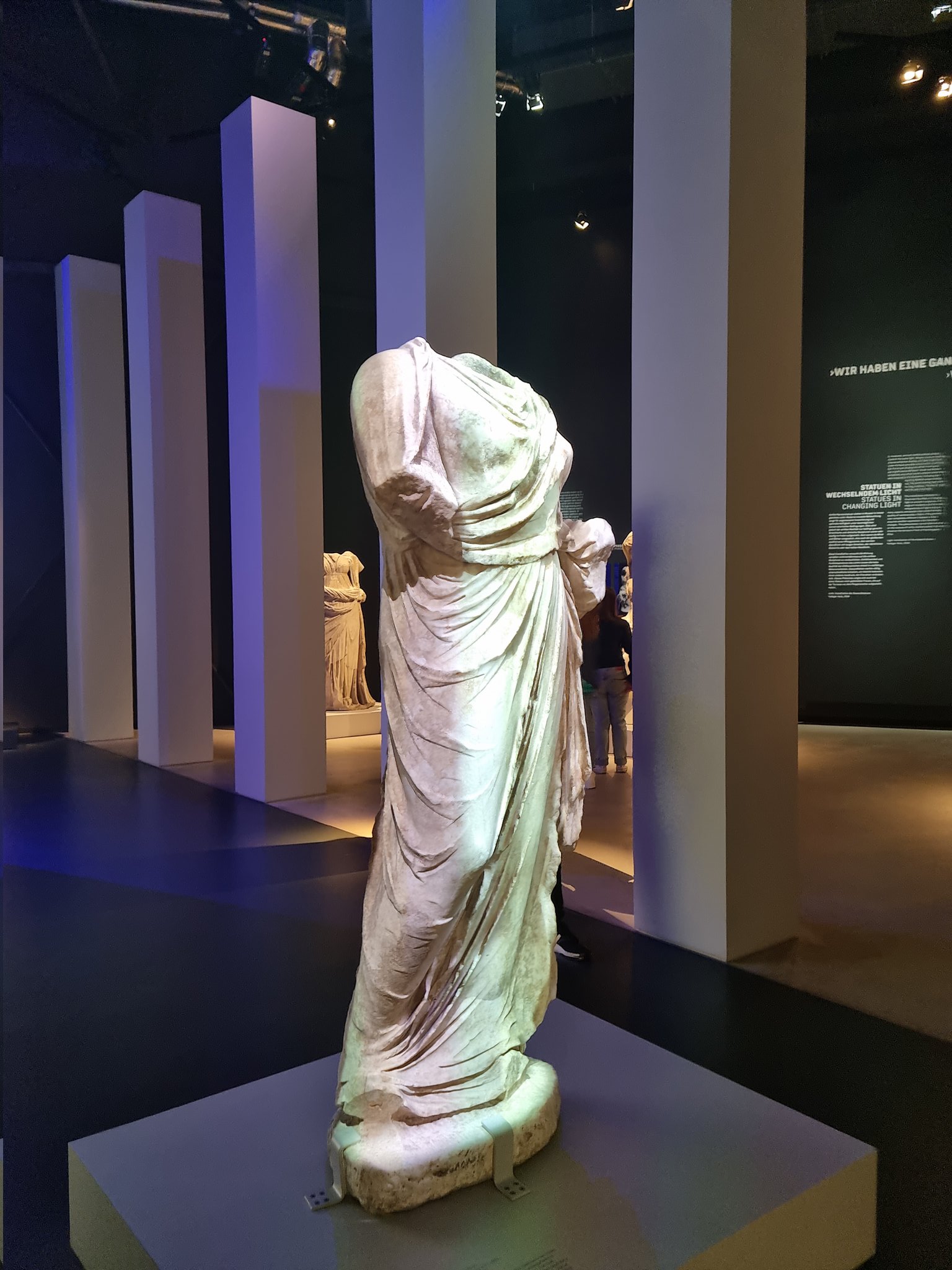
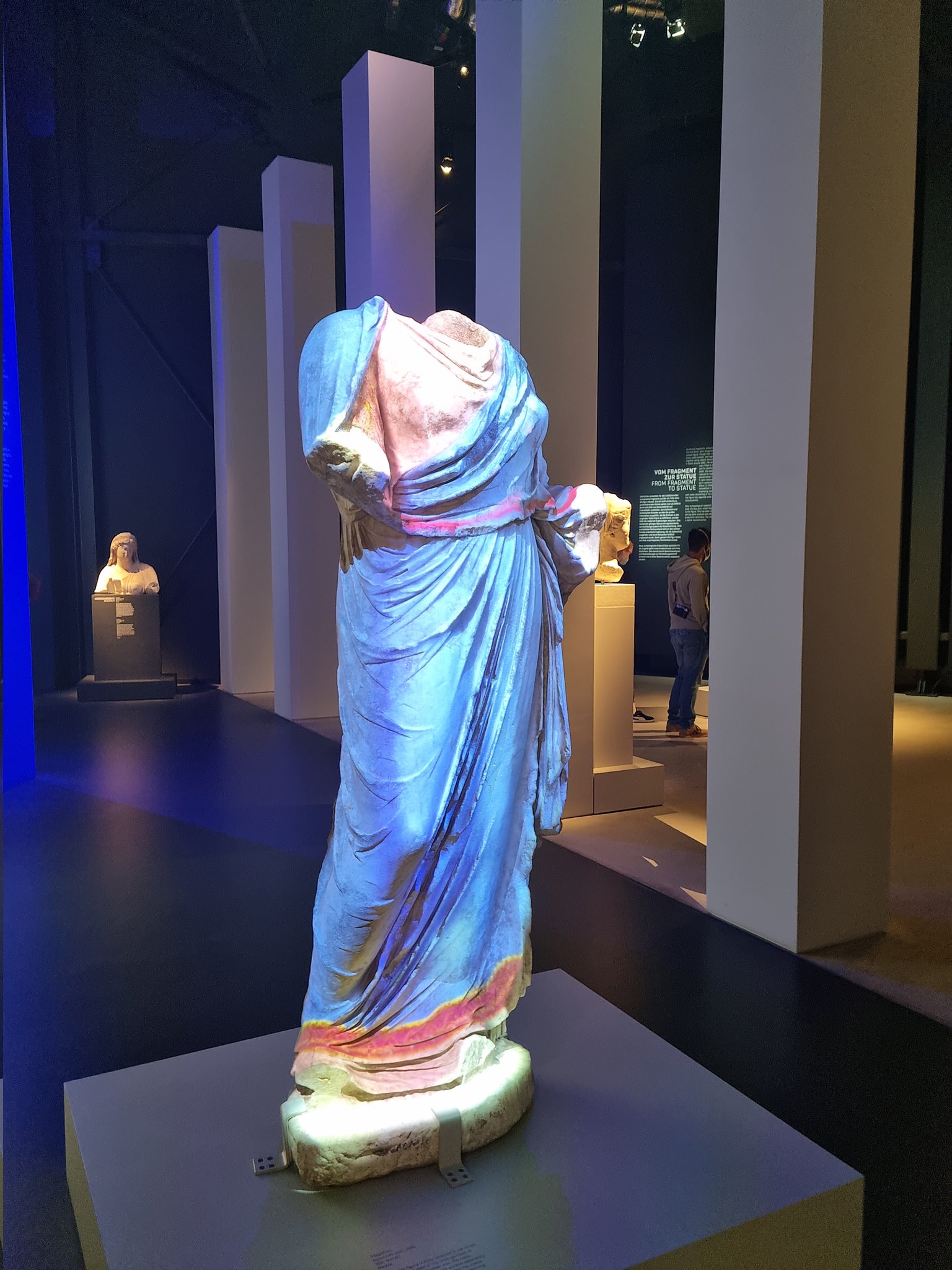
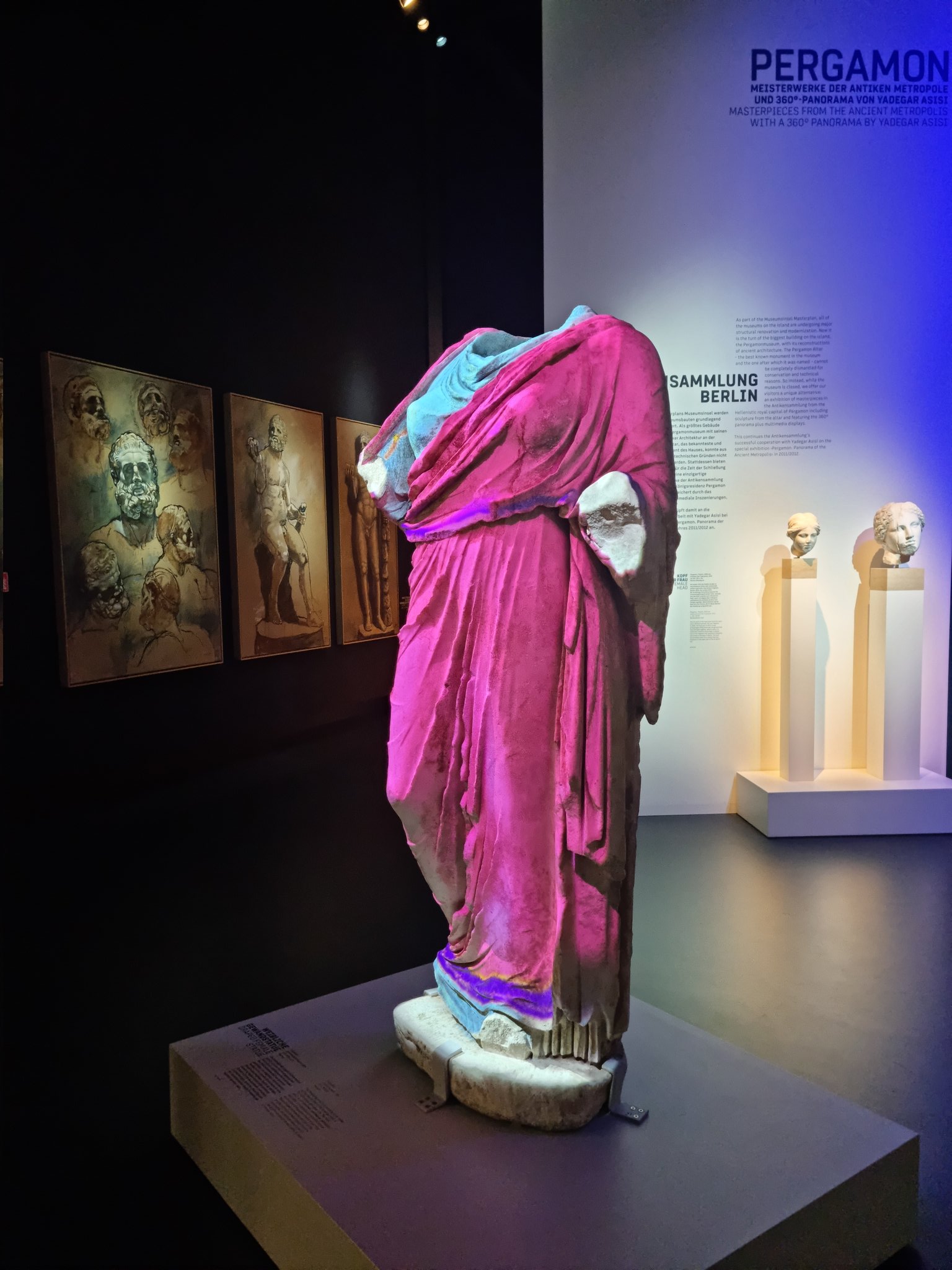
Here are a few interesting pictures from the Pergamon Panorama in Berlin where colored lights are used to show a few different variations on what marble ancient statues might have looked like in their original colors. A very neat idea and some great photography from Twitterer @BelovedOfOizys!
Images: Statuary from Pergamon with colored lights, photographs by @BelovedOfOizys via Twitter
Out There is an occasional feature highlighting intriguing art, spaces, places, phenomena, flora, and fauna.
Would you ever have thought large birds could live in cities? I would’ve found it a stretch on the basis of my experience, but apparently in Amsterdam in the Netherlands there is a large urban population of herons. Photographer Julie Hrudová has been documenting them, and the photos are very arresting.
Some of the birds seem to be getting quite bold:
Fascinating, isn’t it? Also, the pictures gives me all sorts of ideas for secondary worldbuilding. I could easily imagine semi-domesticated herons in a story, rather like the reindeer in Lapland.
The Visual Inspiration occasional feature pulls the unusual from our world to inspire design, story-telling, and worldbuilding. If stuff like this already exists, what else could we imagine?
Recent images taken by the Hope spacecraft launched by the United Arab Emirates show an improved view of auroras on Mars.
The auroras on Mars don’t just appear over the poles, however, but all around the planet. The Emirates Mars Mission didn’t discover these discrete auroras, but Hope’s images are, apparently, the most impressive captured so far.
Modern minakari bowl, photograph by Interesting009 via Wikimedia
This gorgeous bowl is an example of a style of enamel work known as minakari (also spelled meenakari or mina-kari), which literally means “to place heaven into an object.”
The style was developed in Persia under the Safavid kingdom in the sixteenth and seventeenth centuries CE. Artists of that time took enameling techniques from Europe and China and used them to create works whose intricate designs and vivid colors drew on the rich legacy of Persian and Islamic art.
Minakari works are still being produced today, especially in and around the city of Isfahan. “Placing heaven in an object” seems like a good enough description to me.
Out There is an occasional feature highlighting intriguing art, spaces, places, phenomena, flora, and fauna.
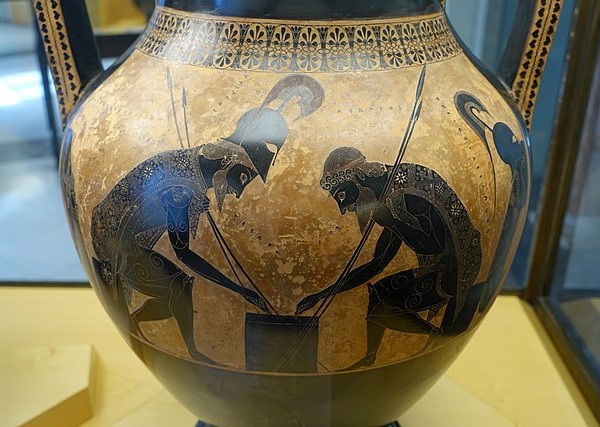
Heroes don’t spend all their time being heroic. They need time off, too. That was the idea behind this beautiful vase by the ancient Athenian painter Exekias.
On one side, we see Achilles and Ajax, two of the great Greek warriors of the Trojan War, putting aside most of their armor for a while and playing a board game. Achilles is winning, as Exekias lets us know because he has given us the score: beneath Achilles’ head is the word “four,” beneath Ajax’s, “three.” According to literary tradition, Achilles’ tent was at one end of the Greek line, Ajax’s at the other, so this was not just a casual pick-up game; one or the other of the heroes must have crossed the entire Greek camp so they could play.
Amphora, Achilles and Ajax playing a game, photograph by Daderot via Wikimedia (Athens, currently Vatican Museums; c. 540-530 BCE; black-figure pottery; by Exekias)
On the other side of the vase, the twin heroes Castor and Pollux return home. They are welcomed by their parents, Tyndareus and Leda. On the left, Pollux leans down to greet a dog who jumps up, excited to see him.
Amphora, Castor and Pollux return home, photograph by M. Tiveros via Classical Art Research Centre (Athens, currently Vatican Museums; c. 540-530 BCE; black-figure pottery; by Exekias)
Exekias was an innovative artist. He was one of the first vase painters to show mythic heroes not in the midst of action but at ease, among the familiar surroundings of everyday life.
If you’ve been feeling the weight of the past year, take some inspiration from heroes: play a game, say hello to family, play with a pet. If it’s good enough for Achilles, Ajax, Castor and Pollux, it’s good enough for you, too.
Out There is an occasional feature highlighting intriguing art, spaces, places, phenomena, flora, and fauna.
Here are some ladies enjoying a good stag hunt, from an illumination in a copy of “The Letter of Othea to Hector” by Christine de Pizan. The image represents the mythical huntresses of the goddess Diana, as imagined by a medieval artist. We see one lady driving game by beating the bushes and another taking aim with her bow while two more blow the hunting horn and manage the dogs.
Hunting scene from the “Letter of Othea to Hector” via Wikimedia (Bibliothèque nationale de France, Paris; 1407-1409; paint on parchment; by the Master of the Letter of Othea)
Out There is an occasional feature highlighting intriguing art, spaces, places, phenomena, flora, and fauna.
I can’t say I’m a night owl, but I nevertheless am definitely not a morning person. That makes me a little wistful sometimes, since mornings can be beautiful.
Case in point: nature photographer David Chambon’s dew-laden insect photos. They are. Just. Stunning!
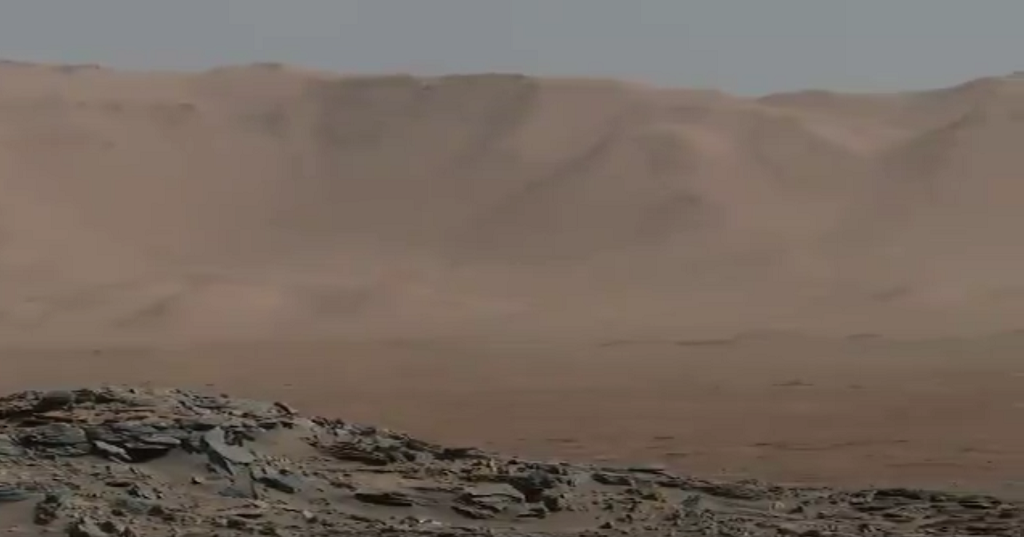
While aimlessly browsing social media, I stumbled upon a 60-second video clip from Mars. Below’s a screencap, since I was unable to find a video to embed:
(Sorry for not including more details of the area; the NASA Twitter account didn’t provide any, and I can’t find a corresponding video on their YouTube account or website, either. Perhaps it’s from Curiosity?)
(This video of Cassini’s grand finale at Saturn seems to have been computer-generated on the basis of Cassini photos, so not really qualify for the high-def photography category, but it’s very pretty nevertheless.)
Not bad for ugly bags of mostly water, eh? It is a very good time to be a space geek. 🙂
In the western desert of Egypt is a valley known as Wadi al-Hitan. Like some of the other famous valleys in Egypt, such as the Valley of the Kings and the Valley of the Queens, this valley is a kind of graveyard, but this one is for whales. Not that people buried whales here; rather, the desert preserves the fossils of a wide variety of sea life from millions of years ago, when this region was under a shallow sea. Among the most striking and important fossils at the site are the remains of several different species showing different stages of the evolution of ancient land mammals into the whales we know today.
Wadi al-Hitan is today preserved as a UNESCO site in recognition of both its stark natural beauty and its paleontological significance.
Images: An excavated fossil skeleton of a prehistoric whale, photograph by AhmedMosaad via Wikimedia. Spine and skull of a Dorudon atrox, photograph by Christoph Rohner via Wikimedia. Vertebrae on the desert sands, photograph by Jolybook via Wikimedia.
Out There is an occasional feature highlighting intriguing art, spaces, places, phenomena, flora, and fauna.
Daisugi is a forestry management technique reminiscent of pollarding and bonsai that produces straight logs without killing the tree. Developed some 600-500 years ago in Japan, it’s still being used to harvest sustainable, durable logs.
Basically, some of the top shoots are pruned so that they’ll grow straight up, and the shoots only are collected when they reach the desired height. It’s not a fast method, as it takes decades to be able to produce logs, but reportedly they come out stronger, more flexible, and knot-free. And the tree stays alive.
Also, the daisugi-managed cedars make amazing shapes in the woods! They would be so interesting in a speculative or fantasy story—or any story, really. Below are a few examples.
Just another example of how ingenious we people are in manipulating our environment. 🙂






 Co-Geeking


You must be logged in to post a comment.