In Which Our Heroes Go Clothes Shopping

161212dyingOur Heroes wake up naked and cold with the chickens in the alley out back of the inn after being on the losing side of a tavern brawl. Clearly this is part of the Call to Adventure that must not be denied, but first things first: they need clothes. What do they do?

We today live in an industrialized world in which consumer goods like clothes are readily available. If you need something to wear, it’s easy enough to go into a store and buy something. Unless you’re shopping for high fashion, it probably won’t cost you too much, either. All of this is possible because of factories, global transportation networks, and a modern economy, but none of these things existed before the last couple of centuries. Any time before then, buying clothes was a very different experience.

To begin with, a lot of clothing wasn’t bought at all. In many pre-industrial societies around the world, producing and maintaining the family’s clothing and other textile goods was one of the main occupations of the household. Although textile production was in many cultures traditionally counted as women’s work, men were involved in it, too, at every stage from shearing sheep or gathering flax to delicate finish stitching.

Only specialty items requiring expert work, like gloves, boots, hats, etc., were routinely made by professionals. As market economies developed, specialty processes, like dying and fulling, were also increasingly outsourced to professionals, but everyday wear was still largely made at home. (As a useful point of reference for the development of specialty production, notice how family names like “Glover” or “Dyer” are much more common than, say, “Shirter” or “Socker.”)

Of course, there were always people who didn’t have a household around them to help make clothes. Soldiers and travelers far from home might need to replace damaged clothing or buy new gear suitable to the local climate. In any reasonably well-developed settlement, those who needed to purchase clothes probably could. They might get lucky and find someone willing to sell off an older set of clothes, or, for the right price, they might be able to get someone to sew them up a new set to order, but the chances of finding a clothing shop with new garments ready to wear were very slim.

So, supposing Our Heroes do find someone with clothes to sell, what are they going to cost? It’s hard to estimate prices in pre-modern economies, but here are a few points for reference:

The Roman emperor Diocletian, during a period of economic crisis, tried to stabilize the Roman economy by issuing an edict dictating wages for many different kinds of workers and prices for a variety of commodities and services. Diocletian’s edict wasn’t very effective in practice, but it’s a useful snapshot of what someone in antiquity thought were reasonable wages and prices. So, for example, the edict prescribes a price of 2,000 denarii for a common shirt. Compare that with the daily wages of 25 denarii for a farm laborer, 50 for a carpenter, or 75 for a skilled terra cotta artist. Even a well-paid artisan would have to spend most of their wages for a month just to buy a shirt. Depending on how rich Our Heroes are, new clothes could set them back a lot of money.

Now, Diocletian’s edict was only one politician’s idea of what things should cost, not a record of what they actually did cost. For a glimpse of actual prices we can look to some of the letters from Vindolanda, a Roman fort in northern Britain, where some everyday letters and paperwork from the fort were preserved by chance in the local soil. Some of these documents mention tunics priced at 3 denarii, boots for 3.5 denarii, and cloaks for 11.5. These goods sound a lot cheaper, but, in this period before the economic crisis that Diocletian was trying to deal with, wages were a lot lower, too. Soldiers at the time were paid 300 denarii a year, less than a denarius a day, a portion of which was held back to cover expenses. At those levels, a soldier would still have to spend most of his pay for a week to buy a tunic, or half a month to buy a cloak.

What was true in Rome was true in most other parts of the pre-modern world. There was no just nipping into a shop to buy a new set of clothes. Even where you could find clothes for sale, they were not a small expense. Outfitting one of Our Heroes in a full new set of clothes could well cost them most of their income for a year.

Image: Linen working via Wikimedia (14th c.; paint on parchment)

History for Writers is a weekly feature which looks at how history can be a fiction writer’s most useful tool. From worldbuilding to dialogue, history helps you write. Check out the introduction to History for Writers here.

Cosplaying Hercules

Heracles on a black-figure pot, photograph by Jastrow via Wikimedia (Currently Louvre; c. 520 BCE; pottery)

Cosplay may seem like a recent invention, but the ancient Greeks and Romans weren’t above dressing up like their favorite heroes. The Greek hero Heracles (better known to us by his Roman name “Hercules”) was easily recognizable with his lion-skin cloak and rough wooden club. While we don’t know that anyone actually did walk around dressed up like Heracles, a few works of art show that Greeks and Romans certainly imagined doing so.

One example is theatrical, from Aristophanes’ comedy The Frogs. The play is about Dionysus getting fed up with the contemporary theatre and deciding to go down to Hades to bring back one of the great tragic playwrights from the past. Being a bit of a coward, Dionysus dresses up like the brave Heracles by putting a lion skin over his luxurious yellow robe and carrying a club while wearing an actor’s high boots, just to keep his spirits up. For extra comedy, Dionysus, dressed as Heracles, goes to visit the actual Heracles at the start of the play for advice on his adventure. Here’s what happens when Dionysus, accompanied by his smart-ass slave Xanthias, knocks on the hero’s door:

Heracles: Who banged the door? Someone pounded it like a centaur. Tell me who it is. (He opens the door and falls over laughing.)

Dionysus: I say, Xanthias!

Xanthais: What is it?

Dionysus: Didn’t you notice?

Xanthias: Huh? What?

Dionysus: How afraid I made him!

Xanthias: Afraid you’ve gone mad, more like!

Heracles: Oh, by Demeter, I can’t stop laughing! I’ll bite my tongue, but still I can’t help it!

Dionysus: Oh, pull yourself together. I’ve got something to ask you.

Heracles: I can’t stifle this laughter, though, at the sight of that lion skin over your saffron gown. Whose idea was this, the club and the high heels at once?

Aristophanes, The Frogs 38-46

(My own translation)

161208commodus
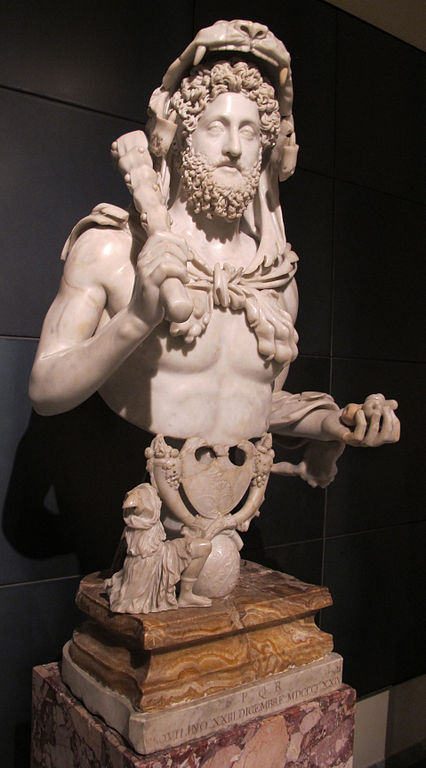
Commodus as Hercules, photograph by Sailko via Wikimedia (Currently Musei Capitolini, Rome; late 2nd c. CE; marble)

Over in the Roman world, the emperor Commodus decided he was not content with traditional portrait sculptures and had himself portrayed dressed up as Hercules. Here he is wearing the lion skin, carrying the club in one hand and the apples of the Hesperides (from one of the hero’s twelve labors) in the other. For an emperor who was obsessed with his public image, adopting the guise of a popular hero like Hercules made sense.

Just like we can recognize our modern heroes by their symbols and distinguishing attributes—an S on the chest and a curl of hair for Superman, a bow and a mockingjay pin for Katniss Everdeen—people of the past knew their heroes in the same way.

In Character is an occasional feature looking at some of our favorite characters from written works and media to see what drives them, what makes them work, and what makes us love them so much.

Ancient Nubian Antibiotic Beer

161128shabtiNo, that’s not not the name of my new band. It’s the answer to a mystery in the bones of ancient Nubians.

You see, strains of bacteria that live in the soil of Nubia—the middle region of the Nile, south of Egypt—naturally produce tetracycline, an antibiotic that the bacteria use to kill off competing bacteria. During the fourth and fifth centuries CE, the people of Nubia stored their grain underground and some of it got contaminated. The result was that the things they then made with that grain, like bread and beer, contained tetracycline. Eating and drinking these products gave the Nubians a dose of antibiotics, which probably helped them resist diseases and infections.

The traces of these antibiotics turned up in the bones of Nubian mummies. We don’t know to what extent the ancient Nubians were aware of the effect their beer was having on them. No one in the ancient world had the medical knowledge to understand antibiotics, but even without understanding causes, people can be very observant of effects. They may well have known that their beer helped keep them healthy, even if they didn’t know why.

Beer. It’s good for you.

Image: Ancient Egyptian shabti statuette of a woman making beer, photograph by yov dothan via Wikimedia (Currently Israel Museum, Jerusalem; c. 2000 BCE; painted wood)

Geeks eat, too! Second Breakfast is an occasional feature in which we talk about food with geeky connections and maybe make some of our own. Yum!

Celebrating Hidden Youth With Rhodopis

161121bendisHidden Youth comes out today! Among the many short stories in this collection about young people from marginalized groups in history is my story, “How I Saved Athens from the Stone Monsters,” about the adventures of two flute girls, one Egyptian and one Thracian, on one strange and terrifying night in ancient Athens. I hope you’ll consider picking up the collection, not just for my story but for all the other amazing work in it.

My story was inspired in part by the Egyptian and Thracian immigrant communities we know existed in Classical Athens. There were temples in the city to both the Egyptian goddess Isis and the Thracian goddess Bendis. But Athens wasn’t the only place Egyptians and Thracians crossed paths.

A famous Thracian courtesan named Rhodopis worked in Naucratis, the Greek trading city in Egypt in the 6th century BCE. She seems to have been a larger-than-life character whom people liked to tell stories about. It was apparently widely believed in antiquity that one of the three great pyramids at Giza was built for her by her lovers. Another fanciful story about her is the closest ancient equivalent to the story of Cinderella:

They say that one day, when Rhodopis was bathing, an eagle snatched her sandal from her serving maid and carried it away to Memphis. There the king was administering justice in the open air and the eagle, flying over his head, dropped the sandal in his lap. The king, moved by the beauty of the sandal and the extraordinary nature of the event, sent all through the country to find out whose it was. She was found in Naucratis and conducted to the king, who made her his wife.

– Strabo, Geography 17.1.33

(My own translation)

While this is obviously just a bit of a fairy tale, Rhodopis was a real person. One of her lovers was Charaxus, the brother of the lyric poet Sappho. Sappho evidently didn’t think much of the relationship. A fragment of one of Sappho’s poems throws a little shade the courtesan’s way (referring to Rhodopis as Doricha—it was not unusual for courtesans to use several different names):

O, Aphrodite, may she find you too bitter for her taste,

and don’t let her go boasting:

“What a sweet thing Doricha has got herself into

this time around!”

– Sappho, fragment from Oxyrhynchus papyrus 1231.1.1.(a)

(My own translation)

Herodotus reports that the rich offering Rhodopis made at Delphi at the end of her life to celebrate her good fortune—an enormous pile of iron roasting spits—was still to be seen there in his day. (Herodotus, Histories 2.135)

Rhodopis sounds like she would have been an interesting person to hang around with, and Hidden Youth is one more reminder that interesting people were everywhere in history, not just in the places we expect.

Image: Greek statue of Bendis, photograph by Marie-Lan Nguyen via Wikimedia (Cyprus, currently Metropolitan Museum of Art, New York; 3rd c. BCE; limestone)

Announcements from your hosts.

Making The Return of the King

Here’s a look at how we made yesterday’s The Return of the King.

Dinner11

The menu

  • Saffron seafood soup
  • Roasted pork with olives and dates
  • Sauteed spinach
  • Almond pastries

erikchef1Since we really only see Gondor in a time of war and Tolkien gives us very little detail about what daily life was like after the defeat of Sauron, it takes some imagination to come up with a proper meal for such an occasion. In creating this month’s menu, I had a specific idea in mind: a feast that would represent all the people of Gondor. Aragorn’s coronation meant a new beginning for a kingdom that had been in a long decline. It touched all of Gondor’s people and it made sense that they would all contribute something to the table.

From the fishing folk of Ethir Anduin, we get a seafood soup. This recipe uses a variety of different seafoods combined with carrots and onions. It is, at heart, food for a hardworking family making a living from the sea and small coastal gardens, but the addition of cream and saffron makes it richer, sweeter, and more luxuriant. (5.1)

From the small farmers and herders of the hill country, we have a haunch of roast pork. To reflect the southern climes of Gondor, the pork is stuffed with herbs, olives and dates. This, too, is simple food, but presented in royal style.

From the fields and gardens of Pelennor, we get sauteed spinach, flavored with garlic and ginger. This recipe is inspired by a medieval dish from the middle east which seems appropriate for the Mediterranean-ish setting of Gondor.

Finally, from the sophisticated city-dwellers of Minas Tirith itself, we end with an artful set of almond pastries representing the white tree and seven stars of Gondor.

Continue reading

The Attack on the Hermas

161114hermaA strange thing happened one night in ancient Athens. This incident, the attack on the hermas, provides the background for my short story “How I Saved Athens from the Stone Monsters,” in the collection Hidden Youth. While there are no stone monsters in the actual history, it’s a fascinating story in its own right.

It was the spring of 415 BCE. All around the city—at crossroads, in marketplaces, in front of houses and temples—stood square stone posts carved with human heads on top and crude penises in front. These were the hermas, stones sacred to the god Hermes that the Athenians believed protected their homes and city against bad fortune. The people of the city woke up one morning to discover that the hermas had been smashed up in the night.

Now, in any city, you would expect people to be upset to wake up to widespread vandalism, but Athens was no ordinary city and these were no ordinary times. Athens had been at war with Sparta for more than a decade. A war that both sides had expected to be quick and decisive had turned into a long, unwinnable slog. The Spartans had repeatedly ravaged the Athenian countryside. Farms had been burned and vineyards wrecked. Behind the walls of Athens, plague had slaughtered the refugees who sought shelter from the Spartans. Athens had not seen such suffering since the Persian army of Xerxes captured and burned the city more than half a century before.

In the midst of the destruction, democracy and social cohesion suffered. The poor farmers from the countryside whose homes and fields got burned lost everything while the rich merchants and landowners in the city were mostly unaffected. The leading general Pericles’ strategy of pulling back behind the walls and sending out the fleet to raid the Spartan coast felt slow and cowardly to people used to the swift clash of the hoplite phalanx. Indeed, it was the solidarity of standing shoulder-to-shoulder, row upon row in the phalanx, regardless of family or property, that grounded the Athenian democracy, but those who served as hoplites were now helpless behind the walls. When the plague struck, already weakened social bonds were snapped as everyone looked out for themselves and people who felt sure they were going to die anyway indulged in every impulse and vice.

In times like this, when social solidarity was strained by factional and regional conflicts, many Greek cities had turned to tyrants: aristocrats who held themselves out as champions of the people and leveraged popular anger as a way to propel themselves into power. Athens itself had had tyrants, in the decades before the wars with Persia. Wherever tyrants had risen, they crushed their rivals and abused their power until finally they were driven out and replaced with new, more balanced forms of democracy. The same had happened in Athens, but the time seemed ripe for a new tyrant to rise and sweep away the democratic system with the anger of a frustrated and fed-up populace.

A new leader had already arisen to promise the people of Athens a better future. Alcibiades, a rich and flamboyant aristocrat with time on his hands, had pushed for a major expedition to sail to Sicily and attack Syracuse. Syracuse had largely stayed out of the war between Athens and Sparta, but they had cultural ties to Sparta and were a major exporter of grain, so there was a fear that Syracuse might decide to step in and shore up Sparta against Athenian raids. The people of Athens were enthusiastic about the prospect of getting out of the city for a fight they could win. They looked forward to looting the treasuries of Syracuse and coming home victorious and rich.

Then the hermas got smashed.

Suspicion fell immediately on Alcibiades. It seemed like the sort of thing he would do. He was well known for holding raucous drinking parties with other rich young men and had a reputation for flippancy and arrogance. He was a student of Socrates, that annoying old man who refused to participate in the democratic assembly but liked to ask people tricky questions and make them look stupid. If anyone in Athens wouldn’t respect the hermas and would think that running around town at night doing some property damage would be a good joke, it would be Alcibiades.

There was some legal wrangling about whether to bring charges against Alcibiades at once or let the expedition go ahead as planned, but the upshot was that the expedition went out and Alcibiades fled Athens to find refuge among his friends in Sparta.

This all may seem like an overreaction to what amounts to little more than the ancient Athenian equivalent of some frat boys going on a bender and playing a little mailbox baseball, but context is everything. It wasn’t just that the people of Athens valued their good luck statues. This sort of flippant disregard for tradition was exactly what one expected from a tyrant. The hermas may have been old-fashioned relics of simpler times, but so, in its way, was the democracy. In the Athenian assembly, the will of the people was the law, and if it was the will of the people to have crude statues in front of their houses, to disrespect that choice was to disrespect democracy itself.

Alcibiades was exactly the sort of person who aimed at tyranny: rich, idle, and dismissive of tradition. The smashing of the hermas made those qualities obvious in a way that no one could ignore.

Thoughts for writers

It’s easy to look at the past and be perplexed by the weight people attached to symbols and minor events, but it is context that gives importance to those things that seem trivial to us. In other times, the attack on the hermas would have been a case of petty vandalism, a scandal to be argued over in the marketplace for a few days and in time forgotten. Because of the times in which it happened, it became the tangible symbol of something far more perilous: a threat to Athenian democracy itself.

This is one of the challenges of worldbuilding. Making a world that works differently from our own means creating contexts in which things that seem trivial to us carry profound weight. The power of such small things depends on the context in which they occur. The smashing up of the hermas might not seem important to us, just like no one from a hundred years ago would grasp the significance of yellow stars and shattered shop windows, or a woman refusing to give up her seat on a bus. Creating such moments—and giving our readers the context to understand them—is part of how we make our worlds feel real.

Image: herma, photograph by André Frantz via Wikimedia (Siphnos; c 520 BCE; marble)

History for Writers looks at how history can be a fiction writer’s most useful tool. From worldbuilding to dialogue, history helps you write. Check out the introduction to History for Writers here.

Random Thoughts on Doctor Strange

161107strangeIn no particular order. Spoiler warning in effect.

  • Doctor Strange is a perfectly good movie, but not the great movie I hoped it might have been. This year, and this fall in particular, have been so lacking in entertaining movies, though, that I’ll happily take “perfectly good.”
  • In terms of narrative structure, character arcs, and facial hair, this was pretty much just Iron Man with magic instead of tech. Iron Man was great, and if anybody can both live up to Robert Downey Jr.’s Tony Stark and at the same time make his version of the insufferable arrogant genius not feel like a poor copy, it’s Benedict Cumberbatch, but I still feel like I’ve seen this movie enough times already.
  • Speaking of insufferable arrogant geniuses, it’s been noted that Cumberbatch is already pretty adept at playing them. Which he is, but his Dr. Strange is, again, a distinctly different kind of insufferable arrogant genius from his Sherlock Holmes. Cumberbatch doesn’t just do insufferable arrogant genius well, he does it with specificity and nuance, which is what makes him such a great actor.
  • Speaking of great acting, Tilda Swinton’s Ancient One is a delight to watch: mysterious without being obscure, playful without being childish, dangerous without being menacing. She and Strange play off one another beautifully.
  • The erasure of Asian people from their own culture and history is a problem, one to which this movie has contributed. This and the above are both true; neither one negates the other.
  • Speaking of erasure, it’s really rather pathetic that there are only two female characters in this movie. One of them dies and a cape has more of an independent story than the other one. Marvel has seriously got to do better.
  • Chiwetel Ejiofor is playing his Serenity character in reverse.
  • The magic in this movie is a beautiful combination of movement and color. This is what magic should look like in film.

Image: Doctor Strange poster via IMDb

In the Seen on Screen occasional feature, we discuss movies and television shows of interest.

Ancient d20s

If you’re a role-playing gamer, you probably recognize the profile of a twenty-sided die, or d20, right away: the collection of triangles making up a bumpy sphere by which we invoke the capricious god of random numbers. This shape (technically known as an “icosahedron”) has been in use a lot longer than Dungeons & Dragons has been around. Here’s an example from Roman-period Egypt which has the names of Egyptian gods marked on its faces in demotic, an Egyptian script.

161103dakhleh
Dakhleh die showing “Isis” face via Martina Minas-Nerpel, “ A Demotic Inscribed Icosahedron from Dakhleh Oasis,” Journal of Egyptian Archaeology 93 (2007), 137-48 (Dakhleh Oasis, Egypt, currently Valley Museum, Kharga, Egypt; 1st c. CE; limestone)

Here’s another example from Egypt. This one has Greek letters on each of its faces.

Icosahedron via Metropolitan Museum of Art (Egypt, currently Metropolitan Museum; 2nd c. BCE - 4th c. CE; serpentine)
Icosahedron via Metropolitan Museum of Art (Egypt, currently Metropolitan Museum; 2nd c. BCE – 4th c. CE; serpentine)

It’s possible that these dice were used for some kind of game, but more likely they were used for divination. The die with the names of gods may have been used to determine which god a person should pray to for help. The Greek letters probably corresponded to a list of pre-written oracular responses: ask your question, roll the die, and consult the table for the answer, sort of like the ancient version of a magic 8-ball.

Some might say the uses of the twenty-sided die haven’t changed much in a couple thousand years.

Of Dice and Dragons is an occasional feature about games and gaming.

Memos Never Change

Memos. Inter-office memos never change.

161027legionThe Roman fort at Vindolanda, near Hadrian’s Wall in northern Britain, is a special place. One reason it is so special is that a collection of wooden writing tablets were preserved there, accidentally, in waterlogged ditches. These tablets were used for everyday matters—personal letters, shopping lists, legionary paperwork—and give us a glimpse into the daily life of the Roman army in a way we rarely get. Here’s an example, a message from the leader of a detachment of cavalry back to his commander at the fort, which may feel depressingly familiar:

To Prefect Flavius Cerialis

From Decurion Masclus

Masclus to his lord, Cerialis, greetings.

My lord, please send us your instructions for tomorrow. Should we all return to the crossroads with our standard or just half of us?

Best of fortune to you and may you look on me with favor. Farewell.

PS. My fellow soldiers are out of beer. Please have some sent.

Tabulae Vindolandenses III 632

Sucking up to the boss. Not getting clear instructions. Needing beer. Some things just never change.

Image: Roman army reenactors, photograph by ChrisO via Wikimedia, text by Erik Jensen

Serving exactly what it sounds like, the Quotes feature excerpts other people’s thoughts.

Klingons, Homer, Falstaff, and the Dread Pirate Roberts: Understanding Honor

161024klingonsIf you grew up on Star Trek: The Next Generation like me, you’re probably most used to hearing the word “honor” come out of the mouths of Klingons, especially our beloved Lt. Worf. Star Trek offers one of the most brilliant portrayals of honor in fiction. As you watch Worf’s story unfold over the seasons of TNG and Deep Space Nine, it seems like, for all that Klingons like to talk about honor, Worf is the only one who actually cares about it. Worf always makes the honorable choice, even when it’s not the smart one. Other Klingons are cynical and self-serving. They pay lip service to the idea of honor, but they don’t follow it.

But what is honor? It seems like such a simple word, but what does it really mean? When we say that a person, either someone in the real world or a fictional character, is driven by a sense of honor, what actually motivates them? I often put this question to my students when we read the the quarrel of Achilles and Agamemnon in the Iliad. They usually answer something like: “Pride,” or “Following a code.” Those are ideas related to honor. They are honor-adjacent. But at its core, honor is something else: honor is reputation.

Agamemnon and Achilles are warrior kings in a world where there is no one to enforce rules. There are no police, no courts, barely anything we would recognize as law. What is it that stops people from being constantly at war with one another? How can Achilles or Agamemnon have a single moment’s rest from every other warrior in the world trying to take away their homes, families, and treasures? Because of their reputation. Because everyone knows that if you hurt them, they will come after you and they will not stop until they have destroyed you. That’s what honor is. It’s the first line of defense.

161024achillesHonor is not an emotion, a code, or an abstract concept. It is a practical tool that Homer’s warrior kings and people in similarly lawless societies use to keep control of their homes and property. When Agamemnon and Achilles break into a fight at the beginning of the Iliad, it’s not because they’re being petty or overly sensitive about wounded feelings. It’s because neither one of them can afford to look weak. A warrior who gets a reputation for giving up easily or not standing up to defend his property is a warrior who will soon be dead.

Honor is what people believe about you. Honor is why, when the Trojans had almost routed the Greeks, Achilles was able to turn the tide of battle just by showing up—unarmed—on the battlefield and yelling his warcry. In other words, honor is like the dread pirate Roberts.

161024robertsWhich also means that there is something artificial about honor. It’s sort of a bluff. The greater a warrior’s reputation as an unbeatable fighter, the less actual fighting they have to do. At the same time, anyone who lets slip that they may not live up to their reputation is just inviting attack, which is why, like in the Iliad, warriors often fight hardest not for the things they want but for the reputation itself.

Honor only matters if it is seen, and it is only what is seen that matters. What makes honor is not what kind of person you are but what kind of person people think you are. What happens in the darkness does not matter to honor. It’s easy to get cynical about honor and call it out as a kind of bullshit. Falstaff, in Shakespeare’s Henry IV, Part 1, does just that:

Can honor set to a leg? no. Or an arm? no. Or take away the grief of a wound? No. Honor hath no skill in surgery, then? No. What is honor? A word. What is in that word “honor”? What is that “honor”? Air. A trim reckoning. Who hath it? He that died o’ Wednesday. Doth he feel it? No. Doth he hear it? No. ‘Tis insensible, then? Yea, to the dead. But will it not live with the living? No. Why? Detraction will not suffer it. Therefore, I’ll none of it. Honor is a mere scutcheon.

– Shakespeare, Henry VI, Part 1, act 5, scene 1

Falstaff isn’t wrong. Neither are Achilles and Agamemnon. Honor is a kind of game that everyone plays along with. The wise understand that it’s a game and what seems like cynicism is really just practicality. Only the naive think that honor is real.

This is what makes Star Trek‘s take on honor so brilliant. It seems at first that Worf is the only Klingon who understands honor, but really it’s the other way around: Worf is the only Klingon who doesn’t understand honor. Worf thinks that honor is real. Other Klingons know it’s a game—a game with the highest of stakes that they play for all they’re worth, but a game nonetheless.

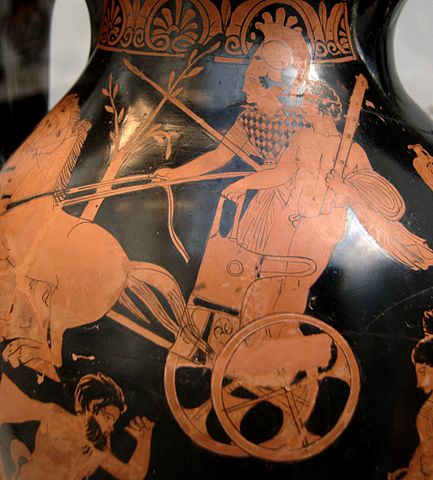
Images: Worf and Martok via Memory Alpha. Achilles battling Memnon, photograph by Bibi Saint-Pol via Wikimedia (Vulci, currently Staatliche Antiknesammlungen, Munich; c. 510 BCE; black-figure pottery). Dread Pirate Roberts via History Mine.