Blue and White Transmogs for 120

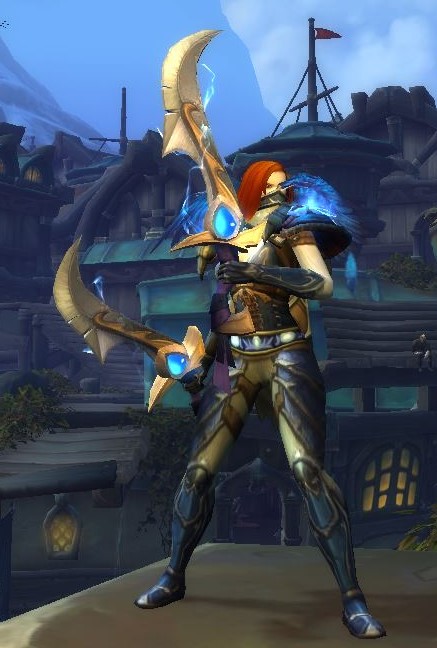
I’m slowly getting all my alts up to 120 and often celebrating with brand new transmogs. My holy priest and outlaw rogue recently made it and, without any particular plan, I ended up giving both of them blue and white transmogs. Here they are for your enjoyment.

My holy priest in his Stargazer’s Perfection outfit.

My outlaw rogue decked out in her Storm-Angel’s Descent look.

Of Dice and Dragons is an occasional feature about games and gaming.

Guest-Friendship

Small-scale societies have ways of dealing with problems that arise within the community, but dealing with the outside world is often a more serious challenge. Small, subsistence-level communities are rarely entirely self-sufficient. Some level of contact with the outside world is useful for trade and joint self-defense, but leaving your home community is risky when you cannot be sure of being safe elsewhere. Within your own village, you may be surrounded by family, neighbors, and people bound to you by mutual bonds of obligation whom you can count on to stand up for your safety and your rights, but once you head out into the wider world, you are alone. If someone attacks you, steals from you, or tries to cheat you in a bargain, who can you look to for help? Different societies have different ways of dealing with this problem, but one useful strategy is known as guest-friendship.

Aspects of guest-friendship are documented in practice in ancient Greece, where the custom was known as xenia, based on the word xenos, which could mean foreigner, stranger, or friend. In the early archaic society described in the Homeric epics, wealthy warrior-nobles—the sort of people represented in the epics by heroes like Odysseus and Menelaus—had faithful retainers to protect them while at home, but traveling with a large retinue was difficult. Since the two major reasons for leaving home were to trade with neighboring communities or to raid them for supplies and slaves, it is understandable that travelers did not always find a warm welcome, even when they came in peace.

To keep themselves safe when away from home, aristocratic families from different communities made agreements of guest-friendship among themselves. These families would provide lodging and food to visiting guest-friends and expect the same when they went traveling themselves, but more importantly guest-friends protected one another. In essence, a guest-friendship was a promise to treat your visitors as if they were members of your own family. That could mean more than just hosting them for a few days. It could also mean standing up for them if they were mistreated or cheated while doing business in your town, even fighting in their defense if they were attacked. In a world without police, courts, or enforceable contracts, where your rights ended at the borders of your home town, these relationships were essential to keeping trade routes and lines of communication open.

In ancient Greece, as in many other places, these relationships were personal, but also hereditary. They could be passed down from generation to generation, sometimes even being revived after lying dormant for many years. Between individuals, guest-friendship could even take precedence over inter-communal hostilities. The Iliad records a battlefield encounter between two heroes, Diomedes and Glaucus, one fighting on the Greek side, the other on the Trojan side. Approaching each other on the field, they shout out challenges and boast about their ancestry and accomplishments, but in doing so, they discover that their grandfathers were guest-friends. Once they realize their connection, Diomedes and Glaucus agree that it would be wrong for them to fight one another. Instead, they exchange armor as a token of friendship and agree to go find other people to fight. (Homer, Iliad 6.119-191)

As a means of ensuring safety for travelers, guest-friendship was unreliable. It depended on mutual personal obligations which could not be enforced on the unwilling. There was no way to prevent the abuse or neglect of the relationship, other than the threat of ending it. As much as Homer’s epics celebrate the uses of guest-friendship among honorable people of good will, they also reflect how precarious such codes of behavior could be when there wasn’t force behind them. While the fairy-tale wanderings of Odysseus are a fantasy version of the dangers of traveling without the protection of familiar customs and norms, the greedy Ithacan suitors eating up Odysseus’ wealth in his absence bring the problems closer to home. Indeed, in Greek myth, the institution of guest-friendship fails at least as often as it succeeds.

Nevertheless, even in later periods of ancient Greek history when legal and diplomatic institutions were better developed, the idea of guest-friendship still had a place. Some aspects of guest-friendship, in a less personal and more formalized way, continued in the role of proxenoi (singular proxenos), who acted as representatives and advocates for outside communities. The Athenian aristocrat and politician Cimon, for example, acted as Sparta’s proxenos in Athens. He hosted Spartan emissaries when they came to Athens and used his influence in Athenian politics to try to make peace between the two cities in the early years of the Peloponnesian War. Like guest-friendship, this role was also often hereditary, passed down through aristocratic family lines from father to son. Guest-friendship itself was even revived as a way of forging relationships across political lines between Greek aristocrats and representatives of the Persian Empire.

The details of ancient Greek guest-friendship are particular to one culture and one time period, but similar relationships—with all their attendant possibilities and problems—existed in many other places and times among small societies lacking strong institutions to keep order. We can find similar patterns of mutual obligation among historical peoples from places as diverse as the Scottish highlands, the Arabian peninsula, and the Pacific islands. Many customs still surviving in the modern industrialized world, such as exchanges of gifts between guests and hosts or the maintaining of multi-generational family friendships, preserve vestiges of practices that were once vital to making it safe tor travel beyond the boundaries of our own homelands.

Image: detail from “Helen Recognizing Telemachus, Son of Odysseus” via Wikimedia (Hermitage Museum; 1795; oil on panel; Jean-Jacques Largenée)

History for Writers looks at how history can be a fiction writer’s most useful tool. From worldbuilding to dialogue, history helps you write. Check out the introduction to History for Writers here.

Rating: Murdoch Mysteries, Season 8

Our favorite soft-spoken Toronto detective / inventor returns for another season of mysteries. Here’s what we thought of season 8.

  1. “On the Waterfront, Part 1” – 4.5
  2. “On the Waterfront, Part 2” – 6
  3. “Glory Days” – 2.5
  4. “Holy Matrimony, Murdoch!” – 8
  5. “Murdoch Takes Manhattan” – 7
  6. “The Murdoch Appreciation Society” – 9
  7. “What Lies Buried” – 8
  8. “High Voltage” – 4
  9. “The Keystone Constables” – 4
  10. “Murdoch and the Temple of Death” – 7
  11. “All that Glitters” – 6
  12. “The Devil Wears Whalebone” – 8
  13. “The Incurables” – 5.5
  14. “Toronto’s Girl Problem” – 4
  15. “Shipwreck” – 2
  16. “Crabtreemania” – 6
  17. “Election Day” – 7
  18. “Artful Detective” – 5.5

This season’s average rating is a 5.8, which is not the best Murdoch Mysteries has done, but is a very strong showing for a series in its eighth year and with no signs of faltering.

This season has the distinction of seeing Detective Murdoch and Dr. Ogden finally tie the knot. Of course, neither their wedding nor their honeymoon can go off without a murder to brilliantly solve together, giving us a delightful pair of episodes in “Holy Matrimony, Murdoch!” and “Murdoch Takes Manhattan.” The latter episode also features a spirited B-story back in Toronto which allows Dr. Grace to take the wheel for a high(-ish)-speed car chase.

The lowest episode of this season is “Shipwreck,” at 2, in which Murdoch finds his beloved childhood priest fallen from his pedestal. There are good parts to the episode, but it is dragged down by slow pacing and uninspired acting. “Glory Days,” a 2.5 in which a legendary lawman of the US old west thinks he’s hunting Butch Cassidy and the Sundance Kid in Toronto is not much better, as it wallows in the unappealing tropes of male resentment.

But these low points are more than outweighed by a number of fine episodes. The best of the season is “The Murdoch Appreciation Society,” at 9, in which Murdoch’s in-universe fans stage a fake mystery for the chance to watch him work, which becomes tangled up with a real murder plot. Also notable are “The Devil Wears Whalebone,” an 8, which features one of the series’ more inventive murder weapons, and “What Lies Buried,” also an 8, a tense and claustrophobic drama in which Murdoch seeks a killer within the police force itself. Along the way, we get the usual Murdoch hijinks with vaudeville theatre, staged wrestling matches, the early days of the women’s suffrage movement, and an Indiana Jones pastiche.

All told, it’s another fun go around with Detective Murdoch and company.

Image: Dr. Grace at the wheel, from Murdoch Mysteries via IMDb

Post edited to correct grammatical errors

In the Seen on Screen occasional feature, we discuss movies and television shows of interest.

Quotes: Cribbage Boards Are as Common as Wooden Spoons

Cribbage boards are as common as wooden spoons in the kitchens of this island. Children raised in this part of Maine often learn to play cribbage before the can tie their own shoes.

Linda Greenlaw writes about Isle Au Haut, Maine, not far from where one part of my family has its roots in the rocky coastal soil. This was one of many parts of the book that had me nodding in recognition. I can’t honestly say whether I learned to play cribbage (a curious card game for which you keep score on a wooden board) or tie my shoes first, but I can say that I don’t clearly remember a time in my life when I couldn’t do both.

Greenlaw, Linda. The Lobster Chronicles: Life on a Very Small Island. New York: Hyperion, 2002, p. 111.

Serving exactly what it sounds like, the Quotes feature excerpts other people’s thoughts.

Some “Deleted Scenes” from Barbarians in the Greek and Roman World

They say good writing is good rewriting. They also say to kill your darlings. Both are good pieces of advice. The process of writing involves a lot of false starts, changes, and reworkings. Sometimes it means having to let go of something you worked hard on, that you like, but that just doesn’t serve the needs of your project.

In writing my book Barbarians in the Greek and Roman World, I had to kill a lot of darlings. A lot of text just got deleted and rewritten, but sometimes I had to cut out things I liked and was happy with, but that just didn’t belong in the book as written or that I had found better ways to express. In those cases, rather than delete the the text entirely, I cut and pasted it into a separate file to save just in case I decided to put it back in future revisions, or maybe to some day develop into its own project. That file ended up being longer than any of the actual chapters in the book.

In the spirit of DVDs with deleted scenes from movies, I present to you a few choice bits that didn’t make it into Barbarians, but that I still think are worthwhile on their own.

On the significance of the Greco-Persian Wars in later Greek culture:

The Athenian playwright Aeschylus was a giant of classical literature. He was the first author to put multiple characters on the stage at once, thus introducing conflict and inventing Greek drama as we know it. He won the Athenian dramatic competition thirteen times and was praised for his compositions by both contemporaries and later generations. But when he died his epitaph celebrated only one achievement: he fought at Marathon. Such was the importance of the wars against Persia in the later history of Greece.

On the connections between Persia and Macedonia:

Alexander trod the path that had been laid down by Cyrus the Younger generations before. He had grown up in a Macedonian court that hosted Greek intellectuals and Persian exiles. The similarities between Cyrus and Alexander’s campaigns are hardly accidental. Both were efforts from the edge of the Persian world to capture the center. Alexander may have started his campaign farther away from that center than Cyrus did, but the ties of politics, diplomacy, and personal relationships that connected Macedonia to Persia were just as strong as those to ran through Anatolia and Greece.

On the shifting definitions of Greekness:

In other words, although both ideas always had some currency, in earlier times it was more common to argue that Greeks were Greeks because they were descended from Greeks, while by the later fourth century it was more common to argue that Greeks were Greeks because they acted like Greeks.

On the political ramifications of culture in the Hellenistic world:

Behind all of these complicated relationships was a fundamental political fact: Macedonian kings now ruled most of the territory of the old Persian empire. These kings and their supporters in the ruling class had chosen to identify themselves with Greek culture. In the past, some Greeks had exercised power over non-Greek populations—particularly in major colonial cities like Syracuse and Massilia—but never on this scale. Now vast new populations had to come to terms with the linking of political power and Greek culture. Their responses ranged from resistance to collaboration to indifference. The Greeks in these kingdoms also had to come to terms with new ways of being Greek.

None of these cultural innovations could erase the boundaries of status and privilege that the Greco-Macedonian ruling class had erected between itself and the peoples over whom it ruled. As in many more recent colonial contexts, the rigid enforcement of cultural lines may itself have given impetus to the reinvention of the cultures of both the rulers and the ruled. When being “Greek” was the key to social and political advancement, it is no surprise that some people looked for novel ways of being Greek while others strove to reassert the value of not being Greek.

All of these selections got cut for good reasons, but it’s a pleasure to be able to share them with you now.

How It Happens is an occasional feature looking at the inner workings of various creative efforts.

What We Want to See in Avengers: Endgame

It’s now just over a week until Avengers: Endgame comes out. The trailers have given us a few hints about what we’ll see in the conclusion to last year’s Infinity War, but there’s still so much we don’t know about how this is all going to end. So, as we await the final countdown, here’s our thoughts on what we would like to see when the lights go down in the theatre:


Erik:

I was disappointed in a lot of Infinity War‘s choices, so it’s easier to say what I hope we don’t see, but in the interest of staying positive, here’s what I actually want:

  • A resolution to the Steve/Tony conflict from Captain America: Civil War. I have complained in the past about the Marvel movies being too focused on Tony Stark’s emotional life, but this one is too big a deal to leave hanging. I want to see them come together, not just because they need each other in a moment of crisis but with a proper resolution.
  • The consequences of the Great Snap. I want us to spend some time understanding the real effects on the world of half its population disappearing at once. Not just that so many of our favorite characters are gone, but that the death of half of all the people on a planet necessarily has profound effects on the culture and society of those who are left behind, effects that stretch beyond the immediate grief and trauma of loss.
  • Someone to tell Thanos that he’s a complete idiot. Thanos’s history and motivation make him an interesting villain, but we spent so much time listening to him monologue about his very, very stupid plan for the universe in Infinity War that I really want someone to let him have it and tell him just how very, very stupid his plan is.
  • At least one more Stan Lee cameo. I really hope they got one in the can for this movie.
  • Heroes with a plan. Most of what we saw the heroes do in Infinity War was scrambling, improvising, punching first and asking questions never. I want to see our heroes take the time to regroup, think about the challenge ahead, and make a proper plan.
  • Shuri. I know she seems to be among the dusted, but dang it, I want more Shuri! More Shuri in everything!


Eppu:

Unlike Erik, I’ll throw in some negative stuff, but I’ll front the good:

  • If the movie’s going to be 3 hours long, good pacing is a must. Marvel Cinematic Universe has generally been pretty good with that, but I found AIW less successful on that score. Here’s hoping for a great editing team!
  • An intelligent plot twist and some semblance of balance between action and planning. I get that the world is reeling after the snap, but especially since AIW failed so spectacularily in trying to counter Thanos in an intelligent manner, they’re gonna need some brain in the game. Like Doctor Strange to have done something epic, planted some seed somewhere, that along with the remainder of the Avengers’ actions will turn the tide.
  • Shuri! Anywhere, doing anything. Likewise for Okoye and Janet Van Dyne, and it had better be more than a flashback!
  • A solution for Banner’s Hulk problems would be nice but optional.
  • I already mentioned Thor using his new axe-mace. (Stormbringer, I think?) We barely saw it in AIW. Some more awesome lightning blast fights like in Ragnarok, too, please!
  • In the same vein, clever fighting tactics and using individual characters’ strengths to the fullest in cooperation with others. (Like Bucky grabbing Rocket by the scruff and spinning around, both of them firing off at Thanos’ monster troops in Wakanda in AIW. That was a thoughtful bit I liked.) That’s why we watch superhero movies: for the smarts and the smashes.
  • Fewer Thanos manologues. So. TIRESOME.
  • For Peter Quill to grow up and stop being such a whiny, self-centered, insecure git. It’s not fun to watch but painful, since he’s not given any growth to speak of. (Whatever there was at the end of Guardians of the Galaxy was essentially negated in AIW when he started measuring himself against Tony Stark. And this applies to any feature he might appear on.) Oddly, though, last I checked I couldn’t find his name on the IMDB full cast and crew for Endgame. I wonder what’s up with that?


That’s what we’ll be looking out for when we head to the movies next week. What about the rest of you? What are you hoping for in Endgame?

Image: Avengers: Endgame poster via IMDb

Creative Differences is an occasional feature in which we discuss a topic or question that we both find interesting. Hear from both of us about whatever’s on our minds.

Fantasy Religions: Novel Religions

The religions that exist in our world can be broadly divided into two categories: traditional religions, which developed gradually in their own native societies and have no clear beginning point, and novel religions, which began at a fixed point in time. Many of the great world religions of the modern day, like Christianity, Islam, and Buddhism, are novel religions, while some traditional religions, like Shinto, still thrive. Some religions, like Hinduism and Judaism, have features of both. In earlier posts, we’ve discussed what sort of things you may want to keep in mind in your worldbuilding for stories or games to make your imaginary religions feel more authentically traditional. Today we’ll take a look at what makes a novel religion feel alive.

There have been many novel religions in world history. A few have gathered large followings and become major forces in the world. Many have faded away after a few generations. Some have done well for a long time, even for centuries, before finally disappearing. There is no single thing that every novel religion has in common, but looking at history, we can see definite patterns as to what makes a new religious movement thrive, even if only for a time. It takes more than a charismatic leader with a new idea, although that is where most of them start.

Connection to the past

New ways of life can be hard to adopt, but they are easier if they connect to things people already know. Christianity and Islam both drew on Jewish traditions, as Buddhism did with the same ancient Indian traditions that informed Hinduism. The ancient Mediterranean cult of Isis based itself on ancient Egyptian religion. Similarly, Zoroastrianism drew on ancient Iranian religious ideas. New movements within existing religions that do not split off on their own also often share the features of novel religions, like the Protestant denominations within Christianity or the Shia branch of Islam. The degree to which new religious movements identify themselves as new or as reforms to or revivals of older traditions can vary widely.

Texts and beliefs

Not every religion, novel or traditional, has sacred texts, but many novel religions do. Such texts help to define how the new movement differs from what has come before and what its followers are expected to do or believe in order to be counted as part of the group. Depending on the religion, these texts may be openly available to anyone who wants to read them, or access to them may be limited only to those who have joined the movement. Novel religions are also more likely to focus on belief, unlike traditional religions which tend to focus on practices and rituals.

Hope in times of trouble

The success of any new religion depends largely on its ability to attract new followers in sufficient numbers to keep the movement going. Most people most of the time aren’t really “in the market” for a new religion, but there are certain times in history when large numbers of people are ready to embrace something new. It tends to happen in times of suffering and uncertainty, among people who have been displaced from their homes and familiar ways of life. The Bacchanal cult of the second century BCE appealed to Italian peasants who had been driven from the countryside into the cities by economic desperation. Haitian Vodou and related religions came out of the traumas of enslaved West Africans in the Caribbean and the Americas. Christianity and Islam both, in different periods and different ways, emerged among the victims of Roman imperialism. Novel religions often offer purpose, identity, and community to people who have lost the things that gave them those comforts before.

Difficult (but not too difficult)

A novel religion often thrives when it demands practices of its followers that are difficult, but not excessively difficult, to carry out. Muslims are expected to pray five times a day. Buddhists engage in meditation of many different kinds. Followers of Isis were expected to furnish a feast for their fellow worshipers upon joining. These kinds of practices, which require time, focus, and effort, but are not overly demanding, help foster a sense of community by creating shared experiences. At the same time, religions which demand overly difficult practices tend to see their followings dwindle. Converts to Mithraism went through initiations involving withstanding heat, cold, and pain (although probably not bathing in bull’s blood, as sometimes alleged). The rigors of these initiations, as well as the fact that it seems to have been open only to men, may have limited the cult’s appeal and kept it from gaining a critical mass of followers.

Outward from the middle

Novel religions tend to begin neither at the top nor at the bottom of the social scale but somewhere in the middle. Simply put, the rich and powerful have little to gain from upending the order of things, while the poor and powerless don’t have the time to ponder on the mysteries of the universe. New religious movements tend to begin among people who, if not always “middle class” by a modern definition, are somewhere on the middling ranks of the social and economic hierarchy. How they spread from there differs. Some religions grow by promising the hope of a better life to the poor, as Christianity did, while others, such as Confucianism, grow by appealing to a discontented elite.

Food

Food, for many of us, is a vital part of our sense of identity and community—think of your favorite family recipes or the special holiday dishes that remind you of heritage and home. Many novel religions present new ways of eating as part of the creation of a new communal identity. One of the central rituals of Christianity involves consuming (literally or metaphorically, depending on one’s theology) the body and blood of the founding figure. Muslims are enjoined to fast during daylight hours during Ramadan and to avoid certain food and drink, including pork and alcohol, altogether. Manichaeism taught that adherents had a duty to spread light in the world and combat darkness by eating certain foods and avoiding others. Eating together, or eating in similar ways to other followers elsewhere, helps to maintain the bonds that hold the adherents of a new religion together.

Thoughts for writers

As an example of how these features of novel religions can inform worldbuilding, here is a short description of an imaginary movement in an imaginary world.

The borderlands of Jash have been ravaged by decades of war between the Jashite cities and the invading armies of the Akluni Empire. As refugees from the rugged hills and scrublands of northern Jash stream into the cities of the lush Jash River valley, they find misery, poverty, and violence. Many of the refugees, looking for the solace of the familiar, have filled the neglected temples of Uzuli, the moon goddess favored by borderland shepherds but little regarded by the city folk.

Among the merchants and farmers of the Jash cities, tensions have been growing as no city seems capable of leading a coordinated response to the Akluni threat. Factions have formed within the cities, some arguing for peace with Aklun, others for resistance to the death; some for throwing the refugees out to fend for themselves, others for redistributing farmland to provide for the hungry. Encounters between members of these factions in the streets and market often lead to harangues, arguments, even fistfights.

Lately, a woman calling herself the Moon Daughter has been gathering crowds in the side streets of the city of Busa, giving stirring speeches promising a return of peace and prosperity. She comes from one of the lesser merchant families of Busa, but no longer speaks to them after beginning her work in the streets. She reports visions from Uzuli that call for all the people of Jash to be as one, to return to the simpler ways of the country, and to withstand the assault of Aklun not by arms but with the patience of Uzuli, who does not fear the waning because she knows that the full moon will come again.

The Moon Daughter’s early followers came from among other merchants families, whose fortunes have fallen under the pressure of war, but she increasingly draws crowds of hinterland refugees. Some of her followers have begun writing down her speeches and publishing them as pamphlets. “Eat of the bitter terebinth and the prickly pear” she says, “in memory of our home that is lost. Then drink of the honeyed wine that promises peace and harmony forever in the turning of the moon.” Her followers gather for common meals, eating and drinking as she commands, but also sharing what food they have with those who have none.

Building in some of the common features of novel religions helps the Moon Daughter’s movement feel fuller and more grounded in the world. It also offers interesting storytelling hooks. What happens if Busa is conquered by Aklun and the Moon Daughter and her followers have to flee elsewhere? What if the priestesses of Uzuli challenge the Moon Daughter for false prophecy? What if the Moon Daughter’s movement becomes so popular its followers take control of Busa, and then have to negotiate with the other Jashite cities who haven’t joined the movement? What if the Akluni Empire collapses and the refugees return home bringing the Moon Daughter’s words and ideas with them, but leaving the life of the city far behind? There are lots of directions you could take a story or a game from this beginning.

Other entries in Fantasy Religions:

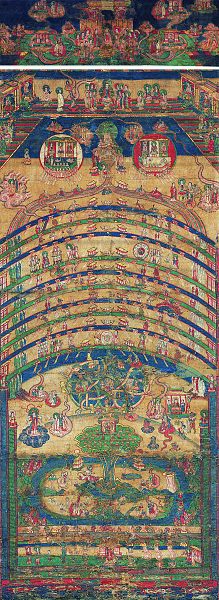
Image: Manichaean diagram of the universe via Wikimedia (China; 1279-1368 CE; paint and gold on silk)

History for Writers is a weekly feature which looks at how history can be a fiction writer’s most useful tool. From worldbuilding to dialogue, history helps you write. Check out the introduction to History for Writers here.

Chariots

War may never change, but the technology of war is always being updated, adapted, and replaced with new inventions. Because of the powerful emotions invoked by our experience of war, outdated military technology is sometimes invested with cultural meaning and takes on a new symbolic life when its functional utility is past. Suits of armor designed to protect soldiers from spears and arrows in wars hundreds of years in the past have become decorative objects that convey a sense of antiquity and dignity to a stately home. Swords have been obsolete on the battlefield for a century, but they still exercise such a fascination for us that we give them to heroes in stories set in the present and future. The town where I live boasts of its possession of a disabled artillery piece from a war more than a hundred years past. In the ancient world, chariots went through a similar transition from practical military hardware to symbolic possession.

A chariot is a light cart, usually on two wheels, though four-wheeled examples exist, designed to be pulled by one or more animals, usually horses. Four-wheeled versions, using heavy solid wheels and pulled by onagers (a type of wild ass) are documented in southern Mesopotamia in the fourth millennium BCE. These wagons would have been relatively slow and ponderous, but they allowed the transport of fighters across the battlefield faster than infantry on foot and provided a defensible fighting platform. Light, fast chariots became possible with the invention of the spoked wheel on the steppes of Central Asia around 2000 BCE.

Light, mobile chariots pulled by horses offered several advantages in war. They allowed swift movement around the battlefield, provided an elevated platform from which to observe the progress of battle, and, on open ground, could stage mass charges to intimidate opposing troops. Horses that were too small to carry a rider under the rigors of war could be used to pull chariots. Between 2000 and 500 BCE, the use of chariots spread across a large swath of Eurasia and northern Africa, from China to Ireland, and from Egypt to the Baltic Sea.

Chariots also had some drawbacks, however. They required skilled construction and maintenance. To be effectively mobile, they had to be built light, but such light construction also made them relatively fragile. They required lots of space to operate and were of limited use on narrow, uneven, or muddy battlefields. Driving and fighting from a chariot solo was a virtuoso feat that few could manage, so the need to provide separate drivers in addition to the fighting troops was a drain on fighting power. In most places, chariots were retired from the battlefield as soon as horse breeds that were large and strong enough to carry an armored soldier became available.

In a few places, like the wide, open plains of Mesopotamia, where the terrain was favorable, chariots were used for fighting into the first century CE, but in most places they had vanished from military use centuries earlier. The glory of the chariot, though, kept its hold on people’s imaginations. In most places where they had been used in war, they were repurposed for symbolic and artistic purposes. In China, chariots were used to make impressive showpieces of engineering, like the famous South-Pointing Chariot, equipped with a figure that always pointed to the south no matter how the chariot turned. In India, chariots were reimagined to become vessels for carrying images of the Hind gods in ceremonial processions. In the Mediterranean, they were used for racing and military parades. In many of these places, chariots also entered mythology, remaining the conveyance of heroes and gods long after they had ceased to be used to carry soldiers around the battlefield.

Image: Model of a four-horse chariot, photograph by BabelStone via Wikimedia (found in Takht-i-Kuwad, Tajikistan, currently British Museum; 5th-4th c. BCE; gold)

History for Writers is a weekly feature which looks at how history can be a fiction writer’s most useful tool. From worldbuilding to dialogue, history helps you write. Check out the introduction to History for Writers here.

Rating: Murdoch Mysteries Season 7

Turn-of-the-twentieth-century Toronto detective William Murdoch is back for season 7, and so are we. Here’s what we thought of the episodes this time:

  1. “Murdoch Ahoy” – 6
  2. “Tour de Murdoch” – 7.5
  3. “The Filmed Adventures of Detective Murdoch” – 7.5
  4. “Return of Sherlock Holmes” – 8
  5. “Murdoch of the Living Dead” – 5.5
  6. “Murdochophobia” – 4
  7. “Loch Ness Murdoch” – 7
  8. “Republic of Murdoch” – 7
  9. “A Midnight Train to Kingston” – 0
  10. “Murdoch in Ragtime” – 6
  11. “Journey to the Centre of Toronto” – 10
  12. “Unfinished Business” – 7
  13. “The Murdoch Sting” – 6
  14. “Friday the 13th, 1901” – 6
  15. “The Spy Who Came Up to the Cold” – 6
  16. “Kung Fu Crabtree” – 4
  17. “Blast of Silence” – 2
  18. “The Death of Dr. Ogden” – 4

This season’s average rating is 5.8, which is pretty good. There is one standout great episode and one standout awful one, but most of the season is middling to good, which makes it good for comfort rewatching.

On the whole, this season holds up well. It offers a lot of what we have come to expect from Murdoch. There are clever takes on modern stories, like the zombie-ish “Murdoch of the Living Dead,” the turnabout con in “The Murdoch Sting,” and half of “Friday the 13th, 1901” in which Drs. Ogden and Grace get a horror movie plot (meanwhile, the boys enjoy an adorably Canadian story about curling). There are also the usual return appearances by our favorite guest characters, like Terrence Myers and Alan Clegg in “The Spy Who Came up to the Cold,” which uses the assassination of US President McKinley as fodder for an espionage thriller. And James Pendrick, the perpetual inventor of things before their time, is back to invent… Murdoch Mysteries!

This season is five episodes longer than previous seasons, coming in at eighteen episodes, which is great. We’re always in favor of more Murdoch. We also see signs of change starting to show through as this season features more people of color as incidental characters and women pushing against the boundaries of social convention.

Our lowest rating for the season goes to “A Midnight Train to Kingston,” at 0. This episode features the return of genius serial killer and Murdoch fanboy James Gillies. We have made our feelings about genius serial killer detective fanboys clear before, and we still have no interest in seeing more of them.

On the other hand, “Journey to the Centre of Toronto,” which takes up contemporary speculation about a hollow earth with a steampunkish spin, makes for a thoroughly delightful 10. This episode suffers a bit from odd pacing and a somewhat unsatisfying ending, but it presents Detective Murdoch and company with such a unique challenge, and they rise to it with such gusto, that we can forgive these weaknesses. We also love the adventurer character, Elva Gordon. It’s a shame she can’t become a regular guest like Myers and Pendrick.

Few series can stand up to the pressures of a long run without faltering, but Murdoch Mysteries continues to deliver. Long may Murdoch continue!

Have a different take on this season? Let us know!

Image: Detective Murdoch explaining an earth-burrowing mole machine, from Murdoch Mysteries via IMDb

In the Seen on Screen occasional feature, we discuss movies and television shows of interest.

Gaulish Wheelbarrow Pigs: A Cautionary Tale

Primary sources are a historian’s best friend, and sometimes worst enemy. Primary sources are essential to our understanding of the past, but if not handled carefully, they can also be deceptive. For a case in point, here are a couple of comments on the Gauls of northern Italy in the third and second centuries BCE.

The Gauls were a warrior elite who had migrated into northern Italy over about a century and established themselves as leaders of scattered towns and settlements in the Po river valley. Some of these groups settled down and built up local power bases based on agriculture and trade. Others made their living by raiding the rest of the Italian peninsula or taking service as mercenaries in the many local wars being fought between Italian peoples like the Etruscans, Romans, Sabines, and Samnites. The native people of the Po valley sometimes resisted Gaulish influence and sometimes assimilated into Gaulish culture. By the second century, the expansion of Roman power had subdued or eliminated many of these groups, while some others had allied themselves with Rome.

The cultural realities of northern Italy were complicated. The view from Rome tended to be simplifying and stereotyping, but even the stereotypes themselves could be complicated.

Here is how the Greek author Polybius, who lived in Rome and aligned himself with Roman culture, described the Italian Gauls:

They lived in unwalled villages without permanent structures. Sleeping on leaves and eating meat, they knew nothing but war and farming; they lived simple lives and had no acquaintance with any art or science.

– Polybius, History 2.17-18

(My own translations)

The image is one of poverty in both material and cultural terms. Polybius’ Gauls are little better than wild animals.

Should we take Polybius’ account as an authoritative statement on what the Romans and their Greek allies thought about the Gauls? There is no doubt that the image of Gauls as feral savages lacking even the rudiments of civilized life was common in the ancient Mediterranean, but it was not the only possibility. In fact, just the opposite was also possible.

Cato the Elder, a Roman statesman, took a different view of the Gauls. Most of his account is lost, but a couple of fragments survive in quotations in later works:

The Gauls devote themselves most diligently to two things: war and cunning talk.

– Cato the Elder, Origins 2, quoted in Charisius, Ars Grammatica 2


The Insubres [a Gaulish tribe] in Italy lay up cuts of pork, three or four thousand at a time, and the pigs grow so big that they cannot stand on their own or walk anywhere. If they want to take a pig somewhere, they must put it in a cart.

– Cato the Elder, Origins 2, quoted in Varro, On Farming 1.2.7, 2.4.11; Columella, Res Rustica 3.3.2; Pliny, Natural History 14.52

Cato was no friend to the Gauls any more than Polybius was, but his view of them is different. Unlike Polybius’ ignorant savages with no art or sceince, Cato’s Gauls are cunning talkers. In contrast to the poverty of unwalled villages and beds of leaves, Cato pictures Gauls as so rich in agriculture that their pigs grow too fat to walk unaided.

Polybius and Cato were roughly contemporary and moved in the same elite social circles in Rome. Despite the differences in their points of view, they both reflect attitudes that must have been current among the Roman upper class. We can explain the differences in their views by their different audiences. Polybius was writing primarily for his fellow Greeks and aimed to portray the Romans as a force for order and stability in the Mediterranean. The more wild and bestial he could make their enemies, the more he could burnish the Romans’ credentials. Cato, by contrast, was writing for a Roman audience in the aftermath of Rome’s complete conquest of the Po valley. By building up the Gauls as a worthy foe, he made the conquest seem more glorious.

The variations in these perspectives should not surprise us. It is rare that any group of people has a single opinion about anything. Even the most reductive stereotypes are rarely universal among the people who hold them. Individuals and groups alike can hold multiple attitudes at the same time, calling up one opinion or another as the occasion demands.

For more recent historical periods when we have richer records of peoples’ thoughts and words, it is easier to get a fuller sense of this sort of complexity. In more distant periods of history when we have much more limited records, it can be tempting to assume that the documents we do have represent an accurate picture of what people thought on a given topic. Polybius and Cato are a good cautionary example that even among people who traveled in the same social circles in the same places and times, multiple different opinions were equally possible.

History for Writers is a weekly feature which looks at how history can be a fiction writer’s most useful tool. From worldbuilding to dialogue, history helps you write. Check out the introduction to History for Writers here.