Teaching in a Pandemic 3: Grades Mean Nothing

(Read previous entries here and here.)

So far, it’s going okay. I have started posting introductions and discussion questions for the blocks of content that my students will be covering for the rest of the spring. Across all my classes, there will be a total of twelve blocks for students to read and respond to. Prepping one block takes me about two solid days of work. I have posted five so far, with seven left to go. Allowing time for housework, fresh air, cooking, and other essential things, I’m probably looking at between two and three weeks more of work to get everything online. Then I’ll be spending the rest of April grading assignments as they come in and keeping an eye of the discussion forums.

Students have started engaging in discussion already. Only a few so far, but that’s understandable. I know everyone is busy right now and it’s going to take people time to get used to new ways of doing things. Responses have been productive. Students are engaging with the ideas I want them to engage with and showing that they have done the new readings and can relate them to ideas we discussed earlier in the semester. That’s as much as I feel I can ask of them right now.

I’m holding virtual meetings with my classes this week via Zoom (videoconferencing service). Not to teach anything new, just to check in with them, go over the procedure for the rest of the semester, and answer their questions. I’ve let everyone know that these meetings are entirely optional, and there will be no negative consequences if they don’t join in. I hope a lot of them will show anyway. I miss seeing them, and I’d like to know that they’re okay.

The big question hanging over all of this is: what will happen to this semester’s grades? As I mentioned last time, the university administration is considering the possibility of shifting to a pass/fail system for this semester, or of giving students the option to individually take courses as pass/fail. Nothing is certain yet, but clarity will hopefully come soon. I’m divided on whether I think it’s a good idea or not. On one hand, there is no way to treat this semester like an ordinary spring or to imagine that the grades students get at the end of it are really comparable to their grades form other semesters. A lot of my students are in difficult situations right now, and going pass/fail might take a burden off their shoulders. On the other hand, implementing such a big change on the fly is going to be a mess, and I worry about people falling through the cracks in a system that none of us have had time to think through and shake the bugs out of.

You see, the secret truth about teaching is: grades mean nothing. Or at least nothing much. A grade is never anything more than your professor’s best attempt to convey to you how well they think you have understood what they were trying to get you to see, and there is no objective way of measuring that. Even in disciplines that have clear right and wrong answers, the decision about what questions to ask is still fraught with human subjectivity. Good and conscientious professors will try to use their grades as a way of communicating honestly with you about what you have accomplished during your time in their class, but the whole thing is an eggshell balanced on top of a rickety shack built on quicksand. You don’t have to stir the sand much before everything breaks.

Let’s hope we don’t break things too badly and we can find a way of doing right by our students.

Image by Erik Jensen

How It Happens is an occasional feature looking at the inner workings of various creative efforts.

Quotes: I Don’t Like You

Before there was the tweet, there was the epigram. The Roman poet Martial was an expert at this art form of highly-condensed snark. Here are a few of his best bits (my own translations):

I don’t like you, Sabidius, and I don’t know why.

All I know is: I don’t like you.

– Martial, Epigrams 1.32


You ask what I get from my farm in Nomentum, Linus?

This is what I get: not seeing you.

– Martial, Epigrams 2.38


Zoilus, why are you soiling the bathtub by washing your ass in it?

If you really want to make it filthy, go soak your head!

– Martial, Epigrams 2.42


Serving exactly what it sounds like, the Quotes feature excerpts other people’s thoughts.

Teaching in a Pandemic 2: Students Are Stressed Enough Already

(Read my last entry here.)

Just a day after my last post, the university administration announced that all classes are going online for the rest of the semester, so I have spent much of the past week figuring out how that’s going to work. I started with a few basic principles and worked my way on from there. Here’s what I started from:

  1. Everything sucks right now, and it probably sucks worse for my students than it does for me. I want them to have a meaningful educational experience, but I don’t want to add to the burden of what they’re already dealing with.
  2. Different students are dealing with very different situations right now. Some of them are relatively safe and calm; their lives have not changed much. Others are back in the midst of bad or stressful home lives from which college was an escape. Some of them have plenty of time and technology on their hands; others are lucky to get a few hours to themselves and have a dodgy cellphone connection to the outside world at best. My course needs to work for all of these students.
  3. My students are good students. They want to put in the work that I am asking of them and do well. If they are struggling right now, it is a reflection of their circumstances and the failures of the larger governmental, social, and educational infrastructure they live within, not of their willingness or ability to learn.

Putting these basics together, I have made the following decisions about my courses:

  1. I will not require anyone to be available at any particular time. I will miss our face-to-face interactions in the classroom, but trying to recreate that experience online is doomed to fail and will only put unnecessary stress on my already stressed students.
  2. I will not require any work that depends on having a stable internet connection and plenty of bandwidth. As long as people can get online occasionally, that should be enough.
  3. I will not hold anyone to more stringent due dates than are absolutely necessary for me to be able to fully and thoughtfully review their work before giving grades.

From these fundamentals, I have decided how my online courses will work.

Instead of the rest of the semester being divided into class days with their own readings and assignments, I have divided the remaining content into large blocks organized around a common theme. Each block represents a week or so of what we would have done in class. Students can now do the readings on their own time, and I am writing short introductions (covering the ideas I would have been introducing in class discussion) with broad, open-ended discussion questions attached. These discussion questions are posted online as discussion threads on Canvas (our course management website). Between now and the end of the semester, I am asking every student to make at least two comments in the discussions for each block. Participating in the discussion threads is counted as part of the attendance and participation grade for the course.

In addition to the discussions in the blocks, students have most of the same writing assignments that were scheduled before we moved online, but I am shifting their due dates to the end of the semester, so that everyone can get their work done at their own pace. I have dropped a few assignments that seemed overly burdensome: those that involved library research (because, even though there’s a lot you can do online these days, it seemed like too much pressure), or visiting museums (because, I mean, duh).

These changes have meant rearranging the grading standards for some courses, which is tricky, but I’ve tried to make sure everyone still has plenty of opportunities of getting good grades. The university administration has made some vague noises about shifting courses to pass/fail grading for this semester, but no decision has been made yet. On the one hand, going to pass/fail would make my job a lot easier—I could give most of my students their course grades right now. On the other hand, some of my students have been putting in a lot of time and effort, and it would be sad not to be able to reward them with the grades they’ve earned. Well, we’ll see what comes of it.

I can’t say with any honesty that I know how the rest of this spring is going to go. We’re all making it up as we go along. I have confidence in my students. They are strong, smart, and hard-working, and I want to see every one of them come out of this experience okay.

Image by Erik Jensen

How It Happens is an occasional feature looking at the inner workings of various creative efforts.

Teaching in a Pandemic 1: Nobody Knows Anything

I’ve decided to use this space to chronicle my experience teaching college classes during the covid-19 pandemic. I can’t promise how interesting this will be to anyone else, but here’s a glimpse inside the process.

We’re still in the first few days of the officially-declared pandemic, and nobody knows anything right now. The federal response in the US has been just about useless. Actions at the state and local level have been more coherent, but we still don’t really know what the next few weeks or months are going to look like. Will we be stuck at home? Limiting our social contacts? Returning to business as usual? Lining up for tests? Hunkering down under quarantine?

The university has not been much help either. Classes have been canceled for a week, in addition to spring break, but no one knows what comes next. We’ve been told to prepare for possibly teaching our classes online. Or not. Or only for a few weeks. Maybe. They’ll tell us later. Maybe.

Now, I don’t envy the administrators who have to make the call about whether to massively disrupt thousands of people’s plans for the next two months or to put those same thousands of people at risk of contracting and spreading a deadly virus. I understand why they’re hesitant to make a decision at this point, but it really isn’t possible to make any plans when I have no idea what I should actually be planning for.

In the absence of any clear direction from the top, I’m thinking of making a decision on my own. I’m thinking that I will plan for all my courses to run online for the rest of the semester. Then, if in-person classes do resume, I’ll make them optional, because I know some of my students have personal or family health concerns, and I don’t ever want to put anyone in a position of choosing between their grades and their or their relatives’ health.

The big problem is: how, exactly, do I do that? I have some colleagues who have taught online and done it very well, but their experiences don’t exactly translate: those were planned online courses that they had months to prepare for, and every student knew what they were signing up for. That’s a long way from cobbling together half a course on two weeks’ notice for students who weren’t planning on taking an online course. I have no idea what kind of technology my students have available to them or what their own living situations right now allow in terms of time and resources, and I have never even thought about teaching online until a few days ago.

The one good thing to emerge so far from this confusion is that I have had to spend some time thinking very seriously about what I want students to get out of my classes, so that I can focus any online teaching on those elements. It’s been a useful exercise. Of course, I have spent plenty of time already thinking about what students should take away from my classes (I’m an ancient historian—having to explain to other people why my field is worth studying is an occupational hazard), but I’ve never tried to distill half a course to its fundamental essence before.

I’m teaching three different courses this spring: Classical Tradition (a broad history of the art and literature of ancient Greece and Rome), History of Rome (from the foundation of the city to the end of the western empire), and Roman Law (an intensive course on legal reasoning—mostly using Frier’s casebook on delict, for those of you who know what that means). Classical Tradition is an introductory-level course mostly for non-majors, History of Rome is a mid-level course with a mix of majors and non-majors, and Roman Law is an advanced course mostly for majors, especially those in the pre-legal track.

We’ve already covered more than half the material for each course. From what’s left, I’ve tried to extract the most important questions I want my students to grapple with:

Classical Tradition: Why did new religious movements, like Christianity, the cult of Isis, Mithraism, and Islam, emerge out of the context of the Roman imperial frontier? Why did some of these movements thrive while others foundered? How did the followers of these movements engage with, repurpose, challenge, or reject the artistic and literary legacy of Greece and Rome?

History of Rome: How did the Roman Empire reach some level of stability in the second century CE? Why did that stability fail in the third century, and why couldn’t it be recovered afterward? What choices did people living in, at the edge of, and outside the empire make in response to these changes?

Roman Law: What’s the most effective way of getting away with murder if your weapon of choice is a live bear?

Okay, I’m kidding about that last one, but not by much—that is exactly the kind of bizarre hypothetical that we often argue over in class. Hard cases, as they say, make bad law, but weird cases are the ones that really show you how the logic of the law works and where its limits lie.

A little more prosaically,

Roman Law: How did the Roman jurists try to construct a logically consistent set of rules that could cope with the vagaries and inconsistencies of Roman society?

Now all I have to do is figure out how to give my students some meaningful way of engaging with these questions online instead of in guided classroom discussions.

I’ll check in later and let you know how it goes.

Image by Erik Jensen

How It Happens is an occasional feature looking at the inner workings of various creative efforts.

The Vivid Colors of the Dome of the Rock

We often picture history in muted terms, at least in the West. We think of the white marble statues of Greece and Rome, the gray stone of medieval castles, the dull brown cloth of historical costumes. It can be hard to remember how much color has been lost to age, weathering, even deliberate destruction. (A few useful examples here and here.) For an alternative view, it helps to look at examples that go far back in history but have been maintained and restored. One good example is the Dome of the Rock in Jerusalem.

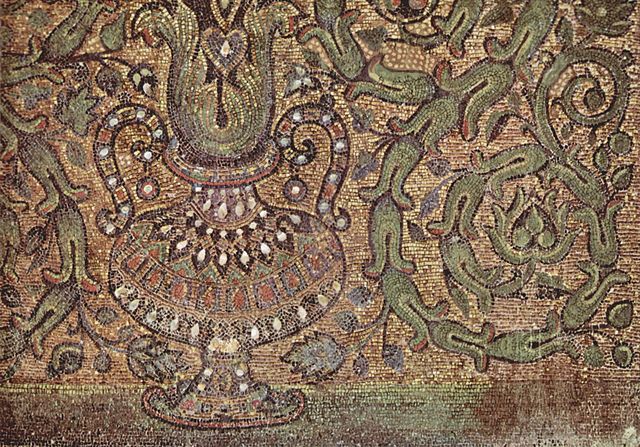
Originally completed in 692 CE, the shrine has continued to be an important Islamic site ever since. Its original design was colorful, and in the following centuries it was elaborated with tiles, mosaics, and metalwork. Several major restoration projects in the past several centuries have kept the colors vibrant. While individual details of the decor may not go back to the original construction, the overall effect gives us a sense of how richly colorful the built environment of the past could have been.

Tiled exterior wall of the Dome of the Rock, photograph by Godot13 via Wikimedia (Jerusalem; construction 692, tiles restored 1552; glazed tile; tiles by the workshop of Abdullah Tabrizi)


Interior mosaic, photograph by the Yorck Project via Wikimedia (Jerusalem; originally 692, later restored; glass, mother of pearl, and stone mosaic)


Dome interior, photograph by Virtutepetens via Wikimedia (Jerusalem; originally 692, later restored; metal and enamel)


The Dome of the Rock was a monument that was meant to make a statement. Other buildings of the time were not necessarily so dizzyingly colorful, but the shrine preserves a variety of visual culture we have very few other examples of. Even if nothing else exactly like it was ever built, many buildings once existed with just as bright an array of colors that are now long gone. When imagining what places in the past might have looked like, or when imagining new worlds inspired by them, remember that gray stone and white plaster are not the only options.

History for Writers looks at how history can be a fiction writer’s most useful tool. From worldbuilding to dialogue, history helps you write.

Rating: Castle, Season 2

We’re back with our ratings for season 2 of Castle, and it’s a decent second act for this crime-solving comedy. Here’s what we thought of it:

  1. “Deep in Death” – 5
  2. “The Double Down” – 6
  3. “Inventing the Girl” – 4.5
  4. “Fool Me Once…” – 5
  5. “When the Bough Breaks” – 6
  6. “Vampire Weekend” – 8
  7. “Famous Last Words” – 4.5
  8. “Kill the Messenger” – 8
  9. “Love Me Dead” – 5
  10. “One Man’s Treasure” – 5
  11. “The Fifth Bullet” – 8
  12. “A Rose for Ever After” – 3
  13. “Sucker Punch” – 2
  14. “The Third Man” – 5
  15. “The Suicide Squeeze” – 3
  16. “The Mistress Always Spanks Twice” – 7
  17. “Tick, Tick, Tick…” – 8
  18. “Boom!” – 4
  19. “Wrapped up in Death” – 7.5
  20. “The Late Shaft” – 4
  21. “Den of Thieves” – 4
  22. “Food to Die for” – 7
  23. “Overkill” – 3
  24. “A Deadly Game” – 8.5

The overall average this season is 5.5, a step down from the first season but still respectable. The episodes are fairly evenly spread between a number of weak offerings in the 2-4 range, a chunk of solid ones in the 5s and 6s, and quite a few good ones at 7 and higher.

Our lowest rating for this season is a 2 for “Sucker Punch,” the start of a long and tedious multi-season arc about political corruption and the murder of Detective Beckett’s mother. None of the episodes in this arc are much fun and most end up being unsatisfying dead ends with conveniently missing evidence, abstrusely shadowy conspiracies, and no end of boring angst for Beckett. When we want to watch X-Files, we’ll watch X-Files. We come to Castle for spark and wit, and these episodes have precious little of either.

At the other end of the scale, “A Deadly Game” gets an 8.5 for a story about a spy LARP gone wrong. This episode has the classic Castle qualities we love: a quirky premise that gives our characters plenty of entertaining rabbit holes to fall into before finally resolving in a serious and satisfying story of human emotion.

In many ways, this season is exactly what a season of Castle ought to be: not always brilliant, but usually imaginative and and entertaining, with room for all the characters to laugh, live, and grow.

Image: Detectives Beckett, Esposito, and Ryan from “When the Bough Breaks” via IMDb

In the Seen on Screen occasional feature, we discuss movies and television shows of interest.
Sappho: Making a Life in Archaic Greece

The poet Sappho (c. 630 – c. 570 BCE) is among the earliest writers whose work comes down to us from ancient Greece. She is best known for her lyric poetry, much of it on themes of love and longing. (Read some of my translations of her work here and here, or hear a recreated musical performance of one of her poems here.) Her literary works were widely popular in Greece and Rome, and later authors wrote many things about her life, few of them reliable. Much of what we think we know about Sappho’s life is conjecture based on her poetry. Still, even amid this uncertainty, Sappho stands for us as a representative of one of the most important transformative forces in ancient Greek history: the rise of trade.

During the Early Iron Age, a period of Greek history extending from around 1200 to 750 BCE, the Greek world was largely isolated. People lived in small villages of at most a few thousand people. Most people got by at a subsistence level, producing enough for their own needs and engaging in trade outside their own households in only a limited way. Political power, such as it was, rested with an entrenched class of warrior-aristocrats who monopolized control of scarce farmland. This elite class occasionally traded their agricultural surplus overseas for modest amounts of foreign luxuries, but that trade had little impact on the Greek world, and to the extent that it did, it only reinforced the social status of an existing elite. The poetry of this elite is represented by the Homeric epics, the Iliad and the Odyssey, which celebrate martial values and the exploits of the warrior heroes that the aristocrats claimed as their ancestors.

Between 750 and 700, this stability was rapidly undermined by the development of new patterns of trade. Greeks began to venture out into the larger Mediterranean more often and more purposefully. The earliest accounts we have from the outside world describe the Greeks as pirates and raiders. Such dangerous ventures were not for the comfortably well off. The first Greeks to try their luck abroad were those who could not survive at home under the dominance of the entrenched aristocracy. Their risky raiding voyages had limited success, but the experience they gained in places like Egypt and the Levant prepared them for more profitable ventures as mercenaries and merchants. By the mid-600s, there was a growing class of successful merchants, artisans, and other professionals in Greece whose prosperity came from their connection to the outside world rather than control of land and who were increasingly agitating against the old aristocracy for a share of political power.

Sappho spoke for this new class of Greeks whose wealth came from abroad. Her brother Charaxus, whom she addresses in a few of her poems, was engaged in trading wine from their home on the island of Lesbos to Egypt. Sappho’s poetry invokes the importance of foreign contacts by using Lydia, a kingdom in Anatolia, as an image of beauty and luxury. Unlike the Homeric epics, Sappho’s lyrics speak of immediate, personal, emotional experiences. Individuals with their own desires and passions emerge as more important than family lines or warlike values.

Sappho’s poetry describes her intense romantic feelings for young women. Although we cannot know for sure to what extent these poems reflect Sappho’s personal experiences and how much is just literary invention, the idea that love mattered was, in its way, a radical thought. Among the landowning class, marriage was mostly a matter of family politics and economic negotiation. Ideally, of course, husbands and wives felt affectionately toward one another, but powerful, passionate love was not something to be sought out or valued. Homer’s heroes have little time for the emotional power of love: Helen is a prize to be fought over like any other piece of treasure, and the suitors who clamor for Penelope’s hand talk of their estates, not their feelings. In Sappho’s day, the Greeks who were making their living in trade could still be perfectly mercenary in their personal relationships, but the idea that love had power and that the feeling of longing for another person was worthy of attention was new and exciting. In much the same way that the shift from an agrarian economy to an industrial one in the nineteenth century CE brought with it a new interest in romantic love, Greeks in the seventh century BCE whose fortunes no longer depended on controlling land were beginning to think of individual feelings of love as something to value in a relationship.

Like the merchants and mercenaries who sought their fortunes amid the dangers of the unknown world outside Greece, the voices of Sappho’s poems dream that they might have what they long for, that their individual lives and struggles might matter.

Image: “Sappho embracing her lyre” via Wikimedia (Musee des Beaux-Arts de Brest; 19th c.; painting; by Jules-Elie de Launay)

History for Writers looks at how history can be a fiction writer’s most useful tool. From worldbuilding to dialogue, history helps you write.

Listening to Sappho

Sappho, like many ancient poets, wrote her poems not to be read on the page but to be sung. We don’t know specifically what her poems originally sounded like when performed, but we know enough about the notes, rhythms, and structure of ancient music to make some reasonable guesses. Here’s a version of Sappho’s first poem (my translation here) performed on a reconstructed ancient lyre by artist Bettina Joy de Guzman.

Sappho fr. 1: to Aphrodite via Bettina Joy de Guzman

An occasional feature on music and sound-related notions.

Gameplay vs. Lore: Faction Conflict in World of Warcraft

World of Warcraft is a game steeped in lore, with stroylines spanning thousands of years and major expansion themes playing out the emotional lives of lore characters. Nevertheless, it’s a common refrain that gameplay trumps lore (a few discussions of the idea here, here, and here). There are many examples: player characters can come back from the dead, while NPCs (mostly) can’t; heroes who defeated a godlike manifestation of evil at the end of the last expansion may struggle to kill an overgrown crab at the beginning of the next; leveling up from 1 in the game as it stands now is a dizzying exercise in time travel through fifteen years’ worth of story, all of it still happening “now” in the zones of the various expansions. These breaks from lore fidelity make the game more fun and more playable, so even those players who care about the lore in depth generally accept them. The story is there to create background and flavor and give us a reason for going out, killing monsters, and taking their stuff. Whenever the lore threatens to get in the way of the monster-killing, stuff-taking fun, it just steps aside and gets out of our way.

With one big exception: the faction conflict. The conflict between the Alliance and the Horde is the product of lore, not gameplay, but for years it has been allowed to overwhelm gameplay and make players’ experiences worse in a way that no other lore element has.

The faction conflict in WoW is a holdover from the Warcraft real-time strategy games. In the RTS context, a red-vs.-blue battle serves a good gameplay purpose. In the early years of the World of Warcraft massively multiplayer role-playing game, it made sense to carry over the familiar elements of the setting that fans of the RTS franchise would know, but WoW is no longer bound to its RTS roots and it hasn’t been for years. The defining game mode of the Warcraft universe is now an MMORPG. It’s time for the game to reflect that fact.

As a multi-player game, WoW is built around groups of players teaming up to take on difficult challenges. While there is plenty to do in game as a solo player, the endgame content that everything builds towards is all geared toward groups of players banding together. By dividing the player base in half and arbitrarily preventing them from playing together, WoW is working against its own game mechanics.

An argument sometimes made in favor of the faction divide is that, although it is detrimental to the player-vs.-environment aspects of the game, it is essential for the player-vs.-player elements, but this argument is manifestly untrue. One of the accommodations Blizzard has made in recent years to the faction divide is the introduction of “mercenary mode,” which allows players from one faction to temporarily join up with players of the other specifically to play in PvP content. If the faction divide can be wished away in the parts of the game that are specifically designed to pit players against one another, what purpose can it possibly serve in the parts of the game that are supposed to bring players together?

Even as a lore-dictated design element, the faction divide has never contributed much to the game story. How many expansions have we seen start with “Oh no, the Horde and the Alliance are at it again, and this time they mean it!” and end with “We have learned our lesson and must put aside our petty differences to work together against the greater threat”? Even in Battle for Azeroth, which has taken the faction conflict more seriously than any expansion before, the Horde-Alliance war has ended up being no more than a big speed bump on the way to fighting the big threat of N’Zoth. The core of WoW‘s gameplay has never been about the Horde vs. the Alliance; it has always been about killing monsters and taking their stuff. The important stories in WoW are about where the monsters came from and why we need to kill them, not about why we can’t kill them together.

The faction divide seems to survive largely for the benefit of a small base of fans who like having something to argue about on the internet. So far, Blizzard seems to be calculating that keeping that small base of fans happy (or, rather, continuing to give them things to get angry about, which seems to be their version of happy) is worth more than making a better game for everyone else.

Perhaps someday the faction divide will finally be removed and my Tauren and Eppu’s Dwarves can go kill monsters together. Until then, we live with a game whose gameplay is subject to an out of date, unproductive relic of lore.

Image: Screenshot from World of Warcraft

Of Dice and Dragons is an occasional feature about games and gaming.

Myths and Marketing

A lot of people have made comparisons between the pop-culture heroes of today like Marvel’s superheroes or the characters of Star Wars and the heroes of ancient Greek myth. (I’ve done it myself, here and here.) There’s a lot to be said for these comparisons in terms of narrative, but there are also interesting similarities in the way these characters are portrayed visually and sold to an admiring public.

Ancient Greek art went through an extraordinary transformation over a few centuries from the early archaic age (mid-700s BCE) to the high classical age (mid-400s BCE). One of the most telling signs of this transformation was the change in how mythic characters were represented.

Geometric krater, photograph by Metropolitan Museum of Art (found Attica, currently Metropolitan Museum of Art, New York; 750-730 BCE; pottery; attributed to the Hirschfeld workshop)

Here is a scene from a Greek vase painted around 750. The human figures are highly abstracted with no individual identifying characteristics. We can make out some of what is happening in the scenes. In the upper register, a single figure lies horizontally on a table or bed surrounded by standing figures with their hands on their heads. This scene is generally interpreted as a funeral, with wailing mourners surrounding the deceased. On the lower register, warriors with shields ride in chariots. Still, for as much as we can make guesses about what is going on in these images, the details elude us. Are these generic images or are they meant to tell a story? Are the two registers even related to one another? One possibility is that this image represents the funeral for Patroclus, from the Iliad, with the funeral pyre on the upper register and the games in honor of the dead on the lower, but we have no way of knowing for sure whether that was what the artist intended or not.

Polyphemus amphora, photograph by Sarah C. Murray via Wikimedia (currently Archaeological Museum of Eleusis; c. 650 BCE; pottery; Polyphemus painter)

This image comes from a vase painted a hundred years later, around 650 BCE. Now we have a definite story. A group of men come from the left carrying a long spear to stab the eye of a larger, seated figure on the right holding a drinking cup. Putting all these elements together, it is clear that this scene represents the blinding of Polyphemus, the giant cyclops whom Odysseus and his men got drunk before stabbing his one eye out. The scene is clear enough if you know the story, but reading the image depends on knowing the whole story and seeing the whole picture. The figures within it are not distinctive. If you took any one of the figures out and looked at it on its own, you would have no way of identifying it or guessing what story it came from.

Black figure olpe, photograph by Jastrow via Wikimedia (currently Louvre; c. 540 BCE; pottery; Amasis)

Another century later, the ways of depicting mythic figures had developed into something new. In this vase painting, from about 540, we see figures with distinctive characteristics. On the left a robed and bearded man holds a trident: unmistakably Poseidon, god of the sea. Hermes, the messenger god, approaches him, recognizable from his broad-brimmed hat, his snake-twined herald’s staff, and the wings on his sandals. Athena comes next, indicated by her helmet and spear and the shield she carries bearing her symbol, the owl. Behind her comes Heracles, not so visible in this image but still recognizable from the bow he carries and the lion skin he wears. Even though nothing much is happening in the image—it’s just a line of people—with this combination of characters, we can tell that it is representing the story of Heracles’ ascension to join the gods on Mount Olympus. Each character, though, is distinct. You could take any one of them out of the scene, and you would still know who you were looking at.

Ancient Greek art developed a rich but understandable visual language for identifying important figures from mythology. To understand why this development mattered, we have to think about the Greeks’ place in the larger Mediterranean.

Despite the importance the modern West has accorded to ancient Greek culture, ancient Greece itself was not a powerhouse of the Mediterranean. Greece was a poor, fractious backwater compared with the great centers of wealth and culture like Egypt, Persia, and Carthage. Trade was crucial to the Greeks’ survival, which meant they had to have something to offer that other people wanted. Wine and olive oil were the major commodities the Greek traded overseas, but over time they increasingly began to export their cultural products as well. Greek artisans, poets, musicians, and actors found work throughout the Mediterranean world and beyond. The changes in how Greeks depicted myths in their art went along with their expansion into the Mediterranean’s trade networks.

Exporting culture only works if your culture can offer something the market wants. The most valuable cultural property the Greeks had was their mythology. Greek mythology was not a complete and canonical body of work to be exported whole (as I discuss here), but a flexible, malleable set of stories and characters ready to be reimagined and recombined in new and unique ways. This flexibility allowed individual Greek artists and merchants to offer their patrons and trading partners versions of myths that suited the tastes of the local market. Heracles, for instance, went over well in Etruria, and before long Etruscans were creating their own stories about the character (calling him “Herkle”) that no Greek would have imagined. The Amazons similarly found their way into Egyptian literature. Underlying it all was a set of characters (gods, heroes, monsters) with basic identifying characteristics, personalities, and stories. A Persian or Carthaginian picking up a new Greek vase in the market might not know all the myths depicted on it, but it was easy to recognize Athena’s owl or Heracles’ lion skin and begin to put together the story from there.

In a similar way, symbolic attributes have become an important part of how we identify our modern heroes. From Captain America’s shield to Luke Skywalker’s light saber, from the Doctor’s TARDIS to the house crests of Westeros, having a set of easily recognizable symbols helps us identify our favorite characters and stories at a glance. They are also great fodder for marketing merchandise—which is exactly what our ancient Greek counterparts were doing with their mythology, too. Besides being the common cultural property of a far-flung people, Greek myths and their visual representations were a brilliant marketing device that got lots of Etruscans, Romans, Egyptians, Scythians, and others to buy Greek goods.

History for Writers looks at how history can be a fiction writer’s most useful tool. From worldbuilding to dialogue, history helps you write.