Disruptive Technology: Iron

These days, every new decade seems to bring a new technology that totally upends the way we live our lives, but the ability of new technologies to disrupt societal structures is not new. Many times in history, the development or introduction of a new technology had far-reaching effects on how people lived their lives. One such technology is iron. The development of iron for military purposes—to make stronger weapons and tougher armor—led to plenty of disruption, but iron could have powerful effects even when used for peaceful and mundane purposes.

One place we can see an example of iron’s effect on society is in southern Scandinavia. The Iron Age began in Denmark around 500 BCE. The changes that came as a result can be seen throughout much of northern Europe, but they have been particularly well studied in Denmark.

Southwestern Denmark is rich in deposits of bog iron, a form of iron ore that is comparatively easy to extract and process. Iron was soon put to use to produce stronger swords, axes, and spearheads, but it was also used to make sturdy blades for agricultural tools such as sickles, scythes, and pruning knives.

The introduction of iron-bladed tools made possible a dramatic change in the agrarian economy. Earlier flint or bronze tools could not hold a cutting edge well enough to effectively cut large quantities of hay or twigs to be stored as fodder for cattle. Accordingly, cattle could only be kept in relatively small numbers to avoid overgrazing the sparse vegetation available through the winter. With iron tools, winter fodder could be cut, dried, and stored in quantity for the winter, allowing large herds of cattle to be kept in denser concentrations. These cattle provided meat and milk as a food source in addition to the grain people were already growing.

Cattle also produce something else: manure. Manure is a rich source of nitrogen for fertilizing fields. With larger herds of cattle producing more manure, exhausted fields could be refertilized without a long period of lying fallow, which increased grain production.

Keeping larger herds of cattle significantly increased the available supply of food, which allowed for population growth. It also, however, changed social relations. Before iron, individual families largely tended their own fields and kept small herds of cattle, producing only enough for their own subsistence. There was little social differentiation between one family and the next because everyone did essentially the same work and there weren’t many opportunities to get richer than your neighbors. With iron came larger cattle herds, which meant that some people had to do the dirty scut work of cutting hay and mucking out stalls, while those who owned the cattle enjoyed extra food to use for trade or creating new social connections through the giving of expensive gifts. The archaeological evidence from Iron Age settlements in Denmark shows a process of social differentiation, as some families consolidated their economic power and rose to the top while others became dependent workers supporting the new elite.

The availability of economic surplus in the form of grain, cattle, and trade goods also meant that raiding nearby settlements could now be a profitable way of life for those strong enough to get away with it, and so the new cattle-owning elite soon also put iron to work to equip themselves for defense or to launch raids of their own. The agricultural elite became in time a military elite, with farming duties largely handed off to dependent workers. In time, this military elite consolidated its power enough to found royal dynasties commanding wide swaths of land and conducting raiding activities far from home.

These changes did not happen quickly. Unlike the effects of electricity, automobiles, and the Internet in the modern world, the effects of iron in ancient Denmark played out over centuries. The changes came slowly enough that, in lived experience, they probably did not seem all that disruptive. Looking back with the perspective of archaeology and history, though, we can see what enormous social transformations can be traced back to the introduction of stronger tools made of iron.

The most disruptive technologies don’t always come from the sources you expect, nor can we always predict the long-term effects of what seem like simple changes. These observations may seem very modern to us, but they were as true in the past as they are today.

Image: Raw bog iron, photograph by Tomasz Kruan via Wikimedia

History for Writers looks at how history can be a fiction writer’s most useful tool. From worldbuilding to dialogue, history helps you write.

Representation Chart: Star Wars, Original Trilogy

We all know that the representation of people of different genders and races is imbalanced in popular media, but sometimes putting it into visual form can help make the imbalance clear. Here’s a chart of the Star Wars original trilogy movies (Episode IV: A New Hope, Episode V: The Empire Strikes Back, Episode VI: The Return of the Jedi).

Characters included

(Characters are listed in the first movie in which they qualify for inclusion under the rules given below.)

  • Episode IV: A New Hope: Luke Skywalker, Owen, Obi-Wan Kenobi, Tarkin, Princess Leia, Beru
  • Episode V: The Empire Strikes Back: General Rieekan, Admiral Piett, Emperor Palpatine, Lando Calrissian
  • Episode VI: Return of the Jedi:

If the absence of major characters like Darth Vader, Chewbacca, and Yoda seems strange, see below.

Rules

In the interests of clarity, here’s the rules I’m following for who to include and where to place them:

  • I only count characters portrayed by an actor who appears in person on screen in more or less recognizable form (i.e. performances that are entirely CG, prosthetic, puppet, or voice do not count).
  • The judgment of which characters are significant enough to include is unavoidably subjective, but I generally include characters who have on-screen dialogue, who appear in more than one scene, and who are named on-screen (including nicknames, code names, etc.)
  • For human characters that can be reasonably clearly identified, I use the race and gender of the character.
  • For non-human characters or characters whose identity cannot be clearly determined, I use the race and gender of the actor.
  • I use four simplified categories for race and two for gender. Because human variety is much more complicated and diverse than this, there will inevitably be examples that don’t fit. I put such cases where they seem least inappropriate. “White” and “Black” are as conventionally defined in modern Western society. “Asian” means East, Central, or South Asian. “Indigenous” encompasses Native Americans, Polynesians, Indigenous Australians, and other indigenous peoples from around the world.
  • There are many ethnic and gender categories that are relevant to questions of representation that are not covered here. There are also other kinds of diversity that are equally important for representation that are not covered here. A schematic view like this can never be perfect, but it is a place to start.

Corrections and suggestions welcome.

Chart by Erik Jensen

In the Seen on Screen occasional feature, we discuss movies and television shows of interest.

Hospitality Tokens

Ancient societies had a problem that we still find familiar today: how do you know that someone is who they say they are? Within small-scale societies (as discussed here) it’s easy enough; when everyone in your village knows you, or knows someone who knows you, it’s not hard to prove who you are. The difficulty comes when you leave your home community and travel far away.

Guest-friendship (which I wrote about here) was one important way of overcoming the challenges of traveling far from home in a time when it was risky to do so. Guest-friends had an established relationship in which each friend promised to help and support the other. Having a guest-friend in a distant place provided some security for when you were far from home.

But even guest-friends might find it difficult to prove their identity to one another. This sort of relationship existed between people whose communities might be widely separated and who might see each other only very rarely. If someone turned up at your door claiming to be a guest-friend who hadn’t visited in twenty years, how could you be sure that they were really who they said they were and not some thief or imposter trying to bluff their way into your house and hospitality? Since guest-friend relationships were often hereditary, the problem could be even more acute: how could you trust that the person who turned up on your doorstep was actually the grandson of your grandfather’s guest-friend and thus someone to whom you still owed a duty of hospitality?

The solution to this problem came with tesserae hospitales, or hospitality tokens. Typically made of bronze, these tokens were a matched pair, sometimes with holes drilled through them, each one inscribed with the name, ancestry, and origins of one of the pair of guest-friends. By putting the two pieces together, one could verify that they matched. A person carrying such a token could present it for verification by comparison with its other half and thus prove that they had a right to claim hospitality in a particular house.

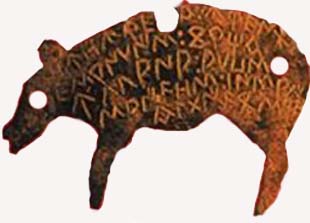
Here’s an example of one such token, made in Spain, probably in the second or first century BCE. This one is in the shape of a pig and has a few holes drilled through it. The text, written in the local Celtiberian language, gives the identity of the man who first carried it: “Lubos, of the Aliso family, son of Aualos, from Contrebia Belaisca.”

Tesseara hospitalis in the shape of a pig, photograph by Carlosblh via Wikimedia (found Uxama, currently Museo Numantino de Soria; 2nd-1st c. BCE; bronze)


Of course, few problems have perfect solutions. Hospitality tokens could, in theory, be lost, stolen, damaged, or copied, but as a way of verifying identity they worked well enough to be used for many centuries in the ancient Mediterranean. Numerous examples have turned up in the archaeological record, and some matching pairs have been found from contexts as widely separated as North Africa and northern Italy.

History for Writers looks at how history can be a fiction writer’s most useful tool. From worldbuilding to dialogue, history helps you write.

Teaching in a Pandemic 6: We Have Done the Best We Reasonably Could Have Expected

(Previous entries: part 1, part 2, part 3, part 4, part 5)

And that’s the semester. The deadlines have passed, the grades are turned in, all that’s left to look forward to is celebrating our graduating seniors at a safe distance. This is not the way any of us wanted this semester to end, but I think all of us—my fellow faculty, my students, and the university administration—have done the best we reasonably could have expected.

I was prepared to be lenient in my grading this semester, but I found that (after making some basic structural adjustments to my syllabi, such as dropping some assignments and adjusting the weight of others), I did not need to. My students have continued to turn in work of exceptional quality, despite the challenges of the times. Their papers are just as strong as I could have hoped for in a normal semester, their self-reflections just as thoughtful, their questions just as insightful. I credit this result to the quality of my students and not my skills at teaching online, which are dubious at best.

Not all my students made the transition to online learning gracefully. Across all my classes, only about two thirds of students ever engaged with the discussion questions I posted online. Still, I am treating those discussions as the equivalent of our classroom conversations, and getting two thirds of a class to speak up is not bad even in person. Some of those who didn’t engage in the online discussions still showed through their written work that they had done the reading thoroughly and thoughtfully. There were a few students who just disappeared, but on the whole they were the same students who had mostly disappeared from in-person classes before the outbreak of the pandemic.

The spread of final grades came out about the same as usual: a lot of Bs, a good handful of As, a scattering of Cs and Ds, and a few Fs for those who just never turned in the required work. I know from email exchanges with a few students that some of them have been under enough stress this spring that it was all they could do to manage a passing grade, and I’ve done my best to guide them to what they need to do to get it. For the most part, though, my students have done as well as I would normally have expected of them.

This will be my last update for this spring. We’ll see what the fall holds. I hope there has been something interesting in this view into the mild chaos of teaching in a pandemic. Stay safe and well, everyone.

How It Happens is an occasional feature looking at the inner workings of various creative efforts.

Rating: Castle Season 4

Season 4 of Castle is mostly solid, with a mix of highs and lows. Here’s how we rated the episodes:

  1. “Rise” – 2
  2. “Heroes and Villains” – 9
  3. “Head Case” – 6
  4. “Kick the Ballistics” – 2
  5. “Eye of the Beholder” – 6
  6. “Demons” – 8.5
  7. “Cops and Robbers” – 7.5
  8. “Heartbreak Hotel” – 6
  9. “Kill Shot” – 6
  10. “Cuffed” – 5.5
  11. “Till Death Do Us Part” – 6
  12. “Dial M for Murder” – 5
  13. “An Embarrassment of Bitches” – 6
  14. “The Blue Butterfly” – 4
  15. “Pandora” – 1.5
  16. “Linchpin” – 1.5
  17. “Once Upon a Crime” – 6
  18. “A Dance with Death” – 5.5
  19. “47 Seconds” – 5
  20. “The Limey” – 3
  21. “Headhunters” – 1.5
  22. “Undead Again” – 8
  23. “Always” – 0

The average for this season is 4.8, a bit of a comedown from season 3’s 5.9. Still, this season has a lot to offer. The average is dragged down by a bunch of boring hyped-up drama episodes, but this season still delivers the crime-solving comedy action we come to Castle for.

The bottom of the heap is the finale, “Always,” that we gave a complete 0. This episode is one more step in the long, drawn-out saga of Beckett’s mother and has absolutely nothing to appeal to us. A number of other episodes also hang out near the bottom of the pack, including “Headhunters,” at 1.5, which, despite reuniting Nathan Fillion with an over-the-top Adam Baldwin, spends too much time wallowing in the dysfunction of Castle and Beckett’s relationship. There’s also the bizarre two-parter “Pandora” and “Lincpin,” both at 1.5, which takes the Castle crew into a hard swerve from crime-solving into international intrigue. It’s not something this particular writing/production team does well.

At the top end, though, we have a good set of wacky cases-of-the-week, which are just what we want from Castle. The best is “Heroes and Villains,” at a 9, about do-it-yourself superheroes. Some of the other great episodes this season similarly dig into geeky subcultures, like ghost-hunting in “Demons” (8.5) and zombie LARP in “Undead Again” (8).

Along the way there’s also a good batch of episodes in the mediocre but perfectly serviceable 5-7 range. There’s a lot to like this season, even if there are several episodes well worth skipping.

Image: Beckett and Castle research superheroes, from “Heroes and Villains” via IMDb

In the Seen on Screen occasional feature, we discuss movies and television shows of interest.

What a Long Walk Does to Your Body

A lot of speculative stories involve characters going for very long walks, whether it’s carrying the One Ring to Mordor or keeping away from other tributes in the Hunger Games. If you’re feeling cooped up inside right now, you may well be imagining a new story in which your characters travel a long way through the wilderness on foot.

I’ve written before about some of the practical details of walking long distances (here), but you may also want to think about the effect a long walk has on the human body. Here is a very interesting article by Robert Moor from a few years back about how walking the Appalachian trail affected him.

The whole article is fascinating reading, but here are few noteworthy observations from Moor about the effects of strenuous walking.

  • Your body learns to recognize good and bad foods: “you begin to acutely feel the quality of the nutrition you are putting into your body.” You come to crave those that will give sustaining energy for hours of walking, while cheap highs of sugars and fats can come with a devastating crash afterward.
  • Many walkers loose weight, shedding fat and building muscle. The result is often that as walkers go on they can walk farther and farther distances.
  • The body’s adaptation to walking, though, makes it less adapted to other demanding activities. A simple swim in a lake left Moor and another hiker “blue-lipped from the water, clutching ourselves and shivering electrically.”

Enjoy your explorations. Even if you are stuck between four walls at the moment, the imagination knows no limits!

How It Happens is an occasional feature looking at the inner workings of various creative efforts.

Representation Chart: Star Wars, Prequels

We all know that the representation of people of different genders and races is imbalanced in popular media, but sometimes putting it into visual form can help make the imbalance clear. Here’s a chart of the Star Wars prequel movies (Episode I: The Phantom Menace, Episode II: Attack of the Clones, Episode III: The Revenge of the Sith).

Characters included

(Characters are listed in the first movie in which they qualify for inclusion under the rules given below.)

  • Episode I: The Phantom Menace: Obi-Wan Kenobi, Qui-Gon Jin, Anakin Skywalker, Palpatine, Chancelor Valorum, Padme Amidala, Shmi Skywalker, Captain Panaka, Mace Windu, Kitster
  • Episode II: Attack of the Clones: Captain Typho, Jango Fett, Boba Fett, Count Dooku, Cleigg Lars, Owen Lars, Bail Organa, Beru, Captain Typho, Dorme
  • Episode III: Revenge of the Sith: Commander Cody

Rules

In the interests of clarity, here’s the rules I’m following for who to include and where to place them:

  • I only count characters portrayed by an actor who appears in person on screen in more or less recognizable form (i.e. performances that are entirely CG, prosthetic, puppet, or voice do not count).
  • The judgment of which characters are significant enough to include is unavoidably subjective, but I generally include characters who have on-screen dialogue, who appear in more than one scene, and who are named on-screen (including nicknames, code names, etc.)
  • For human characters that can be reasonably clearly identified, I use the race and gender of the character.
  • For non-human characters or characters whose identity cannot be clearly determined, I use the race and gender of the actor.
  • I use four simplified categories for race and two for gender. Because human variety is much more complicated and diverse than this, there will inevitably be examples that don’t fit. I put such cases where they seem least inappropriate. “White” and “Black” are as conventionally defined in modern Western society. “Asian” means East, Central, or South Asian. “Indigenous” encompasses Native Americans, Polynesians, Indigenous Australians, and other indigenous peoples from around the world.
  • There are many ethnic and gender categories that are relevant to questions of representation that are not covered here. There are also other kinds of diversity that are equally important for representation that are not covered here. A schematic view like this can never be perfect, but it is a place to start.

Corrections and suggestions welcome.

Chart by Erik Jensen

In the Seen on Screen occasional feature, we discuss movies and television shows of interest.

Teaching in a Pandemic 5: Online Teaching Leaves Me Feeling Drained

(Read previous entries part 1, part 2, part 3, and part 4)

Things are starting to get routine. My teaching day goes like this: I check my email for any messages from students and respond to individual questions and problems. If someone raises a question that I think others may be wondering about, I send out a general email to the whole class or to all my students. I try not to send more emails than necessary, because I know my students are already getting a lot of information from the administration, but sometimes important things need to be said or reiterated. I’ve been surprised by how many of my students have missed or misunderstood basic instructions about how to participate in online discussion for my classes, but I don’t hold it against them. We’re all struggling right now, and I have to be aware that just because I understand something doesn’t mean that my students do. My job is to give them the information they need, and if that means repeating the same information in different words four or five times, then I will.

Next I grade and comment on any assignments that have been submitted. Then I move on to the online discussions. Wherever there are new comments, I record who participated in the discussion so that I can give credit. To do this I have a sheet of paper, on the same model as the sheet I always use for taking attendance at the start of class, with rows for all my students’ names and columns for the different discussion topics. When a student makes a comment on a given topic, I make check mark in the corresponding box on my sheet. At the end of the semester I will put this sheet together with the attendance sheets from the first part of the spring and combine them to give participation grades.

Depending on the day, this process can take anything from an hour to the whole afternoon. When I have time to spare, I work on my current book project, which is getting close to being finished. This schedule is exhausting, but in an entirely different way than a day of in-class teaching is. After a good day in the classroom, I feel energized and alive. Even at the best, this online teaching just leaves me feeling drained.

I miss the spontaneity and verve of the classroom. I miss the way a good class takes on a life and spirit of its own. I miss the dumb jokes and pointless but entertaining tangents that help bind students and professor together. I miss the performance-art craft of leading a discussion so gently from my students’ own questions and ideas to the points I wanted to make that they feel like they got there on their own. I miss the wonder of seeing my students strike off in new directions and arrive at ideas I never expected them to come up with.

This is an emergency situation, and we all understand that this is how things have to be for now. My fear at the moment is that we will not be able to return to the classroom in the fall. I know that there are some professors who are amazing at online teaching, but I am not one of them. For all of us, the end of this spring semester has been a rickety tub held together with duct tape and twine. With a summer to prepare, I’m sure I could make my online teaching better in the fall if I have to, but I cannot be at my best for my students from the other side of a screen.

Image by Erik Jensen

How It Happens is an occasional feature looking at the inner workings of various creative efforts.

Teaching in a Pandemic 4: The Things that Matter Are Still Pretty Much the Same

(Read previous entries part 1, part 2, and part 3)

It’s been a couple of weeks since I’ve posted about teaching, and in the past two weeks things have started to become clearer. Students are starting to engage in the online discussions and submit online assignments, and I’m seeing how they respond to what I’ve asked them to do.

The results are mostly good. Students are thinking about the questions I’ve wanted them to think about, and coming up with some pretty good responses. Some of the work I’ve seen is even better than I would have expected out of a classroom—one student wrote up a paragraph about how different types of early Christian churches reflect the social dynamics of Christianity at different levels of Roman society that could have come from a scholarly book. (It didn’t, as far as I can tell.)

More typical responses rephrase the ideas I’ve already given them in my written introductions, but that’s good enough for these times. There is pedagogical value in paraphrasing. The act of putting an idea into your own words is a useful kind of thinking, and for my lower-level classes, it is as much as I feel I can ask of my students under these circumstances.

For my upper-level Roman Law class, I’ve posed a number of hypothetical cases for my students to try to interpret, and occasionally given them the chance to come up with hypotheticals of their own. The results can be amusing, but they are also good for seeing how clearly my students have thought through the logical implications of various legal principles. (On the other hand, because some students were making reference to it in their responses, I have had the misfortune of having to find out what Tiger King is all about. Thank goodness for Wikipedia, but also: yuck.)

Perhaps the biggest thing that has become clear in the last few weeks is that even though everything is online now, the things that matter are still pretty much the same. The students who were active and engaged in the classroom are active and engaged online. The ones who sat in the back scrolling on their phones through classtime are nowhere to be found online. Students who were confused in person are now confused by email, while the ones who always turned their assignments in on time still do.

The same principle can be applied to the university administration. The administrators who were helpful and responsive before the crisis are helpful and responsive now. The ones who were overpaid nonentities in person remain overpaid nonentities at a distance.

Like many crises in history, this pandemic has not so much caused new problems as it has revealed the problems that were already there but we had gotten used to not seeing.

Image by Erik Jensen

How It Happens is an occasional feature looking at the inner workings of various creative efforts.

Rating: Castle, Season 3

Season 3 of Castle keeps the mystery/comedy engine chugging along nicely with some fantastic episodes. Here’s how we rated them:

  1. “A Deadly Affair” – 8
  2. “He’s Dead, She’s Dead” – 8
  3. “Under the Gun” – 8
  4. “Punked” – 9.5
  5. “Anatomy of a Murder” – 7
  6. “3xk” – 2
  7. “Almost Famous” – 9
  8. “Murder Most Fowl” – 8.5
  9. “Close Encounters of the Murderous Kind” – 10
  10. “Last Call” – 10
  11. “Nikki Heat” – 6.5
  12. “Poof! You’re Dead” – 4
  13. “Knockdown” – 1
  14. “Lucky Stiff” – 7.5
  15. “The Final Nail” – 6
  16. “Setup” – 1.5
  17. “Countdown” – 1
  18. “One Life to Lose” – 6.5
  19. “Law & Murder” – 6.5
  20. “Slice of Death” – 7
  21. “The Dead Pool” – 4
  22. “To Love and Die in L. A.” – 4.5
  23. “Pretty Dead” – 4
  24. “Knockout” – 0.5

This season’s average rating is a pretty good 5.9, but that average is the product of a lot of really good episodes and a bunch of real stinkers.

The bottom of the barrel is the final episode of the season, “Knockout,” which gets a measly 0.5. This episode and the earlier “Knockdown” (1) are both part of the interminable story arc about Beckett’s mother’s murder and the shadowy conspiracy surrounding it. Another interminable story arc is introduced this season with “3xk” (2), in which Castle picks up his very own obsessed serial killer, which seems to be an accessory that every tv detective must have, no matter how boring or implausible. These plus the tedious terrorism-themed two-parter “Setup” (1.5) and “Countdown” (1) drag this season down by a lot. We come to Castle for the quirky murder-of-the-week stories and the fun interactions among the characters. Serious Drama just gets in the way of the fun.

But there is definitely fun to be had this season! There are two episodes that we rated a full 10; “Close Encounters of the Murderous Kind,” a fun X-Files pastiche that pits Castle and Beckett against space scientists, men in black, and (not quite) aliens. After that comes “Last Call,” about a murder connected to the discovery of a secret Prohibition-era stash of fine whiskey. Both of these episodes offer good mysteries for the team to solve while leaving lots of room for the usual antics. Beyond those two, there are plenty of episodes in the 8-9.5 range as well.

This season also solidifies a trend, emerging in the first two, in which the week’s case takes the team deep into some particular subculture—be it steampunk, stage magic, or pizza—before finding a familiar human story at the center of it. These episodes give Castle and the boys (Ryan and Esposito) lots of room for goofy side adventures while Beckett rolls her eyes and gets on with the business of crime solving. And what else can you ask for from Castle?

Image: Castle and Beckett consult with a man in black, from “Close Encounters of the Murderous Kind” via IMDb

In the Seen on Screen occasional feature, we discuss movies and television shows of interest.