Train Like a Spartan

There are some folks who are very into bodybuilding, weightlifting, and other such activities and who like to fancy themselves as the heirs of the ancient Greeks, especially the Spartans. Now, there’s nothing at all wrong with having hobbies like these. Do what makes you happy, and don’t let anyone tell you otherwise! But the ancient Spartans wouldn’t want modern bodybuilders among their number.

The details of ancient Spartan training are not easy to be certain about, since many of the sources that describe them were written by non-Spartans, often those who held unrealistically admiring attitudes toward Sparta. Yet even these sources are of some interest, because they were written by people familiar with the conditions of ancient warfare trying to imagine what kind of training a nation of perfect warriors would institute for themselves. Among these descriptions we find very little focus on getting big muscles or sculpted abs. Spartan training instead focused on two things: the endurance of hardship and camaraderie among the Spartiate elite.

A Spartan character by the name of Megillus in conversation with an Athenian interlocutor in Plato’s dialogue The Laws gives this account of the most important institutions in Spartan life:

Athenian: […] Should we say that the eating clubs and exercise grounds were established by the lawgiver for the sake of war?

Megillus: Indeed.

Athenian: Is there a third and fourth thing? […]

Megillus: The third thing he instituted is hunting, as I and any Lacedaimonian will tell you.

Athenian: Let us try to state the fourth thing, if we can.

Megillus: I will try to explain the fourth thing as well: we train ourselves to endure pain, both by fighting each other hand-to-hand and by stealing at the risk of a sound beating every time. Also the “Crypteia,” as some call it, is an astonishingly painful thing to endure, as they go barefoot in winter, sleep rough, attend to themselves without servants, and wander the whole countryside both by day and night. In our Gymnopaideia festival we face awful sufferings as we contend with the stifling summer heat, and there are so many more examples that listing them all off would nearly take forever.

Plato, Laws 633a-c

(My own translations)

There are good reasons why Spartan training focused on these areas rather than building muscle or cutting fat. Fighting makes up a very small part of what soldiers do in war. Most of an ancient soldier’s activity was marching, setting up and taking down camps, marauding for food and supplies, standing watch, and carrying out maneuvers. Even when the moment to fight came, big masses of muscle were of less use than the willingness to stand and fight and risk one’s life for one’s fellow soldiers.

In these conditions, physical endurance and a commitment to the one’s comrades were what mattered. Soldiers who could march for days on little food and no sleep were worth far more than those with low body fat. Maintaining big muscles and a sculpted physique takes time, food, and sleep that soldiers on the march couldn’t afford. Such fighters would be dead weight on their comrades, not an asset on the battlefield.

The poet Archilochus, who had experience as a mercenary soldier, gave his own opinion about soldiers who liked to show off their bodies:

I don’t like a general who is big or who likes to run,

nor one who is vain about his curly locks or sculpts his beard.

Give me a little bandy-legged-looking one

who’s steady on his feet and full of guts.

Archilochus, quoted/paraphrased in Dio Chrysostom, Orations 33.17

Now, while bodybuilding was not a favorite Spartan pastime, there were two activities for which Spartans were famous that trained both endurance and the ability to work well with the people around you: dancing and choral singing. Spartans were renowned for their skills in both coordinated group dances and singing together.

So, if you really want to train like a Spartan, leave the gym and the weights behind and go join a choir or take a ballet class. That will make a true Spartan out of you.

Image: Gerard Butler as Leonidas in 300 via IMDb

History for Writers looks at how history can be a fiction writer’s most useful tool, from worldbuilding to dialogue.
Three Trailers for Villeneuve’s Dune: Part Two

At some point in 2023 when I wasn’t looking, three trailers for Villeneuve’s Dune: Part Two were published.

Part Two, trailer one:

Dune: Part Two | Official Trailer by Warner Bros. Pictures on YouTube

Here’s trailer two:

Dune: Part Two | Official Trailer 2 by Warner Bros. Pictures on YouTube

And trailer three reasonably recently (from mid-December):

Dune: Part Two | Official Trailer 3 by Warner Bros. Pictures on YouTube

Wow, trailer three’s music deviates quite strongly from the other two. (Too much ululation in the others?) Other than that, it’s clear we have a war coming—as those who’ve read the books know—and the Bene Gesserit looks to have a larger role. The emperor (Christopher Walken) also makes an appearance, but it isn’t clear how much we’ll be seeing him.

I did also notice how strongly the Fremen-eye blue stands out in the otherwise very sepia-toned environment. And is it just me, or have the Harkonnen gone even more monochrome than in Part One?

At this writing, the release date is set to March 1, 2024.

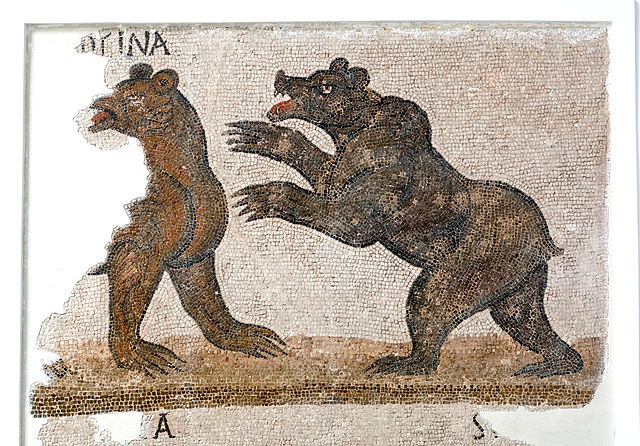
How to Get Away With Murder, In Ancient Rome, With a Bear

If someone out there is looking for a good plot for an ancient Roman mystery thriller, here’s a tip. There’s a famous case in classical Roman law according to which it is possible to get someone killed and face no legal consequences. The catch is: you have to get lucky, and you have to use a wild animal like a bear.

To start with, we have to lay down a few fundamentals of Roman law: dominium and possessio. Dominium means ownership, the absolute right to control a particular piece of property. Possessio, unsurprisingly, means possession, the direct control of property.

In most cases, people have both dominium and possessio at the same time. You own a vase, which you keep in your house as decoration on a table—you have both the legal right to that vase (dominium) and direct physical control over it (possessio). It is also possible to have one without the other. If you lend that vase to a friend so they can decorate their house for a party, you still own the vase (dominium) even without possessio; as long as your friend has it in their house, they have possessio, but that doesn’t give them dominium.

Now, if someone uses that vase to smash someone over the head and kill them, it doesn’t matter who owned or possessed the vase. Inanimate objects are not responsible for what people do with them. The person who did the smashing is liable for the results of their actions. Neither an owner nor a lawful possessor is liable for what other people do with their property.

With animals, though, we get into a more complicated area. Sometimes people can directly provoke animals to cause harm, like spooking a herd of cattle into a stampede or siccing a dog on another person. In those cases, Roman law recognizes that the person who provoked the animals is responsible for the harm they caused, in the same way that someone who picks up a vase and smashes it over someone else’s head is responsible for the damage done by the vase. Yet animals can also act on their own initiative. A charging bull or biting dog can ruin someone’s day without a person directly commanding it, and you can’t sue an animal for the damage it causes.

To deal with cases where animals caused harm without direct human intervention, Roman law provided the action of pauperies. In a lawsuit for pauperies, the owner of an animal was held legally liable for harm the animal did when acting on its own nature. It didn’t matter whether the owner caused the animal to act, or was even present when the damage was done. The person who had dominium of an animal was responsible for what that animal did. (There was a limit, however: if a person was sued for damages done by their animal, they could escape all liability by handing over the animal in question to the wronged party. In this way, the limit of liability was the value of the animal itself.)

For domesticated animals, pauperies provided a degree of legal recourse, because a domestic animal always belongs to someone. Even if your bull breaks out of its paddock and goes on a rampage through town, it’s still your bull. Once the bull is off your property, it is no long in your possessio, but you still have dominium and the legal liability that goes with it.

Wild animals are a different case. Under Roman law, you can have dominium over a wild animal only so long as you have possessio of it. If you are hunting a deer and catch it in a trap, the deer belongs to you as long as it is in your trap or if you can get a rope on it to wrangle it back to your property, but if it breaks free and runs off through the woods, you loose your claim to it unless you catch it again. If another hunter kills the deer while it is running from you, you have no recourse against them, because as soon as the deer is out of your possessio, it is also out of your dominium.

So far so good. All of these legal principles have a sound practical purpose and make logical sense. When we put them together, though, an unexpected result emerges.

Suppose you have a bear in a cage. A bear is a wild animal, like a deer, so as long as it is in your direct physical control, it belongs to you. If the bear reaches out of its cage and mauls someone, you are legally on the hook for damage because it is an animal in your dominium. But what if it gets out? Once the bear escapes its cage and is running free, you no longer have direct physical over it, so you lose possessio. Because it is a wild animal, not a domestic one, as soon as you lose possessio, you also lose dominium. On one hand, that means that if someone else captures or kills the bear, you have no legal right to sue them or demand they return it to you. On the other hand, you also have no legal liability for any damage the bear does.

It would take a lot of luck to pull off, but if you can concoct the right scenario where a dangerous animal gets loose at the right time and kills the person you want to target, under Roman law, you would be free and clear.

Image: Roman mosaic of a bear, photograph by Jerzystrzelecki via Wikimedia (currently Bardo Museum, Tunisia; Roman period; tile mosaic)

History for Writers looks at how history can be a fiction writer’s most useful tool, from worldbuilding to dialogue.

When a Meme Propels You to Dig Deeper, Or: The Case of Green Balls

The other day on Tumblr I ran into a Legolas meme that involved a candy I grew up with:

Tumblr homunculus-argument Legolas w Green Ball

“One small bite is enough to fill the stomach of a grown man.”

That’s actually not too terribly far from the truth. 😀 It’s quite possible to inadvertently overdose yourself on them—these suckers are surprisingly large. See for yourself:

Green Ball jelly candy in Hand

Since I’m a nerd who never wondered about this candy before, I had to read a bit more. 🙂

Fazer is an old Finnish company that makes biscuit and grain products, confectionery, and other candy. In addition, they run a chain of popular cafes. One of their seasonal products is pear-flavored marmalades or jelly candy called vihreät kuulat (green balls).

(Marmalades are not one of Fazer’s international brands, which was tough for me when we were still living in the U.S.—I could only get my green ball fix when visiting Finland at the right time of the year, or if someone sent or brought them as a gift.)

Apparently Fazer has been making jelly candies for Christmas since the end of 1800s, when the founder Karl Fazer brought a recipe home from St. Petersburg, where he had been studying. The green ball format and flavor has been for sale since 1929.

Besides Christmas, the second big season for green balls is Easter (although I have to admit that’s escaped my notice thus far). Altogether Finns eat some 25 million green balls a year. These days there are also green ball flavored chocolate and cookies, and I’ve even seen spreadable jelly.

Woo, only 6 years to their centennial! I hope they’ll make something special. 🙂

Images: Legolas meme via homunculus argument on Tumblr. Green ball by Eppu Jensen.

Top Five Posts of 2023

2023 is behind us now, so we’ve had look back at what posts got the most attention this year. Among the things we posted during 2023, here’s the ones that got the most views:

  1. A Competence Porn Viewing List. Eppu’s list of some of her favorite movies and shows to watch that are about awesome characters being awesome together.
  2. Completely New Night Elf Balance Druid Transmog. Eppu’s butterfly-winged transmog for her druid.
  3. Visual Inspiration: Bohemian Waxwing in White. A bit of striking nature photography shared by Eppu.
  4. Are You Aware of National Velociraptor Awareness Day? A silly little comic by Erik for a silly little holiday.
  5. A Compelling Mashup of Columbo and Star Trek: TOS. Some fun cross-fandom stuff found by Eppu.

The lion’s share of views on our site in this past year, though, went to posts from a few years back. Here are the posts that got the most views overall in 2023:

  1. Testing Witches with Water. A whole bunch of you are still really interested in how (or how not to) determine if someone is a witch; this post from 2019 still gets a lot of attention.
  2. Race in Antiquity: Skin Color. A post from 2018 about the complex intersection of skin color and racial diversity in the ancient Mediterranean.
  3. Race in Antiquity: Who Were the Romans? Another 2018 historical post about identity and its convolutions in the Roman world.
  4. Tali for Satrunalia. A post from 2018 about how to play the ancient Roman game of tali.
  5. A Random Find: Ancient and Early Medieval Persian or Iranic Women’s Clothing. An interesting find we posted in 2018 showing some reconstructions of women’s clothing from the cultures of ancient Iran.

Thanks for visiting in 2023. We’ll do our best to keep sharing things worth reading and looking at in 2024!