Tales of haunted places are a nearly universal part of human experience. Ghost stories can be one of the ways in which we remember the past, especially traumatic or painful parts of it. Even in ancient Greece there were legends of hauntings connected with the site of the battle of Marathon.
Normally, in ancient Greece, the bodies of fallen soldiers were brought back to their home city after the battle and buried wherever their families buried their dead, but an exception was made for the fallen of Marathon in recognition of the exceptional nature of the battle. The dead of Marathon were buried on the site of the battle and an enormous earthen mound raised over their tomb.
The travel writer Pausanias reported local legends about ghostly apparitions around the tomb mound some six centuries after the event (and a warning to any would-be ghost hunters):
Every night there can be heard the sound of horses neighing and men fighting. It has never done anyone any good to go looking for these manifestations on purpose, but those who happen upon the scene by chance do not suffer the spirits’ wrath.
Pausanias, Description of Greece 1.32.4
(My own translation)
If you’re enjoying some ghost stories this Halloween, know that you’re in good company and part of a long tradition.
History for Writers looks at how history can be a fiction writer’s most useful tool, from worldbuilding to dialogue.
Erik and I usually go to the library at the same time, but do our own things, sometimes with funny results: the other day we picked up the same book.
(Nettle and Bone by T. Kingfisher)
While there’s overlap in our interests, they’re not identical—I tend to prefer scifi, Erik fantasy, for example—and while we’ve read and liked many of the same novels, it’s never been quite this coordinated before. We didn’t even discover it until a few days later when one of us got through their current book and pulled out the next on Mt. To Be Read.
Plant fibers come basically from one of three parts: stem, leaves, or seeds. Bast fibers are harvested from the stems of various plants or trees and include flax (linen), hemp, jute, and ramie (a nettle family plant). Among leaf-derived fibers, sisal is perhaps the most commonly known. Seed fibers include cotton, coir (coconut shell fiber), and kapok, for example.
Plant fibers have been used for textile production for tens of thousands of years, at latest since the Neolithic. Many of the coarser plant fibers were (and still are) used for utility items like ropes and cords, nets, sails, bags, sacks, packs, and various wrappings. The softer ones were, naturally, a desireable material for wearable textiles.
This post will concentrate on linen and cotton, and treats their history and processing separately. However, dyeing and typical uses of of linen and cotton will be discussed together.
LINEN
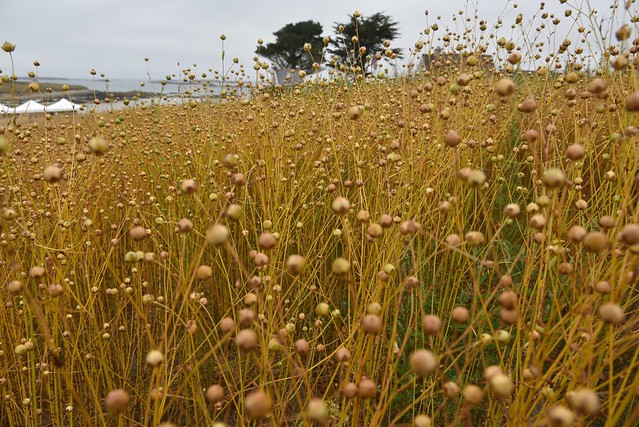
Linen is produced from the fibers of the common flax (Linum usitatissimum). Flax provides both oil (known as linseed), edible seeds, and fibers. As a bast fiber, the length of the raw fiber is determined by the height of the flax plant when harvested.
(As a sidenote, nettle is a bast fiber similar to linen. In archaeological finds, it can be very difficult to differentiate between flax and nettle by eye or even by microscope. It does seem, though, that nettle has been used in northern, central and eastern Europe, e.g. among Finnic tribes, at least from 2500 BCE onwards. For example, the Oseberg ship burial apparently included some nettle fragments. The processing of nettle follows in broad strokes that of linen, except nettle doesn’t necessarily need to be retted. However, the loss of plant material during processing is greater, i.e., even less spinnable fiber is gained than from flax.)
Origins of Linen Production
The world’s earliest extant linen remnants are tens of millenia old. The Upper Paleolithic Dzudzuana Cave in the foothills of the Caucasus Mountains in Georgia was inhabited intermittently during several periods dated to approximately 32,000-26,000 / 23,000-19,000 / 13,000-11,000 BCE, and has preserved dyed and knotted flax fibers (either twisted or spun) used for hafting stone tools, weaving baskets, or sewing garments.
Over time, first in the Fertile Crescent region, humans domesticated flax, focusing on taller plants with fewer branches and pods but longer stems that yielded more fiber. Cultivation seems to have started in the Near East around 8000-7000 BCE. In Turkey and Palestine, the use of flax dates back to at least the 7th millennium BCE.
The oldest known piece of linen cloth, dated to c. 7000 BCE, was found at Çayönü in southeastern Turkey. From Nahal Hemar Cave near the Dead Sea in Israel’s Judean Desert were found scraps of linen yarn and fabric, produced with twining, knotting, and looping techniques, including the remains of what appears to be some type of headgear, dated to 6500 BCE or thereabouts.
There is evidence for linen production in Egypt approx. 5500 BCE and for flax cultivation 4000 BCE or so, and for the latter on an industrial scale from around 2000 BCE onwards.
Linen goods from the tomb of Ramose and Hotnofer, Dynasty 18, reign of Hatshepsut, c. 1479-1458 BCE, photograph by wilddaughter via Flickr (CC BY-NC 2.0)
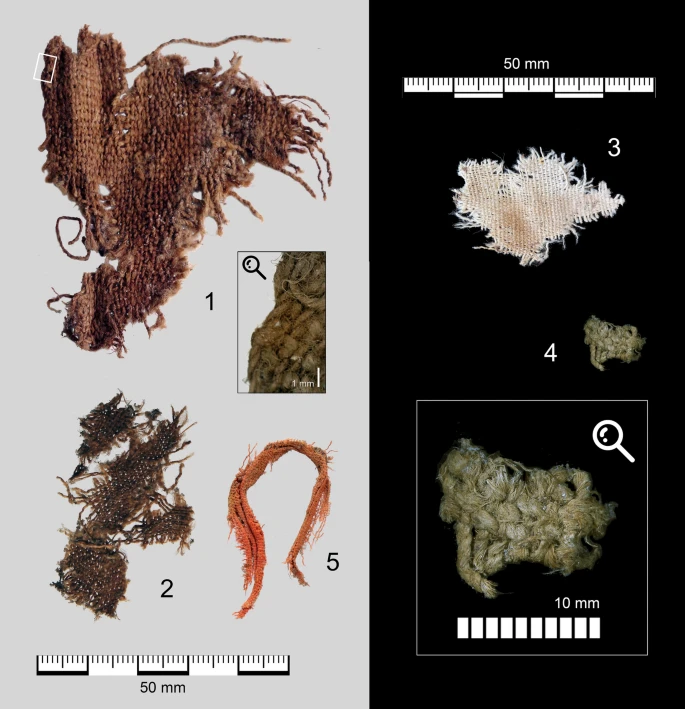
Also in Europe, flax cultivation at least from 4th millennium BCE is plausible. For example, numerous artefacts to do with textile production plus finished products like fabrics and netting dating between 3900 and 800 BCE have survived in late Neolithic and Bronze Age sites in eastern Switzerland and Germany. In southern Spain, near Córdoba, a 4th to 3rd millennium BCE burial deposit (five spliced-yarn flax fragments) in a small cave at Peñacalera in the Sierra Morena hills preserved the oldest examples of loom-woven textiles in the Iberian Peninsula. In Italy, linen textile fragments found at Lucone di Polpennazze have been dated to Early Bronze Age (2000 BCE or so).
Five linen textile fragments recovered from the Peñacalera Cave in southern Spain, dated to the 4th to 3rd millennium BCE, by M. Gleba et al. via Scientific Reports
Types of Linen
In modern commercial linen production, fibers aren’t formally graded by international standards like for example silks are. However, as a general rule, the better the quality of a linen yarn is, i.e., the longer the fibers in the yarn, the higher quality fabric can be woven from it. Tow-based yarns are coarser and rougher.
These days, the best fibers are used for lace, fabrics (e.g. shirt or suits), and bed sheets. Coarser grades are used for twine and rope, and historically for canvas and webbing.
Collecting and Processing Linen into Useable Forms
Cultivating flax starts from gathering seeds as well as sowing and weeding the fields. Harvesting modern flax usually happens 90 to 100 days from planting. Uprooting the plants by hand (pulling) yields the longest stems (i.e., the longest possible fibers) but is slower than harvesting with a blade or a machine.
Once harvested, seeds are removed from the stalk (rippling). Next the stalks are soaked in water (retting) to dissolve lignin and pectin and loosen the fibers. Care must be taken not to over-ret the stalks and by so doing damage (rot) the fibers. Depending on the method used, retting may take from several days up to three weeks.
It’s also possible to leave linen unretted. This so-called green linen (or green flax) is stronger and stiffer than retted linen. Nowadays it’s used as the raw material for utility textiles such as sails, packing materials, and other functional products.
Retted, dried flax is ready for breaking and scutching. Breaking is done with a wooden instrument (a sawhorse-like set of hinged wooden blades called a brake), or, even more simply, something club-like to remove the outer rotted stalk. In scutching, bundles of flax stems are beaten or struck with a long wooden knife (swingle) to separate the woody parts of the stem from the fibers.
The last step before linen can be spun is heckling or hackling, a process similar to the carding of wool in which combs or brushes are used to straighten and align the fibers; heckling also removes the final remains of the stem (tow), which can itself be re-hackled and/or spun into a coarse yarn.
An alternative technique to spinning, likely the oldest form of yarn making with flax and other bast fibers, is known as splicing. There are several variations (for example, rolling fiber ends between thumb and index finger) depending on material and local traditions. In broad terms, splicing means joining strips of fibers individually (end to end) or layered together in a thin bunch, often after having been stripped from the plant stalk directly without (or with only minimal) retting. Spliced yarn is weaker at the splice point and is often reinforced by plying. There is some evidence to suggest that the change from spliced to spindle-spun yarn is linked to fiber length (i.e., an alteration in the plant), quite possibly the result of conscious selection by humans.
Linen is stronger wet than dry, so it’s easier to spin damp using a spray bottle, or regularly dipping fingers in a water bowl. Drop spinning (spindle spinning with a whorl) and supported spinning (rolling against the thigh) are both ancient options.
Modern weavers recommend higher humidity also when weaving linen. Another factor to pay attention to is tension to avoid snapping the warp, since linen is not as elastic a fiber as for example wool.
Suggested prehistorical spinning and weaving speeds can be gleaned from research and experimenting. Two academic analyses in Denmark done by expert spinners on flax averaged about 24-33 meters and 55 meters per hour, respectively. Weaving a 95 cm wide linen tabby for a reconstruction of the so-called Viborg Shirt at Ribe Viking Centre took approx. 37 hours per meter (not including setting up the loom). Although the processing of flax is more complicated than that of wool, the extra work is still a fraction of the total labor spent to produce wearable clothes; the majority of time still goes to spinning and weaving.
COTTON
The 50 or so wild cotton (Gossypium) species are found in nearly all tropical areas and can grow as tree, bush, or grass. The plant was independently domesticated on both sides of the Atlantic. Cotton is currently enormously important as a commodity and textile material.
In the Indian subcontinent, the earliest extant cotton finds have been dated to 5500-5000 BCE. Spinning probably started by around 3000 BCE at latest. India had the monopoly for cultivating cotton till approximately 2000 BCE, after which cultivating spread to the Persian Gulf and Asia, and later to Egypt, Greece, Malta, and the Roman Empire.
The Incas and Mayas also used cottons, and there recent archaeological research has identified the use of cultivated cotton (Gossypium barbadense) in the ancient Andes dating back to at least 7800 years ago. The so-called Paracas Textile is a cloak made from cotton and camelid fiber, produced by the Nasca culture around 100-300 CE, and one of the most renowned Andean textiles in the world.
Closeup of one of the corners of the Paracas Textile via Brooklyn Museum (Paracas, Peru; 100-300 CE; cloak made from cotton and camelid hair)
By 4th or 5th centuries CE, areas further from the core cotton production areas had also picked up the skill; for example, in Kara-tepe, a pre-Islamic site near the Aral Sea in northwestern Uzbekistan, cotton seeds were found in amounts too numerous for them to be casual debris. By early 600s CE in the kingdom of Khotan (in the Tarim basin in Xinjiang, northwestern China), most people had moved away from wearing wool or fur and dressed in light silks or white cotton.
It also seems that Lower Nubia in Africa (roughly modern southern Egypt to northern Sudan) had developed its own cotton industry using their native variety of Gossypium herbaceum, sometimes referred to as ancient Nubian cotton, by 400 CE or so.
Types of Cotton
Currently there are about ten cotton cultivars of commercial viability. Most of the wild varieties have too short fibers and are, therefore, completely useless for making thread. (It’s difficult if not impossible to spin plant fibers shorter than 10 mm.)
The most important modern subspecies are Gossypium hirsutum, which is native to Central America, and Gossypium barbadence from Ecuador and Peru. The original South Asian variety is called Gossypium arboreum and there is evidence of its cultivation already in the Indus Valley civilization.
As a plant fiber, cotton’s most important component is cellulose (unlike protein in animal fibers). Cotton can also contain minor amounts of waxes, fats, pectins, and water. The quality of cotton depends largely from genetics, but growing conditions, especially humidity, also have an impact.
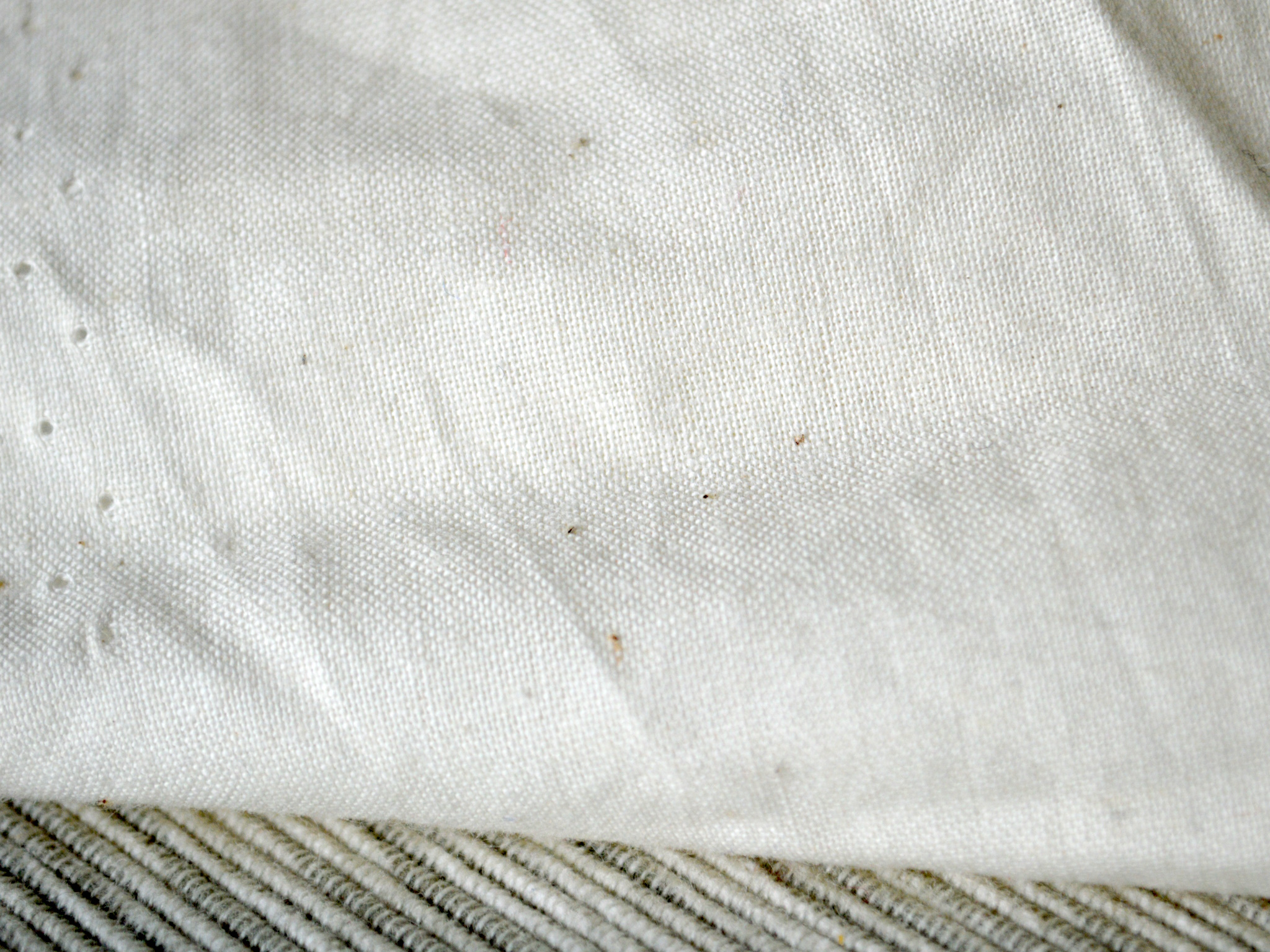
Grading cotton involves multiple attributes (color, purity, fiber length, fineness, strength, etc.) and there are many international standards. Purity, which refers to the amount of stem, leaf, and seed remnants (trash particles) among the fiber, is another important factor. Impurities can be seen as dark spots in the fabric.
Cotton muslin with impurities, photograph by Eppu Jensen
One of the most important factors in cotton grading is fiber length. Extra long varieties are those with fiber length over 35 mm, long 30-35 mm, medium long 15-30 mm, and short 10-20 mm. The fibers’ fineness is in direct relationship to their length: the longer the fiber, the finer it is.
Collecting and Processing Cotton into Useable Forms
The cultivation of cotton takes about 120 days to develop from sowing to harvest. The difference between day and night time temperatures should be as small as possible for optimal yields, and high humidity and strong sun benefit seed growth. Cotton plants are not the easiest of crops, because they are susceptible to pests, molds, and plant and fungal diseases.
Cotton fibers (lints) grow inside a seed pod (boll) mingled with seeds. The seed pod surface is covered by shorter nap-like fibers (fuzz). These days, each seed contains approximately 10,000-20,000 fibers. Once seeds ripen, the bolls open and fibers burst out; the seed pods are then easy to pluck off. For the majority of cotton cultivation’s history, harvesting was slow because it took place by hand.
Once the seed pods have been collected, they need to be dried. Then fibers are pulled from the bolls (ginning), and contaminant plant material is separated from fibers (cleaning). Before the invention of cotton gins in the late 1700s, this was all done by hand. (From c. 400 CE onwards, first in India, the process got a little faster with the help of handheld roller gins.)
In modern processing, the residual fibers after ginning (linters) can be used to make paper and as a raw material for semi-synthetic fibers like rayon, viscose, or modal. Cleaned cotton fibers are graded and baled for transport.
Prior to spinning, cotton is carded like wool to align the fibers. The trace amounts of waxes in cotton help keep the fiber softer and more elastic, which make it easier to spin. In modern processing, the waxes are therefore removed only after spinning.
Cotton is more difficult to spin by hand than wool, since its fibers are short and don’t tend to adhere to each other as readily. Modern hand spinners recommend making a thinner yarn with more twist for a more stable end product and spinning much faster than they normally would.
DYEING PLANT FIBERS
Plant fibers withstand hot dye baths better than wool and silk, but are in general more difficult to dye. There nevertheless exists a long history of dyeing plant fibers. For example, one of the Peñacalera linen fragments mentioned above, dating to approx. 2500-2300 BCE, was exceptionally fine and dyed with cinnabar (a red mineral).
As a rule of thumb, plant fibers require mordanting beforehand, and are a good fit for tannin mordants. The degree of bond and colorfastness (fade-resistance) depend on the fibers and dyes used. Dyeing takes approximately 14 liters of water per 1 kg of linen or cotton yarns.
Undyed, unbleached linen has a yellowish to grayish brown color. Cotton tends to be white, but there are also varieties of pale yellow to brown or reddish hue. Cotton and linen require more dyestuff to achieve deep or vibrant colors, because they dry three values lighter than when wet. (For example, cotton dyed with the same directions as wool will produce a paler and more subdued color.)
TYPICAL USES OF PLANT FIBERS IN CLOTHING
When linen or cotton were first introduced to a new area, they were often reserved for high-status uses such as burial goods or Sunday best. With time and increased imports or the start of local production, the new materials became common enough even for menial purposes.
Since their strength increases when wet, both linen and cotton have long been used in contexts where that is a benefit (e.g. fishing nets and other such utility textiles). Cotton has also been applied for sewing or as a trim. In Iron Age Finland, threads made from linen, hemp, or nettle were used in sewing (e.g. of leather knife sheaths) or as warp for tablet-woven bands. In later periods, too, cotton was used as warp when weaving fabric (e.g. silk or wool) to increase durability. Historically, linen has been long used for underclothes, bed sheets, and table linen.
Under woollen outer clothes, plant fibers can be worn as the layer closest to skin for comfort, but they make poor insulation on their own. Multiple layers trapping air between them do, however, provide some benefit, as does napping the fabric (e.g. flannel), or fluffier or multi-ply yarns.
Plant fibers don’t pill or form an electrostatic charge (static) as readily as wool. They also tend to be fairly heavy and bend or wrinkle easily. (Compare them with paper, which is also made of cellulose.) Linen is stiffer, stronger, and more absorbent than cotton but even less elastic, meaning that wrinkles show very well in it. Linen has excellent heat conductivity, plus—thanks to its stiffness—is less likely to cling to skin, which are desirable qualities in humid or hot circumstances.
Linen tolerates high temperatures especially when wet (i.e., it can be ironed on high heat effectively with steam or through a damp cloth), but prolonged dry high heat will start breaking the fibers down, which happens at 260-320 C. Linen doesn’t handle mechanical stress (rubbing) very well, is susceptible to mildew and is more difficult to bleach than cotton. Linen is also shinier, almost silky, and dries fast. Linen tolerates direct sun better than cotton, and because of the smoothness of the linen fibers, it’s somewhat resistant to dirt. Linen’s poorer capacity to handle rubbing makes it a more challenging choice for utility clothing, but its higher tolerance for heat is often useful.
Scene from the Haithabu (Hedeby) Viking Museum, photograph by Kai-Erik via Flickr (CC BY-NC-ND 2.0)
Cellulose in general is good at retaining moisture, and cotton can hold moisture without feeling wet, which makes it a good fabric to wear next to the skin. However, it’s also relatively inelastic and dries slowly, slower than linen. On the other hand, cotton handles rubbing and bending better than linen.
Cotton also tolerates heat pretty well, although not quite as well as linen: from 120 C upwards the fibers get damaged (reduced strength, yellowing), thermal decomposition starts soon after, and the fibers finally break down at 240 C. Prolonged direct sun can also damage cotton fibers. Cotton burns like paper: it ignites easily, burns fast, and leaves a paper-like ash residue.
Common uses for the softer plant fibers both historically and in pre-historic eras include miscellaneous homewares and garments: wrappings for burials, swaddling and diapers, bandages, underclothes of various forms, tunics and shirts, dresses and skirts, wimples and other headwear.
Underclothes might be made from coarser quality material, since they typically remain unseen, or an underlayer might a combination of two fabrics, the finer being visible while the rougher remaining hidden by overclothes. (Although made from wool, the reconstructed Iron Age Kaarina woman’s underdress from southwestern Finland exhibits this feature.)
How It Happens looks at the inner workings of various creative efforts.
While browsing for cosplay and Halloween inspiration, I’ve seen pictures of some inventive plant outfits, including dandelions and mushrooms. Sheila’s pine cone dress takes the cake, however.
The base layer is a black cotton dress, onto which she added about 300 individually painted felt scales. In addition to the paint job, Sheila stuffed about 200 scales with cotton balls for the skirt portion.
Tremendous, isn’t it? Apparently Sheila didn’t just decide to do a generic pine cone, she selected a pine variety local to her area. That meant sewing a citrine bead (to mimic the thorny bits) to the tip of each scale. That’s committing on an original design!
Animal fibers come most obviously in the shape of various hairs, including wool. Also silk both from spiders and moths is used in various textiles. Feathers and down are sometimes included in animal fibers as well, but since their application tends to be incidental apart from decorative uses or as pillow or blanket fill, we will skip them here. (Sea silk is another rare but intriguing fiber we’ll skip.)
Sheep are probably the most common source for animal fibers for clothing use. Other common sources of animal hairs are goat (e.g. cashmere) and camelids (camel, llama, and alpaca), but even rabbit, cow, pig, or horse hair textiles exist. In Egypt, for example, extant fragments at the Workmen’s Village at Tel el Amarna (dated around 1350 BCE) included among others a small amount of wool textiles and two goat’s hair samples.
This post will first discuss sheep wool and then move on to moth silk.
WOOL
Wool is very common in pre-modern clothing. Sheep are not only easy to keep, they also provide different kinds of useful materials—wool, leather, bone and horn, gut, sinew, etc.—in addition to meat and milk.
Origins of Wool Production
Sheep grow their fleece out year round, and it serves them as insulation against cold, wet, and the hazards of the wild. (Note that fleece was originally just another name for sheep wool or certain woolly textiles; it was only after the introduction of synthetic fibers that polyester fleeces have become a thing).
Sheep were domesticated thousands of years before common era, most probably in multiple locations and/or episodes. The regions where domestication happened have been estimated to range from the Fertile Crescent to a large area from central Turkey to northwest Iran or to the Aralo-Caspian steppe. It looks like sedentary communities were practicing sheep management there already by 10000-8000 BCE. Following 7000 BCE or so, along with other elements of Neolithic life, humans spread domesticated sheep to neighboring regions, including Europe, northern Africa, and central Asia.
A sheep type bred to produce more wool came to Europe from the Near East or southwest Asia, along with the technology for wool processing during the 4th and 3rd millennia BCE. Around the same time, by 4000 BCE or thereabouts, camelids (camel, llama, alpaca, vicuña) were domesticated in the Americas, Africa, and the Arabian Peninsula.
Types of Wool
Modern sheep are the result of millennia of breeding. In the pre-modern world, sheep were smaller, and their wool was lighter in weight and less fine. In some places today there are heirloom breeds similar to sheep of antiquity, such as the North Ronaldsay sheep found today in the Orkney Islands.
Early sheep populations also typically had two wool layers with different qualities. Underwool, i.e. the innermost layer, is softer, as is lambswool. The overhair is longer, more resistant to water, and more hard-wearing. The separate layers have been bred out from many domesticated breeds; wild sheep populations, however, may still exhibit the feature. Wool quality also varies between individual sheep and between the sexes. The finest wool is found around the front shoulder blades and coarsest around the rump and leg areas.
Wild sheep tend to be brown, but Iron Age finds do also include black, grey, and white wool. The development of dyeing made breeding white sheep desireable. Conscious selection seems to have begun by Iron Age at latest, probably already earlier.
Collecting Materials
It’s plausible that when humans were first learning to use wool, it was collected by picking from the environment (and presumably also by removing it from carcasses). Once sheep were domesticated, plucking, combing, or shearing it off living animals became options.
Wool on barbed wire fencing, photograph by Eppu Jensen
Modern sheep are first sheared at about at 8 months of age, and after that, typically every 6 or 12 months, but even up to 4 times a year is possible. A professional can take as little as 2-3 minutes to shear a sheep, but with prehistoric tools the process must have taken much longer.
Simple handmade shears, photograph by Eppu Jensen
Processing Wool into Useable Forms
There are a number of pre-spinning steps that make it easier to turn wool into yarn. After fleece is collected, it needs to be sorted by type and quality. A modern fleece yields 5-7 types of wool. The wool is also washed to remove dirt, lanolin (the natural oil produced by sheep’s skin), and plant and fecal remnants. Depending on the intended use, some grease might be left in to retain its waterproofing qualities in the finished product or to aid spinning, because wool is easier to spin when some of the lanolin remains. Sometimes washing might take place before shearing, or if the sheared fleece was washed, it might be re-oiled.
Cleaned wool is carded or combed (the terms sometimes seem interchangeable) using two combs or brushes to disentangle, straighten, and align the fibers.
Finally, clean carded wool can be spun into yarn ready for weaving, knitting, braiding, or other methods of textile production. Apparently, the earliest twill weaves are associated with wool (not linen), known from Anatolia in the 4th millennium BCE and the Caucasus in the early 3rd millennium BCE. Also the Hallstatt culture in Austria employed woollen twills during their Bronze Age (until approximately 1200-800 BCE) and Early Iron Age (800-400 BCE).
An example of the versatility of twill weave is the eye-catching diamond pattern, found for example in many Viking Age finds from Scandinavia. An early sample of diamond twill is found in the sleeves of the Lendbreen tunic from Norway (estimated to be from 230 to 390 CE).
Diamond twill of the Lendbreen tunic, photograph by Mårten Teigen, Kulturhistorisk Museum via Gudbrandsdølen Dagningen
Common alternatives to spinning yarn and weaving fabric from wool include felting, fulling, or using the fleece as is. Felt is made from interlocked fibers pressed together. Felting is technologically much simpler than weaving; in addition, coarser hairs that don’t spin well might be put to use in felted textiles. Friction and pressure is applied to fibers in conjunction with a wash, i.e., the fibers are somehow agitated or pounded in warm or hot water. (This should be a familiar concept if you’ve ever inadvertently shrunk a wool garment in the washing machine.)
For example, the earliest (2nd millennium BCE) attested textile remains from a cemetery at Qäwrighul in Xinjiang, northwestern China, include woollen samples, almost all of which are either felted or plain weave fabric.
One of the advantages of felt is that it doesn’t fray. Felt can also be dyed and/or embroidered, so a felted textile need not look boring.
Fulling is similar to felting, but it starts with woven wool fabric instead of loose fibers. At Hallstatt, most textiles dating from the Bronze Age are coarse, single-color, and made of thick wool yarn loosely woven using plain weave, with a surface often heavily fulled. Some areas in the world have retained their fulling tradition to modern times, e.g. the waulking in the Outer Hebrides.
Once fibers have been felted or fulled, it’s irreversible; therefore, attention must be paid while processing wool to avoid unintentionally ruining it.
Dyeing Wool
There is evidence of early people taking advantage of natural variations in wool colors to create various kinds of stripes or other motifs. (E.g. the Turfan rider’s pants from ca. 1200-1000 BCE used at least two different natural shades of wool.) Dyeing took that kind of decorative treatment to another level.
In Europe, for example the Bronze Age samples from Hallstatt that date to 1500-1200 BCE show multiple colors (blue, red, purple, yellow, green, brown, black) and variation in both dye selections and shades of wool. The popularity of blue and black shades there is perhaps based on the arresting contrast to the polished and shiny bronze and iron jewellery.
La Tène women’s dress reconstructed at the Musée d’Histoire de Berne in Bern, Switzerland, photograph via Leaellynasaurus at Pinterest
In the Levant, in southern Israel, woollen textile finds dyed red, blue, and yellow are dated to the Late Bronze and Early Iron Ages (13th-11th and 11th-10th centuries BCE), some even accompanied by tassels or beads. By 1000 BCE at the latest, dyeing wool was already so well established in the Tarim basin area (also in Xinjiang, northwestern China) that several finds include multiple colored fabrics, many of them multi-colored—plaids and brightly colored twills, for example, in yellows, blues, and reds.
Before dyeing, wool must be washed thoroughly, because lanolin may prevent the dyestuff from sticking onto the material or the results may become spotty. If using prewashed wool, the material must be wetted thoroughly and evenly for the same reason. Also, for an even color, large enough tubs and plenty of water must be used. A working estimate is to use 40 liters for 1 kg of wool yarn.
Typically, animal fibers absorb color more fully than plant fibers. However, animal fibers cannot tolerate extreme or sudden changes in temperature. Cool to cool-ish water must be used. If heating of the dye bath is desired, it must be done slowly, and care must be taken not just with temperature—keeping it below boiling—but also with stirring, squeezing, or rubbing for example while moving the material between containers, lest the wool felt.
A reconstruction of an Iron Age natural dye bath using birch leaves in a wooden trough heated with hot stones, photograph by Mervi Pasanen
Another detail to watch out when dyeing wool is that using the same dye batch on wools of different colors (white, off-white, grey, brown) results in different shades. Also, different types of wool may not take color the same way, nor (if they were added during spinning) will any so-called effect fibers from other animal species. As always when dyeing for a project, it’s advisable to dye all of the material at the same time.
Apart from the threat of felting, it is easier to achieve initial success when dyeing wool with natural materials than when dyeing plant-based fibers. However, stronger colors or certain more intense shades require overdyeing or multiple baths with different dyestuffs. For example, many Bronze Age and Iron Age textiles from Hallstatt show evidence of being dyed at least twice.
Regarding mordants or assists, also to note is that many plant-based ones tend to produce yellowy tones in wool, and that iron can easily make the texture rough and brittle. However, if urea was used for mordanting, the dyed product has to be washed and/or aired extensively to get rid of the strong smell. (And it still might not be enough, I understand.)
Typical Uses of Wool in Clothing
Due to its versatility and relatively easy production cycle, wool is an extremely common material. It’s probably true that if you can name an article of clothing, it’s been made from wool somewhere at some point.
Crown Prince Sir Gerhardt, an SCA character, in a reconstructed viking outfit, photograph by Jonas Evertsson via Flickr (CC BY-NC-ND 2.0)
Especially the coarser types of wool can feel rough against the skin. In many pre-modern cool clime grave finds (e.g. the Danish Huldremose woman from 2nd century BCE), there are remnants of plant fibers (linen, nettle, cotton, or the like) underneath wool remnants, so it looks like contemporary humans aren’t the only ones to prefer a softer layer next to their skin. Apart from the rough texture, wool is also susceptible to moths and carpet beetles, and direct sunlight will eventually damage the fibers.
Wool does make an excellent overlayer, though, because it’s warm even when wet. However, it doesn’t tolerate mechanical stress well, i.e., wool shrinks and felts easily. Depending on the processing methods used, wool can also resist water to some extent. This characteristic can be taken advantage of: for instance, when the grease is left partially in, when the fibers are felted, or when the fabric is fulled, the surface of the textile sheds droplets easily.
Water drops on felt, photograph by Eppu Jensen
There are other features that make wool a good material for pre-modern contexts. The excellent insulation and absorbtion capabilities of wool makes it useful in warm to hot climates as well as cool ones. It’s a solid choice for utility textiles, too, because there’s a certain amount of elasticity in wool, which can help with the longevity and adjustability of wool items. Wool doesn’t wrinkle or ignite as easily and burns less well than plant fibers. Unfelted it also absorbs water (or other liquids such as sweat or urine) quite well. In addition, wool is relatively light and muffles sound. Wool has also been used e.g. as a wrapping for the deceased, and articles of clothing that have reached the end of their useful life have been repurposed as utility textiles such as sacks, bandaging, various kinds of wipes, or diapers or swaddling clothes.
Baby Blue, a 3800-year old mummy from Tarim basin, Xinjiang, China, wrapped in a rust red wool shroud and wearing a fluffy blue bonnet, photograph by elaine via Flickr (CC BY-NC-ND 2.0)
SILK
Like wool, moth silk is an animal protein. The cultivation of silk (silk farming) is called sericulture.
Origins of Silk Production
Silk was certainly known for millennia prior to its appearance in historical records. For example, from Jiahu, Henan province, central China, there is biomolecular evidence of silk fibroin (a silk protein) found along with rough weaving tools and bone needles in tombs dated to ca. 6500 BCE. From the neighboring provice of Shanxi, from a Yangshao culture site, comes a find of cut silk cocoons dating back to between 5000 and 3000 BCE.
The earliest woven silk fabrics may have been used as wrappings of bodies for burial (two such samples from Henan province are dated to about 5000 to 3000 BCE). Other early scraps, including a remnant of a tabby weave from a Liangzu neolithic site in the Zhejiang province in southern China, date back to approximately 2750-2700 BCE.
By the Shang dynasty, 1600 to 1050 BCE or so, the domestication process had become highly developed, and silk weaving had achieved a very high level of quality. It is then we also find the earliest written records of silk (some oracle bone inscriptions) in China.
For a long time, from around 114 BCE to 1450s CE, the Silk Road—or Silk Routes—were the main network for cultivated silk trade between Asia and the Middle East, East Africa, and Europe. However, there were contacts even before that, for silk was found for instance in Egypt in a twenty-first dynasty mummy’s hair (1077 BCE to 943 BCE) and in a Ptolemaic-date (305 to 30 BCE) wollen tunic with decorative stripes with a weft of white silk. Around the same time, about 300-250 BCE, silk is encountered in Pazyryk in the Altai Mountains.
It is also possible that sericulture was developed independently and roughly concurrently in India. There is some evidence of processed silk fibers dating to about 2450-2000 BCE from Harappa and Chanhu-daro, two important Indus Valley civilization sites.
Types of Silk
The basic divisions of silk types are according to species of moths producing it, and according to fiber length and coarseness.
The domesticated silkworm or mulberry silkworm, Bombyx mori, is derived from a species native to northern India (Assam and Bengal) known as Bombyx mandarina Moore. These days most cultivated silk comes from Bombyx mori. The color of silk they produce ranges from white to cream white.
Tussah silk is a term for wild silk from Asia. Several species are commercially viable, for example some Antheraea or Saturniidae species, whose silk is sometimes referred to by geographical area (Chinese tussah, Indian tussah, etc.). Its texture is a little coarser and color darker than Bombyx Mori silk, from light to dark honey and beige, some even greenish or greyish.
There is also a species from another family of moths and butterflies, the Lasiocampidae Pachypasa otus, which produces a workable silk. Its present range is in the Mediterranean, and they were quite probably the source of the so-called silks of Cos of 5th century BCE Greece. For example, Aristotle (Historia Animalium 5.97.6 = 551b) describes the life cycle of a wild silk moth associated with Cos. Pliny the Elder (Natural History 11.76) describes a Syrian moth, which may be the same as the Coan one.
Silk is the only biological fiber that comes in long, continuous strands or filaments. (Some synthetic fibers, for example polyester and nylon, are also produced in filaments.) The kinds of domesticated silk fibers that are too short for regular processing are called waste silk. Wild silk is by default collected in smaller stretches, because the moth is allowed to emerge and break the cocoon. Both types of shorter silks can nevertheless be combed and spun.
(Rugs and other utility textiles are a good use for lesser-quality silks. Silk pile carpets are often exceptionally fine. For instance, the Baharestan Carpet was an enormous Sassanian work of art woven of silk, gold, silver, and rare stones. Kilims, on the other hand, could be put to work not just as rugs, but as wall art or other hangings, tablecloths, bedspreads, bags, or upholstery. )
Another division is between raw and processed silk. Technically, raw silk is any unprocessed form of silk that retains sericin, whether in unspun, yarn, or fabric state, but popularily the term is now often used to refer to raw silk fabric. Modern silks are classified to different grades according to quality, with A being the finest and F the poorest, with grades not eligible to rank below that.
Collecting Materials
Bombyx mori reproduce several times a year. Already by the Song dynasty, about 960-1270 CE, there were two or three annual silkworm harvests, but prized varieties could produce as many as eight generations in a single year.
After the Bombyx mori larvae hatch, they’re fed for about a month until they start spinning. Over two or three days, the silkworm secretes one continuous, fine fiber filament, approximately 300-800 m per cocoon.
After about 10 days from being finished, the cocoons are harvested, and hot air or steam is used to kill the pupae before they emerge as moths.
Wild silk moths are allowed to emerge and break the cocoon, which shortens the length of silk fibers collected.
Processing Silk into Useable Forms
Silk is a polymer composed of two types of proteins, sericin and fibroin. Fibroin is the structural center of the silk. Sericin is a gluey or gummy outer coating, and if it is removed, the fiber becomes easier to use. The process of de-gumming Bombyx mori silk by boiling or immersing in warm water developed at some point between 2500-2000 BCE.
Raw silk still contains some sericin; its presence makes wild silk a bit stronger than cultivated silk, but also heavier; therefore, raw silk fabric tends to have a more uneven, nubby, almost linen-like texture.
After the cocoons are de-gummed, filaments are stroked with a brush, chopstick, or fingers and collected onto reels. Long stretches of intact filament are unwound from cocoons (reeling) and twisted together (throwing) into multi-strand thread or yarn.
Some pieces of the cocoon are broken while harvesting and processing. For example, the coarse outside layers of cocoons, pierced cocoons (from moths allowed to hatch to lay eggs), or the leftovers remaining after reeling can be combed and spun for silk of lesser quality.
Silk is easy to spin because of its long fibers—the worm has a lot of the work already. Modern handspinners typically recommend fast and lightweight spindles and a lot of twist, especially for yarns meant for warp. Silk makes a high-grade yarn both smooth and strong with regard to its thinness, and it blends extremely well with other fibers.
However, silk fibers will catch easily on dry or rough spots on hands or nails, so using hand lotion or exfoliants (scrubs) is recommended for smooth spinning. Some spinner-suggested natural ingredients for skin softeners include olive oil, sugar, lemon juice, and sesame milk. Most of these would also have been available in prehistoric eras (depending on geography, of course).
It is difficult to find information on pre-industrial spinning speeds for silk. Presumably silk is about as speedy to spin by hand as wool. During the early years of the Warring States period (475-221 BCE), the so-called spindle wheel was developed. Although not a true spinning wheel as we know it, this device, where the spindle was driven by a belt (drive band), mechanized the reeling and throwing stages and helped to increase productivity by about three times.
Dyeing Silk
Silk has excellent dyeing properties, and early surving silk samples show evidence of dye work. By the latter half of the first millennium BCE at latest, there are dyed fabrics with detailed woven patterns or embroidery. (The collection at The Metropolitan Museum of Art even includes a 2nd century BCE fabric fragment with stencil printing and hand coloring.)
Silk hand dyed with madder pre-mordanted with alum, photograph by Madelinetosh via Flickr (CC BY-NC-ND 2.0)
A male mummy found at a site in Yingpan, Xinjiang, northwestern China, and widely referred to as the Yingpan Man, dated to 266 to 420 CE, was accompanied by a host of stunning, high-grade wool and silk textiles, many of them ornately woven in what must’ve originally been vivid colors. Among those colors were yellow and green silks, plus red and brown both in silk and wool.
Some of the trappings of Yingpan Man, 3rd-4th century CE, photograph by elaine via Flickr (CC BY-NC-ND 2.0)
(Incidentally, the roots, bark, leaves, and berries of many mulberry cultivars can be used not just to feed the silkworms but also as natural dyes, which sounds very helpful for the early development of sericulture.)
Like wool, silk cannot tolerate extreme or sudden changes in temperature. It starts decomposing at about 170 degrees C. In dyeing, temperatures higher than 80 degrees C or so should be used with care, and only up to 140 degrees C at maximum. Silk requires more dyestuff to achieve deep or vibrant colors, because it dries two values lighter than when wet.
Typical Uses of Silk in Clothing
Silk is more heat-resistant than wool, but not impervious to fire. (Interestingly, the smell of burnt silk is similar to that of burnt hair.) Silk deteriorates with time, especially if sweaty or in sunlight, and might attract insects, especially if dirty. It’s also weaker when wet, tolerates strong detergents badly, and is susceptible to static cling in dry conditions.
On the other hand, silk is fine but strong for its delicacy, one of the strongest natural fibers. It has less elasticity than wool but more than cotton, which means that silk is elastic enough to be somewhat wrinkle-resistant. It absorbs moisture well—silk can absorb 30 % of its weight in liquid without feeling wet—and is a good insulator. Silk is also lightweight, soft, and shimmery.
Blue silk satin and grey cotton satin, photograph by Eppu Jensen
Silk is a very versatile fiber mostly used for luxury fabrics both historically and now. (From my own experience I can say that silk satin is especially lovely and lustrous.) It’s been sewn into tunics, gowns, belts, mittens, socks, pillows, pouches, sachets, and wrapped as burial shrouds, among other uses. High-status uses include ecclesiastical vestments like the papal pallia.
Weaving a tablet-woven band in silk and silver based on the finds from a Hvilehøj woman’s grave (dated to the 900s CE) in Jutland, Denmark, photograph Ariadne Kordélla via Historical Museum, University of Oslo
Alternatively, silk was often used in embellishings such as ribbons, bands, or embroidery along with other fibers, even thin gold or silver thread. (An example is the Parthian remnant of a cotton-lined felt garment, likely for a child, with blue silk cord closure, from ca. first half of the 1st century BCE, currently held at The Metropolitan Museum of Art.) These were easy, relatively inexpensive ways to introduce some indulgence into your wardrobe.
How It Happens looks at the inner workings of various creative efforts.






 Co-Geeking

