Living Vicariously Through Social Media: 60 Seconds of Mars

While aimlessly browsing social media, I stumbled upon a 60-second video clip from Mars. Below’s a screencap, since I was unable to find a video to embed:

Twitter NASA360 60 Seconds of Mars

(Sorry for not including more details of the area; the NASA Twitter account didn’t provide any, and I can’t find a corresponding video on their YouTube account or website, either. Perhaps it’s from Curiosity?)

Isn’t it amazing, when you think about it, that we as a species have not only sent multiple vehicles to space, but our technology is good enough that we have high-definition photography from the surface of our neighboring planet that we can just casually scroll through. And not just Mars, but the outer solar system as well.

(This video of Cassini’s grand finale at Saturn seems to have been computer-generated on the basis of Cassini photos, so not really qualify for the high-def photography category, but it’s very pretty nevertheless.)

Not bad for ugly bags of mostly water, eh? It is a very good time to be a space geek. 🙂

Found via NASA 360 on Twitter.

Out There is an occasional feature highlighting intriguing art, spaces, places, phenomena, flora, and fauna.

Superheroes and Fascism

There’s an idea that sometimes raises its head in pop culture discussions that superheroes are fundamentally fascist. (Here’s a version of the argument from a few years back, some pushback from the time, and some more recent reflections on the same idea.) The essential argument is that superheroes are a version of the might-makes-right ideology of fascism, grounded in the idea that the only way to solve problem is to look to a single, nearly (or actually) superhuman individual who reshapes the world, often with violence. Superhero stories portray a world incapable of coping with injustice without the intervention of such a superior individual, which is the same claim made by fascist movements, whether past or present. Others have objected to this idea, pointing out that while fascists seek power, superheroes traditionally reject it, many of them even hiding behind secret identities to avoid even taking credit for the good they do.

As with many challenging ideas, there may be some merit in both sides of the argument, but I think it helps us make sense of the debate to look at it from a greater distance and think about both superheroes and fascism in the deeper context they both draw on: heroes. I’ll speak specifically about the heroes of Greek mythology—in part because they are the ones I know best, and in part because they were particular points of reference both for the fascist movements of the twentieth century and for the creators of early superheroes—but similar patterns can be found in cultures throughout the world.

Heroes in ancient Greece were not just figures of myth and story; they were surrounded with religious, cultural, and political significance. Their significance varied, though, with time and context.

Some of the earliest signs of the veneration of heroes is archaeological. In the 800s and 700s BCE, there is evidence for religious rituals at tombs dating from the Mycenaean period hundreds of years earlier. The people of the ninth and eight centuries had very little understanding of the realities of the Mycenaean kingdoms, but they seem to have associated those tombs with heroic figures from their mythic past. These characters first appear to us in literary form in the Homeric epics as warrior kings like Achilles, Agamemnon, and Odysseus, but their legends must have been circulating in oral tradition for generations before.

In the eighth century, these heroes were claimed as literal, direct ancestors by aristocratic families around Greece. These families maintained the ceremonies at the Mycenaean tombs and sponsored the poets who performed epics like the Iliad and Odyssey. The claims they made to descent from such famous heroes were political, part of how they competed for power against rival families. The epics reflect the way in which heroes were perceived as the exclusive property of the aristocrats—when the rank-and-file soldier Thersites dares speak up against Agamemnon in the Iliad, the hero Odysseus gives him a dressing down for daring to challenge his betters and threatens to strip him naked and beat him with Agamemnon’s scepter. When Odysseus returns home to Ithaca, he comes home not as a leader of the whole community but as an avenging warlord defending his own property against rivals. (Homer, Iliad 2.212-277; Homer, Odyssey 22)

But heroes did not remain the sole property of the aristocrats. In the volatile politics of the seventh and sixth centuries, those who agitated to wrest power from the entrenched aristocrats and create more inclusive democratic governments also laid claim to the heroes. Figures of myth were reinterpreted not as the literal ancestors of specific families but as part of the shared heritage of whole communities. Some heroes were claimed by cities in the regions they were historically connected to, such as Theseus in Athens or Orestes in Sparta. Other heroes, like Heracles, were more wide-ranging, and could be invoked by the Greeks who traveled and settled throughout the Mediterranean.

The process of making these heroes the collective heritage of a community rather than the exclusive property of aristocratic families had many aspects. Unlike the private tomb cults of the ninth and eighth centuries, heroes and their worship became part of communal religious practices, including public shrines and festivals. The stories of heroes were reimagined; unlike the Homeric heroes, who behaved as larger-than-life aristocrats defending their own private interests, heroes of the later archaic and classical periods were defenders of their homelands and peoples who stood for justice. Theseus, for instance, is portrayed unifying the people of Athens by journeying through Attica and around nearby coastlands slaying dangerous monsters and subduing bandits and murderers—a long way from Odysseus slaughtering his wife’s suitors to defend his own home and property. Heroes were often physically incorporated into the life of the community through the practice of collecting and preserving what were believed to be their bones. Herodotus recounts how the Spartans brought the bones of Orestes back to Sparta from neighboring Tegea to give them victory in war and how Greek preparations for the naval battle against the invading Persians at Salamis included sending a ship to the island of Aegina to retrieve sacred images of the hero Aeacus and his equally heroic sons. These relics belonged to whole communities, not to single families. By these means, the exclusive, aristocratic heroes of early Greece became the collective, democratic heroes of the classical age. (Herodotus, Histories 1.67-68, 8.64, 8.84; Plutarch, Parallel Lives, “Life of Theseus”)

The tension between these two kinds of heroes—the exclusive ones who justify the power of a narrow elite and the inclusive ones who stand for the best qualities of a whole community—is not unique to ancient Greece. We can see it repeated in cultures throughout history up to the present day. The “heroes” involved need not be figures of myth and legend, either; historical figures, celebrities, and political leaders can receive the same treatment as well.

Fascism and superheroes both draw on this history, but they apply different aspects of it. Fascism looks back to the exclusive, aristocratic kind of heroism that claimed a connection with great figures of myth and history to justify the power of a limited group, whether defined by class, ethnicity, family, or political affiliation. Fascist leaders of the twentieth century claimed the heritage of a semi-historical, semi-mythical past as an exclusive property of their followers. Modern quasi-fascistic movements have a similar obsession with jealously gatekeeping their own chosen semi-historical models, from the inhabitants of medieval Europe to the Founders of the United States.

Superheroes, by contrast, represent the inclusive, democratic response that makes heroes represent not the interests of a self-defined elite but the aspirations of a broad community. Superman is the immigrant experience in the US writ large. Captain America stands for the courage and integrity of Americans at their best, while Iron Man represents Americans rising to do the right thing despite the arrogance and materialism that defines them at their worst. The “friendly neighborhood Spider-Man” is the neighborhood Spider-Man for a reason.

So my answer, in the end, is: no, superheroes aren’t fascist, even if they draw on some of the same roots. Fascism is the modern world’s darkest kind of heroism; superheroes are our answer.

Image: A version of Captain America’s shield, photograph by ze_bear via Flickr (CC BY-SA 2.0)

History for Writers looks at how history can be a fiction writer’s most useful tool. From worldbuilding to dialogue, history helps you write.

Bounceback Boys Parkour Their Way Through Wintry Helsinki

Parkour! In Helsinki! In the winter! Jumping into mounds of snow!

HELSINKI WINTER TAKEOVER (PARKOUR) by Bounceback Boys on YouTube

Wow! Lots of impressive stunts here; I admire the Bounceback Boys’ skill. (My fear of heights, however, would like a word with the young men… LOL!)

Found via Helsingin Sanomat. (NB. Finnish only.)

Hey, look! We found a thing on the internet! We thought it was cool, and wanted to share it with you.

Ancient Egyptians Knew How to Party

Here’s how the ancient Greek traveler and historian Herodotus describes the festivities surrounding a great festival held every year in honor of the goddess Bast, popular with both native Egyptians and foreign residents like Greek mercenaries and traders:

When they celebrate the festival in Bubastis, they do these things. Men and women sail there together, huge numbers of them in every boat. Some of the women shake rattles and some play flutes the whole way there; the rest sing and clap their hands. Whenever they sail by a city, they put in to shore and do the following: some of the women keep doing what I described, some call out tauntingly at the women in the city, some dance, and some stand up and hoist up their dresses. They do this at every city along the river.

– Herodotus, Histories 2.60

(My own translation)

Now, Herodotus was an outsider describing customs he didn’t entirely understand, and he certainly got some of his facts wrong. Still, many of the details he recounts of daily life in Egypt seem to have come from his own observations, and more than a few hold up on comparison with Egyptian literature and art. In any case it sure sounds like the ancient Egyptians knew how to have a good time!

Serving exactly what it sounds like, the Quotes feature excerpts other people’s thoughts.

The Valley of the Whales

In the western desert of Egypt is a valley known as Wadi al-Hitan. Like some of the other famous valleys in Egypt, such as the Valley of the Kings and the Valley of the Queens, this valley is a kind of graveyard, but this one is for whales. Not that people buried whales here; rather, the desert preserves the fossils of a wide variety of sea life from millions of years ago, when this region was under a shallow sea. Among the most striking and important fossils at the site are the remains of several different species showing different stages of the evolution of ancient land mammals into the whales we know today.

Wadi al-Hitan is today preserved as a UNESCO site in recognition of both its stark natural beauty and its paleontological significance.

Images: An excavated fossil skeleton of a prehistoric whale, photograph by AhmedMosaad via Wikimedia. Spine and skull of a Dorudon atrox, photograph by Christoph Rohner via Wikimedia. Vertebrae on the desert sands, photograph by Jolybook via Wikimedia.

Out There is an occasional feature highlighting intriguing art, spaces, places, phenomena, flora, and fauna.

Daisugi Allows Log Harvesting without Killing the Tree

Daisugi is a forestry management technique reminiscent of pollarding and bonsai that produces straight logs without killing the tree. Developed some 600-500 years ago in Japan, it’s still being used to harvest sustainable, durable logs.

Basically, some of the top shoots are pruned so that they’ll grow straight up, and the shoots only are collected when they reach the desired height. It’s not a fast method, as it takes decades to be able to produce logs, but reportedly they come out stronger, more flexible, and knot-free. And the tree stays alive.

Also, the daisugi-managed cedars make amazing shapes in the woods! They would be so interesting in a speculative or fantasy story—or any story, really. Below are a few examples.

Spoon Tamago Yusuke Narita Long Shot
Spoon Tamago Ai Hirakawa Daisugi in Fall
Wikipedia Bernard Gagnon Ryoan-ji Garden

Just another example of how ingenious we people are in manipulating our environment. 🙂

Found via Good Stuff Happened Today on Tumblr.

Images: Long shot by Yusuke Narita via Spoon & Tamago. In the fall by Ai Hirakawa via Spoon & Tamago. Ryoan-ji garden, Kyoto, Japan by Bernard Gagnon via Wikipedia (CC BY-SA 3.0).

In Live and Active Cultures we talk about cultures and cultural differences.

Hoplites, the Chigi Vase, and the Problems of Artistic Sources

Art can be a priceless source of evidence for early history, especially for areas and periods with limited surviving written sources, but, just like texts, artistic sources can be tricky to interpret.

Chigi Vase, reconstructed frieze via Wikimedia (7th c. BCE; painted pottery)

Take, for example, this scene from an archaic Greek vase (commonly known as the Chigi Vase, named for one of its modern owners). It provides us with some of our earliest evidence for Greek hoplites and the phalanx formation. Although we understand a lot about the essentials of how hoplite warfare worked, many questions remain unanswered about the precise details of both how a hoplite battle was fought and how the hoplite style of warfare developed over time. Arguments about these topics often depend in part on interpretations of the Chigi vase.

The vase depicts warriors arming themselves and marching into battle as hoplites. Many of the characteristic features of hoplite armament and warfare are on display: heavily armored fighters with large round shields and spears confronting one another in a head-on clash. We can date the creation of this vase to the seventh century BCE, around the same time that the hoplite style of warfare first appeared, so this artwork offers us crucial evidence about what the earliest phase of hoplite warfare looked like and how early some of its defining features emerged.

We can be fairly confident that the artist who painted the decorations on this vase was familiar with the realities of hoplite warfare. The ranks of the phalanx were filled by small farmers and prosperous crafters, including potters and artists. If the painter of this vase was not well-off enough to have fought as a hoplite themselves, they would certainly have known people who had. At the same time, the images are also artistically stylized in ways that make it hard to be sure how much we can rely on them as evidence.

For example, all the warriors shown on this vase are similarly equipped: they have the helmets, breastplates, greaves, and round shields that we think of as the standard parts of the hoplite panoply. Is this vase evidence that hoplite equipment was standardized from an early period, or did the artist depict a standard set of armor to create a pleasing image at a time when real hoplite gear was more of a hodge-podge with individuals equipping themselves as best they could? This question goes to more than matters of artistic taste: one of the most vexed questions in the history of the hoplite phalanx is whether it developed gradually out of older, less rigorously organized styles of warfare or it was created as a fully-realized concept in some particular place and time. Because hoplite warfare was connected with the rise and subsequent fall of early Greek tyrants, understanding the origins of the hoplite phalanx better would have implications for our understanding of major developments in political and social history. Knowing what the Chigi vase painter had in mind would tell us some important things about the early history of ancient Greece.

Out There is an occasional feature highlighting intriguing art, spaces, places, phenomena, flora, and fauna.

MacramĂ© Inspiration Photos for Speculative Writers

There are times when my expertise and interests affect my response to the stories I consume. (I’m pretty sure I’m not the only one.) Lately I’ve been noticing the presence or absence of textiles in my media, and how those textiles came to be.

I’m using macramĂ© as an example of a technique that’s not getting much attention—in fact, I’m not sure I’ve ever seen a story using macramĂ© even as a background element—despite its versatility.

For example, in a fantasy world, you don’t always have to have woven or embroidered wall hangings decorating the lord’s hall. You could also have a ginormous macramĂ© room divider like “Ocean”, below, by Bali-based fiber artist Agnes Hansella:

Colossal Agnes Hansella Ocean

Apart from being refreshingly non-Eurocentric (if we consider the earliest records of macramĂ©-style knots coming from Babylonian and Assyrian carvings), large-scale macramĂ© works obviously require a high level of skill to complete, which makes them a perfect option for displaying a character’s wealth and social capital.

And even in smaller sizes, macramé can come in intricate shapes that in no way resemble the 1970s handiwork that may stereotypically come to mind (plant hangers, wall hangings, or cute but perhaps not entirely flawless friendship bracelets).

Etsy TBiaDesign Macrame Wall Shelf

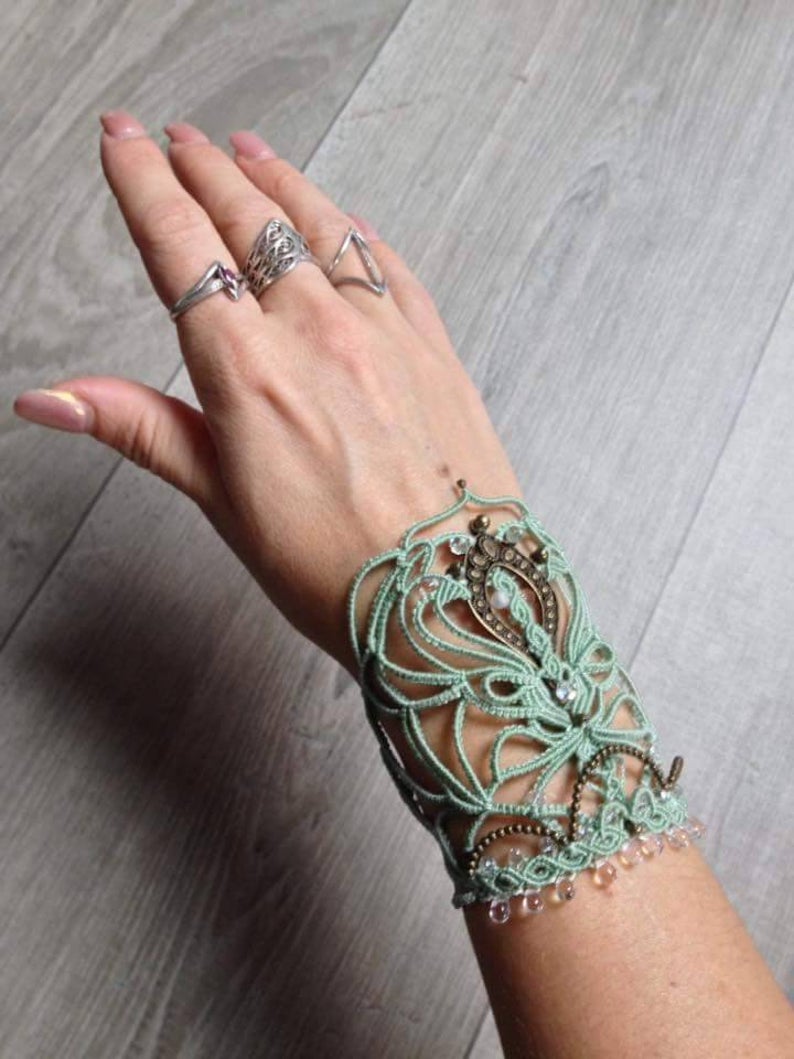
Speaking of small, when writing this blog post I leared that some people make micro macramé, where the working yarn or cord is quite thin. The result is almost lace-like:

Etsy AmeEtTiss Macrame Fillory Cuff

You can make an almost endless range of items with macramé. If you can make cording (like bracelets), you can make anything used for supporting, holding, or edging, for instance like belts, suspenders, bands, animal harnesses (think of ceremonial processions etc.), pulls, straps, or decorative edges.

Macramé also does not need to be made from only unbleached or single color cord; on the contrary, colorful combinations can be quite eye-catching:

Etsy Toni Lasee kitdesignsbykith Green Macrame Belt

If you can make flat surfaces (like wall hangings), you can create items that could also be made from fabric, like table runners, curtains, cushion covers, pouches, or bags.

Pinterest Blue Macrame Bag

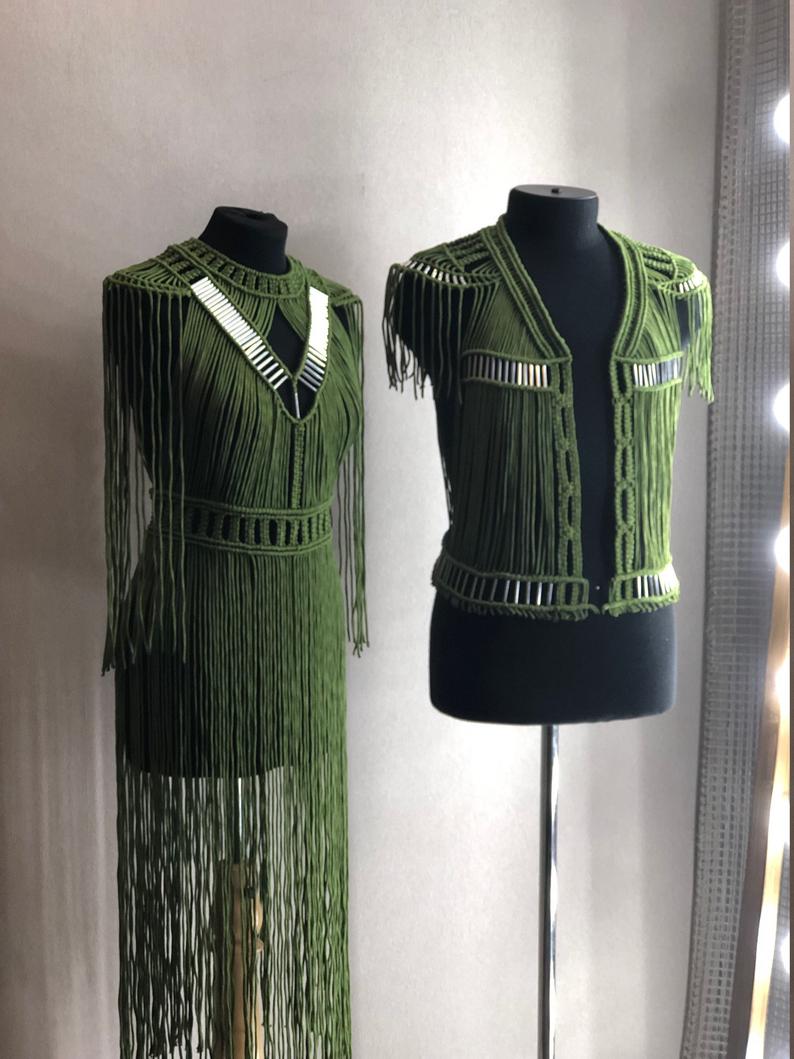
I could also imagine a macramé-style outer garment worn over fabric clothes looking fantastic. Indeed, someone else has had that very thought—check out these outfits promoted as Coachella or Burning Man costumes:

Etsy SeyanaStyle Macrame Vest and Dress

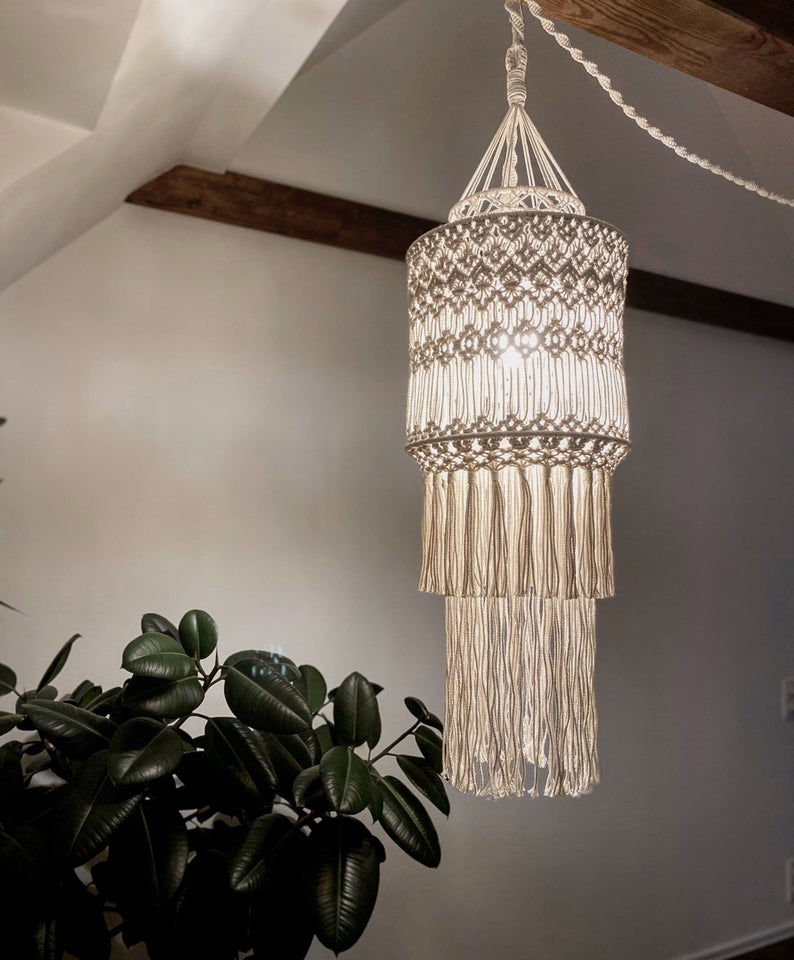
Depending on the type of cord, you could even make more utilitarian household items like chair seats, hammocks, lampshades, or baskets.

Etsy CraftingMode Big Macrame Basket Birch Green
Etsy Irina Kharebava Macrame Lamp Shade

As with all creative work, the maker’s skill and imagination are the limit.

Images: Agnes Hansella via Colossal. Wall shelf by TBiaDesign on Etsy. Lacy cuff by AmeEtTiss on Etsy. Green belt by Toni Lasee at kitdesignsbykith on Etsy. Blue bag with macramé strap via Pinterest. Macrame vests by SeyanaStyle on Etsy. Rectangular basket by Phing Chutima at CraftingMode on Etsy. Lamp shade by Irina Kharebava on Etsy.

Out There is an occasional feature highlighting intriguing art, spaces, places, phenomena, flora, and fauna.

Beautiful Reconstructions of Mesoamerican Cities

Here are some beautiful computer reconstructions of important archaeological sites in Mesoamerica.

Tenochtitlán, Mexico, by Advestudios

Pueblo Bonito, Chaco Canyon, US, by Advestudios


Advestudios, which produced these images, also creates videos and 360 vistas. Their work is wonderful for helping to picture these sites as living, functioning cities and settlements.

Hey, look! We found a thing on the internet! We thought it was cool, and wanted to share it with you.


Rating: Deep Space Nine, Season 6

The Dominion war heats up, taking the characters of Star Trek: Deep Space Nine in lots of new directions, some more interesting than others. Here’s our take on what season 6 has to offer.

  1. “A Time to Stand” – 6
  2. “Rocks and Shoals” – 7
  3. “Sons and Daughters” – 0
  4. “Behind the Lines” – 3.5
  5. “Favor the Bold” – 5
  6. “Sacrifice of Angels” – 6
  7. “You Are Cordially Invited” – 8.5
  8. “Resurrection” – 2
  9. “Statistical Probabilities” – 4
  10. “The Magnificent Ferengi” – 8.5
  11. “Waltz” – 3
  12. “Who Mourns for Morn?” – 7.5
  13. “Far Beyond the Stars” – 8
  14. “One Little Ship” – 9
  15. “Honor Among Thieves” – 0
  16. “Change of Heart” – 4
  17. “Wrongs Darker than Death or Night” – 0
  18. “Inquisition” – 2
  19. “In the Pale Moonlight” – 7
  20. “His Way” – 1
  21. “The Reckoning” – 4
  22. “Valiant” – 2
  23. “Profit and Lace” – 2
  24. “Time’s Orphan” – 6
  25. “The Sound of Her Voice” – 4
  26. “Tears of the Prophets” – 5.5

This season’s ratings are all over the place. There are a number of strong episodes in the 7-9 range, but also multiple 0s. The average comes to 4.4, in line with season 5 and a bit less than seasons 3 and 4. It seems a bit unfair to average out this season’s episodes, though, because there are so many different things going on. The Dominion war storyline runs through the season and provides a lot of solid episodes. There are also big moments of character development, some good—Worf and Dax getting married in “You are Coridally Invited”, everyone’s favorite barfly getting a backstory in “Who Mourns for Morn?”—some less good—Kira doing a reverse Back to the Future on her mother and Gul Dukat in “Wrongs Darker than Death or Night,” Quark learning what it’s like to be a feeeemale in “Profit and Lace”. Then there are some episodes that just come out of nowhere, like Sisko having a vision of twentieth century science fiction and racism in “Far Beyond the Stars.”

At the bottom end of the scale, we have a trifecta of absolute 0s. There’s “Sons and Daughters,” in which Worf’s son Alexander and Dukat’s daughter Ziyal both get to have strained relationships with their respective fathers. There’s “Honor Among Thieves,” in which O’Brien inexplicably has an undercover mission infiltrating a seedy crime syndicate, an episode with no good reason to exist, let alone be in this series. And there’s the aforementioned “Wrongs Darker than Death or Night,” a limp episode for such a pretentious title that is both overly contrived and weightless at the same time. I’ve mentioned before that it sometimes feels like there was a frustrated noir writer in the writers’ room, and they have their fingerprints on this season as well. “Honor Among Thieves” is straight-up noir, and “Wrongs Darker than Death or Night” leans hard in the same direction. It’s as uninterseting now as it was before.

But this season also has some great episodes at the other end of the scale. The best of the season is “One Little Ship,” at 9, in which a miniaturized Dax, Bashir, and O’Brien in a miniaturized runabout help rescue the Defiant from being captured by the Jem’Hadar. It’s a fun episode that gives all the characters something to do and nicely balances the silliness of its main conceit with the seriousness of the ongoing war plot. Two more episodes that also strike a good balance between goofiness and gravity are “You Are Cordially Invited” and “The Magnificent Ferengi,” both at 8.5. In “You Are Cordially Invited,” the weighty question of whether Worf and Dax can make it as a couple despite their differences is interwoven with Klingon wedding rituals that are as gloriously over the top as you would imagine. “The Magnificent Ferengi” finds Quark, Rom, Nog, and some of our other favorite Ferengi mounting a rescue operation when their Moogie is captured by the Dominion, and it goes both hopelessly wrong and delightfully right.

For all that Deep Space Nine is remembered as the dark, gritty version of Star Trek, filled with tension and war, it has also given us some of the goofiest, most wonderfully weird episodes of the franchise.

Image: Little O’Brien and Little Dax contemplate big problems on the Defiant, from “One Little Ship” via IMDb

In the Seen on Screen occasional feature, we discuss movies and television shows of interest.