Dining in Middle Earth: Of Herbs and Stewed Rabbit

“’I’ve got a bit of a stew for you, and some broth, Mr. Frodo. Do you good. You’ll have to sup it in your mug; or straight from the pan, when it’s cooled a bit. I haven’t brought no bowls, nor nothing proper.’

“Sam and his master sat just within the fern-brake and ate their stew from the pans, sharing the old fork and spoon. They allowed themselves half a piece of the Elvish waybread each.”


LotR Dinner7

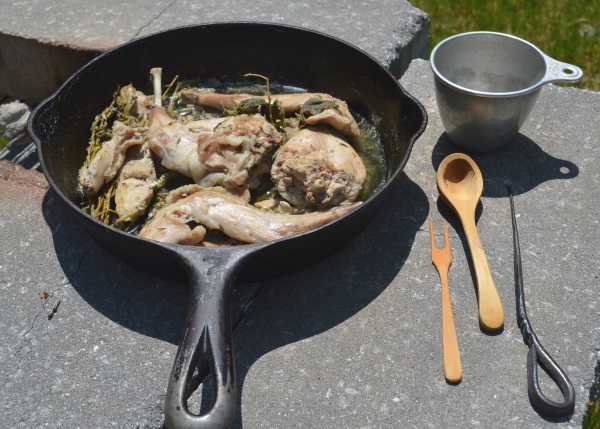
The simplest and most famous of all meals in The Lord of the Rings is without doubt the rabbit stew cooked in the wilds of Ithilien by Sam Gamgee. This is the closest Tolkien comes to giving us a recipe and we have done our best to honor both Tolkien’s words and the simplicity of the scene he evokes. This month we have a simple rabbit stew cooked on a fire outdoors and accompanied by our version of lembas bread.

LotR Dinner7 Stew

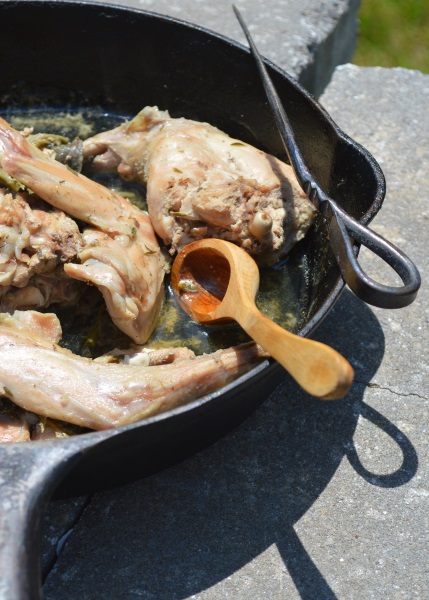
Like in The Lord of the Rings, our stew is served from the pan. Hobbit implements from previous dinners (Long-Expected Party and Farewell Feast in Bag End) make a reappearance. There’s also a skewer-like metal poker for cooking, and an old metal measuring cup has pretensions of mughood. Lembas wrapped in strawberry leaves and blackberries inside a piece of cloth add a hint of comfort to the austerity.

LotR Dinner7 Munchies

Check out what’s it about in the introduction, or read the how-to!

Images by Eppu Jensen

Geeks eat, too! Second Breakfast is an occasional feature in which we talk about food with geeky connections and maybe make some of our own. Yum!

The Great Walls of China

The Great Wall is perhaps the most iconic piece of Chinese architecture and the best known outside of China. It is also widely misunderstood. Border walls like the Great Wall in China, Hadrian’s Wall in Britain, and the Great Wall of Gorgan in Persia do not function the same way as the walls of a city or fortress. These walls are less about keeping people out than they are about managing, observing, and sending a message to the people entering the country or already within it.

A view of the wall from near the eastern terminus, photograph by Jack Upland via Wikimedia

Continue reading

Legal Brief Partly in Klingon to Counter a Big Movie Studio

The copyright infringement case filed by Paramount Pictures Corporation against the Star Trek fan production Axanar has been in the news a bit this spring. I have a mild interest in it, but I don’t spend much time following the reports—with one marvellous, excellent, and hilarious exception.

Attorney Marc Randazza wrote an amicus curiae brief for Language Creation Society (i.e., for the defendant’s benefit) to counter a copyright claim by Paramount “over the entire Klingon language, not any particular words or portions of dialogue from any episodes of Star Trek, but in the entire vocabulary, graphemes, and grammar rules of Klingon.”

His friend and co-blogger Ken White at Popehat shared the story and the brief itself (as a .pdf file). (The full docket for the case is also available via the U.S. Courts Archive.)

Mr. Randazza not only argues that one cannot copyright an entire language, invented or not; he also briefly summarizes the history and some current uses of Klingon. (Did you know, for example, that the Klingon Language Institute has overseen Klingon wordplay contests? I didn’t. Check them out; the palindromes are especially awesome.)

The best thing about the brief, however, is how Mr. Randazza uses Klingon—complete with the Klingon font, transliterations to the Latin alphabet, and translations—to illustrate his arguments.

I’ve copied three examples below without the Klingon font, using the Latin transliterations instead and adding the English translations Mr. Randazza provides. It’s worthwhile to visit the .pdf brief available online (here or here) for the full effect, though.

“Plaintiff Paramount Pictures Corporation (“Paramount”) has claimed this copyright interest for many years, but has not actually asserted it in court before now – most likely because the notion of it is [meq Hutlh / it lacks reasons].”

[p. 9 of 26]

“Just as poker jargon is unprotectable, so is Klingon. To grant such protection would be to attempt to leash that which Plaintiffs have no right to control. Plaintiffs will learn that [Suvlu’taHvIS yapbe’ HoS neH / brute strength is not the most important asset in a fight].”

[pp. 16-17 of 26]

“Plaintiffs attempt to downplay the significance of their claim of ownership over the Klingon language by arguing that ‘a language is only useful if it can be used to communication [sic] with people, and there are no Klingons with whom to communicate.’ […]

“A language is not constrained to a given ethnic or racial group. By their logic, Ancient Greek is not ‘useful’ because the Ancient Greeks are no longer with us, and the language has no native speakers, despite it being the original language of some of the seminal literary and philosophical works of the western world. Plaintiffs’ logic would seem to dictate that French is not ‘useful’ if spoken by a native German. [qoH vuvbe’ SuS / The wind does not respect a fool.]”

[pp. 23-24 of 26]

At the very least, do yourself a favor and check out how the first line of the Sesame Street theme song translates into Klingon (pp. 23-24). Ha!

Randazza Amicus Curiae Paramount v Axanar

Mr. Randazza’s straightforward and humorous writing not only counters stereotypes about legal language, but it’s also very informative. (And he did it pro bono!) Qapla’, sir!

Image: Screencap from Brief of Amicus Curiae by Marc J. Randazza for Paramount v. Axanar (case no. 2:15-cv-09938-RGK-E) filed April 26, 2016

Out There is an occasional feature highlighting intriguing art, spaces, places, phenomena, flora, and fauna.

Top Five Greek and Latin Poems that Read Like Teenage Facebook Updates

Woot! We made it! Hidden Youth has gotten funded! Thank you so much to everyone who contributed, spread the word, or expressed support over the past few weeks. I am so thrilled to be part of this anthology.

And now, as promised, I give you: The Top Five Greek and Latin Poems that Read Like Teenage Facebook Updates

5. #CRUSHINGSOHARDYOUCANTEVEN (Sappho, frag. 31)

He’s lucky as the gods,

any man who sits by you,

listening close to your

sweet voice

and lovely laugh. It just

makes my heart tremble in my chest.

When I glance at you, words

won’t come,

my tongue shatters, a thin

flame runs under my skin,

I can’t see,

my ears ring.

Sweat pours, I break out

trembling, I’m paler than a

flower. I could almost die.

But I can take it all…


4. #THATONEGUY (Horace, Satires 1.3.1-3)

The trouble with all these musical types is when you’re out with friends

and you beg them to sing, nothing will open their lips,

but when you don’t want them to sing they won’t shut up.


3. #DTMFA (Catullus, Poems 85)

I hate and I love. Maybe you wonder why I do this?

I don’t know, but I feel it happening and it’s torture.


2. #YOLO (Archilochus. Elegies frag. 232.8)

Aisimides, no one who listens to other people’s

criticisms ever gets to have a good time.


1. #BESTFRENEMIES (Martial, Epigrams 1.32)

I don’t like you, Sabidius, and I don’t know why.

All I know is: I don’t like you.


Announcements from your hosts.

Why Hidden Youth Matters to Me

There are just five days to go in the Kickstarter for Hidden Youth, the anthology of speculative fiction about marginalized young people in history. As I posted before, my story, “How I Saved Athens from the Stone Monsters,” is one of the stories in this awesome collection. I wanted to post again to thank everyone who has contributed to making Hidden Youth happen and also to say something about why this collection is so important to me, and would be even if I didn’t have a story in it.

160701frescoI teach ancient Mediterranean history at a state university. Ancient Mediterranean history is the dead-white-guy-est of all dead-white-guy history. It’s filled with the sorts of dead white guys that people make white marble statues of and that living white guys like to point to as the pinnacles of western literary, artistic, and philosophical achievement. We’ve basically had two thousand years of white guys burnishing their white-guy cred by laying exclusive claim to the legacy of the great dead white guys of the ancient Mediterranean. So successfully have they done this that a lot of people have a hard time imagining an ancient Mediterranean world that isn’t all white guys.

Now, I’m a white guy. I’ve always had the comfort of seeing myself in history. Even as a professional historian, doing my best to be objective and fully conscious of how complicated, contingent, and constructed such identities are, I can never really know what it is like to look at history and not see people who look like me. That’s a barrier I can’t cross, but I have a lot of friends who live on the other side, especially my students.

Half my students are women and a lot of them are black, Hispanic, and southeast Asian kids from working-class towns. They’ve lived their lives in the shadow of other people’s histories. They have been shown the dead-white-guy-marble-statue version of history and told—sometimes subtly, sometimes not so subtly—“This is ours. You don’t belong here.” I consider it my job to say: “Yes, you do. You were always part of this history.”

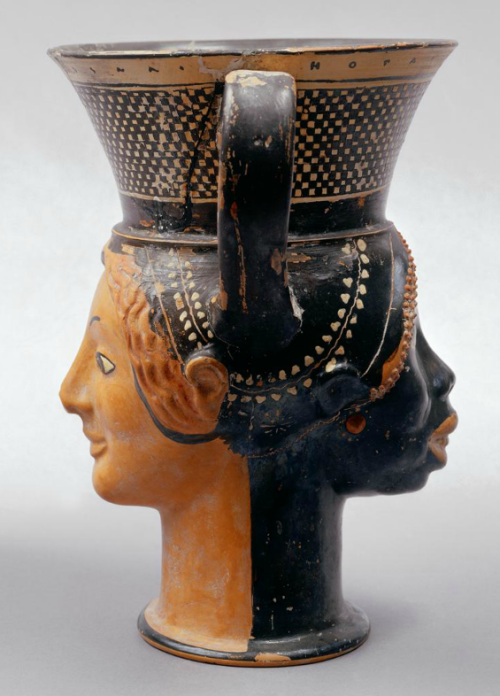
160701kantharosThe ancient Mediterranean world was multicultural, multi-ethnic, multilingual, and full of connections both within itself and to the larger world beyond. Like in my story, there were Egyptians in late classical Athens with their own Isis temple. A Sri Lankan king sent ambassadors to open diplomatic relations with Rome. And it wasn’t all a bunch of men, either. The queen of Halicarnassus was a military adviser to the Persian king. A wealthy woman of African ancestry was buried in style in late Roman York. The evidence is everywhere once you start to look for it.

The power of dead-white-guy-marble-statue history is strong and it needs to be challenged. I confront it in the classroom and my scholarly work, but we also need books like Hidden Youth out there to send the message: history is for everyone, not just people who look like me.

If you’ve already supported Hidden Youth, thank you so much. If you haven’t, please consider it. You can give as little as a dollar, and if you can’t do that, please spread the word.

On a less serious note, let me offer an added incentive to give: if Hidden Youth meets its funding goal, in honor of the collection’s theme I promise to translate and post my picks for The Top Five Greek and Latin Poems that Read Like Teenage Facebook Updates.

UPDATE: Hidden Youth got funded! Hooray! So, as promised, here you go: The Top Five Greek and Latin Poems that Read Like Teenage Facebook Updates.

Images: Bull leaping fresco (restored), photograph by Nikater, via Wikimedia (Knossos; 1550-1450 BCE; fresco). Janifrom kantharos, via People of Color in European Art History (Etruria, currently Villa Giulia; 6th c. BCE; ceramic)

Announcements from your hosts.