A series of mashups of Monty Python’s Holy Grail and Game of Thrones by Robin Edds and Jamie Jones saw the light at BuzzFeed:

Even more at the source!
Serving exactly what it sounds like, the Quotes feature excerpts other people’s thoughts.
A series of mashups of Monty Python’s Holy Grail and Game of Thrones by Robin Edds and Jamie Jones saw the light at BuzzFeed:
Even more at the source!
Serving exactly what it sounds like, the Quotes feature excerpts other people’s thoughts.
 We all know that the pyramids of Egypt were tombs for the pharaohs. (Yes, yes, and landing pads for Goa’uld spaceships; you can put your hands down now.) Thinking about what it took to build them, though, gives us an idea of what else they were.
The construction of the pyramids is a perpetual favorite subject of cranks and crackpots (Lost technologies of Atlantis! Sound waves!). Even among the more reality-bound, there is no end of theories ranging from the mundane (ramps and sledges) to the reasonably plausible (pulleys and levers) to the unlikely but not impossible (poured concrete). No matter what technique we imagine, however, one thing was definitely required: massive amounts of labor.
What most armchair pyramidologists miss about the problem of megalithic construction is that the physics of moving large stones are very simple. Apply enough force to a mass and it will move. Some things can make the application of force easier: ramps, pulleys, rollers, whatever you’ve got, but in the end it’s just a matter of force versus inertia. No matter how you go about building a pyramid, what you need in the end is the same: muscle power and time. With enough muscle power and time you can build pretty much anything, but labor is expensive. The real problem that would-be pyramid builders have to solve isn’t technological, it’s economic. The real question isn’t “How did they build the pyramids?” but “How did they afford the pyramids?”
Turns out a group of people in Great Britain is hankering after a real Minas Tirith so much that they started an Indiegogo campaign to fund the building effort:
“We are a team of Tolkien fans who are passionate about creating a beautiful, inspirational and fully-functioning replica of Peter Jackson’s depiction of Minas Tirith, as seen in his Lord of the Rings films.
“We all share a love of Tolkien’s work, and a desire to challenge the common perception of community and architecture. We believe that, in realising Minas Tirith, we could create not only the most remarkable tourist attraction on the planet, but also a wonderfully unique place to live and work.”
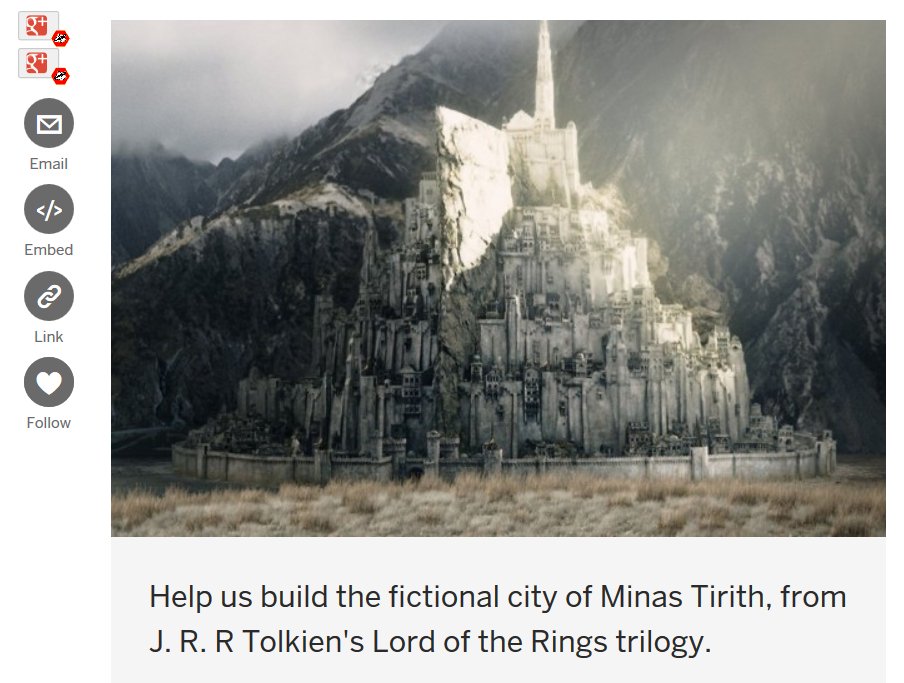
If the project sounds far-fetched to you, rest assured: the team knows it’s a long shot:
“Please only donate within your means, and in the knowledge that this project is a light-hearted venture with virtually no chance of succeeding. […] We make no claim on the image or name of Minas Tirith, and will happily cancel this project should any dispute arise over such.”
Two things come to mind: it’s a fascinating example of 1) how throwing money at something has become an established way to show public support for a project or person, and 2) how the Internet allows people to engage in collective daydreaming across the globe.
Hey, look! We found a thing on the internet! We thought it was cool, and wanted to share it with you.
We’re all familiar with gatekeeping: when members of a fandom (or geekishness in general) try to exclude others for not being true fans or real geeks because they haven’t seen/read/played every obscure iteration of the franchise or don’t know every minute detail of the lore. “Oh, you haven’t seen the Holiday Special?” they sniff. “Well, you’re not really a Star Wars fan, then.” “You don’t know how many buttons were on the second Doctor’s costume? Begone, fake Whovian!”
If you’re fortunate enough to have never witnessed or experienced gatekeeping, here’s a few discussions (picked more or less at random) to give you an idea of what it is and why it sucks:
No One Can Deny You Entry to Geekdom, But Some Can Make It Really Hard to Get Through the Door First by Michi Trota on Geek Melange
The Psychology of the Fake Geek Girl: Why We’re Threatened by Falsified Fandom by Dr. Andrea Letamendi on The Mary Sue
A Creator’s Note to “Gatekeepers” by John Scalzi on Whatever
You see what I mean? Gatekeeping is wrong, hurtful, and no fun. And while it’s true that it can be done by anybody to anybody (I’m a straight man and I’ve had my fandom cred challenged by queer women half my age), it is a weapon frequently deployed by the privileged against the un-privileged, in whatever terms those categories may be defined.
Gatekeeping needs to stop. It’s time we all acknowledge that none of us has seen everything and none of us knows everything, even about the things we love the most. No one is any less of a geek or a fan because of the things they don’t know. All it means is there are still things for us to watch and read and play and find out about, and that’s awesome. Seriously, I feel so sorry for anyone who has nothing new left to learn or experience.
And so, I propose a new pastime: gatesmashing! Instead of obsessing over the things we have seen and read and played, let’s proclaim the things we haven’t. Tell us what you’ve never experienced, and tell us proudly. Not a comprehensive list, of course, but the first few things that come to mind.
I’ll go first.
I have never seen:
I have never read anything by:
I have never played:
And the fact that I haven’t doesn’t make me any less of a geek than anyone who has.
Here there be opinions!
Krishna Shenoi mashed up Mad Max: Fury Road and the Star Wars universe with a surprisingly believable end result:
Road Wars: The Imperator Strikes Back (Mad Max / Star Wars Mashup) by Krishna Shenoi
The 2-minute clip combines material from the existing SW trilogies, Episode VII trailer(s), and Mad Max. Seamless work!
Hey, look! We found a thing on the internet! We thought it was cool, and wanted to share it with you.

Ostrich pulling a cart at the Los Angeles Ostrich Farm. Postcard by unknown; Lincoln Park, Los Angeles, California, 1919. From the Werner von Boltenstern Postcard Collection; Department of Archives and Special Collections, William H. Hannon Library, Loyola Marymount University. In public domain.
Why do fantasy stories so often employ equines as beasts of burden, when you could breed large birds for the task? In our world, humans do have a long history with the horse family, but who’s to say that in another, more SFFnal one you couldn’t find giant versions of armadillos, capybaras, or rats used for transportation? Or faster, large-scale chameleons?
The Visual Inspiration occasional feature pulls the unusual from our world to inspire design, story-telling, and worldbuilding. If stuff like this already exists, what else could we imagine?
 The majority of the stuff that needs to get done in an agrarian society is basic manual labor: primarily farm work, but also things like construction, building and road maintenance, mining, carrying, housework, etc. Any functioning pre-industrial society needs lots of workers to do all that work, but there are many different kinds of workers, some of which are not so familiar to us today. Some of these kinds of workers had it much better than others.
Here’s a list of possibilities, by no means exhaustive, arranged roughly in order from worst to best conditions.
Photographer Beth Moon‘s new series Diamond Nights documents baobabs and quiver trees against moonless, starry night skies with breathtaking results. For a Nordic city dweller like me, the images might as well be from a different planet.


In her artist’s statement, Moon writes of the technical aspects of shooting:
“The majority of these photographs were created during moonless nights, shot with a wide angle lens and ISO of 3200 – 6400. […] Exposures up to 30 seconds allowed enough light to enter the lens without noticeable star movement. Each location required a lot of experimenting. and different lighting techniques. Sometimes a short burst of diffused light from a flashlight was sufficient, or bounced light from multiple flashlights was used for a softer more natural glow.”

Photos like these remind me of the incredible diversity of our planet, and how much more of the world we can see and share through the power of Internet than even our parents. Love it!
Found via Colossal.
Out There is an occasional feature highlighting intriguing art, spaces, places, phenomena, flora, and fauna.
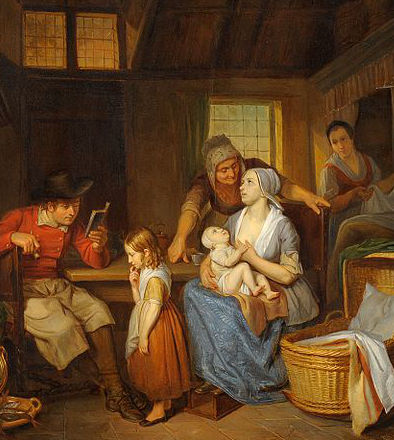 I suppose that title’s a little more interesting than “Pre-modern Demography.”
You’ve probably heard the statistic that the average lifespan in the European middle ages was 35. I remember learning that when I was young. Most of my students have heard it, too, and just like I used to, they imagine that it means that when medieval people got to thirty-two or thirty-three it was time to start looking around for a cemetery plot and a good gravedigger, and that anyone who made it to forty must have been a revered elder, if not a terrifying freak on nature. The truth is much more interesting.
Data about births and deaths is hard to come by for periods before the rise of modern bureaucracies. In a few localities there are church records going back into the late middle ages. Legal documents like wills, deeds, and contracts occasionally offer information about peoples’ births, ages, and deaths, but such documents come from only a very restricted class of people and they may be unreliable because people misrepresented the truth when it suited their political and economic purposes. Archaeological studies of burials can be very useful, although determining age from skeletal remains is imprecise, and we are at the mercy of biases in burial customs and survival of remains. All of these sources of information are partial and biased, but pulling them together gives us a rough sense of how people lived and died in earlier ages.
There are broad patterns that can be discerned from the evidence, but as with most such broad patterns we should always be alert to local variations. Another caution: I’m working from the evidence that I happen to be familiar with, which is mostly European and Mediterranean. Many of the same forces that were at work in that region of the world are relevant to others as well, but we must be alert to regional differences.
 Co-Geeking
You must be logged in to post a comment.