A Cat to Keep You Safe at Sea

Cats (or at least most cats) may not like water, but this one might have kept an ancient sailor safe on the waves.

Scaraboid, photograph by The Trustees of the British Museum. Outline illustration and collage by Erik Jensen. (Found Naukratis, currently British Museum; 600-570 BCE; glazed composition)
(CC BY-NC-SA 4.0)

The cat is part of the decoration on the underside of a small talisman found at the site of the ancient city of Naukratis in Egypt. Talismans of this type are called scaraboids because they are similar in shape and size to scarabs, but do not have the traditional scarab markings on their domed top.

The cat is a hieroglyph, one of three on the bottom of the object. Reading from right to left, the feather represents the sound i, the cat represents m (from the Egyptian word for cat, miu), and the sun disc represents n (from the word niut, meaning town or city, which the sun disc sometimes stood for). Put together, these hieroglyphs spell imn, a form of the name of the Egyptian god Amun. Many other scarabs and similar talismans from Naukratis contain forms of the name of Amun.

Amun was an important god in ancient Egypt, at times regarded as the king of the gods. Among his other functions, he was worshiped as a god of air and winds who protected sailors and other travelers on the sea. A talisman of Amun was an appropriate thing for an ancient sailor to carry around.

Naukratis is an interesting place to find a talisman like this. Naukratis was a Greek city founded inside Egypt by permission of the Egyptian kings. It was originally built as a home for Greek mercenaries serving in Egypt, but it quickly became a port for Greek and other foreign merchants who wanted to trade in Egypt. Most of the sailors who came through Naukratis were not Egyptians, yet there seems to have been a thriving trade in Egyptian and Egyptian-themed talismans, many produced in local workshops. It is likely that the intended customer for this scaraboid was not an Egyptian but a visiting Greek.

On one hand, the prominence of the cat on this talisman makes it seem like a bit of tourist kitsch designed to appeal to foreigners. Domestic cats were not yet common in most of the ancient Mediterranean, and Greeks associated them with Egypt. Including a cat in the talisman made it extra Egypt-y for a Greek audience. On the other hand, Naukratis amulets include many different hieroglyphic ways of spelling names of Amun, not all of which use cats or other specifically Egyptian symbols. Even if some pieces were made as tourist souvenirs, there also seems to have been a market for talismans referencing the Egyptian sailors’ god, even in a place where most of the sailors were not Egyptian.

This talisman and others like it are an interesting window into the multicultural world of Naukratis, where Greek sailors hoped for protection from an Egyptian god and cats were good protectors against the dangers of the sea.

Cults and the Cult of Bacchus

Cults are a staple of modern fantasy. When you need a shadowy organization for your hero to go up against, whether they’re protecting an ancient secret or scheming to bring about the end of days, you can’t go wrong with a cult.

There are plenty of modern examples of secretive organizations that draw in forlorn or gullible people and condition them to submit to the will of charismatic leaders. Such organizations can serve as models for imagining fictional cults, but if you want to write a cult in a fantasy setting, it can be helpful to look at ancient examples. One of the oldest documented examples of a secretive religious organization in conflict with larger society is the ancient Roman cult of Bacchus.

The cult of Bacchus emerged in southern and central Italy in the late third century BCE. It was centered on the worship of the god Bacchus, a version of the Greek Dionysus associated with wine, fertility, and ecstatic release. The Italian Bacchus also borrowed some traits from the Roman god Liber, connected with grapevines, wine, fertility, and freedom. The worship of Dionysus, Bacchus, and Liber was well established as part of the state religion of the Roman republic, which by this time had solidified its control over the whole of the Italian peninsula. The cult of Bacchus was a new religious movement that drew on older traditions but offered its followers new ways of celebrating them.

Followers of this movement practiced their worship in secret, not as part of the state-sanctioned public religion. Only initiated members of the cult were allowed to join in. Unlike traditional Roman religious celebrations, which maintained distinctions between social classes and had separate roles for men and women, initiates of Bacchus included people of all genders and classes who mixed together indiscriminately in their rites. Celebrations were raucous nighttime affairs that featured feasting, drinking, music, and dance.

The Roman elite was scandalized by the popularity of this religious movement. All the surviving sources describing its activity come from this hostile perspective and include lurid suggestions that the Bacchic revelers were practicing magic, engaging in wild sexual frenzies, and scheming at poisonings and other nefarious deeds. Despite these unfavorable sources, there is no reason to think that the cult of Bacchus was actually so outrageous. Seen in the context of the time, we may actually find the cult appearing in a much more favorable light.

To understand the cult of Bacchus, we need to set aside both the hostile attitude of the Roman elite and many of our modern associations with the term cult. While we associate the term today with secretive, manipulative organizations, cult, in its historic use, refers simply to the set of practices that are appropriate to the worship of a particular god or divine entity. All ancient gods received cult from their worshipers, from the official ceremonies for gods of the state to the everyday rituals that attended family and household spirits. Although the cult of Bacchus carried out its rituals in private, there is no indication that the organization was manipulative or coercive, or that members were isolated from the rest of society. In fact, in many ways, the cult offered a positive experience for its members.

Italy in the late third century BCE was recovering from the devastation of the second Punic War. From 218 to 204 BCE, the Carthaginian army led by Hannibal operated largely unchecked in Italy. The effects of war were far-reaching. Many young people from Rome’s Italian subjects were called up to fight in Rome’s legions, some never coming home again. Roman and Carthaginian armies alike ravaged farms up and down the peninsula. In the aftermath of the war, many small farms faced ruin, and a lot of Italian families had little choice but to sell their land to the aristocratic elite at whatever price they could get and move into cities like Rome looking for any work they could find to scrape together a living. Italy in the late third and early second centuries BCE had a vast population of poor people barely getting by, dislocated by war and poverty from their ancestral homes, and resentful of the elite who had come out of the war riding high on plunder and foreign slaves.

The cult of Bacchus offered relief from the pressures of life—if not a hope for a better world, at least a temporary distraction from the troubles of this one. It helped people who had been displaced from deeply rooted ties of family and community find new connections outside the limitations of gender and class. For people who had little joy in their lives and faced a hard daily grind just to eat, the appeal of a celebration full of food, music, and dance was strong. It’s not hard to understand why the cult gained a following in post-war Italy.

It’s also not that hard to see why the Roman aristocracy reacted with such alarm and hostility. The Second Punic War had hit Rome hard. Even though the Romans emerged victorious over Carthage in the end, a generation of potential recruits for Rome’s armies was killed or wounded in the fighting. Rome’s resources were stretched to the limit. What’s more, the war exposed weaknesses in Rome’s hold on Italy. Hannibal’s strategy was to deny Rome resources and fighting power by helping its subjects in Italy rebel. Not all of Italy took Hannibal up on his offer, but enough cities did, especially the Greek cities of southern Italy, to make the Roman elite nervous about their ability to maintain control of the peninsula. Since the cult of Bacchus particularly appealed to the southern Italian Greeks, it doesn’t take much to see why the Roman aristocracy in the years after the war saw disaffected poor Italians gathering together in secret and challenging established social lines as a dangerous thing that needed to be stamped out. The Roman state aggressively suppressed the cult of Bacchus, the first documented example in Western history of a religious movement persecuted by the state.

The cult of Bacchus may not fit the mold of the classic sinister fantasy cult, but understanding the context in which it arose and the forces which drew people to it can help with the worldbuilding for a story in which a cult may not be so benign. Desperate times drive people to find community, relief, and happiness in whatever ways they can. The cult of Bacchus was in reality a benevolent organization that provided much-needed fellowship, but unscrupulous people and organizations can take advantage of the same needs for darker ends.

Image: A scene of Bacchic revelry from a Roman sarcophagus, photograph by Wolfgang Sauber via Wikimedia (currently Anatalya Archaeological Museum; 2nd c. CE; marble)

Quotes: He Lay on top of Me Like an Enormous Stone

Saint Patrick’s Day is coming, and while some folk will be out there marching in parades or drinking green beer, I am reminded that Patrick is the source of one of the clearest early accounts of sleep paralysis and the frightening sensations that can come with it.

Patrick wrote an account of his life, called the Confession. This document was written late in his life and in response to some unknown allegations of misconduct during his mission in Ireland. Patrick’s Confession accordingly focuses on his humility and spiritual piety as it tells the story of how he was enslaved in Ireland as a young man, escaped to Britain, and finally returned to spread the Christian message. At one point in narrating his escape, Patrick recounts a frightening nighttime experience which he perceived as a demonic attack:

On that very night as I was sleeping, Satan tested me powerfully, such that I shall remember it for as long as I am in this body. He lay on top of me like an enormous stone, and I had no strength in any of my limbs. How did it occur to me, ignorant in spirit, to cry out “Elias?” In the midst of this, I saw the sun begin to rise in the sky, and as I shouted “Elias! Elias!” with all my strength, behold, the splendor of the sun fell over me and at once all the weight left me.

Saint Patrick, Confession 20

(My own translation)

Sleep paralysis is a frightening experience that happens when the brain’s processes for falling asleep or waking up are not quite in sync. In normal sleep, the body becomes paralyzed at the same time the brain becomes unconscious, and both states pass when we wake up. Sleep paralysis happens when the body is paralyzed but the brain is partially aware of its surroundings. Unable to properly process stimuli, the brain fills in the gaps with hallucinations. Because the brain is aware of the body’s vulnerability in its paralyzed state, these hallucinations often feel threatening. It is not unusual for a sufferer to scream themselves awake in response. Sleep paralysis most often happens in the evening when first going to sleep or in the early morning while waking up.

Many cultures have folk traditions that interpret sleep paralysis as the effect of hostile supernatural visitation. Old-fashioned explanations include incubi, night hags, and ghosts; more modern folktales may feature alien abduction. Patrick details a clear account of sleep paralysis—it happens at dawn, he is unable to move, he feels a weight on his body and perceives a hostile presence which he shouts away—but interprets the events in a specifically Christian context.

Patrick’s night terrors are a reminder of both the universality of human experiences, and how powerfully our own specific cultural outlook can shape our reactions to those experiences.

Fantasy Religions: Divinity and the World

It’s been a while since I last wrote about ways of making religious elements of a secondary world feel more authentic, but here’s another thought worth considering when you’re writing: how people feel about the gods tends to reflect how they feel about the world.

Traditional religions tend to see the world differently and posit that divinity exists within the world, that the physical world around us and the social world we inhabit as humans is also inhabited by sacred forces. Interacting with the world means necessarily interacting with divine entities. Some modern religions preserve this view of the divine, notably Hinduism and Shinto. In traditions like these, divine forces are located within the world, whether they are gods associated with natural features such as mountaintops or rivers, or divinities connected to human relationships, such as blessed ancestors or household spirits.

For many of the major modern religions, by contrast, such as Buddhism, Christianity, Islam, and some versions of Judaism, the divine exists outside the world. The physical world we live in and the social world we inhabit as human beings is a barrier between ourselves and divinity, and the function of religion is to help us transcend that barrier. Attachments to worldly goods or to social relationships are seen as impediments that must be resisted or shed in order to achieve harmony with the divine.

This distinction is not an absolute one. Traditional religions can also understand divine forces as abstractions or seek ways of achieving a closer communion with the divine through asceticism, and modern religions can see sacredness connected to specific places and people. Still, one of the defining characteristics of any religious tradition is whether it encourages people to seek harmony with the divine by inhabiting the ordinary world in meaningful ways or by escaping from its distractions and temptations.

The point for writers is not that one or the other of these religious approaches is right or wrong for an imagined world, but that each one responds to the needs of societies under different circumstances. People are inclined to see the divine in the world around them when they feel at home in that world. Well-established cultures with a strong sense of identity and long history moored in place are likely to see the world itself as sacred. Shinto in Japan and Hinduism in India both arise out of this kind of long history. Religions that see the world as a barrier to be overcome tend to arise in times when people are unsettled and feel powerless within the world they live in. Buddhism, Christianity, and Islam all arose among peoples who lived with chaos, violence, and a lack of control over their own destinies, while Judaism has been deeply shaped by a history of diaspora and oppression.

What kind of religions exist in your invented worlds depend on what the people in them have experienced. If your characters feel connected to and safe within the world they inhabit, they are likely to perceive divine forces all around them; if their world feels dangerous and alien, they are likely to feel equally alienated from the divine.

Other entries in Fantasy Religions:

History for Writers looks at how history can be a fiction writer’s most useful tool. From worldbuilding to dialogue, history helps you write.

Quotes: The Templars, Who Were My Friends

The following story is related by Usamah Ibn Munqidh, a twelfth-century Muslim writer who lived during the time of the early Crusades, about his interactions with some of the Knights Templar who occupied Jerusalem in his day.

Whenever I visited Jerusalem I always entered the Aqsa Mosque, beside which stood a small mosque, which the Franks had converted into a church. When I used to enter the Aqsa Mosque, which was occupied by the Templars, who were my friends, the Templars would evacuate the little adjoining mosque so that I might pray in it.

One day I entered this mosque, repeated the first formula, “Allah is great,” and stood up in the act of praying. Then one of the Franks rushed to me, got hold of me and turned my face eastward, saying, ‘This is the way you should pray!’

The Templars came up to him and expelled him. They apologized to me, saying, ‘This is a stranger who has only recently arrived from the land of Franks and he has never before seen anyone praying except eastward.’

– Usamah Ibn Munqidh, Autobiography


Ibn Munqidh’s experience is certainly not typical of Christian-Muslim relations in the Crusade period, but it is a useful illustration of the kinds of friendly and respectful relationships that could be forged between individuals of different backgrounds, even in times of war.

From another point of view, it is useful to note that the Templars were effectively enforcing an anti-harassment policy on their own members. If a militant religious order in a war zone could do that, then there’s no excuse for modern fan conventions not doing the same.

Translation from Philip K. Hitti, An Arab-Syrian Gentleman and Warrior in the Period of the Crusades. New York: Columbia University Press, 2000, 160.

Serving exactly what it sounds like, the Quotes feature excerpts other people’s thoughts.

Fantasy Religions: Novel Religions

The religions that exist in our world can be broadly divided into two categories: traditional religions, which developed gradually in their own native societies and have no clear beginning point, and novel religions, which began at a fixed point in time. Many of the great world religions of the modern day, like Christianity, Islam, and Buddhism, are novel religions, while some traditional religions, like Shinto, still thrive. Some religions, like Hinduism and Judaism, have features of both. In earlier posts, we’ve discussed what sort of things you may want to keep in mind in your worldbuilding for stories or games to make your imaginary religions feel more authentically traditional. Today we’ll take a look at what makes a novel religion feel alive.

There have been many novel religions in world history. A few have gathered large followings and become major forces in the world. Many have faded away after a few generations. Some have done well for a long time, even for centuries, before finally disappearing. There is no single thing that every novel religion has in common, but looking at history, we can see definite patterns as to what makes a new religious movement thrive, even if only for a time. It takes more than a charismatic leader with a new idea, although that is where most of them start.

Connection to the past

New ways of life can be hard to adopt, but they are easier if they connect to things people already know. Christianity and Islam both drew on Jewish traditions, as Buddhism did with the same ancient Indian traditions that informed Hinduism. The ancient Mediterranean cult of Isis based itself on ancient Egyptian religion. Similarly, Zoroastrianism drew on ancient Iranian religious ideas. New movements within existing religions that do not split off on their own also often share the features of novel religions, like the Protestant denominations within Christianity or the Shia branch of Islam. The degree to which new religious movements identify themselves as new or as reforms to or revivals of older traditions can vary widely.

Texts and beliefs

Not every religion, novel or traditional, has sacred texts, but many novel religions do. Such texts help to define how the new movement differs from what has come before and what its followers are expected to do or believe in order to be counted as part of the group. Depending on the religion, these texts may be openly available to anyone who wants to read them, or access to them may be limited only to those who have joined the movement. Novel religions are also more likely to focus on belief, unlike traditional religions which tend to focus on practices and rituals.

Hope in times of trouble

The success of any new religion depends largely on its ability to attract new followers in sufficient numbers to keep the movement going. Most people most of the time aren’t really “in the market” for a new religion, but there are certain times in history when large numbers of people are ready to embrace something new. It tends to happen in times of suffering and uncertainty, among people who have been displaced from their homes and familiar ways of life. The Bacchanal cult of the second century BCE appealed to Italian peasants who had been driven from the countryside into the cities by economic desperation. Haitian Vodou and related religions came out of the traumas of enslaved West Africans in the Caribbean and the Americas. Christianity and Islam both, in different periods and different ways, emerged among the victims of Roman imperialism. Novel religions often offer purpose, identity, and community to people who have lost the things that gave them those comforts before.

Difficult (but not too difficult)

A novel religion often thrives when it demands practices of its followers that are difficult, but not excessively difficult, to carry out. Muslims are expected to pray five times a day. Buddhists engage in meditation of many different kinds. Followers of Isis were expected to furnish a feast for their fellow worshipers upon joining. These kinds of practices, which require time, focus, and effort, but are not overly demanding, help foster a sense of community by creating shared experiences. At the same time, religions which demand overly difficult practices tend to see their followings dwindle. Converts to Mithraism went through initiations involving withstanding heat, cold, and pain (although probably not bathing in bull’s blood, as sometimes alleged). The rigors of these initiations, as well as the fact that it seems to have been open only to men, may have limited the cult’s appeal and kept it from gaining a critical mass of followers.

Outward from the middle

Novel religions tend to begin neither at the top nor at the bottom of the social scale but somewhere in the middle. Simply put, the rich and powerful have little to gain from upending the order of things, while the poor and powerless don’t have the time to ponder on the mysteries of the universe. New religious movements tend to begin among people who, if not always “middle class” by a modern definition, are somewhere on the middling ranks of the social and economic hierarchy. How they spread from there differs. Some religions grow by promising the hope of a better life to the poor, as Christianity did, while others, such as Confucianism, grow by appealing to a discontented elite.

Food

Food, for many of us, is a vital part of our sense of identity and community—think of your favorite family recipes or the special holiday dishes that remind you of heritage and home. Many novel religions present new ways of eating as part of the creation of a new communal identity. One of the central rituals of Christianity involves consuming (literally or metaphorically, depending on one’s theology) the body and blood of the founding figure. Muslims are enjoined to fast during daylight hours during Ramadan and to avoid certain food and drink, including pork and alcohol, altogether. Manichaeism taught that adherents had a duty to spread light in the world and combat darkness by eating certain foods and avoiding others. Eating together, or eating in similar ways to other followers elsewhere, helps to maintain the bonds that hold the adherents of a new religion together.

Thoughts for writers

As an example of how these features of novel religions can inform worldbuilding, here is a short description of an imaginary movement in an imaginary world.

The borderlands of Jash have been ravaged by decades of war between the Jashite cities and the invading armies of the Akluni Empire. As refugees from the rugged hills and scrublands of northern Jash stream into the cities of the lush Jash River valley, they find misery, poverty, and violence. Many of the refugees, looking for the solace of the familiar, have filled the neglected temples of Uzuli, the moon goddess favored by borderland shepherds but little regarded by the city folk.

Among the merchants and farmers of the Jash cities, tensions have been growing as no city seems capable of leading a coordinated response to the Akluni threat. Factions have formed within the cities, some arguing for peace with Aklun, others for resistance to the death; some for throwing the refugees out to fend for themselves, others for redistributing farmland to provide for the hungry. Encounters between members of these factions in the streets and market often lead to harangues, arguments, even fistfights.

Lately, a woman calling herself the Moon Daughter has been gathering crowds in the side streets of the city of Busa, giving stirring speeches promising a return of peace and prosperity. She comes from one of the lesser merchant families of Busa, but no longer speaks to them after beginning her work in the streets. She reports visions from Uzuli that call for all the people of Jash to be as one, to return to the simpler ways of the country, and to withstand the assault of Aklun not by arms but with the patience of Uzuli, who does not fear the waning because she knows that the full moon will come again.

The Moon Daughter’s early followers came from among other merchants families, whose fortunes have fallen under the pressure of war, but she increasingly draws crowds of hinterland refugees. Some of her followers have begun writing down her speeches and publishing them as pamphlets. “Eat of the bitter terebinth and the prickly pear” she says, “in memory of our home that is lost. Then drink of the honeyed wine that promises peace and harmony forever in the turning of the moon.” Her followers gather for common meals, eating and drinking as she commands, but also sharing what food they have with those who have none.

Building in some of the common features of novel religions helps the Moon Daughter’s movement feel fuller and more grounded in the world. It also offers interesting storytelling hooks. What happens if Busa is conquered by Aklun and the Moon Daughter and her followers have to flee elsewhere? What if the priestesses of Uzuli challenge the Moon Daughter for false prophecy? What if the Moon Daughter’s movement becomes so popular its followers take control of Busa, and then have to negotiate with the other Jashite cities who haven’t joined the movement? What if the Akluni Empire collapses and the refugees return home bringing the Moon Daughter’s words and ideas with them, but leaving the life of the city far behind? There are lots of directions you could take a story or a game from this beginning.

Other entries in Fantasy Religions:

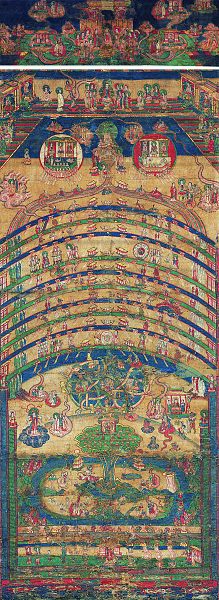
Image: Manichaean diagram of the universe via Wikimedia (China; 1279-1368 CE; paint and gold on silk)

History for Writers is a weekly feature which looks at how history can be a fiction writer’s most useful tool. From worldbuilding to dialogue, history helps you write. Check out the introduction to History for Writers here.

Quotes: Our Real Journey in Life Is Interior

Trappist monk Thomas Merton apparently was very concerned with silence and retreat from the world and its opposing force, that of engagement with the world and its ourward pull.

Current Reading Silence

“Our real journey in life is interior. It is a matter of growth, deepening, and of an ever greater surrender to the creative action of love and grace in our hearts. Never was it more necessary for us to respond to that action.”

– Thomas Merton, 1975

Apparently this quote is from a collection of journal entries Merton made in Asia shortly before his accidental death during the trip.

Not being a philosopher or a spiritual person, I couldn’t tell you what I think of “the creative action of love and grace”. However, the conclusion I’m more and more leaning towards is that the most important thing in life is one’s internal growth and what external actions (hopefully positive or beneficial to others) stem out of that.

Merton, Thomas. “Serious Communication”: The Asian Journal of Thomas Merton, eds. Naomi Burton, Brother Patrick Hart and James Laughlin, p. 29. New York: New Directions, 1975. Quoted in Brox, Jane. Silence: A Social History of One of the Least Understood Elements if Our Lives. Boston: Houghton Mifflin Harcourt, 2019, p. 225.

Serving exactly what it sounds like, the Quotes feature excerpts other people’s thoughts.

Angels and Pinheads

How many angels can dance on the head of a pin? For many of us, this is our go-to example of a pointless question. It is often used to ridicule the Middle Ages as a time of naive religiosity still mired in darkness and ignorance before the coming of the Enlightenment and the scientific revolution. Nothing could be farther from the truth. The question of how many angels can dance on the head of a pin is one of the most important and consequential questions in western intellectual history.

The key is that the question isn’t really asking for a number. The number is irrelevant. The answer that matters is: finite or infinite?

Angels, according to the traditions of the western monotheisms—Judaism, Christianity, and Islam—are God’s agents in the world. They are how the divine will is enacted in the physical world we live in. For believers in those faiths, therefore, understanding angels is a way of understanding how God acts in the world.

If the number of angels who can dance on the head of a pin is some finite number, then two angels cannot occupy the same space. It doesn’t matter what the number is; if there is a point at which you just can’t fit any more angels on that pin, then angels must have volume and mass. If they have volume and mass, they necessarily have other physical properties derive from those qualities like density and velocity. In other words, angels are bound by the same physical laws that operate in the rest of the world and which we humans can observe, study, and understand. On the other hand, if there is no limit to how many angels can dance on a pin, then they must not have these same physical properties and therefore cannot be understood or described by analogy with anything that exists in the material world.

What this all adds up to is: if the number is finite, then we can understand the workings of God’s will through mathematics, physics, and observation of the natural world, but if the number is infinite, then those studies are of no use and we can only comprehend God through the study of revealed texts and the writings of inspired individuals like prophets and saints. To understand those texts, however, we have to understand not just the languages in which they are written but the literary genres in which they were composed and the historical and philosophical references they depend upon to convey their messages.

Or to put it in even more familiar terms: science versus humanities.

As human beings, we often rely on symbols and shorthand to discuss important questions. Those symbols draw on the cultural context that surrounds us and they can seem nonsensical without that context. In a thousand years, people may think 20th-century Americans had an odd obsession with arguing over whether donkeys or elephants are better animals, and their 21st-century descendants were no less ridiculous with their fights over whether red or blue is a better color, but we today know the weight of complicated ideas that lie behind those convenient symbols. In the context of medieval scholastic thought, angels and pins served a similar purpose.

Thoughts for writers

The “angels and pin heads” debate is a fine example of how important cultural context is for both research and worldbuilding.

When doing research, it is crucial to remember that people in past societies had thoughts and arguments that are just as complicated as we have today, but they often expressed those ideas in shorthand references that are not transparent to us. If you’re doing research or reading primary sources and people seem to be hung up on arguments that seem pointless or silly, chances are there’s something much more serious behind it and you need to get a handle on their symbolic vocabulary in order to understand it.

(Of course, sometimes people do have pointless and silly arguments, and that’s just as true in the past as it is today. Looking at you, Star Wars vs. Star Trek folks.)

For worldbuilding, think about the kinds of symbolic shorthand people in your fictional world use for their important debates. Symbolic arguments are useful. When everyone around you already knows what the symbols mean, they save time and energy. If the big question for people in your world is whether hereditary monarchy or military aristocracy is a better basis for government, most people aren’t going to go around talking about “hereditary monarchy” or “military aristocracy” all the time. Those are long and cumbersome words to be throwing around. They’re more likely to argue about crowns and helms, or the hunter and the fawn, or some other metaphor. The arguments will also probably turn around seemingly insignificant questions, such as whether one should eat sitting at a table or on the ground, or what color shoes women should wear. Part of your worldbuilding is understanding how the symbols connect to the serious questions.

Whether you explain things for your audience or not is up to you, but layering in symbolic arguments like pin heads and dancing angels is part of the depth that makes a fictional world feel real.

Image: Five dancing angels, photograph by Jebulon via Wimikedia (Musée Condé, Chantilly; c. 1436; oil and gold on wood; by Giovanni di Paolo)

History for Writers is a weekly feature which looks at how history can be a fiction writer’s most useful tool. From worldbuilding to dialogue, history helps you write. Check out the introduction to History for Writers here.

Keep Out

The image above is a papyrus sign found near an ancient temple complex at Saqqara, Egypt. The original is 36 cm (a little more than a foot) wide. The text is in Greek and reads:

By order of Peukestes:

No entry.

This is a sacred enclosure.

My own translation

What does this sign mean and why was it posted in Greek somewhere near an Egyptian temple?

The name Peukestes helps us towards an answer. There is one important Peukestes we know from the sources with a connection to Egypt. In 332 BCE, Alexander the Great arrived in Egypt with his Greek and Macedonian army. The Egyptian people had lived unhappily under the rule of the Persian empire for generations and they greeted the newcomers as liberators. When Alexander moved on the next year to continue his conquest of Persia, he left Egypt under the charge of two of his commanders, Balakros and Peukestes. (Arrian, Anabasis of Alexander 3.5.5)

The Greeks and Macedonians of Alexander’s army had Egyptian good will on their side and they did not want to lose it. At the same time, Egypt and its great monuments were a source of endless fascination to foreign visitors in antiquity, just as much as today, and not all foreigners knew how to behave with respect. Centuries earlier, Greek mercenaries in the service of the Egyptian pharaohs had carved graffiti into the stones of ancient temples. Balakros and Peukestes, trying to hold onto a valuable province through the turmoil of liberation, certainly did not want any of that going on.

The sign was probably originally posted outside of the temple complex at Saqqara as a warning to any Greek troops indulging in a bit of sight-seeing that they had better be on their best behavior, including staying out of places that were sacred to their Egyptian friends.

Multicultural and cross-religious encounters are nothing new in the world. People have been thinking about the problem of how to get along peacefully with those whose ways of life are different from ours for thousands of years. Respecting other peoples’ religious traditions isn’t just polite, it’s sound policy.

Reference for the papyrus: Eric G. Turner, “A Commander-in-Chief’s Order from Saqqara,” Journal of Egyptian Archaeology 60 (1974): 239-42.

History for Writers is a weekly feature which looks at how history can be a fiction writer’s most useful tool. From worldbuilding to dialogue, history helps you write. Check out the introduction to History for Writers here.

Fake News in Ancient Athens

170109athenaThere’s been a lot of talk lately about fake news and its effect on politics, but the phenomenon is not a new one. Consider this story about how the tyrant Peisistratus seized power in Athens in 556 BCE.

There had been long-simmering unrest between three broad groups in Attica: the wealthy farmers of the plains, the fishing and trading people of the coast, and the poor villagers of the hills. Peisistratus organized the hill people as his base of support, promising to represent their interests if they helped him take power. After a first attempt that fell apart when the plains and coast factions organized against him, Peisistratos made a second bid for power a few years later when the coastal faction switched sides and backed him. Here’s how Herodotus tells the story of how Peisistratus managed to take power the second time:

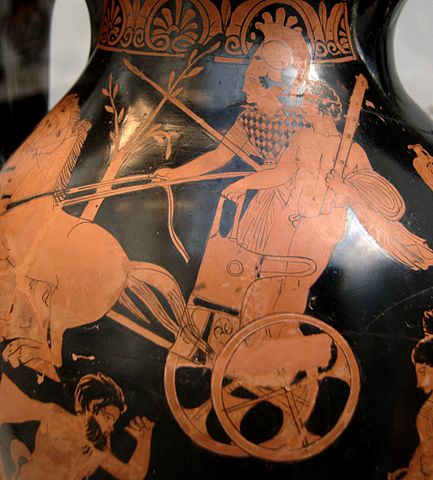
In Paeania [a hilly region of Attica] there was a woman named Phye who was very tall and beautiful. They dressed her in full armor and put her in a chariot, decking her out to make her the most impressive spectacle, and drove her to the city. Heralds ran on ahead and when they reached the city they proclaimed: “Athenians! Welcome Peisistratus, whom Athena has honored above all! She herself is driving him to the acropolis!” They went all around saying these things and the rumor spread at once throughout Attica that Athena was returning Peististratus to the acropolis. The people of the city believed the woman to be the goddess herself, so they worshiped her and received Peisistratus as their tyrant.

– Herodotus, Histories 1.60

My own translation

Were the people of ancient Athens really that gullible? We shouldn’t doubt that most of them believed that the goddess Athena existed and could intervene in human affairs, but it’s still a bit of a leap from there to believe that she would show up in person to deliver a controversial politician back into power. The idea of dressing up a woman like Athena and having her ride into town in a chariot was nothing strange, either. The Panathenaic Festival, one of the major holidays in the Athenian year, featured exactly that. In fact, many historians believe that Peisistratus was actually using the festival as the occasion for his comeback. In that case, everyone knew that Phye was not really Athena, just playing a role in the procession. It may actually be Herodotus who is the gullible one and the “fake news” is the story that anyone was fooled by Phye at all, as opposed to participating in a well-orchestrated bit of political theatre.

We know from modern research that people tend to change their beliefs to suit their politics, not their politics to suit their belief. If anyone in Athens really did believe that Athena was bringing Peisistratus to town, it’s more likely that they were already a backer of his faction and so were willing to accept the story than that believing the story made them back Peisistratus. Similarly, Herodotus was a firm anti-monarchist, so he was disposed to believe that the Athenians must have been tricked into welcoming Peisistratus rather than willingly choosing him to be tyrant.

Either way you cut it, there’s nothing new about people believing false reports that happen to suit their political outlook.

Image: Athena carrying Heracles in her chariot, photograph by Bibi Saint-Pol via Wikimedia (Staatliche Antikensammlungen, Berlin; 420-400 BCE; red-figure pottery; by the Cadmus Painter)

Edited for consistency in spelling

History for Writers is a weekly feature which looks at how history can be a fiction writer’s most useful tool. From worldbuilding to dialogue, history helps you write. Check out the introduction to History for Writers here.