During my years in the U.S., I’ve been asked more than one variation of the question “Is it always cold?” in Finland. (The short answer, of course, is No; the long answer is It depends on your definition, and when and where in Finland you are. It CAN be cold, but “always”, no.)
What southern people don’t usually realize is that it’s not the winter cold but the long dark that affects you most. (Of course, as a counterpoint, we do also have the magical light summer nights.)
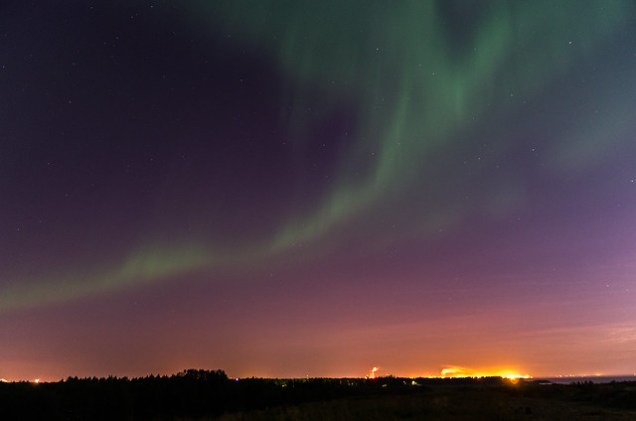
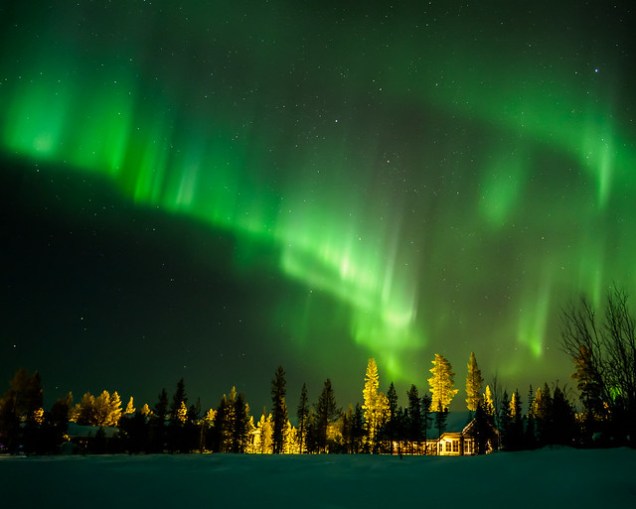
Besides, the dark isn’t all bad. Away from light pollution there is the Milky Way on clear nights, and the further north you go, the higher are your chances of seeing northern lights. The latter can range from faint whisps to quite a light show.
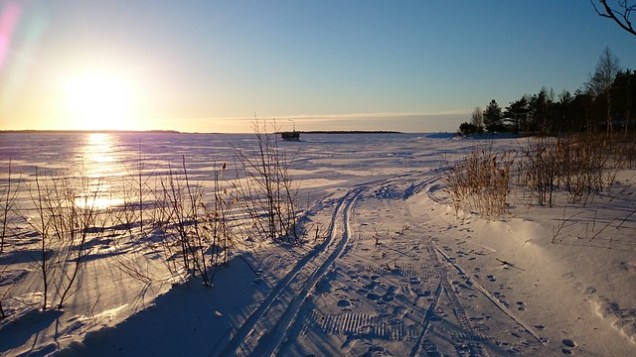
For your potential worldbuilding inspiration, here is a small selection of Flickr photos roughly from around where I grew up, including travel destinations in the north.
For me, and indeed most other Finns, winter starts some time in November to December, depending on the temperatures each year. And even though technically I didn’t grow up with the polar night (when the sun doesn’t rise above the horizon at all), it was quite dark especially before the snow fell—which is exactly why getting snow on the ground was such a relief.
The Visual Inspiration occasional feature pulls the unusual from our world to inspire design, story-telling, and worldbuilding. If stuff like this already exists, what else could we imagine?
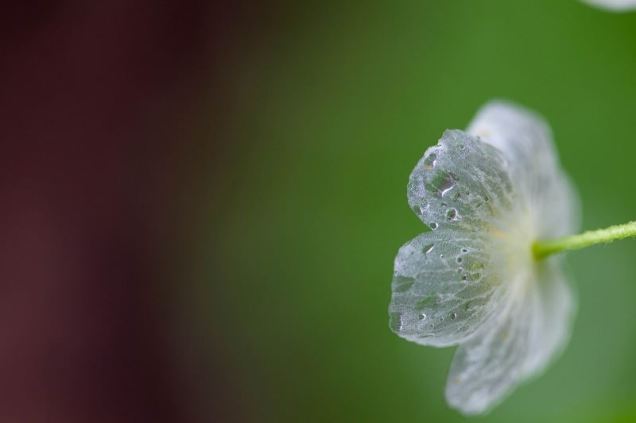
There’s this amazing white flower, Diphylleia grayi, whose petals turn transparent in the rain!
The perennial is sometimes called skeleton flower for good reason. According to My Modern Met, they grow on moist, wooded mountainsides in the colder regions of East Asia and Japan.
My goodness! I could’ve never seen this—wouldn’t have known to look for this—with my own eyes if it weren’t for the Internet.
One of the best things about social media—like the Internet, too—is how many different phenomena you can witness if not first hand then at least in a secondary capacity; way more than would be possible in a regular human lifetime.
Case in point: the Clay Forest is a massive gorge like the Grand Canyon, except it’s located in Western Tibet. Apparently it wasn’t really accessible for Westerners until 2015.
One of the best things about social media—like the Internet, too—is how many different phenomena you can witness if not first hand then at least in a secondary capacity; way more than would be possible in a regular human lifetime.
Case in point: the occultation of Saturn (i.e., hiding behind another object, in this case the moon) a few days ago.
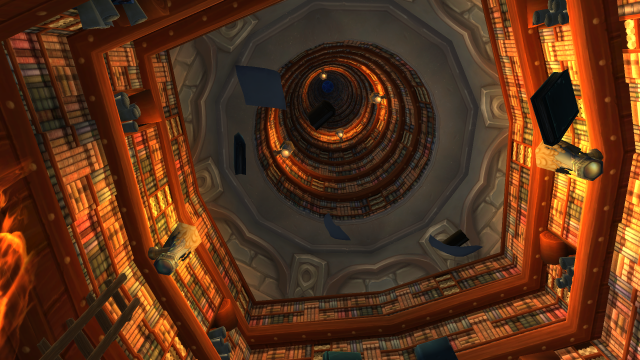
I was browsing my WoW screencaps for something entirely different when my eye fell on two shots from the Dalaran inscription trainer’s place. (This is in the Legion version of Dalaran.) Both are actually from inside the book-filled cupola: the first looks up towards the impossibly high ceiling, the second down towards the trainers’ room floor.
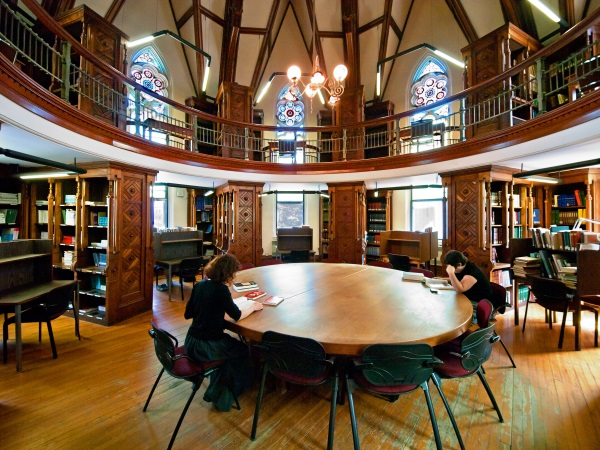
Neat, right? Well, I wondered whether anyone’s actually done anything similar for real and hit the Internet. And I found some!
The library is situated in the neo-Gothic Morrice Hall building that previously housed the Presbyterian College of Montreal from 1871 to 1961.
None of them are exactly the same as the game library cupola, of course: apart from the the scale of the rooms, the scale and direction of the bookcases might differ. But apparently it isn’t terribly far-fetched to make a round multi-storey library and pack it chock-full. 😀
I’m not a fan of the Victorian age per se, but watching Murdoch Mysteries has piqued my interest somewhat. Here are some intriguing photographs from the later 1800s to early 1900s.
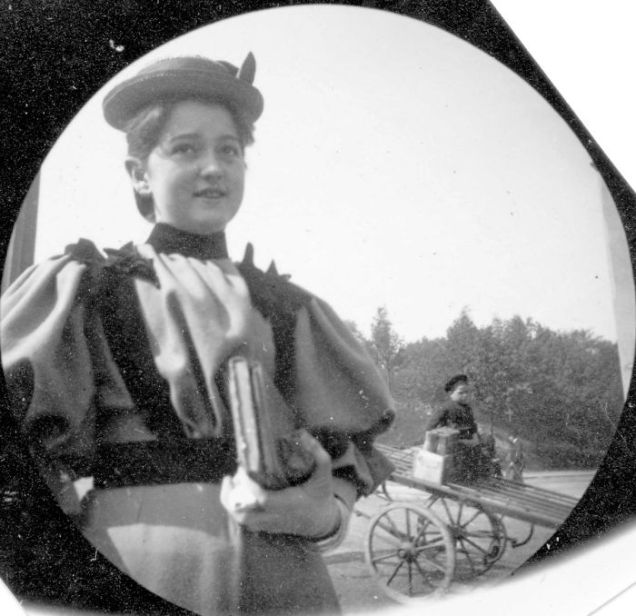
From a set of unscripted photos taken in the streets of 1890s Norway by Carl Størmer, a young woman with books:
Young woman with books, photograph by Carl Størmer via Imgur (Oslo, Norway, 1890s)
All of the subjects in this set are remarkably relaxed. Love the contrast to the stiff studio portraits of the era!
(I’ve had trouble finding a more detailed source, unfortunately. Possibly Størmer’s photos are gleaned from the 2008 book 80 millioner bilder: Norsk kulturhistorisk fotografi 1855-2005 [’80 Million Pictures: Norwegian Culture-Historical Photography 1855-2005′], edited by Jonas Ekeberg and Harald Østgaard Lund.)
Finnish ladies and gentlemen on a ski trip in the 1890s:
Hiihtoretkeläiset ryhmäkuvassa (‘ski trip participants in a portrait’), photograph via Helsinki City Museum (Helsinki, Finland, 1890s, image number N252030, CC BY 4.0)
Judging by their attire, they are indeed ladies and gentlemen. What struck me is that, apparently, it wasn’t at all odd for the upper class to go skiing in their regular daywear.
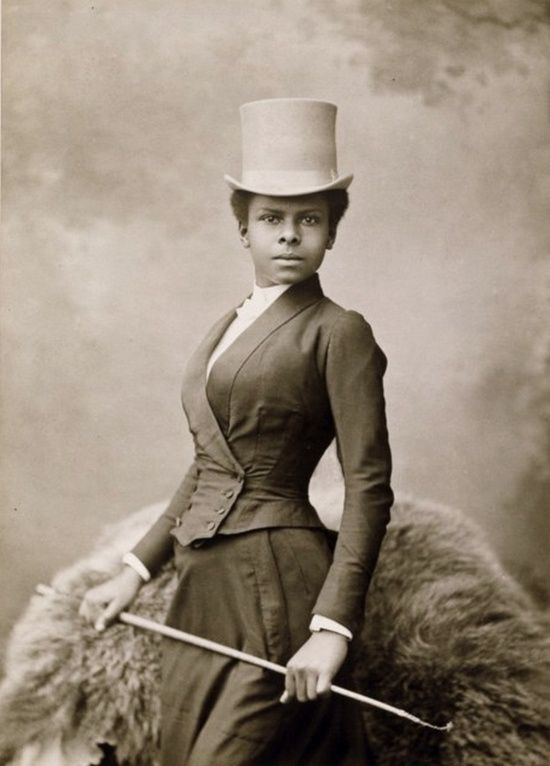
Speaking of sports and Victorians, from 1891, here is high school dressage equestrian Selika Lazevski by Félix Nadar:
Selika Lazevski, photograph by Félix Nadar courtesy of Ministère de la Culture, France, via Black Female Equestrians (Paris, France, 1891)
What an arresting portait!
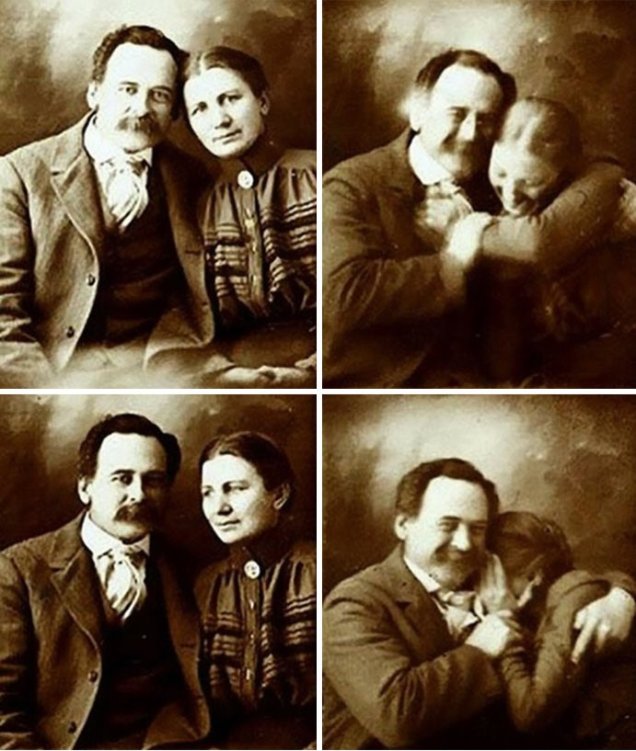
A Victorian couple from Leeds trying not to laugh while getting their portraits done in the 1890s:
Victorians certainly loved their wheels! I wonder exactly how one would’ve operated this chair—there’s clearly a handle bar connected to the front wheel, but if grabbing it with both hands, where does the propelling force come from?
A Sami woman from Finland photographed at Ellis Island in the U.S., so presumably immigrating, around 1905-1914:
Laplander / Sami woman from Finland, photograph by Augustus F. Sherman via New York Public Library digital collections (Ellis Island, New York, NY, c. 1905-1914, image ID 418041, public domain)
I wish the portrait hadn’t cut off at the waist; I would’ve liked to see the rest of the details of her dress (the belt looks especially interesting). I know that nowadays Sami outfits (gákti) are unique. Each is made for its wearer to reflect the personal / family history and area (and possibly the people as a whole?). I don’t know, however, how far back in time that practice goes.
Anyway. These old photos give fascinating glimpses of western life only about 100 years ago. So similar and yet so, so different.
Out There is an occasional feature highlighting intriguing art, spaces, places, phenomena, flora, and fauna.
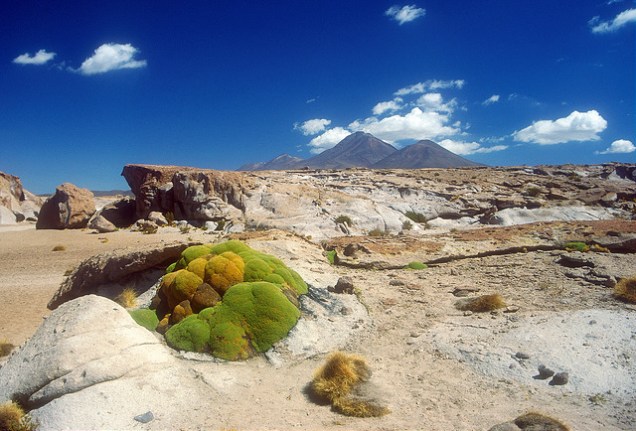
Yareta or llareta (Azorella compacta) is a low evergreen that grows in the Andes mountains in Peru, Bolivia, northern Chile, and Argentina.
Looking at the landscape where it’s found, it seems that the yareta latches onto ground or rock and grows up and out into the rounded shape over the years.
The rounded, cotton-ball-like shape reminds me of how some mosses grow. Unlike them, though, the yareta can grow in dry conditions and nutrient-poor soil, if slowly. (According to Wikipedia, their growth rate is approximately 1.5 cm / 0.6 inches per year; however, an article in Pharmacognosy Magazine cites 1 cm in 20 years.)
Apparently the Andean people used yareta since Pre-Columbian times for the treatment of colds, pains, diabetes, asthma, bronchitis, womb complaints, gastric disorders, backache, wounds, and altitude sickness (Pharmacognosy Magazine Aug 2014).
Yareta looks like a great option for speculative writers and artists looking to break out of the Eurocentric worldbuilding mold.
Images: Yareta at Ollague Volcano lookout by Miguel Vieira via Flickr (CC BY 2.0). Yareta – Bolivian Altiplano by Knut-Erik Helle via Flickr (CC BY-NC-ND 2.0)
Out There is an occasional feature highlighting intriguing art, spaces, places, phenomena, flora, and fauna.
A false-color image of Saturn’s rings made from uncalibrated ultraviolet data, created and selected by Joshua Colwell, UVIS co-investigator:
The colors are incredible—the red is a real stand-out.
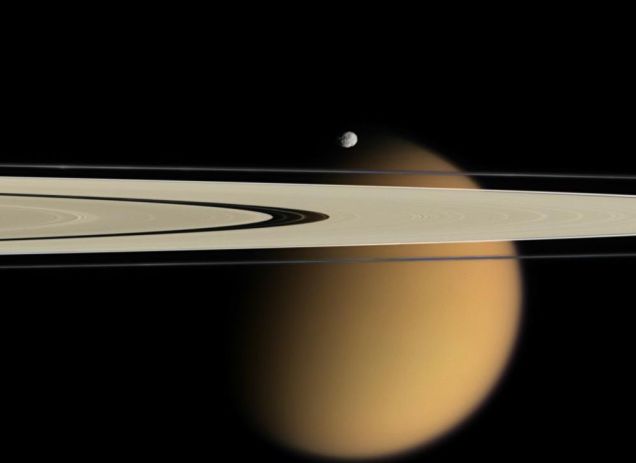
Titan and Epimetheus, selected by Morgan Cable, Project Science and system engineering assistant:
The size differences of Saturn’s moons are amazing. Moreover, this photo almost looks like it’s framed by a professional photographer when, in fact, it’s from outer space. Love it.
Enceladus’s plumes, selected by Molly Bittner, systems engineer, Cassini Spacecraft Operations:
Jets of water bursting from a subsurface ocean. On an icy moon. In Saturn’s orbit. And NASA got photos of it!
Jan Fröjdman hand-built a short tour of Mars using high-resolution images from the High Resolution Imaging Science Experiment (HiRISE) camera on NASA’s Mars Reconnaissance Orbiter. Here it is on Vimeo:
Not only did Fröjdman add color to the original black-and-white photos, he transformed them into 3D. The four-and-a-half-minute video starts with an approach to Mars from beyond the moon Phobos and then moves to several clips of “flying” above the planet, looking down over craters, plains, and other features.
“This film is not scientific. As a space enthusiast I have just tried to visualize the planet my way,” Fröjdman says.
Scientific or not, it looks absolutely beautiful. Being a visual person, I just love being able to glimpse at the scenery. Kudos!
Hey, look! We found a thing on the internet! We thought it was cool, and wanted to share it with you.
One recent introduction in our tv diet is Canadian detective fiction series Murdoch Mysteries. It’s based on novels by Maureen Jennings and set in Toronto during the 1890s and early 1900s. The series includes historical characters (Winston Churchill, Alexander Graham Bell, Emma Goldman and others), inventions (fingerprinting), and events (the Great Fire of 1904 in season 10) in their fictitious plots, and often hints at or spoofs future phenomena (telefax, sonar, Area 51).
Although not without issues, Murdoch is fun and interesting in its approach to history. Even if the Victorian era hasn’t ever really been my cup of tea, the production manages to make the era feel alive, not stuffy or staid.
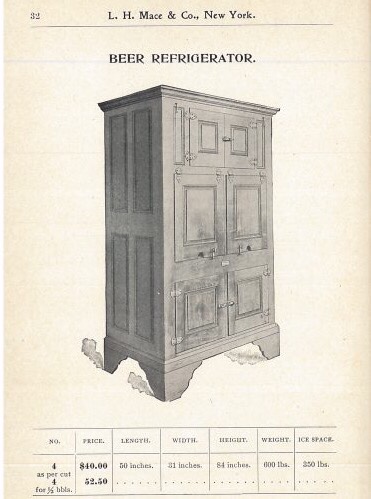
And while I know just barely enough of Victoriana to say that feature X in Dr. Ogden’s dresses looks a little odd, or feature Y on that building appears historical, most of the time I’m guessing. It’s therefore nice to run into a historical detail that looks to have informed elements on the set, like this beer refrigerator from 1899:
The image comes from a catalog of by L. H. Mace & Co. of New York, currently in the Smithsonian Libraries collections. (It’s also very interesting to note that this fridge was actally sold and marketed as a beer fridge, specifically.)
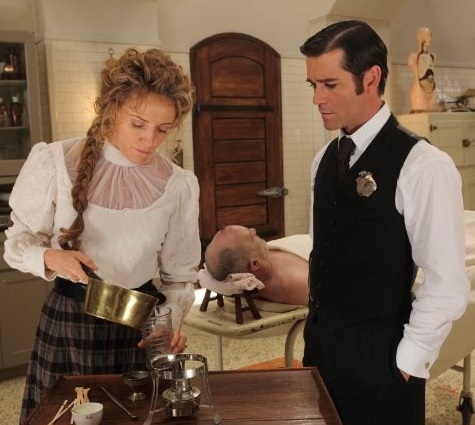
In the earlier Murdoch seasons, there used to be an ice cabinet for storing smaller body parts in addition to larger cadaver drawers. I don’t happen to have a screenshot handy, but fortunately the fridge appears in the background of a few random shots on the Internet: in the photo below, behind Dr. Julia Ogden and Detective Murdoch on the right…
…and behind Dr. Emily Grace in the photo below:
It looks almost identical to the L. H. Mace & Co. beer fridge. Really very, very cool!
It’s such a great detail it’s a shame that at some point when the set was re-decorated it seems not to have made the cut. I will have to try to get a better screenshot of it when we re-watch.













 Co-Geeking
You must be logged in to post a comment.