Tomyris: Standing for Women

The Greek historian Herodotus tells us a story about the death of the Persian king Cyrus that centers a fascinating female character, Queen Tomyris of the Massagetae.

Cyrus, king of Persia, wanted to expand his empire eastward into the lands of the Massagetae, a nomadic people ruled by their widowed queen Tomyris. Cyrus at first proposed marriage to Tomyris as a ruse for conquest, but she refused him. He then mustered his army and prepared to invade.

Cyrus’ adviser Croesus cautioned Cyrus against trying to fight the wild Massagetae, but since Cyrus was determined to proceed, Croesus proposed a stratagem to overcome them. Following Croesus’ advice, Cyrus led his army into Massagetae territory, then had them make camp and prepare a sumptuous feast with plenty of wine, but they did not eat it. He then withdrew with most of his army, leaving behind his weakest soldiers.

When a part of the Massagetae army led by Tomyris’ son Spargapises came upon the Persian camp, they easily defeated the Persian troops there. Then they saw the feast. Being used to living rough, they had never seen such an amazing spread of food before, so they immediately sat down and filled their bellies. When the feast had made them all drunk and sleepy, Cyrus led the rest of his army back to attack them, easily defeating the Massagetae warriors and capturing Spargapises.

When Tomyris learned of her people’s defeat and her son’s capture, she sent a message to Cyrus proposing a peaceful end to the conflict: if Cyrus returned Spargapises safe, Tomyris would allow the rest of Cyrus’ army to retreat from her lands unharmed. If he refused, Tomyris promised to satisfy his desire for blood. Cyrus refused, and when Spargapises came to his senses and found himself a prisoner, he killed himself.

Tomyris then marshaled the rest of her people and fell upon the Persians. The fighting was intense, but at the end of the day the Persians were routed and Cyrus himself was killed. Tomyris found the body of Cyrus and thrust his head into a wineskin full of blood, fulfilling her promise to slake his thirst for blood.

It’s a good story, as many of Herodotus’ are, but what are we to do with this as historical evidence? Did any of these events happen? Did Tomyris even exist?

We have reasons to be skeptical. No other historian mentions Tomyris, not even other historians who wrote about the life of Cyrus. The story Herodotus tells is full of dramatic moments that sound like they come from a Greek tragedy rather than from history. Cyrus figures as the tragic hero, a noble leader driven by ambition to attempt something that wiser men warn against and meeting an ironically fitting end. Tomyris’ line about sating his thirst for blood is a bit too on-the-nose to be real. Does anything in this story hold up?

The Massagetae at least were a real people, known from plenty of other sources, one of many nomadic cultures of the Central Asia steppes. Ancient sources are uncertain about their location, placing them anywhere between the Caspian Sea and the Altai Mountains, although whether this variation reflects the migrations of a mobile people, smaller sub-groups joining and leaving a tribal coalition, or just the ignorance of Mediterranean writers about the geography of Central Asia is hard to say. Among many ancient steppe cultures, women could wield both weapons and power. The idea that Cyrus died while leading an unsuccessful campaign against steppe nomads is likely to be true, and it is plausible that those people might have been ruled by a woman.

The rest of Herodotus’ narrative has more to do with Greek literature and oral tradition than with historical events, but that narrative also serves a larger point for Herodotus. Many powerful and wise women feature in Herodotus’ account of history. Tomyris is the first whose story he tells in detail, but she is followed by many others in both large roles and small, with Artemisia of Halicarnassus, who commanded her own ships in Xerxes’ invasion of mainland Greece, among the most prominent. Tomyris in some ways prefigures Artemisia: a wise warrior queen who gives the Persian king a chance to save himself from defeat and embarrassment, though he fails to heed her.

Tomyris appears near the beginning of Herodotus’ history, playing a role in the life of the first Persian king; Artemisia comes in at the end, taking her place next to the last Persian king to feature in Herodotus’ text. The repetition of the theme of the wise warrior woman at both the beginning of Herodotus’ history and at the end gives it a particular weight and prompts us to consider what point the historian was making. Herodotus’ text is layered with subtle messages, and many of the stories he tells have some applicability to the audience he was writing for. Herodotus lived and worked in Classical Athens, a society in which the status of women was low.

Women’s participation in Athenian social and political life was a casualty of democracy: since Athenian democracy was based on solidarity between citizen men across class lines, as manifested in all-male institutions like the voting assembly and the hoplite militia, the stronger the democracy was, the more women were pushed aside. Herodotus was a fan of democracy. His text points out how democracy, and especially the Athenian version of it, gave the Greek allies the strength and resilience to resist invasion by the monarchic Persian Empire. At the same time, he also seems to have been warning his Athenian audience that by leaving women out of public life, they were squandering one of their most valuable resources.

While contemporary Greek philosophers and playwrights were denigrating women’s capacity for rational thought and scoffing at the idea of them playing a role in politics, Herodotus had a different message. In his narrative, women can both lead military forces to victory and give sound advice on political matters, two areas of life that Athenian women were barred from. Herodotus’ women keep their heads in a crisis, and powerful men would be better off if they listened to what women told them.

Tomyris may be a fictional or heavily fictionalized character, but she helps us understand a critique of Athenian democracy as framed by someone who both lived with and admired it.

Image: “Head of Cyrus Brought to Queen Tomyris” via Wikimedia (Museum of Fine Arts, Boston; c. 1622-1623; oil on canvas, by Peter Paul Rubens)

Envisioning Persepolis

Persepolis was the ceremonial capital of the Achaemenid Persian Empire. While other cities such as Babylon, Susa, and Ecbatana had royal residences and centers of administration, Persepolis was the symbolic heart of the empire. It was here that one of the central rituals of Achaemenid rule was carried out, the annual presentation of gifts from the peoples of the empire to the king.

Early Persian kings, like Darius I and Xerxes I, built up the palace at Persepolis into an impressive monument suitable for the ceremony. Persepolis was meant to be both imposing and welcoming, asserting the king’s power while also embracing the diverse peoples of the empire in a peaceful ritual in which they were treated as valued members of the empire, not defeated subjects.

It was in part because of Persepolis’ symbolic significance that Alexander the Great burned the palace in his conquest of Persia. The site of the palace was not reoccupied but was left in ruins, which has allowed modern archaeologists to reconstruct the Achaemenid palace in significant detail.

The stills below come from a video exploring a digital reconstruction of the palace, which can be viewed on Wikipedia.

In a wide view, we see the palace complex as it stood at the edge of the hills. The large columned hall in the center is the apadana or throne room where the king received the delegations of gift-bearers from around the empire. To the left is the Gate of All Nations, through which the procession of gift-bearers entered the complex, and to the right are the buildings of the treasury where the ceremonial gifts were stored after the ritual was completed.

A view of Persepolis, still from a video by ZDF/Terra X/interscience film/Faber Courtial, Gero von Boehm/Hassan Rashedi, Andreas Tiletzek, Jörg Courtial via Wikipedia

From a ground-level view we see the Gate of All Nations, erected by Xerxes, which gave admission to the courtyard before the apadana.

The Gate of All Nations, still from a video by ZDF/Terra X/interscience film/Faber Courtial, Gero von Boehm/Hassan Rashedi, Andreas Tiletzek, Jörg Courtial via Wikipedia

Another ground-level view gives us an idea of what it would have been like to approach the apadana, with some human and animal figures for scale.

The north porch of the apadana, still from a video by ZDF/Terra X/interscience film/Faber Courtial, Gero von Boehm/Hassan Rashedi, Andreas Tiletzek, Jörg Courtial via Wikipedia

The whole video is well worth a watch. It can be quite valuable to try to imagine ancient spaces not as the ruins we find them in today but as living places filled with life and activity.

A Preview of The Greco-Persian Wars

I am pleased to announce that my second book, The Greco-Persian Wars: A Short History with Documents, is coming out in just a few days. This book tells the story of the wars between Greeks and the Persian Empire in the early fifth century BCE through translations of ancient documents.

While the wars of the early fifth century in Greece dominate modern histories of Greco-Persian interaction, they were only part of a larger history in which the main actors were not Greeks but Persians, and whose events played out not simply in Greece but across the eastern Mediterranean. Looking at a broader history allows us to put the Greco-Persian Wars into a more meaningful context. The story of Persia’s engagement in Greece is not one of East-West cultural clashes or Greek ascendancy, but of Persia’s success in adapting to the challenges of an unstable, frequently violent frontier region, and that is the history my book explores.

This book features over eighty-five separate selections translated from Greek, Old Persian, Elamite, Akkadian, Hebrew, Aramaic, Egyptian, and Lycian, each with contextual notes. They are accompanied by a short historical introduction, a glossary, a chronology, maps, and a select bibliography.

Here is a selection from one of the documents. In this text, set some hundred years after the famous battles of Marathon, Thermopylae, Salamis, and Plataea, we see how complicated relations between Greeks and Persians remained. This text is a useful reminder that we have to think not of relations between Greece and Persia but between Greeks and Persians. On both sides, individuals had their own motivations and interests that could lead to unexpected alliances and tricky rivalries.

* * *

Friendship and its complications

Xenophon, Hellenica 4.1.31-39

Relationships of xenia, or guest-friendship were a traditional way in which Greek aristocrats formed personal relationships across the boundaries of the polis. Similar relationships were also extended to Persians who dealt with the Greek frontier. While these relationships could be channels for diplomacy and political negotiation, they could also create conflicting loyalties. The exchange between the Spartan king Agesilaus—at that time ravaging the Persian-held territories in Ionia—and the satrap Pharnabazus in 395 or 394 BCE shows both the potentials of xenia and its dangers.

First they greeted each other and Pharnabazus held out his right hand. Agesilaus clasped it. Then Pharnabazus spoke first, since he was the elder.

“Aegsilaus, and you other Spartans here,” he said, “I became your friend and ally when you were fighting the Athenians. Not only did I support your fleet with money, but I myself fought alongside you on horseback and we drove your enemies into the sea together. You cannot accuse me of ever having played you false, like Tissaphernes. Yet despite this, you have now left my land in such a state that I cannot even feed myself, unless I gather up the scraps you leave behind like an animal. All the beautiful houses and woods full of trees and beasts that my father left me, which I used to enjoy so much, I now see either cut down or burned up. Well, if I don’t know what is righteous and just, you tell me how these are the acts of men who know how to repay favors.”

The thirty Spartans were ashamed and said nothing, but then after a time Agesilaus spoke up.

“Pharanbazus,” he said, “I think you understand that in the Greek cities, people also become guest-friends to one another. But when their cities go to war, such people fight on behalf of their homelands against their friends, and even kill them, if it should so happen. In the same way, since we are now at war with your king, we are compelled to treat everything of his as enemy territory. However, we would think it the best thing in the world to become your friends. Now, if it were a matter of throwing off the king to be ruled by us instead, I certainly would not advise it, but if you side with us now you will have the chance to flourish without having any master or humbling yourself to anyone. I think freedom is, after all, worth any amount of money. Even so, we are not urging that you should be free and poor. Rather, by taking us as your allies, you will increase your own power, not the king’s, and by subduing those who are now your fellow slaves you will make them your own subjects. You will become both free and rich—what else could you need to have perfect happiness?”

“In that case,” said Pharnabazus, “shall I tell you plainly what I will do?”

“That would be a good idea,” said Agesilaus.

“Well then,” he said, “if the king sends another general here and makes me subordinate to him, I will gladly become your friend and ally. On the other hand, if he gives the command to me, ambition is such a powerful force that I will fight you to the best of my ability.”

When he heard these words, Agesilaus grasped Pharnabazus’ hand and said:

“My dear friend, I hope you will be our ally! But know this: I will leave your territory now as quickly as I can, and in the future, even if the war continues, we will leave you and your land alone as long as we have other foes to fight.”

That was the end of the meeting, and Pharnabazus mounted up and rode away, but his son Parapita, a fine young man, stayed behind. He ran up to Agesilaus and said:

“Agesilaus, I make you my guest-friend.”

“For my part, I accept,” Agesilaus replied.

“Remember it,” said Parapita. He at once gave the beautiful javelin he was carrying to Agesilaus. In return, Agesilaus took a splendid decoration from the horse his secretary Idaeus was riding and gave it to Parapita. Then the young man leapt upon his horse and followed after his father.

* * *

If you’ve found some of my previous posts about Persians, life in the Persian Empire, and the complicated relationships between Persians and Greeks interesting, you may enjoy The Greco-Persian Wars.

The Greco-Persian Wars: A Short History with Documents comes out February 24th from Hackett Publishing.

Hardcover: $49 / Paperback: $18 / e-book versions available

You can pre-order directly from Hackett or on Amazon or Barnes and Noble, or from your local bookseller.

Image: Greco-Persian Wars paperback cover by Hackett Publishing

Announcements from your hosts.


Well-Dressed Immortals

Very few works of art survived from ancient times with color intact, which can make it hard to imagine just how richly colorful the world may have been in the past. So we’re fortunate to have this frieze of Persian soldiers in glazed brick survive with so much visible color, especially the richly patterned details of their robes. These soldiers, depicted on the Persian kings’ palace at Susa, probably represent the professional core of the Persian army, popularly known as the Immortals.

The brightly patterned robes these soldiers wear may be a ceremonial dress more suited to putting on a display at court than to campaigning on the wild frontiers of the empire, but it is interesting to note that the Greek historian Herodotus makes special mention of the clothing of Persian soldiers when praising the bravery of the Athenian and Plataean soldiers who faced them at Marathon:

These were the first Greeks we know of to charge into battle, and also the first to look on men in Persian clothing unshaken, for up to this time even hearing the name of the Persians had struck the Greeks with terror.

– Herodotus, Histories 6.112

(My own translation)

The Persians were well aware of the use of spectacle for political purposes. It may well be that Persian soldiers dressed to impress when on campaign as well in order to intimidate their opponents, for much the same reasons that the British army of the eighteenth and nineteenth centuries loved to put their bright red coats on display in formation.

Image: Immortals relief from the palace at Susa, photograph by mshamma via Wikimedia (currently Pergamon Museum, Berlin; 5th c. BCE; glazed brick)

History for Writers looks at how history can be a fiction writer’s most useful tool. From worldbuilding to dialogue, history helps you write.

Artemisia: Between Greece and Persia

We know little about the life of Artemisia I (early 5th c. BCE – ca. 460 BCE) apart from one event, but that event and her participation in it give us a valuable insight into how Greeks lived at the frontiers of the Persian Empire.

Artemisia was the daughter of Lygdamis I, the first satrap of the city of Halicarnassus under Persian rule. Halicarnassus was a city on the coast of Anatolia, modern-day Turkey, one of many culturally Greek cities on the eastern shore of the Aegean Sea in the region more broadly known as Ionia. Like other such cities, Halicarnassus’ population was a mixture of local peoples—mainly Carians from the surrounding mountains, in the case of Halicarnassus—and the descendants of Greek settlers and merchants who had migrated to the Anatolian coast over several centuries. Artemisia’s family was a product of such interactions, as her father, Lygdamis, was of mixed Greek and Carian ancestry, and her mother was from Crete.

Lygdamis passed his power down to Artemisia’s husband, of whom we know nothing else except that he died soon thereafter, and Artemisia herself came to power in his place, probably acting as regent for their young son Pisindelis. Artemisia ruled Halicarnassus as a satrap, or local governor, on behalf of the Persian kings. Her most famous deeds came in this role.

When the Persian king Xerxes mounted his invasion of Greece in 480 BCE, he called upon the Ionian Greek cities to furnish warships for the campaign. Despite Athenian efforts to persuade the Ionians to defect or hold back in the fighting, Ionian Greek ships and their crews participated eagerly in the Persian invasion.

As satrap of Halicarnassus, Artemisia had the responsibility to furnish her share of ships for the fleet, but she went even further, personally commanding her own contingent and serving Xerxes as an adviser during the campaign. The historian Herodotus describes her this way:

She led the forces of Halicarnassus, Cos, Nisyurs, and Calyndus, crewing five ships. Of all the ships in the fleet, besides the Sidonians, hers were considered to be the best, and of all the allies she gave the king the best advice.

– Herodotus, Histories 7.99

(All translations my own)

Herodotus credits Artemisia with an exceptional display of skill and cunning in the midst of the Persian naval defeat at the battle of Salamis:

I cannot say exactly how any other ship, whether Greek or barbarian, did in that battle, but this is what happened to Artemisia and won her even greater respect in the eyes of the king. The Persian fleet was in chaos and an Athenian ship was bearing down on Artemisia’s. There was nowhere for her to flee to since her ship was hemmed in by friendly ships and close to the enemy lines, so she made a decision which turned out very well for her. Pursued by the Athenian, she rammed a friendly ship at full speed. This ship was crewed by the Calyndians and carried not only many Calyndian men but also their king, Damasythimus. I cannot say whether there had been some quarrel between Artemisia and Damasythimus when they were stationed at the Hellespont, or if she had planned to attack him, or if it was just by chance that the Calyndian ship was nearby. In any case, when Artemisia rammed and sank that ship it turned out well for her in two ways. In the first place, when the Athenian captain saw her ship sink one of the barbarians, he thought she was either on the Greek side or was coming over to their side, so he broke off and turned his attention elsewhere, and so she got away. In the second place, even though she was doing harm to his own fleet, she won high praise from Xerxes.

They say that as the king was watching the battle and saw her ship ram the other one, someone by his side said: “My lord, do you see what a good fight Artemisia is putting up and how she has sunk one of the enemy’s ships?”

The king asked it if was really Artemisia and the bystander confirmed it, since he knew the markings of her ship well and assumed that the ship she destroyed must be an enemy. As I said, all this turned out to her benefit, since no one from the Calyndian ship survived to accuse her.

In response to this observation, it is reported that Xerxes remarked: “My men have become women, and my women have become men!”

– Herodotus, Histories 8.87-89

Artemisia displayed similar shrewdness when, after the defeat of his fleet, Xerxes consulted his advisers on how to continue the war in Greece. When the general Mardonius offered to remain in Greece and keep fighting while Xerxes himself returned to Persia, Artemisia offered this advice:

When consulted on the question of what to do, Artemisia said: “Sire, it is hard to give good advice in such a case, but what seems best to me is for you to march home and leave Mardonius and whatever troops wish to remain with him here, if he is willing to undertake this task. If Mardonius is successful and accomplishes what he says he can, the credit for it will belong to you, since he is your servant. If he is wrong and things go against him, it will be no great disaster for you and your house. As long as you and your line endure, the Greeks will often face great struggles, and no one will much care if anything happens to Mardonius, nor will defeating your servant count as a great victory for the Greeks. You, however, will depart having accomplished what you set out to do, which was to burn Athens.”

Xerxes was delighted with this advice, since he had been thinking exactly the same thing. He was gripped with such fear that he would not have stayed in Greece even if all the men and women in the world had recommended it. He thanked Artemisia for her advice and entrusted her with taking his children to Ephesus, since he had some of his illegitimate children with him.

– Herodotus, Histories 8.102-103

Now, Herodotus—a fellow Halicarnassian—may be accused of partiality and playing up Artemisia’s involvement in the war effort, but the kinds of deeds he attributes to her are telling. Artemisia was actively engaged in Xerxes’ war, but she was also politically canny and willing to seize her own advantage when it came. Given the opportunity to demonstrate her utility to the king, she took it and personally led her forces as part of the Persian fleet. Finding herself in a difficult position in battle, she saved herself at the cost of a friendly ship. When consulted for her advice, she told the king what he wanted to hear and was rewarded with an important commission.

Many Greeks were in positions like Artemisia’s when it came to the Persian Empire. Persia was large, powerful, rich, and right at the Greeks’ doorstep. Persia was a huge market both for Greek exports and for the services of Greek artists, crafters, and mercenaries. For all that historians have tended to celebrate the Athenians and Spartans for resisting Persian invasions in 490 and 480-479, far more Greeks worked for the Persian kings than ever fought against them.

The boundary between Greece and Persia was porous. Many people went back and forth across it as their own interests dictated. While modern narratives have tended to paint the division between Greece and Persia in stark terms, the reality was much more gray than black and white. Not everyone who negotiated the space between Greece and Persia did it with the skill and panache that of Artemisia, but she was far from alone.

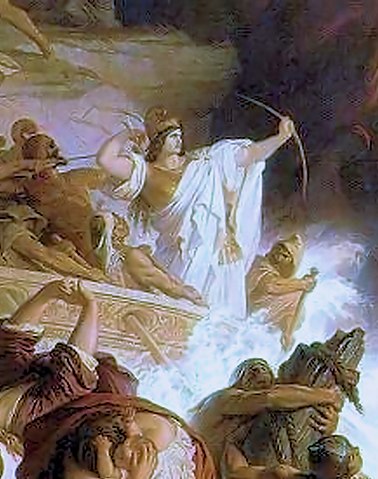
Image: A modern artist’s impression of Artemisia, detail from “Die Seeschlacht bei Salamis” via Wikimdeia (Maximillianum, Munich; 1868; oil on canvas; by Wilhelm von Kaulbach)

History for Writers looks at how history can be a fiction writer’s most useful tool. From worldbuilding to dialogue, history helps you write.

The Strange Poetry of an Index

One of the tricks of the trade in academia is: when you pick up a new book, look at the index first. Seeing what terms appear there and which ones have large numbers of references tells you a lot about what the book is about.

I’ve been working on the index to my latest book, a collection of primary sources on the Greco-Persian Wars. Most of the entries are proper names for people, places, and institutions, and their specificity tells you pretty clearly the topic of the book. If you take those out, though, the terms that are left have a strange kind of poetry about them. You could let your imagination wander and dream up some very different books that had these terms in their indices. For your enjoyment:

animals, archers

beer, bees, bread, brick, bridges, bulls

canals, cannibalism, carnelian, cattle, cavalry, chariots, childbirth, clothing, colonies, crown, cuneiform

democracy, diplomacy, disease, dreams

earth and water, earthquakes, esparto, exiles

forgery, fowl, frankincense, frontiers

gifts, goats, gold, grain, guest-friendship

hair, helots, heralds, heroes, hoplites, horses, hostages

incense, ivory

labor, language, lapis lazuli, laws, linen, lions

medicine, mercenaries, merchants, moon, mules, multiculturalism, mummification

oil, ointment, oligarchy, oracles

palaces, papyrus, phalanx, pomegranates, poultry, propaganda

racing, rain, religion, roads

sacrifice, satraps, satrapies, sheep, shields, ships, shipwrecks, sieges, silver, storms, stone

temples, tolerance, tombs, trade, translation, tribute, triremes, turquoise, tyrants

walls, water, wind, wine, wood

How It Happens is an occasional feature looking at the inner workings of various creative efforts.

A Gift of Water

Sometimes the smallest gestures can mean the most, even to people who already have a lot. Here’s a story told about the Persian King Artaxerxes II and how he graciously received a humble gift.

Once when people were presenting him with various gifts along the road, a poor farmer who could come up with nothing else at the moment ran to the river, scooped up water in his hands, and offered it to the king. Artaxerxes was so delighted that he sent the man a golden cup and a thousand darics.

– Plutarch, Life of Artaxerxes 5.1

(My own translation.)

A daric was a golden coin worth about a month’s pay for a soldier or skilled artisan. A thousand darics was an unimaginable fortune to a poor farmer.

Like most such anecdotes, this story may or may not be true. Plutrach tells it as an illustration of Artaxerxes’ good-natured personality. Still, it makes a good illustration of the point that what matters isn’t always how much you can do for other people but your willingness to do what you can.

Serving exactly what it sounds like, the Quotes feature excerpts other people’s thoughts.

The Persian Version

We know the story of the Greco-Persian Wars very well from the Greek side of things, especially from Herodotus whose Histories is all about the conflict. Modern histories have tended to tell the story the same way the Greeks told it—as a triumphant victory of hardy, democratic Greeks over soft, despotic Persians—in large part because we have no Persian version for comparison.

Even though we don’t have a Persian account comparable to Herodotus, however, we do have a hint as to how the wars may have been remembered inside the Persian Empire. This hint comes from a second-hand story reported several centuries after the fact by the Greek rhetorician Dio Chrysostom:

I heard a Mede say that the Persians do not agree at all with the Greeks’ version of events. Instead, he said that Darius sent Datis and Artaphernes against Naxos and Eretria, and that after capturing these cities they returned to the king. A few of their ships—not more than twenty—were blown off course to Attica and the crews had some kind of scuffle with the locals. Later on, Xerxes made war on the Spartans. He defeated them at Thermopylae and slew their king Leonidas. Then he captured the city of Athens, razed it, and enslaved those who did not flee. When this was done, he made the Greeks pay him tribute and returned to Asia.

– Dio Chrysostom, Discourses 11.148-149

(My own translation)

This version of events is not exactly wrong. The basic sequence matches up with our other evidence: in 490 BCE, King Darius sent a campaign against Greece that successfully captured the cities of Naxos and Eretria, but was defeated at Marathon and failed to take Athens. Ten years later, Darius’ son and successor Xerxes led an invasion of Greece which defeated a small Spartan-led holding force at Thermopylae and killed the Spartan king Leonidas, then captured and burned Athens. Numerous Greek cities became tribute-paying subjects of Persia rather than fight Xerxes’ force.

The only real differences between this Persian account and the Greek legend are the ways it emphasizes successes and downplays defeats. The battle of Marathon becomes a mere fistfight between a few stragglers and some local color. The capture and destruction of Athens is celebrated, even though the aim of the campaign was to absorb Athens into the empire, not just burn it and leave. The Persian kings could rightly say that they had made a significant show of force against the Greeks, while leaving out the fact that they hadn’t quite achieved what they set out to. As spin goes, this isn’t spun too far.

We know the Greek stories about the wars so well that we can easily see the places where the Persians seem to have burnished their memories, but that observation should also make us question the Greek stories themselves. If Persians could tweak their story to make themselves look better after the fact, what’s to say that the Greeks didn’t do the same? If we had a fuller Persian account of the conflicts in Greece, we might well find plenty of places where Herodotus and his fellow Greeks had played up their own successes and swept some embarrassing missteps under the historical rug.

Image: A Persian “Immortal,” selection from photograph by Mohammed Shamma via Flickr (currently Pergamon Museum, Berlin; 5th c. BCE; glazed brick) CC BY 2.0

History for Writers looks at how history can be a fiction writer’s most useful tool. From worldbuilding to dialogue, history helps you write. Check out the introduction to History for Writers here.

Trailer for Tomiris

Apparently, there is a Kazakhstani movie on the historical female leader Tomyris of the Massagetae, and we also have a trailer with English subtitles:

TOMIRIS – Official trailer (HD) (English subtitles) by SATAIFILM on YouTube

We know for sure that Tomyris fought Persians in the 500s BCE, but as far as we know she did not unite all the people of the steppe as the movie claims. Well, it wouldn’t be the first movie to play fast and loose with history.

At this writing, IMDB only has the most rudimentary information and gives the year 2019 for release. Director Akan Satayev’s credits include a dozen or so writing and producing projects, mostly local and directed at a decidedly non-English-speaking audience.

It’s possible, then, that Tomiris will also remain outside of the Anglo-American market. I, for one, would find that sad, for the production looks really interesting (although I could do with a little less blood flying around).

Come to think of it, I should have a look to see if I can find any movies of ancient Persia or thereabouts. Anything you can suggest would be welcome!

Found via Helsingin Sanomat (NB. Finnish only).

Hey, look! We found a thing on the internet! We thought it was cool, and wanted to share it with you.

Wine and Sheep for a Princess

Administrative records from the Persian Empire preserve some evidence of a lady of the royal court gathering resources, probably in preparation for a feast:

A message to Yamaksheda, the wine carrier, from Pharnaces: Issue 200 marrish [about 2,000 liters] of wine to Princess Artystone. By the king’s order.

First month of the nineteenth year [March or April, 503 BCE]. Ansukka wrote the text. Mazara conveyed the message.

– Persepolis Fortification Texts (published) 1795

A message to Harriena, the herdsman, from Pharnaces: King Darius commanded me in these words: “Issue 100 sheep from my estate to my daughter, Princess Artystone.”

Now Pharnaces says: “As the king commanded me, I command you: Issue 100 sheep to Princess Artystone as the king ordered.”

First month of the nineteenth year [March or April, 503 BCE]. Ansukka wrote the text. Mazara conveyed the message.

– Persepolis Fortification Texts (collated) 6754

(My own translations.)

We can learn some interesting things from this evidence.

For one thing, it gives us a sense of how the Persian imperial bureaucracy worked. There were higher officials like Pharnaces who were responsible for overseeing the distribution of goods, scribes like Ansukka, messengers like Mazara, and lower officials in charge of particular categories of goods. Messages like these directed those who were lower down in the hierarchy to issue certain quantities of goods while at the same time keeping a record of what had been issued and where it came from.

Secondly, this is evidence for the scale on which elite Persian women could command economic resources. 2,000 liters of wine and 100 sheep cost no small amount of labor to produce. Artystone could, with her father’s consent, draw on the fruits of all that labor.

And finally: it looks like Artystone really know how to throw a party.

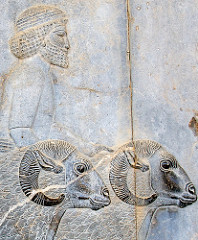
Image: Tribute bearer with rams, photograph by A. Davey via Flickr (Persepolis Apadana staircase; c. 518 BCE; stone relief). CC BY 2.0

History for Writers is a weekly feature which looks at how history can be a fiction writer’s most useful tool. From worldbuilding to dialogue, history helps you write. Check out the introduction to History for Writers here.