I find that this fall I need to go all out on coziness to try and offset some of the horrible in the world. My comfort browsing therefore includes several of the core aesthetics: cozycore, naturecore, forestcore, summercore, hobbitcore, cottagecore, and more.
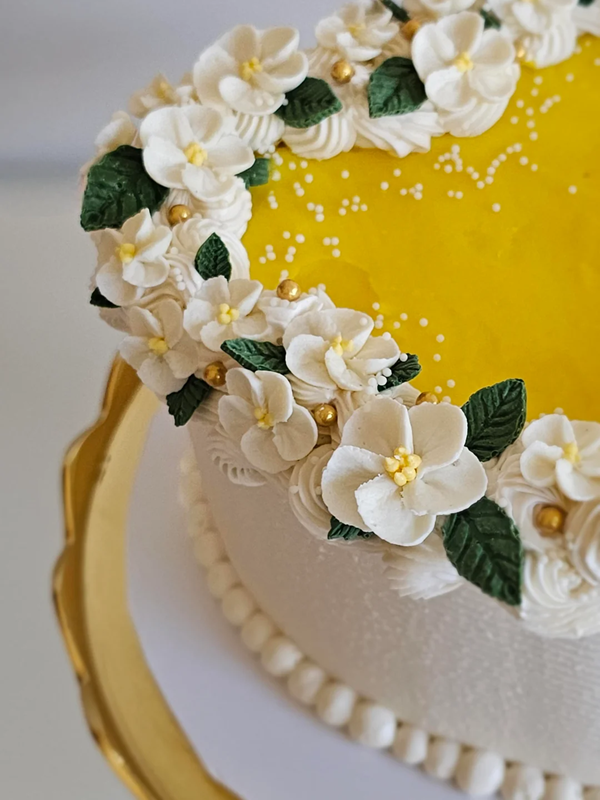
In addition to comfy things, now and then you find something simply stupendous. For instance, Reddit user Green-Cockroach-8448 makes just incredible, absolutely jaw-dropping cakes. Here are two examples that I adore:
The incredible thing is that she bakes as a hobby, not professionally. These results definitely do put some professional efforts to shame, they’re so astounding. My gast is thoroughly flabbered.
With these mouth-watering treats we wish a Happy Thanksgiving to our readers in the U.S.!
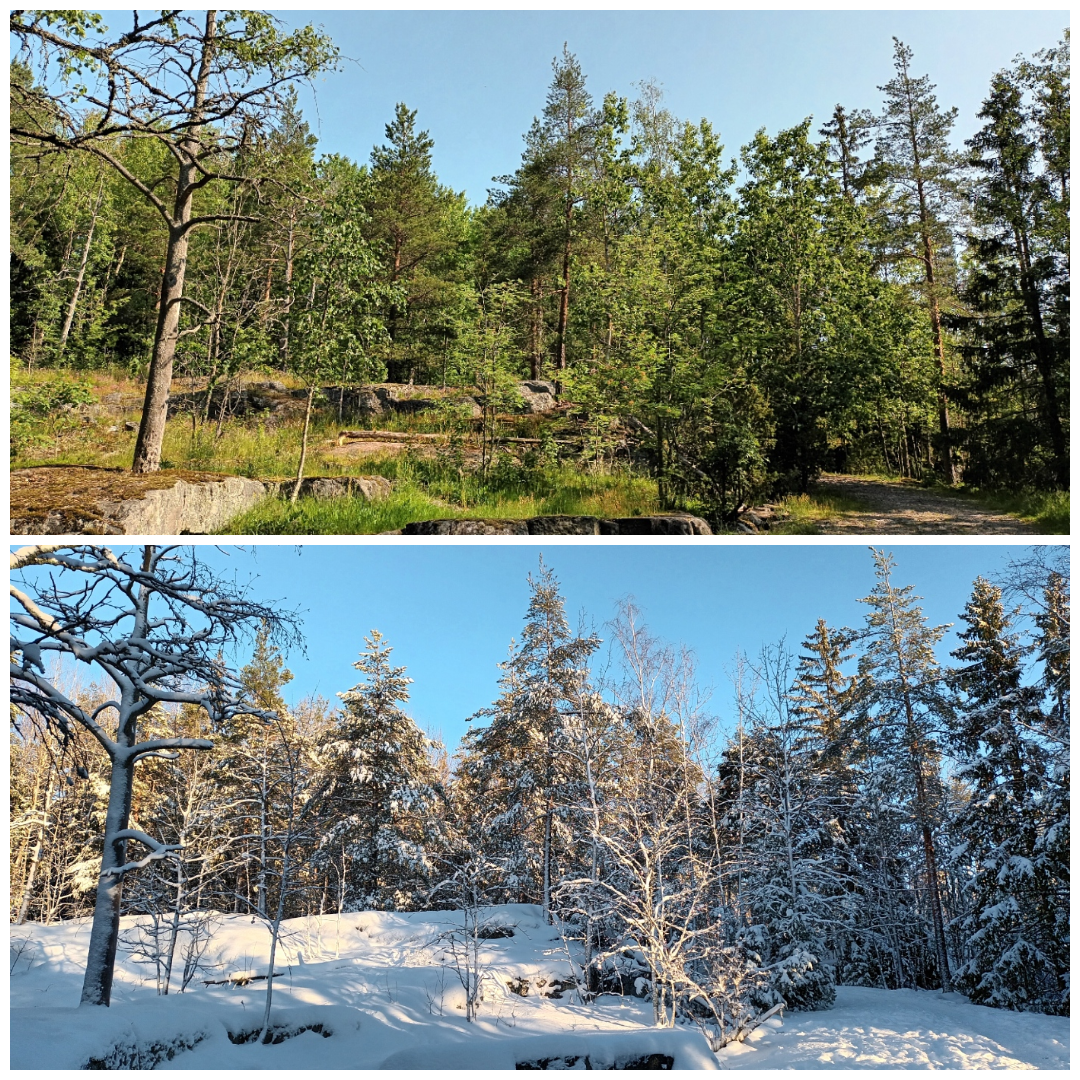
One of the things I love so much about living in Finland is the light. In every time of the year, the sunlight is beautiful, but the winter light and the summer light are so different from one another that it can be striking to see.
One day last winter we had a particularly beautiful day of clear skies and sunlight after a big snowstorm. I tramped out in our local woods and took a few pictures of the winter light on the snowy trees. Now that midsummer is here, I went back and took pictures of the same scenes to compare the summer and winter light.
Every season has its own special beauty.
Images by Erik Jensen
Out There highlights intriguing art, places, phenomena, flora, and fauna.
Living root bridges are an ingenious type of suspension bridge shaped from plant roots. They are common in the southern part of the Indian state of Meghalaya (in the northeast of the country), home for some of the wettest locations on Earth.
The Khasi and Jaintia communities who inhabit the region needed a low-cost way to cross the valleys and gorges in the rainforest during monsoon season. Living root bridges are sturdy and easy to build—albeit time-consuming—and apparently they withstand flash flooding and storm surges quite well.
“Building these bridges takes decades of work. It begins with planting a sapling of Ficus elastica – a tree that grows abundantly in the subtropical terrain of Meghalaya – in a good crossing place along the riverbank. First the trees develop large buttressing roots and then, after about a decade, the maturing trees sprout secondary aerial roots from further up. These aerial roots have a degree of elasticity, and tend to join and grow together to form stable structures.
“In a method perfected over centuries, the Khasi bridge builders weave aerial roots onto a bamboo or another wooden scaffolding, wheedle them across the river and finally implant them on the opposite bank. Over time, the roots shorten, thicken and produce offshoots called daughter roots, which are also trained over the river. The builders intertwine these roots with one another or with branches and trunks of the same or another fig tree. They merge by a process called anastomosis – where branching systems like leaf vessels, tendrils and aerial roots naturally fuse together – and weave into a dense frame-like structure. Sometimes, the Khasi builders use stones to cover the gaps in root structures. This network of roots matures over time to bear loads; some bridges can hold up to 50 people at once.”
Despite not having the capacity of bridges built entirely from man-made materials, the capabilities of living root bridges are nothing to sneeze at in the kinds of difficult terrains they’re used for. For example, the longest living root bridge is the Rangthylliang bridge at 50+ meters long. That kind of length makes for plenty of potential for similar live-plant-based bridges in speculative gaming campaigns or stories, from ad hoc methods of river crossing for an army or a group of refugees (with the help of plant-growth spells) to permanent structures for local communities.
Living bridges can also last for many hundreds of years in ideal conditions. Even if the oldest currently existing bridges were “merely” from the 1800s, it’s clear that that kind of longevity wouldn’t be possible without community building and traditions passed on and cherished. I.e., the structures solve a concrete problem in a way that both suits and takes advantage of local conditions. We humans tend to be smart like that. 🙂
Visual Inspiration pulls the unusual from our world to inspire design, story-telling, and worldbuilding. If stuff like this already exists, what else could we imagine?
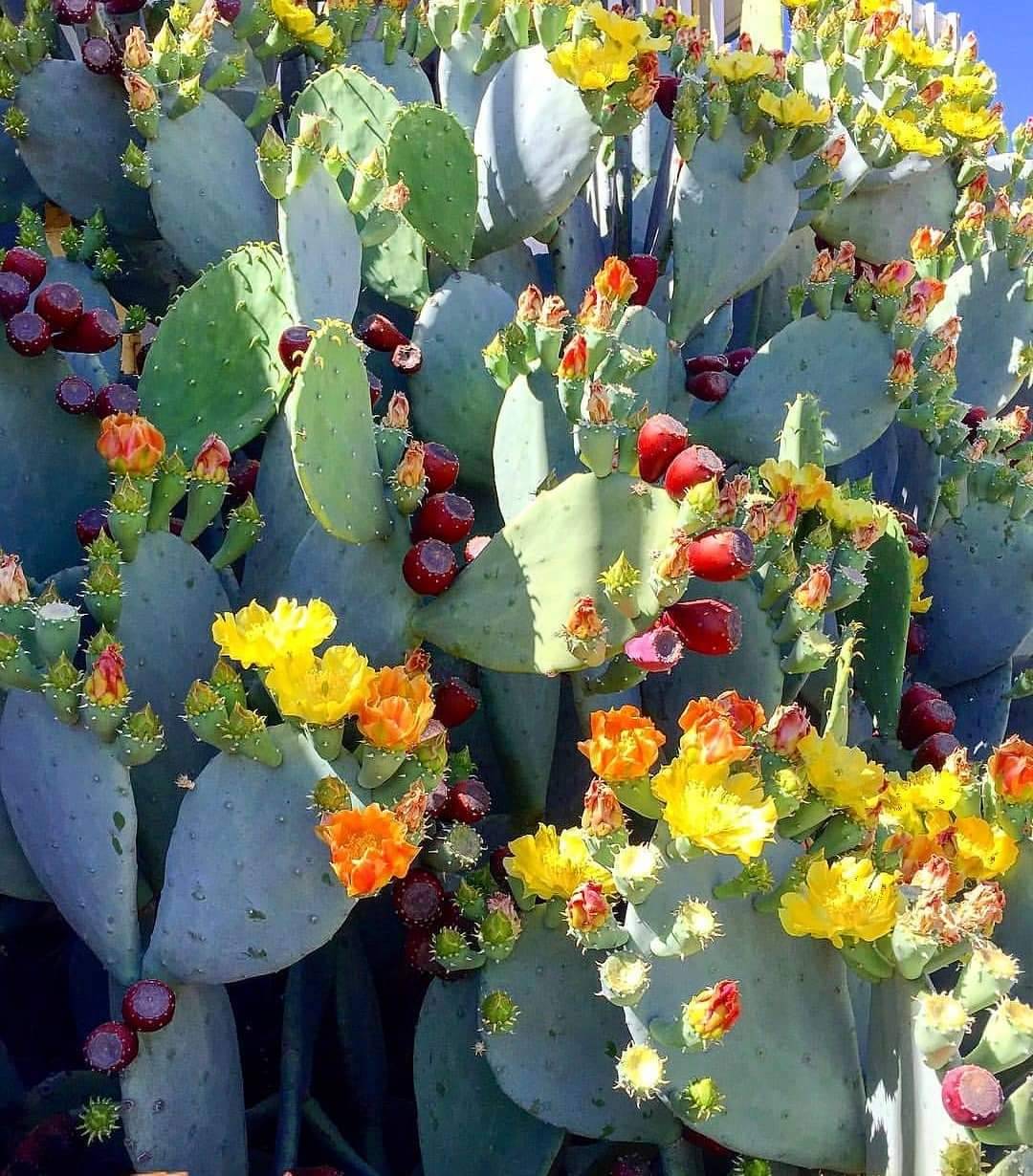
I grew up essentially on a flood plain. While I have visited a few, and know that a lot of deserts are not mostly smooth sand dunes like the Tatooine and Dune stereotype would have us believe, I’ve never actually experienced deserts as a living environment. This is a fabulous glimpse—especially after the long and cold winter Finland had this year.
The greater blue-eared glossy-starling (Lamprotornis chalybaeus) is a common bird in parts of Africa. It’s as handsome as handsome gets—absolutely gorgeous!
This stunning starling breeds in a band of land stretching from Senegal in the west coast all the way east to Ethiopia, and south again through eastern Africa to northeastern South Africa, northern Botswana, southern Namibia, and northern Angola. They live in subtropical forests, savanna, and shrublands.
I’ve always found the English name starling lovely—certainly lovelier than the Finnish one (kottarainen)—but the looks of the common starling haven’t, sadly, quite lived up to the name in my mind. Now, the greater blue-eared starling is quite something else! It would be so remarkable to see a turquoise-blue murmuration in a fantasy production, wouldn’t it?
The Visual Inspiration occasional feature pulls the unusual from our world to inspire design, story-telling, and worldbuilding. If stuff like this already exists, what else could we imagine?
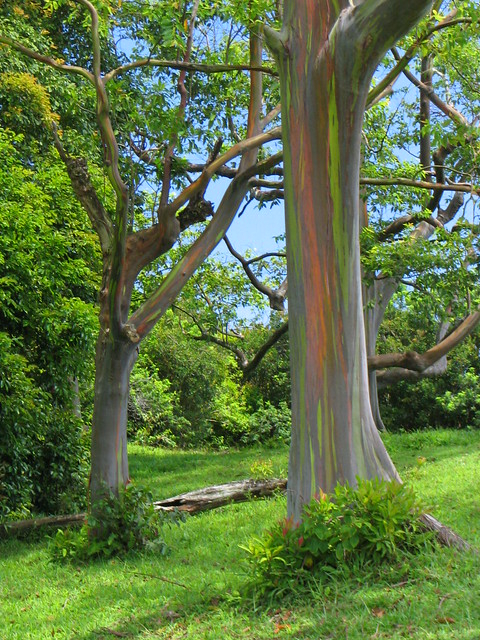
Rainbow eucalyptus trees (Eucalyptus deglupta) shed their bark at a strip at a time, and the tree trunks look stripy as a result. That’s not all, however—the stripe colors can vary surprisingly much. A freshly revealed area will look bright pale green, which then darkens and changes to orange, red, brown, and grey or blue.
Rainbow eucalyptuses are native to the Philippines, Indonesia, and Papua New Guinea, but have been planted elsewhere in suitable climates.
Amazing, aren’t they? I wonder whether the Weta artists looked at rainbow eucalyptus trees as an inspiration for their saturated, weird Mirkwood trees for the Hobbit movies. (They talked about the design in the behind-the-scenes documentaries; the movies as released are too dark to see the colors properly, if memory serves.)
Whiskered treeswifts (Hemiprocne comata) live in various subtropical or tropical forests in Southeast Asia.
They remind me of swallows, but are more colorful. Especially the combination of grey plus blue in the wings and back appeals to me.
Setting personal color preferences aside, wouldn’t it be so much more interesting to read a secondary world fantasy story with, say, messenger birds that look like whiskered treeswifts rather than the uninspired and unoriginal corvids?
Yes, corvids are AMAZING birds, but they’re used EVERYWHERE. Could they not be replaced by something else in a fantasy story? Or at least made vibrantly colored?
The Visual Inspiration occasional feature pulls the unusual from our world to inspire design, story-telling, and worldbuilding. If stuff like this already exists, what else could we imagine?
The mossy frog or Vietnamese mossy frog (Theloderma corticale) comes from Southeast Asia. (Apparently it’s known by many other names, too, like Tonkin bug-eyed frog, but that just sounds offputting, doesn’t it?)
Not the only animal with camouflage to play dead when threatened, the mossy frog does it cuter than others, if you ask me. Very effectively, too, if the photo below is any indication:
Just think if your fantasy role-playing game had a party of player characters traveling through a clearing in a wild, overgrown forest dotted with mossy boulders, which suddenly started moving… and turned out to be huge frogs! Or a secondary world story with villagers somewhere in the boonies struggling to catch and cook these abnormally large frogs before they eat the village’s harvest.
As a total side note: while writing this post I learned that one of the synonyms for camouflage is the phrase plain brown wrapper. I’ve no idea how I’ve never come across that before, but now I know it. It’s one of the joys of language learning to me: you never really stop picking up new words and expressions. 🙂
Images: On a stick by Smithsonian’s National Zoo and Rawpixel via Flickr (CC BY 4.0). Camouflaged by mamojo via Flickr (CC BY-SA 2.0).
Visual Inspiration pulls the unusual from our world to inspire design, story-telling, and worldbuilding. If stuff like this already exists, what else could we imagine?
Now that it’s cold again in the northern hemisphere, it doesn’t feel wrong to post about this phenomemon.
I discovered that in March 2022, storms in Sahara threw a lot of dust into the atmosphere, and winds carried it hundreds of miles away. Here’s a photo from a ski resort in the French Pyrenees, where the slopes were covered with a layer of reddish sand:
An amazing sight, isn’t it?
Although, as someone who’s grown up using sand and gravel on snow to stop motion, I do have to wonder at one thing: how on earth are you able to ski down these slopes?
(Being the wrong kind of Master of Science, I can only guess it has to do with the skier’s weight pushing the skis below the surface of the snow, therefore escaping the sand friction and still enabling skiing, but I don’t know.)
In September 2021, Photographer Dmitry Kokh visited the currently unoccupied Kolyuchin Island in the Chukchi Sea between Russia and Alaska, and documented some of the wildlife there. A bunch of polar bears seem to have settled in the abandoned buildings of a former Russian weather station.
You can see the bears casually stroll in between the houses, and apparently even spend time inside the buildings, often peeking out of the glassless windows. Astounding!







 Co-Geeking
You must be logged in to post a comment.