The Kindness of Sherlock Holmes

It’s a good time to be a Sherlock Holmes fan. There are now plenty of adaptations to choose from. There’s the BBC’s Sherlock if you like visual inventiveness and whip-crack dialogue. For a more traditional procedural that does interesting things with characters, there’s CBS’s Elementary. For Hollywood thrills you can go back a few years to the films starring Robert Downey Jr. as the great detective. For series in the Holmesian spirit without the same characters there’s the medical drama House or the mystery/comedy Psych.

However the setting may change, there are some key elements of Sherlock Holmes’s character that remain the same: the keen powers of observation and deduction, the cycles of intense focus on a problem and lethargic dissipation, the antisocial habits that make him near impossible to live with.

Oh, and Sherlock Holmes is a total jerk-ass.

160204sociopath

The standard interpretation of Holmes in modern media is that he is an asshole with no patience for anyone else, either because he’s not neurotypical in some fashion or because he just can’t be bothered to care about anything so pedestrian as decent manners. He gets away with it because he’s just so brilliant.

Well, lately I’ve been rereading the original Sherlock Holmes stories by Conan Doyle, something I’ve been meaning to do for years. I’ve gotten very used to the modern Holmes, so I was surprised to rediscover that the original Holmes wasn’t like that at all. In fact, Conan Doyle’s Holmes is compassionate and generous.

Continue reading

R.I.P. Alan Rickman

Actor Alan Rickman has passed. Apart from a fantastic Professor Severus Snape, Rickman brought to life both on stage and screen numerous other characters, including my favorite Colonel Brandon in the 1995 adaptation of Jane Austen’s Sense & Sensibility.

Sense & Sensibility – Weep You No More Sad Fountains via anotherrainbow2008

I also have fond memories of his performance as Alexander Dane / Dr. Lazarus in Galaxy Quest and the sheriff of Nottingham in Robin Hood: Prince of Thieves (with the unforgettable delivery of “Because it is dull, you twit, it’ll hurt more!”, on the desirability of a spoon as a torture device).

Rest in peace, sir. You will be missed.

Things I Can Do Without

We all have our storytelling pet peeves: the things that make us yell in frustration at the screen or put down a book in disgust. Some things have been done to death already and we want to see something new. Some things play on outdated assumptions and problematic tropes. Some are just lazy writing.

Misery loves company, so let’s share. Here’s a few of mine.
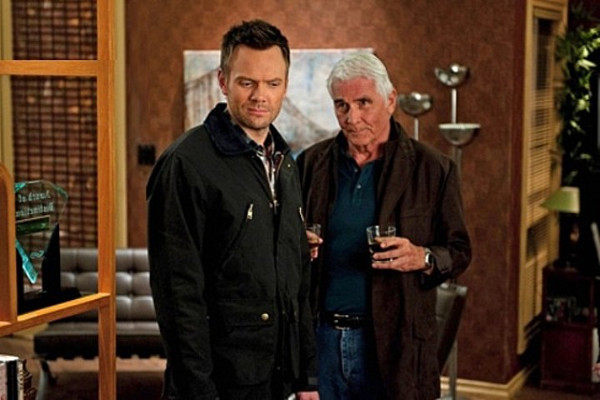
1. Fathers and sons who have a bad relationship.

A father who was never emotionally available to his son and is now disappointed in his son’s failure to live up to his expectations? A son who resents the pressure put on him to be like his father and craves the love and approval his father never gave him?

It’s been done. Really, it has. Everyone from Homer to Shakespeare to George Lucas has done it. That dead horse has been pounded into subatomic particles by now. There is nothing new to be said on the subject. Time to move on.


160107Kirk2. Heroes who have no plan

Or if they do have a plan, it depends on factors that the hero can’t control or predict.

This doesn’t mean that plans have to be perfect or go off without a hitch. You can’t control for everything. Plans have to change in response to unforeseen events. There can be plenty of good drama in the uncertainties of chance, and I’ll even take the occasional deus ex machina if it’s clever enough. But a hero who’s counting on the deus ex machina for victory? That’s right out.


160107Moriarty3. Villains who have no goal

A good villain has a goal they are trying to accomplish and a plan for achieving that goal. No matter how fiendishly complicated the plan, if the goal is just to indulge a vaguely sexual obsession with the hero, something has gone wrong in the writing.

“Annoy the hero and force them to play with me” isn’t a goal, it’s a toddler tantrum.
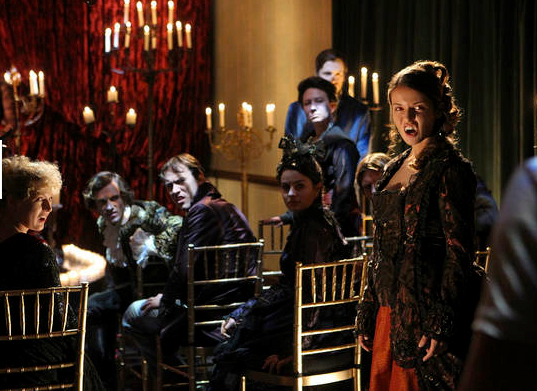
160107CSI4. Weirdos who can’t tell fantasy from reality

A terrible murder has happened at an SFF convention. When the police show up to question witnesses, the bystanders refuse to speak English and answer all their questions in Klingon. It turns out a vampire cosplayer killed a werewolf LARPer. Why? Because vampires hate werewolves! No other motive required!

This one isn’t just lazy writing, it’s insulting. The usual targets are fandom or kink communities, but anyone who isn’t in the mainstream can be a victim. I’m a history professor. According to popular media, that means I must show up in class wearing a toga and insist that my students address me as “emperor.”

Writers of the world: the inability to distinguish reality and fantasy is a sign of a serious mental illness. It is not how those of us who belong to non-mainstream interest groups go through life.


160107Se7en5. “Gimmick” serial killers

This one is really just the intersection of 3 and 4, but it shows up often enough to merit special mention. These are the characters who kill people as part of some elaborate symbolic game. “My God, the killer is targeting people whose names are anagrams of Alice in Wonderland characters and staging their bodies to look like scenes from Rogers and Hammerstein musicals, and they’re doing them in reverse alphabetical order when translated into Albanian!”

That sound you hear is my suspension of disbelief repeatedly slamming its head into a wall in hopes of inducing a coma.


I could go on, but that’s enough from me for now. Your turn. Got something on your mind that you could do without ever reading or watching again? Share in the comments!

Images: Community via ScreenCrush. Kirk via Memory Beta. Moriarty via Baker Street. CSI Blood Moon via dkompare. Se7en via Crash/Burn

Story Time is an occasional feature all about stories and story-telling. Whether it’s on the page or on the screen, this is about how stories work and what makes us love the ones we love.

The Abominable Sherlock

We saw The Abominable Bride on the big screen yesterday, a few days after Europe. (It aired in UK on January 01, 2016.) Unfortunately, I got barely any sleep last night, so these preliminary thoughts are probably very ramble-y and incoherent, but here we go.

And note: SPOILER ALERT. I will also assume that you’ve seen all the preceding seasons and TAB itself.

Continue reading

Final Star Wars: Episode VII Mood

In our area, there were Episode VII showings pretty much continuously starting from 7 p.m. last night. I was ever so briefly tempted to go from viewing to viewing straight through the night. But no.

FB The Dark Side of Force 5 More Mins

No, we didn’t go.* Instead, we’re about to head out to a noon showing. It remains to be seen how many others we’ll have to fight for seats decided to wait till daytime on the official release day.

How early did you see The Force Awakens? Do tell!

*) I think we’re both at that stage where, rather than do something right the moment it’s possible, we prefer to take our creature comforts into consideration. (Especially sleep, much like an old cat. Yay for old cats!)

Image via The Dark Side of the Force on Facebook

Hey, look! We found a thing on the internet! We thought it was cool, and wanted to share it with you.

The Return of the Bread Pudding

For our final Star Wars rewatch, here’s a sweet but simple bread pudding.

The Return of the Bread Pudding

Ingredients

  • Stale bread, any kind, enough to make 4-5 cups loosely packed cubes
  • 4 egss
  • 1 tablespoon rum
  • 1/4 cup sugar
  • 1 teaspoon cinnamon
  • 1 teaspoon nutmeg
  • 3 cups milk

Cut the bread into chunks and press into a buttered baking dish until well packed in.

Beat the eggs, rum, sugar, and spices together until well mixed.  Add the milk and beat well.

Pour the milk mixture over the breadcrumbs. Press down the top with a spatula or spoon to make sure the liquid is well distributed.

Let sit for half an hour, pressing again occasionally, until the liquid is thoroughly absorbed by the bread.

For best results, set the baking dish inside a larger dish of water to make a water bath, ensuring that the level of the water reaches up to the top of the pudding. If this is not practical, you can just bake the pudding in its dish, but be aware that the edges may get crusty.

Bake at 350F / 175 C for 1 and 1/4 hours.

Serve warm with ice cream or whipped cream.


Image by Eppu Jensen

Geeks eat, too! Second Breakfast is an occasional feature in which we talk about food with geeky connections and maybe make some of our own. Yum!

Our Star Wars Rewatch Project: Epsidode VI

Our Star Wars rewatch concludes with Episode VI – Return of the Jedi.

1. Best Fight

Eppu: The space battle above Endor! Epic! (Even if it’s modeled after aerial dogfights, but nostalgia…)

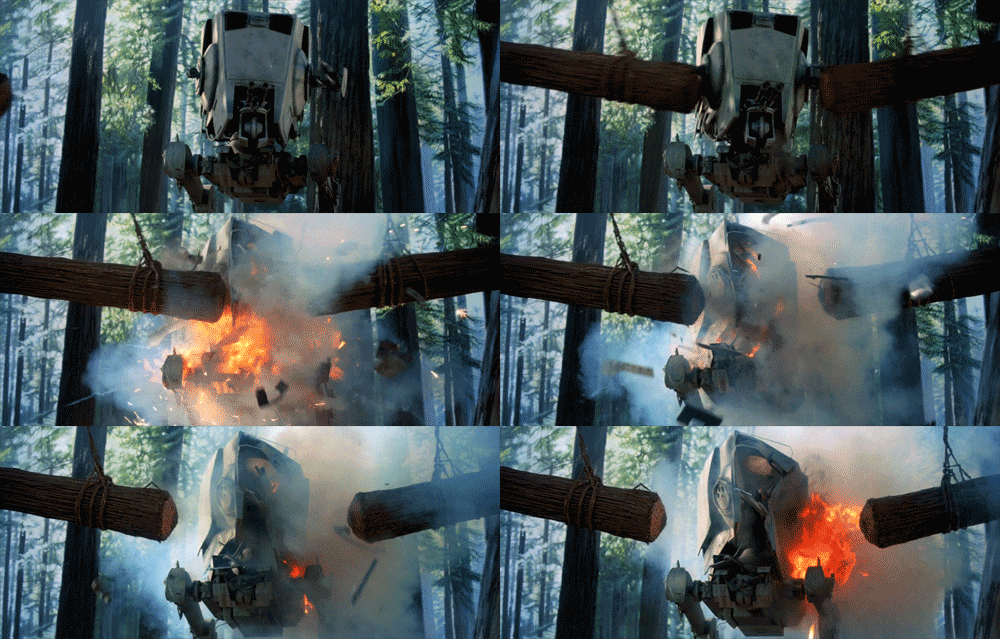
151217atstErik: Ewoks vs. stormtroopers. I know some people think it’s too silly, but I disagree. The rebellion vs. the empire was always a case of guts and inventiveness vs. industry and regimentation. The fact that the empire never even considered that the ewoks could be a threat was their undoing. Besides, there’s nothing like seeing an imperial walker get smushed between two dropping logs.

2. Best Line

Erik: “I don’t know. Fly casual.” Han’s approach to life in five words.

Eppu: “How are we doing?” Luke: “Same as always.” Han: “That bad, huh?”

3. Best Minor Character

Eppu: This may be a little corny, but Admiral Ackbar! (“It’s a trap!”)

Erik: The commander in charge of the Death Star construction. He seems like a well-organized, conscientious leader, just the sort of person you’d want to put in charge of such a huge project. Too bad he works for a genocidal totalitarian dictatorship.

4. Best Reveal

Erik: R2-D2 was carrying Luke’s lightsaber in Jabba’s palace all along. The moment that lightsaber handle pops up out of the droid’s top is the moment when “Luke, you naive idiot!” turns into “Luke, you cunning bastard!”

LG_CRACK lennongirl Han epi626

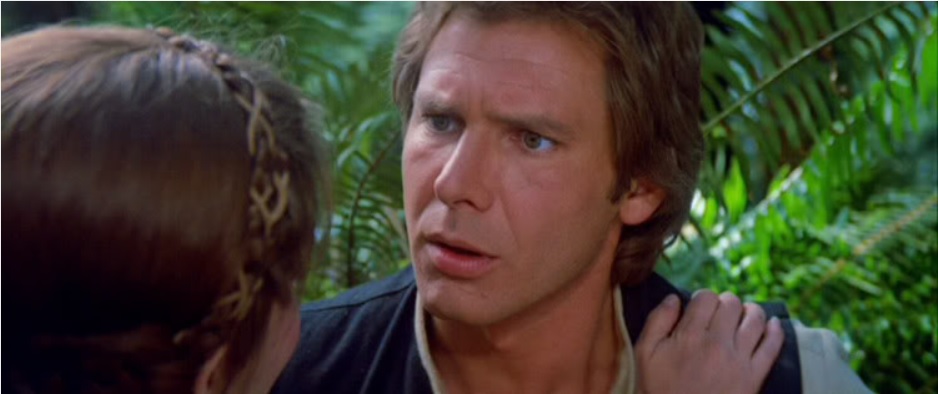
Eppu: A two-parter: Luke finds out on Dagobah that Leia’s his sister, and Leia tells Han that Luke’s her brother. Mostly the latter because of the expression on Han’s face (click, click, click… you can see the wheels turning).

5. Best Save

Eppu: Chewie and ewoks commandeering a walker on Endor and turning its guns against the Imperial troops. Pew pew!

Erik: Luke Force-floating C-3PO in the ewok village to convince the ewoks to let them go. C-3PO’s mid-air freak-out pushes it just far enough over the top to go from ridiculous to hilarious.

6. Best Visual

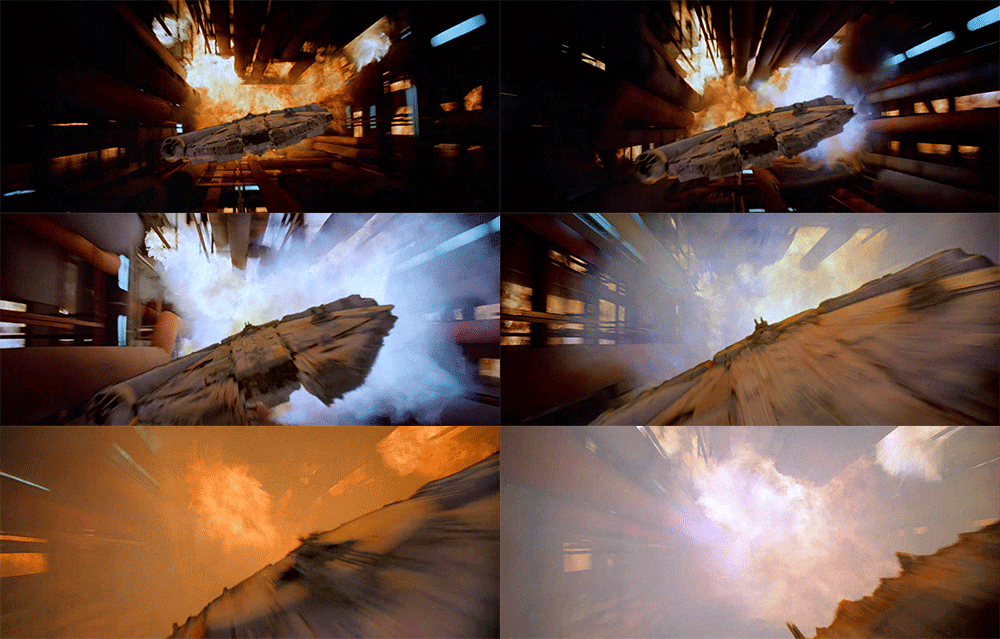
151217MFErik: The Millennium Falcon racing the fireball out of the exploding Death Star. It still gets me on the edge of my seat.

Eppu: The rebel fleet coming out of hyperspace to attack the new Death Star.

Extra: Best Guess for an Episode VII Hook

Eppu: Leia’s become a Jedi. Her title has been revealed to be General, which lines up nicely with her holo-message line to Obi-Wan in Episode IV (“General Kenobi. Years ago, you served my father in the Clone Wars…”).

[And a week after writing the above, the world came crashing down: J.J. Abrams revealed in an interview with IGN (as reported by Moviepilot) that Leia chose to lead the rebellion instead of becoming a Jedi. Ohwell.]

Erik: Palpatine has been pulling the rebellion’s strings all along. He’s a master manipulator who can foresee the future. Did he have a contingency plan for Vader’s betrayal and his own (apparent?) death? Are his dead(?) hands still pulling the strings?

Images: Ewok log trap via History Bomb. Han’s bafflement via lennongirl / LG-CRACK on LiveJournal. Millennium Falcon escaping Death Star via Starscream & Hutch

In the Seen on Screen occasional feature, we discuss movies and television shows of interest.

Star Wars and the Classics, Part II: The Original Trilogy

151216vaseYesterday we looked at how classical literature offers interesting ways of looking at the Star Wars prequel movies. We continue today with the original movies.

Episode IV: A New Hope – Homer, the Odyssey, Books 14-22

Episode IV can be read, from a certain point of view, as an essay in heroism. In particular, we see three different kinds of heroes: the always-was-a-hero, the becoming-a-hero, and the choosing-to-be-a-hero.

Leia is the always-was. She is a hero from the beginning of the movie straight through to the end. We never see her stop being heroic, even when being rescued. She has been part of the rebellion literally since she was born and even the destruction her homeworld doesn’t stop her.

Luke is the becoming. He starts as just a farmboy who dreams of far-off adventure. When he discovers his true heritage he strives to live up to the legacy of his father Anakin the great Jedi. Much is expected of him and he does his best to be the hero that people like Obi-Wan and Leia need him to be.

Han is the choosing-to-be. He’s a smuggler and scoundrel who isn’t in it for the rebellion. He just wants to do a job and get paid. He could have just flown away from Yavin with his hold full of cash and nobody would have been surprised. Instead, he decides to come back and help Luke blow up the Death Star.

The same three kinds of heroes appear in the Odyssey. In Book 14, Odysseus has just made it safely home to Ithaca but is still in disguise, getting the lay of the land and figuring out how to deal with the suitors who have been gorging themselves in his hall. The next few books follow Odysseus as he gathers allies, makes plans, and finally confronts the suitors in the final battle in Book 22.

Odysseus is here the always-was. He is a veteran of the great war at Troy and a cunning warrior. He begins the epic as a hero and never falters. Nothing stops him in his determination to get home and reclaim his place as king. Books 14-22 show him as a steady, crafty commander, biding his time and waiting for the right moment to strike.

Odysseus’ son Telemachus is the becoming. As the epic begins, he is just entering manhood and starting to take his first tentative steps into his father’s old role. For Telemachus, the Odyssey is all about proving that he is a worthy son to a heroic father that he knows only through stories. In this stretch of the epic he finally meets his father and proves that he can live up to his example.

The choosing-to-be hero of the Odyssey is Eumaeus, swineherd to Odysseus’ house and one of the servants who remains loyal to Odysseus, even when his master has been gone for twenty years. The sensible thing for Eumaeus to do would have been to abandon Odysseus and suck up to the suitors, like many of the other servants do, to secure his place in the household when Penelope eventually marries one of them. Instead, he sticks by his old master and helps him take back his home.

Continue reading

Star Wars and the Classics, Part I: The Prequels

151215stormStar Wars takes many of its cues from mythology and classical history. Here’s some recommended reading if you want to see how themes from the classics found their way to a galaxy long ago and far, far away.

Episode I: The Phantom Menace – Homer, the Iliad, Book 1

I can still remember my feeling of anticipation when I first sat in the theatre to watch The Phantom Menace. We’d waited years to get the story of Anakin Skywalker’s fall from grace. We were going back in time to a more civilized age, a golden age of Jedi knights and the sophistication of the galactic republic.

The screen went dark. John Williams’s fanfare blasted from the speakers. The opening text began to scroll up from the bottom. This was everything we had been waiting for!

So what’s this crap about taxation of outlying trade routes? Huh? What is this, Accounting Wars?

The story began. We saw Jedi sitting in a conference room waiting for some cowardly bureaucrats to come and talk turkey. My heart sank in disappointment. (And we hadn’t even gotten to Jar-Jar Binks yet.)

It took many more years and several viewings of Episode I for me to appreciate what George Lucas was doing in this movie. There is a point here and it’s an important one: momentous events don’t start out looking momentous. Terrible things happen because no one is paying close enough attention to stop them when they’re small enough to be managed; only when they roll out of control do people realize what’s happening. Of course the fall of the galactic empire started because of a minor trade dispute and a lonely boy from a desert planet in the middle of nowhere. It could have started in any number of ways, but they all would have seemed just as trivial.

(Mind you, this doesn’t actually make Phantom Menace any better as a movie. It’s still plagued by terrible dialogue, wooden acting, and disturbing racial caricatures. But as a storytelling choice, it’s interesting.)

The classic mythic example of small causes leading to momentous and terrible events is the Trojan War. While pieces of the story are told in many different sources, there’s no single work that covers the entire war. Book 1 of the Iliad, however, puts us in the middle of the action to watch the last act of the war unfold. I’ve written about Book 1 of the Iliad here before, but it’s one of those texts that rewards going back to again and again.

As the Iliad opens, the Trojan war has already been going on for ten years. What we witness here is the conflict between two of the Greek captains, Achilles and Agamemnon. It begins when Agamemnon refuses to ransom a captive woman back to her father. By the end of the book, Achilles has withdrawn his forces from the fighting, which will swing the war in the Trojans’ favor, leading to the near defeat of the Greek forces, the death of Achilles’ friend Patroclus, and Achilles slaying the Trojan prince Hector in madness and grief. The death of Hector robbed the Trojans of their best warrior and sealed the fate of Troy. And it all flows from a dispute over the ransoming of a prisoner from an outlying village.

Continue reading

The Empanada Strikes Back

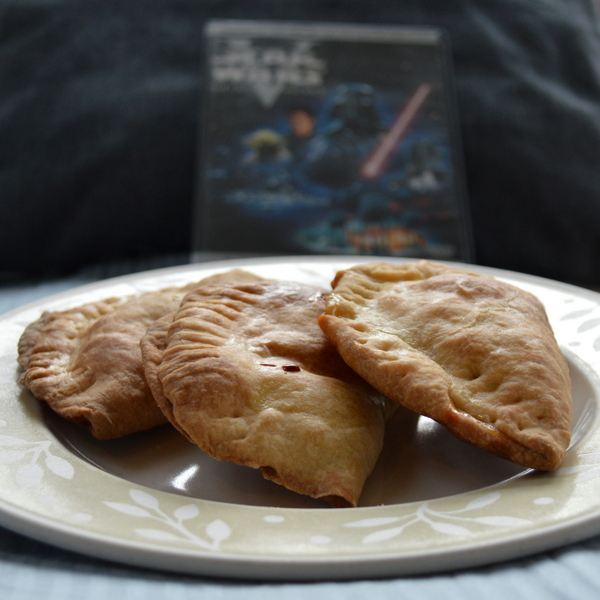
Empanadas are often savory and filled with meat, but for our Star Wars rewatch I made this sweet variety filled with caramel and apple.

The Empanadas Strike Back

Crust

Ingredients

  • 1 cup milk
  • 3/4 cup butter or shortening
  • 1 package dry yeast
  • 3 cups flour
  • pinch of salt
  • pinch of cinnamon

Heat the milk in a saucepan until bubbles form on the top.

Add the butter and let stand 10 minutes until butter is melted.

Stir in the yeast and let stand another 10 minutes.

In a large bowl, combine the flour, salt, and cinnamon. Make a well in the center and pour in the milk mixture. Stir until it forms a ball.

Turn out onto a floured surface and knead well, adding flour as needed.

Let rise in a warm place for 30 minutes to an hour.

Punch down the dough, turn it out on a floured surface for another quick knead, then divide into sixteen small balls. Flatten these balls out into six-inch circles and place them on parchment paper on baking sheets.


Filling

Ingredients

  • 1/2 cup sugar
  • 2 tablespoons water
  • 2 tablespoons cream
  • 2 medium apples

You will want to fill and bake your empanadas as soon as the filling is ready, so preheat the oven to 425 F / 220 C while you work.

Peel, core, and finely dice the apples.

Place the sugar and water in a shallow saucepan and stir until the sugar is well dissolved.

Put the pan on medium heat. Large bubbles will eventually give way to smaller bubbles. Stir gently as the sugar mixture begins to brown.

When the caramel has reached a golden brown, add the cream and mix well.

Add the apple pieces and stir well.

Place a generous tablespoonfull of filling centered on one half of each dough circle. Fold the dough over and press the edges together with your fingers, then crimp the edge with the tines of a fork.

Bake for 20 minutes or until beginning to brown. You can continue to cook them as they are until golden brown (about five more minutes) or take them out, glaze them with egg, and return them to the oven to finish baking.


Image by Eppu Jensen

Geeks eat, too! Second Breakfast is an occasional feature in which we talk about food with geeky connections and maybe make some of our own. Yum!