Jimtheviking on Tumblr wrote about how the Dwarven names in J.R.R. Tolkien’s The Hobbit connect with Old Norse, especially Dwarf names listed in the poem Völuspá.
According to Jimtheviking, Tolkien chose a number of names from Old Norse and tweaked those names in an interesting way. Namely, Tolkien grasped Old Norse grammar well enough to know that the omission of one n from a name ending in –inn changed it from masculine to feminine. To quote Jimtheviking:
“Well, I give you the names of the Dwarves from the Hobbit, as they appear in Dvergatal (stanzas 14-16) and in the order they appear:
“Now, you notice something with the way those names got changed? That’s right, he changed the masculine -inn definite suffix to -in, which is feminine.
“That means that, at least grammatically, Dwalin, Dáin, Thorin, Thráin, and Glóin are female Dwarves.”
Then, moving on from purely linguistic, Jimtheviking continues with an intriguing argument:
“Since we know Tolkien was meticulous about his grammar, this was done most likely as an in-joke […] [emphasis original]
“But there’s a not-inconceivable chance that the Dwarves were using the masculine pronouns in Westron because that’s what the Men who met them used, despite the fact that a third of the company was female, and hey, it’s kinda neat to think he wrote a bunch of Dwarf-ladies going on an adventure.”
It is really interesting, isn’t it, to posit male and female Dwarves in Tolkien’s adventures?!
Poking around, I found versions of Völuspá that differ from the Dwarf list as given by Jimtheviking*. Not just the list itself, but also spellings differ depending on the edition you’re using (which isn’t rare at all in philology). Nevertheless, the main point stands: Tolkien changed names that had –inn in the original to just –in in English.
Of all Tolkien’s Dwarf names, he seems to have adopted Durin, Dwalin, Náin, Dáin, Bifur, Bofur, Bombur, Nori, Óin, Thorin, Thrór, Thráin, Fíli, Kíli, Fundin, Náli, Oakenshield (Eikinskjaldi, cf. Icelandic ‘oak shield’), Glóin, Dori, and Ori from the Völuspá.
Of them, Durinn, Dvalinn, Náinn, Dáinn, Óinn, Þorinn, Þráinn, Fundinn, and Glóinn are all originally spelled with a double n. (In addition, there’s a change from a double r to a single one in Bívurr / Bívǫrr, Bávurr / Bávǫrr, and Bömburr / Bǫmburr, which Jimtheviking does also comment on.)
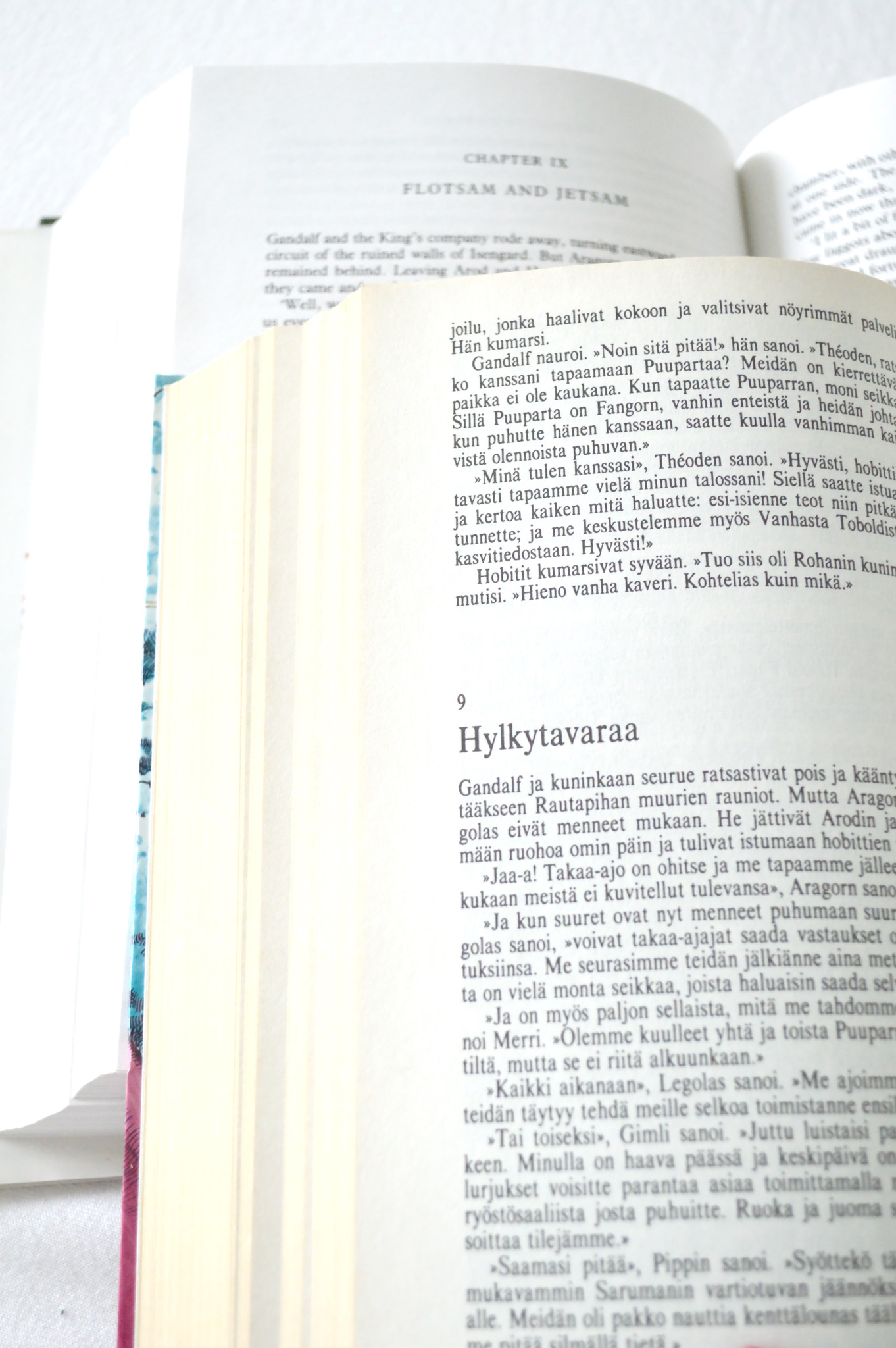
Anyway, the whole thing kinda reminds me of the first time I read The Lord of the Rings, decades ago now. I was young enough that it was in translation, which means the young me ploughing through LotR was quite confused over the gender of some characters. The Finnish language doesn’t have grammatical gender, you see. Instead of he or she, we just have one third-person singular pronoun, hän, which is used of all people regardless of sex, gender, age, kinship, marital status, whatever, just like the English third-person plural they is. Normatively, in Finnish everyone is a hän.
Even at that young age, I knew that (apart from Astrid Lindgren) most of the publications, including those for the younger audience, centered boys and male characters. Contextually, I could tell that Frodo and Sam were male. Same for Legolas and Gimli, Aragorn and Boromir, and Gandalf and Elrond. Arwen, Galadriel, and Eowyn were female.
But Glorfindel? Maybe male, I thought, but there is nothing explicit at all in the Finnish translation. And Merri and Pippin? Somehow at that time I couldn’t make them out at all; indeed, they’re the two characters whose gender confused the young me the most.
Having grown up reading the Moomins, Pippi Longstocking, Ronia the Robber’s Daughter, The Famous Five series, and The Dark Is Rising sequence, I saw nothing odd in girls and women also going on adventures. So I thought it was quite plausible that Merri and Pippin could be female, and was too young to read all of the textual cues that imply they aren’t. (Remember that in Finnish the gender-neutral pronoun hän gives absolutely no clue whatsoever about anyone’s gender.)
The possibility of a linguistic in-joke regarding these Dwarven names really tickles the imagination and would be completely plausible of Tolkien. Interestingly, the name Gandalf also originally comes from the Dvergatal (see e.g. stanza 12 in Pettit’s 2023 edition, which lists the name as Gandálfr). A Dwarven Gandalf would, indeed, give quite a different vibe to LotR.
And now I kinda want new movies of The Hobbit, with the amazing attention to detail that Weta lavished on the effects and props in Peter Jackson’s versions, but with more heedful writing and with half the Dwarves in the party female. That would be a truly intriguing take!
(A super-short recap of his post: the song Bara bada bastu, ‘Just having a sauna’, despite representing Sweden, is in fact performed by the Finnish comedy group KAJ. As a result of KAJ’s popularity, Swedes and Finns are finding a new spirit of Eurovision togetherness, and it has also brought some international recognition to the little-known Swedish-speaking minority in Finland.)
Here, as a companion post, is a listing of cultural references in KAJs song and in the performance.
I’m pulling some of this from my own experience growing up in Finland, but others from online commentary, or my Swedish-Finnish friends’ stories. This list is, therefore, likely not to be complete. Additions are very welcome!
KAJ—which rhymes with the English word guy—is made up of Kevin Holmström, Axel Åhman, and Jakob Norrgård, who all originally hail from Vörå, Ostrobothnia, Finland. The idea behind the song is to gently poke fun at how Swedes view Finns and our culture. Here we go! 🙂
Bara bada bastu by KAJ is the song representing Sweden in the Eurovision Song Contest 2025, and it’s been shaking things up in Sweden, Finland, and the Eurovision bubble as a whole. If you haven’t been following the run-up to Eurovision 2025, you may not know the story of Bara bada bastu and why it matters so much to so many people. Here’s a short introduction to get you caught up.
Finland, Sweden, and Swedish-speaking Finns
Finland and Sweden have a long and complicated history, grounded in the fact that what is today Finland was conquered by Sweden in the Middle Ages and ruled as part of the Swedish kingdom for centuries. Until recently, Finland was largely a poor and undeveloped area compared with metropolitan Sweden. The elite in Finland were traditionally Swedish transplants or had close social ties to Sweden. As a result, the typical Finnish stereotype of a Swede is a stuck-up, rich dandy, while the Swedish stereotype of a Finn is an uncultured, violent drunk. It is an old joke in Finland to say (of a hockey game, or some other equally serious contest) “I don’t care who wins as long as Sweden loses.”
Relations are not purely hostile. The two countries also have a history of cooperation and mutual support. Sweden supported Finland’s self-defense against and recovery from Russian invasion in World War II, and it has long been a commonplace that Finland is Sweden’s first line of defense. Despite this solidarity, there is still a lingering antagonism. When Finland and Sweden joined NATO in response to Russian aggression in Ukraine, it was important to both sides that they join together. It was also important to Finns that Finland was accepted into the alliance first.
Caught in the midst of this sibling rivalry are the Swedish-speaking Finns. Finland has a minority population who speak Swedish as their mother tongue, mostly concentrated in the cities in the south and along the western coast and islands. They make up about five percent of the population. Some are descended from the old Swedish aristocracy, but most of them these days are just ordinary folks, not much different from other Finns. Because of this population and Finland’s historical ties to Sweden, Swedish is the second official language in Finland, and Finnish-speakers are required to learn Swedish in school (just as Swedish-speakers are required to learn Finnish). Many Finnish-speaking Finns resent this language requirement, and some turn that resentment against their Swedish-speaking neighbors. Swedish-speaking Finns are stereotyped in much the same way as Swedes: rich, snobby, and stuck-up. While Swedish-speaking Finns are subject to this sort of low-level resentment and caricaturing at home, they are practically invisible to the rest of the world. Even in Sweden, not everyone knows that some of their Finnish neighbors speak Swedish as their first language.
The Eurovision Song Contest
Leaving aside the world of frosty Finns and snooty Swedes for a moment, let me introduce you to the next thing you need to know about: the Eurovision Song Contest. The Eurovision Song Contest (commonly just called Eurovision) is an annual multinational extravaganza in which countries from around Europe and beyond (G’day, Australia!) compete in putting on musical performances. The exact format and rules have changed frequently since the contest was first held in 1956, but if you’re not up on Eurovision, here are the essentials you need to know.
Every participating country sends one stage act with a song (not longer than three minutes).
Every country chooses its competing act in whatever way it likes. Many production and performance teams are international, and while at least some members of the overall team usually come from the country they are representing, nothing requires the artists appearing onstage to come from or be in any way connected with that country. (Write this down! It’ll be important later!)
The participating acts compete against one another in two semifinals. The viewing audience votes a set number of acts from each semifinal into the four-hour grand final, where they join a small set of acts from countries who get an automatic place by paying the major costs of the broadcast (currently: France, Germany, Italy, Spain, and the United Kingdom).
After all the acts have performed in the grand final, two sets of votes are collated. In each participating country, a jury made up of music industry professionals awards points to their top ten favorite songs. The top song gets 12 points, the second 10, and rest from 8 down to 1. The viewing audience in each country also gets to vote on their favorite songs, with points awarded in the same way. (Neither juries nor audience are allowed to vote for their own country.)
The points are announced onstage in dramatic fashion, and the country with the most combined points wins.
Traditionally, the winning country each year hosts the next year’s contest, although exceptions are sometimes made (such as in 2023, when Ukraine won the contest, but because of the ongoing war, the runner-up, United Kingdom, stepped in as host).
The Eurovision Song Contest has been a venue for good-spirited competition between nations, using music to foster both national pride and international solidarity in much the same way the Olympic Games use sports. It has also created its own subculture with traditions, factions, customs, and quirks of its own.
One of the long-running truisms of Eurovision is that juries and audiences tend to favor different kinds of songs. Conventional wisdom says that juries like serious songs that demonstrate artistic virtuosity and range, while audiences like wacky stage hijinks, fun gimmicks, and a danceable beat. Neither assumption is entirely borne out by the voting results, but Eurovision acts often try to court one set of votes or the other. The way points are divided often means that a song that would have won on the strength of audience votes doesn’t win because the juries favor something else, sometimes to ire of some fans who feel their favorite was cheated.
Finland has traditionally done quite poorly in Eurovision. The country has only one win to its credit, 2006, when the monster metal band Lordi unexpectedly pulled off a win in what is seen as the audience rebelling against a contest they felt had grown stale with too much bland, predictable pop music.
Finland has become a semi-reliable source of audaciously weird contributions to Eurovision, most of which fall absolutely flat in the voting results, but which appeal to some parts of the audience by standing out against a background of highly-polished pop.
Sweden, on the other hand, is a Eurovision powerhouse, with a current total of seven wins to its credit. Highly-polished pop is Sweden’s Eurovision bread and butter, and they pull it off better than most other countries, earning frequent recognition from juries. Sweden is home to a major pop music industry, and Swedish composers, lyricists, and choreographers are frequently found working on other countries’ Eurovision entries.
Recent Eurovision history
With the stage set, we turn to the recent history of the Eurovision Song Contest to see how these deeply-rooted forces have played out to lead us to this year.
In 2012, the Eurovision Song Contest was hosted in Azerbaijan and won by the Swedish singer Loreen with her song Euphoria. While Euphoria leaned a little to the weird side for Sweden, it was still highly produced and sung in English, making it easy for an international audience to follow. Euphoria swept both the audience and the juries.
Sweden took home the trophy again just three years later in 2015, when Austria was hosting. The singer Måns Zelmerlöw won with his song Heroes. Like the usual Swedish entry, Heroes was an immaculate pop anthem with a clever stage show, but it caught the heart of Europe. While Italy and Russia did better in the audience vote, Heroes soared with the juries, and Måns’s telegenic charisma won over even those fans who didn’t place Sweden first.
The next year, 2016, Sweden hosted the contest. Måns returned to the stage not just as a performer but as co-host of the festivities along with comedian Petra Mede. The 2016 show was carried off brilliantly and established Måns as not just a beloved past winner but one of the contemporary faces of the contest. He reappeared in several following contests as part of the general entertainment and the interval acts that fill up time while votes are counted. (2016 also gave us Peace Peace, Love Love, a loving parody of the contest itself, performed by Petra and Måns.)
In the following years, Finland and Sweden continued their usual patterns. Swedish songs routinely scored well with juries, and Finland’s songs occasionally excited some fans while mostly ending up near the bottom of the vote tallies. Then came Käärijä.
Finland chooses its Eurovision act with a televised national contest called Uuden Musiikin Kilpailu (New Music Contest, abbreviated UMK). In 2023, a young Finnish rapper/singer known as Käärijä had a runaway victory at UMK with his song Cha Cha Cha and quickly became a sensation among Eurovision fans. Cha Cha Cha was a challenging song: unabashedly weird, sung in Finnish rather than internationally-friendly English, and reflecting in complicated ways on Finnish alcohol and dance culture, but something about it spoke to a wide and adoring audience in Europe.
Sweden selects its competitor with Melodifestivalen (Melody Festival, casually known as Melfest or Mello), a multi-week tournament of songs which finally crowns a winner after several rounds. In 2023, Loreen returned to Eurovision by winning Melfest with Tattoo, a smooth jury-pleasing vocal performance.
Going into Eurovision 2023 (hosted in the United Kingdom on behalf of Ukraine), Finland was in the strange position of audience favorite. The outpouring of fan love for Käärijä and Cha Cha Cha was unheard-of in Finland’s Eurovision history. It quickly became clear that Tattoo was also gathering momentum. In the final voting tally, Finland came out way ahead with the audience, but the juries showed Finland much less love and delivered the victory to Sweden.
The 2023 contest felt like an encapsulation of the Finland-Sweden relationship: Finland the scrappy, weird underdog went up against Sweden the polished, practiced former winner, and the juries swung for Sweden. In the days after the contest there was a lot of resentment from Eurovision fans who felt the juries had cheated Käärijä of a win and the audience of their favorite. Finns felt deflated, and losing to Sweden rankled especially hard. Unkind things were said. In time, tempers cooled, and Finns and Swedes got back to the usual routine of quiet mutual disdain.
The 2024 contest, hosted again by Sweden, did what it could to soothe tempers. The Swedish hosts (Petra Mede again and actress Malin Åkerman) had plenty of self-deprecating jokes about Sweden’s Eurovision obsession, and Käärijä himself performed in one interval act.
It was a turbulent contest, however. Protesters demonstrated against Israel’s participation, and there were rumors about the Israeli delegation at the contest harassing other performers. The biggest cause of discontent, however, was when the Dutch performer, Joost Klein, an audience favorite and one of the leading contenders for victory, was suddenly booted from the contest after an altercation with a camera operator. The details of the incident are murky, but it was widely seen as an overreaction by Eurovision’s governing body. The live audience at the event was vocal with its displeasure, and in the aftermath many Finns enjoyed some schadenfreude at Sweden’s expense.
When do we get to the sauna brothers?
We’re almost there! I promise!
Finally we come to 2025. This year, Finland selected Erika Vikman’s Ich komme (I’m coming) to represent the country. Ich komme is a pumping, upbeat song celebrating a woman’s sexual desire. Sexiness is no stranger to the Eurovision stage, but it traditionally caters to the male gaze. Ich komme, though plenty sexy, is very clear in being about a woman’s own joy in her body and does it without disparaging men, either, a novelty for Eurovision. After UMK, Ich komme gathered some positive buzz, and, while probably not a winner, looks like it may do well at the contest.
And then came this year’s Melfest. As usual, it was a smörgåsbord of well-known Swedish pop music talent, but the star attraction was the return of Måns Zelmerlöw. Måns competed with Revolution, another highly-polished pop anthem in the same spirit as his winning Heroes.
Other great names in Swedish music filled the roster, including John Lundvik, a former Eurovision contestant who came close to winning in 2019. And then there was KAJ.
KAJ is a Finnish comedy group made up of three Swedish-speaking Finns from one of the smaller municipalities on Finland’s west coast. The group takes its name from the first letters of its performers’ names: Kevin, Axel, and Jakob. Although they were locally popular, they were not well known even on the national stage, and were practically unheard-of outside of Finland. KAJ was invited to join Melfest by one of the festival’s producers, and the trio figured it might be a good way to increase their name recognition and maybe score a few more gigs in Sweden but without much hope of anything more. KAJ joined the contest with Bara bada bastu (Just having a sauna), a light-hearted but sincere tribute to the joys of relaxing in sauna after a long day, performed in their own regional dialect of Finland Swedish. KAJ and Måns went up against each other in one of the last rounds of the competition and both passed through to the final.
KAJ stood out from the other performers in the final. Surrounded by media-sexy pop stars and their slickly-produced English-language international hits, the performers in KAJ were self-consciously nerdy, unfashionably authentic, and the only contestants so gauche, so outré, so utterly unsophisticated as to show up to the Swedish song-selection contest and sing in Swedish! Yet the audience loved them! When the votes were counted (Melfest uses a voting system similar to Eurovision’s), it came down to KAJ and Måns. It felt like Käärijä and Loreen all over again: the weird, provincial Finnish nobodies singing a niche but heartfelt little song in their own language up against Eurovision royalty with a whole national pop music industry behind him belting out a focus-group-perfect anthem in English.
And then the impossible happened: KAJ won! The juries broke just barely in Måns’s favor, but the Swedish audience went for KAJ by a million votes, giving KAJ the most audience votes in Melfest history! In this year’s Eurovision Song Contest, Sweden will be represented by a little-known humor group from Finland!
(Måns was less than gracious about his loss. One might have forgiven him for a few unguarded comments in the heat of emotion after a tense contest, but in the weeks since the Melfest final Måns’s wife has announced a divorce with allegations of abuse and drug use that have tarnished Måns’s reputation. Many Swedes are relieved that he will not be representing them on the international stage, especially not with the bitter aftertaste of 2024’s contest.)
The effects of the win have been remarkable to witness. Coming after the rancor of 2023 and chaos of 2024, Swedes and Finns are finding a new spirit of Eurovision togetherness. KAJ’s win has gone some way to patch over old resentments and break down timeworn stereotypes. It has also brought some international recognition to the little-known Swedish-speaking minority in Finland.
This year’s Eurovision Song Contest will be held in Switzerland in the middle of May. We will see what the rest of Europe makes of Ich komme and Bara bada bastu. At this moment, the boys in the sauna are running strong for the top spot, and if they win, then for once Finns will be just as happy for Sweden’s victory as the Swedes are.
An occasional feature on music and sound-related notions.
Amazons, the bold warrior women who figure in Greek myths, are imaginary, but the myths about them likely had their origin in Greek experiences with actual fighting women in the cultures around the shores of the Black Sea. Ethnographic and archaeological evidence shows that women who trained with weapons and fought in battle were known in many of the cultures in the region, and the association of mythic Greek Amazons with horses and bows also matches the realities of life on the Black Sea steppes.
Greek literature and art records numerous Amazon names. Most of these names are Greek, and they are descriptive of relevant Amazon traits, such as Hippolyta (“She who sets the horses loose”), Melanippe (“Black horse”) or Antiope (“She who confronts”). These names may have been simply invented by Greek writers in the same way that fantasy authors today concoct suitable names for their characters. There is evidence, however, that some of the Amazon names recorded in Greek art might be actual names from languages spoken around the Black Sea.
Greek vase fragment via the J. Paul Getty Museum (made Athens, currently Getty Museum, Malibu; c. 510 BCE; glazed pottery; painted by Oltos)
This Greek pottery fragment shows Amazons riding into battle against the Greek hero Heracles (who appears accompanied by the god Hermes on the other side of the cup). We can recognize the riders as Amazons from their clothing and the bowcases they carry. Text in Greek letters surrounds them, although it is painted in a dark color that is difficult to see. Most of the text is fragmentary and hard to reconstruct, but one word seems to be a complete name. The text PKPUPES can be read by the head of the leftmost rider, evidently her name.
“Pkpupes,” at first glance, may look like mere gibberish. It certainly isn’t Greek. Many scholars in the past dismissed this and similar texts as nonsense words written by semi-literate vase painters. Maybe “pkupupes” was just an attempt at an onomatopoeic for the pounding of a horse’s hooves. It may, however, be something more significant.
Dense clusters of hard consonants like “pkp” are a common feature of languages spoken today in the Caucasus Mountains east of the Black Sea. “Pkpupes” is, in fact, fairly easy to read as an attempt to render a name in Circassian, a cluster of closely related languages of the northwestern Caucasus, with the letters of ancient Greek, which did not perfectly match up to the sounds of the original language. English doesn’t have all the right letters to easily represent the sounds of Circassian either, but a reconstructed Circassian name that would be rendered in English something like “Pqp’upush” is perfectly intelligible. This name is composed of several elements, the first referring to the body, the next to covering, and the final one connoting worthiness. Altogether, the name would mean “Worthy to wear armor,” a suitable name for a warrior woman.
Greeks had extensive contact with peoples around the Black Sea. Many Greeks migrated to the region, and people from the area also settled in Greece. The painter of this vase signed his name “Oltos,” which is not a typical Greek name, and he may have been an immigrant himself. He and other ancient vase painters may well have known people who spoke foreign languages or had ancestors from the Black Sea region who could recommend appropriately authentic names for Amazon characters. It may even be that some of the obviously Greek Amazon names like Hippolyta or Antiope were not invented by Greeks but are Greek translations of authentic names, in the same way that the names of many indigenous Americans in recent history have been translated into English, like Sitting Bull or Red Cloud.
The Amazons of Greek myth remain mythical, but we have evidence for some history behind that myth, maybe even the names of some real warrior women from the edges of the world known to the Greeks.
Source
Adrienne Mayor, John Colarusso, and David Saunders, “Making Sense of Nonsense Inscriptions Associated with Amazons and Scythians on Athenian Vases,” Hesperia 83, no. 3 (July-September 2014): 447-93.
History for Writers looks at how history can be a fiction writer’s most useful tool, from worldbuilding to dialogue.
J.R.R. Tolkien died on September 02, 1973, exactly 50 years ago this Saturday. Also 50 years ago this year saw the publication of The Fellowship of the Ring in a Finnish translation. In celebration, a new, improved Finnish translation of the whole trilogy will be published this September.
Often a translation, especially of a fictional work, seems less good—less satisfying, skillful, expressive, vivid, what have you—as the original.
In my experience, however, there is one exception—and perhaps you guess the connection? The Finnish translation of The Lord of the Rings trilogy.
The prose for Taru sormusten herrasta is by Kersti Juva and Eila Pennanen; the poems were translated by Panu Pekkanen. It was Juva’s first job as translator. In fact, Juva did most of the work while Pennanen supervised the first two books, and Juva got solo credit for the prose in The Return of the King.
The translation is wondrous. Somehow in the Finnish version, the Hobbits seem more homey, the Dwarves more earthy, and Elves more ethereal than in the original. The desolate areas feel more despondent, and darkness deeper. I’d also say that Pekkanen’s poetry translations wipe the floor with Professor Tolkien’s—having first read the Finnish, I was, frankly, disappointed in the English-language poems in the LotR.
I’m sure some of my appreciation of Taru sormusten herrasta comes down to nostalgia and sense of wonder—I first read the trilogy when I was in my early teens, an impressionable age if there ever was one. Some of it, I’m also sure, comes down to reading my native language.
These days, however, after decade+ of higher ed in and on the language plus daily use with a fellow language nerd, my English is quite as good as my Finnish. I can and do recognize the skill in Tolkien’s writing, plus many of the references and nuances, including some of the Old English. (Though not being a mainstream literature person, I’m sure I also miss other connections—my degree in English is primarily in the language, not lit.)
I’ve been reading in foreign-for-me languages for about 35 years now. Most of my non-native-language reading has been in English, either as original or translations. Some has been in Swedish, German, or Estonian, all translations of works I’ve previously read in the original language. While I can’t boast university education in the field of translating, I’d call myself an educated hobbyist. And as such, I can see the quality of Juva’s work. Erik and I have even read the first 400 pages or so of Fellowship out loud to each other, first a sentence in English and followed by the same passage in Finnish. You really do see Juva and Pekkanen’s skill in the text.
This new, improved version of Taru sormusten herrasta is also by Kersti Juva. In interviews she’s said the focus of the new version is to polish the language and to weed out the uncertainties a newly-minted translator (herself) wasn’t yet able to see her way past.
Sounds ever so good to me! In fact, I already have a preorder in. 🙂 Also, the celebratory edition looks to be a gorgeous, gorgeous book, with the famous LotR illustrations by Tolkien himself.
Image: screencap from a sample of the newly revised Finnish translation of The Lord of the Rings trilogy by WSOY via Issuu. LotR and TSH side by side by Eppu Jensen.
“At the beginning of May of 2023, I was completely burned out. Then I watched Eurovision and this awesome Finnish dude with a bowl cut, a lime green bolero, and a name that’s a multi-level pun (Käärijä = wrapper) reminded me why I love performing and gave me some desperately needed inspiration with a song called ‘Cha Cha Cha.’ […]
“We had a fun day in the recording studio and I hope that fans of Käärijä, of which I am one, will catch the small details musically, in the translation effort, and in the accompanying lyric video.
“It’s my sincere hope that Käärijä fans who know nothing about Star Trek or Klingon enjoy this acoustic cover as much as my nerdy Trekkie fans.”
Wow—they got the spirit down pat! I mean, Klingons aren’t my cup of tea, but as far as I can tell, bang on. And how amazing is it that cha means ‘torpedoes’ in Klingon?
Cha cha cha! 🙂
Hey, look! We found a thing on the internet! We thought it was cool, and wanted to share it with you.
I’ve long been seeing mentions that the use of the plural pronoun they to refer to a singular antecedent is older than the present attempt to introduce it as a gender-neutral option. Here’s a little history I ran across.
Dennis Baron, Professor of English and linguistics at the University of Illinois at Urbana-Champaign, blogs about singular they for The Oxford English Dictionary. According to him, the oldest recorded use within the OED is from 1375, in the medieval romance William and the Werewolf.
Continues Baron:
“Here’s the Middle English version: ‘Hastely hiȝed eche . . . þeineyȝþed so neiȝh . . . þere william & his worþi lef were liand i-fere.’ In modern English, that’s: ‘Each man hurried . . . till they drew near . . . where William and his darling were lying together.’ [original emphasis]
“Since forms may exist in speech long before they’re written down, it’s likely that singular they was common even before the late fourteenth century. That makes an old form even older.”
Since I’m a Finn and we don’t have grammatical gender in our language, singular they seems natural to me. In fact, I fail to see a reason to choose to kick up a major kerfuffle over it; after all, (normative) English already mixes up the numbers with singular and plural you.
I’m pretty sure that within the past decade or so I have spotted multiple examples from non-woke modern English sources, both television series and novels, that do use singular they seemingly unconsciously, very naturally, and entirely unambiguously. I wish I had realized to write them down for my own interest.
The embodiment of the Enemy in The City We Became by N.K. Jemisin, the Woman in White, says of the catalytic effect of human cities:
“You eat each other’s cuisines and learn new techniques, new spice combinations, trade for new ingredients; you grow stronger. You wear each other’s fashions and learn new patterns to apply to your lives, and because of it you grow stronger. Even just one new language infects you with a radically different way of thinking! Why, in just a few thousand years you’ve gone from being unable to count to understanding the quantum universe—and you’d have made it there faster if you didn’t keep destroying each other’s cultures and having to start over from scratch.” [original emphasis]
To me, one of the most fascinating features of my native Finnish is that the negator ei (‘no’) can be conjugated in personal forms, as if it were a verb: en, et, ei, emme, ette, eivät. For example, a one-word answer “En” to a question (e.g. “Would you like some tea?”) translates as ‘[I do] No[t]’, while “Emme” means ‘[We do] No[t]’, etc. And this is just one little, tiny detail of the amazing linguistic variety that exists on Earth. There are times I wish I had studided linguistics even further.
Anyway.
Obviously for the Enemy us petty humans had better stay petty and not learn anything new ever. She’s not wrong, though: we’ve come a long way, and human ingenuity can be astounding. Unfortunately, so can the human cruelty. If only we could stop the needless hate and reach for more amazing heights…
Jemisin, N.K. The City We Became. New York: Orbit, 2020, p. 342.
Serving exactly what it sounds like, the Quotes feature excerpts other people’s thoughts.
The Greek historian Herodotus recounts a tale about a rather dubious experiment in linguistics supposedly carried out by the Egyptian king Psammetichus.
The point of the experiment was to find out what people or nation in the world was the oldest. It was based on the assumption that the oldest culture’s language would be the language that people who had never heard spoken language before would speak. Further, Psammetichus assumed that the invention of this original language could be artificially recreated. The result of these mistaken assumptions is a bit of a comedy of errors. Here’s how Herodotus tells the tale:
When Psammetichus could not find out by inquiry what people were the oldest, he devised the following plan. He took two newborn children at random and gave them to a shepherd to bring up among his flocks, with orders that they be raised in such a way that no one should make any sound in their presence, that they stay in a lonely hut, and that he should regularly bring his goats there so they could drink their fill, and attend to their other needs. He did these things, and Psammetichus commanded him to notify him at once what word first burst forth from the children, once they had left behind the meaningless babble of infants. And it did indeed happen. When the shepherd had been taking care of the children for two years, once when he opened the door of the hut and went in, both of them fell upon him stretching out their hands and crying: “Bekos!” At first, the shepherd took no notice of what he had heard, but when he kept hearing the same word on his repeated visits, he began to pay attention to it. He sent word to the king, and when ordered, brought the children before him. When Psammetichus heard it for himself, he investigated what people called something “bekos,” and from his investigations he learned that it was the Phrygian word for bread. Taking this fact into consideration, the Egyptians acknowledged that the Phrygians are older than they are.
– Herodotus, Histories 2.2
(My own translation)
As should be obvious (and probably was to Herodotus’ audience), the experiment was in fact a failure. When the children exclaimed “bekos” at the shepherd’s arrival, they were not producing an actual word but simply imitating the bleating of his goats, the only sound they had heard another living creature produce. The fact that Psammetichus did not realize this (and had not accounted for it in designing the experiment) makes this whole story a joke at his expense. The punch line of the joke may be a little lost on a modern audience: the Phrygians were a people who lived in inland Anatolia and spoke a language related to Greek. Phrygians were stereotyped by the ancient Greeks as ignorant country bumpkins. For the Egyptians—proud of the antiquity and sophistication of their culture—to be forced to yield the title of “most ancient people” to the Phrygians was a deflation of their cultural pretension.
Although Herodotus claims to have heard this story from Egyptian priests, like more than a few of the stories he tells about Egypt it sounds more Greek than Egyptian. Specifically, it sounds like a Greek joke told at the Egyptians’ expense. Greeks and Egyptians had close and friendly relations in Herodotus’ day, but it was a relationship in which the Greeks were definitely the junior partners. Egyptians liked to celebrate the antiquity and wisdom of their culture, and we can understand if Greeks occasionally got a bit fed up with being looked down on. This story uses language was a way of turning the tables to suggest that not only were the Egyptians not as ancient a culture as they liked to claim, perhaps they were not as wise, either.
Today is the premier for the animated sequel Frozen II here in the U.S. Unlike most Di$ney princess movies*, I will be seeing this one during its theatrical release for a particular reason.
In the story, Anna and Elsa et al. travel to the north and meet a people resembling the Sámi. For their research and inspiration, the Walt Disney Animation Studios not only talked with Sámi people but actually signed an agreement with the Sámi to do it in a respectful, collaborative way.
The Sámi are the only indigenous people within the European Union area. They currently live in the northern reaches of Norway, Sweden, and Finland, and the Kola Peninsula in northwestern Russia.
Disney even invited some members of the Sámi Parliaments to U.S. to see the movie at the world premier, meet some of the makers, and tour the animation studio.
The most exciting part for my linguist brain is that the studio will record and release a version dubbed in Northern Sámi, the largest of the Sámi languages. The voice actors are drawn mainly from Sweden and Norway, among them the acclaimed Sámi musician Mari Boine, but also one Finn. (Yay!)
While it’s true they aren’t very numerous these days (partly thanks to racial, linguistic, and cultural discrimination), the Sámi do exist and do have a living culture. (Just check out the music scene for one incredibly vibrant aspect—yoik comes almost in all styles now!) I grew up two hours south of the Arctic Circle, and the Sámi were my classmates, neighbors, and teachers. For me it’s delightful that Disney took the time to research, listen, and respectfully pay homage to people I grew up with.
Undoubtedly I will also enjoy scenery that reminds me of trips to Lapland even if the first reports say the northern mountains look too young and rugged to be based on the fells on the Finnish side of the border. 🙂
*) The only other exception is Moana, which was also produced in cooperation with indigenous peoples.
Images: Per-Olof Nutti, Aili Keskitalo, Åsa Larsson Blind, and Tiina Sanila-Aikio with their daughters at the world premier of Frozen II by Siv Eli Vuolab / Sámediggi via Yle. Three members of the northern herder tribe from Frozen II via Yle. View overlooking a northern valley from Frozen IIvia Yle.
In Live and Active Cultures we talk about cultures and cultural differences.





 Co-Geeking
You must be logged in to post a comment.