When a Walrus Shows up at Your Door

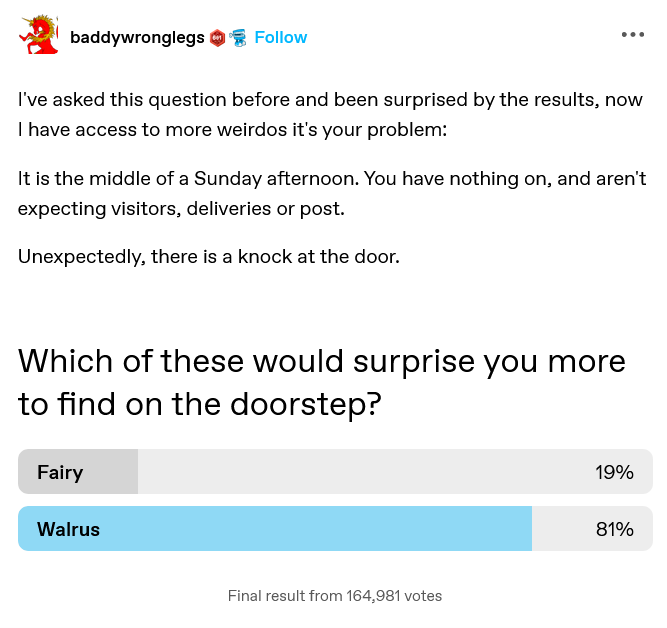
There’s been a thing going on in the past month on the Internet about fairies and walruses. If you’re not in the loop, it all started with a poll posted on tumblr by user baddywronglegs that asked respondents to consider which one they would be more surprised to find at their front door, a fairy or a walrus?

The fun of this poll is that it pits two very surprising (in most parts of the world) things against one another, but those things are surprising in two different ways. Fairies don’t exist, but if they did, it would be perfectly plausible for one to knock on your door. Walruses do exist, but the idea that one would survive the trip out of the Arctic, make it to your front door, and knock is beyond belief. What’s more surprising: the most unsurprising surprising thing or the most surprising unsurprising thing?

But, then, surprising things do happen sometimes. Like walruses showing up where they have no business being. A lost walrus found itself on the shores of southeastern Finland in the summer of 2022. It didn’t knock on any doors, but it did take a nap between some beached rowing boats, literally rolled around on someone’s yard in the grass, and posed in front of an emergency vehicle.

Yes, Finland is an Arctic country in the sense that we straddle the Arctic Circle, even though most of our land area is south of it. We do not, however, currently have any coastline in the north; all of our salt water access is to the south and west, i.e., to the Baltic Sea. Visits like this are, therefore, extremely rare. The walrus had to travel all the way around Scandinavia, through the Danish Straits (Kattegat and Skagerrak), and east along the Gulf of Finland to reach Hamina and Kotka.

(Alas, the poor thing turned out to be famished, and died in the middle of an attempted rescue en route to the Wildlife Hospital of Korkeasaari Zoo in Helsinki. It’s since been preserved and it’s on display at the Finnish Museum of Natural History.)

Wikimedia Antti Leppanen Haminan mursu

It’s quite staggering that we live in a place where, theoretically—very much in theory, but nevertheless—a walrus could turn up on the yard! (No sign of fairies, though.)

Images: Screenshot of tumblr post by baddywronglegs. Stuffed walrus in the Natural History Museum of Helsinki by Antti Leppänen via Wikimedia (CC BY 4.0).

Making Clothes 9: Calculations

This post is a part of our Making Clothes series.

Now that we’ve gone through the process of producing raw materials, turning those materials into textiles, and turning those textiles into clothing, we’re rounding out this series with a little math. Given the labor and resources that went into making one outfit, how long would it have taken to make, from start to finish, and how much land did it take to grow everything on?

Our figures here are necessarily approximate. There are too many variables to take them all into account. A good year’s flax harvest or a clumsy hand at wool-carding could make a difference to how fast workers could gather and process materials. We’re also generally working with optimistic estimates. A more thoroughly realistic assessment would have to allow for lost time and material from shrinkage, breakage, wastage, crop failures, inclement weather, and so on. We’re aiming here to get a rough sense of just how much of an investment of labor time and productive land, at minimum, one set of clothes represented in the pre-modern world.

We are also assuming a community of skilled agriculturalists and crafters who know their trade and do not need to be taught or to experiment with processes of production. The passing on of such knowledge to new generations was in itself an important part of historical agricultural and textile production, but we leave that labor out of our calculations.

Pixabay Jo-B Medieval Man

Our example outfit consists of several pieces, each of which required materials and labor to make:

  • A long-sleeved linen undertunic reaching to the mid-thigh
  • A long-sleeved silk overtunic reaching to the knees
  • Leather footwear
  • A rectangular wool cloak of about knee-length

To see what it would take to produce this outfit, it is helpful to think backwards: the dimensions of our imaginary wardrobe tell us how much raw material would be needed to make it, which in turn dictates how much work would go into producing that material. We’re imagining this outfit for a person of any gender of about medium height and build. It does not represent any specific historical outfit, and does not belong to any particular place or time; a certain amount of vagueness in the design allows our outfit to reasonably stand in for clothes that could be found in many places and historical eras.

We calculate the following dimensions for the items in our wardrobe:

  • Undertunic: The undertunic is made from a piece of fabric measuring 210 x 75 cm, which is cut to yield two sleeve pieces and a long piece folded poncho-style for the front and back, with a hole cut for the head. The whole piece of fabric amounts to 1.575 square meters.
  • Overtunic: The overtunic is similarly cut from a piece of fabric measuring 225 x 90 cm, with two sleeve pieces and one long piece for front and back, amounting to 2.025 square meters of fabric.
  • Footwear: Our shoes are made from approximately one third of a square meter or leather per shoe, thus two thirds of a square meter for a pair.
  • Cloak: Our cloak is a rectangle 1 meter by 2 meters, for 2 square meters of wool.
T-Tunic Patterns Small

Finished clothes

Undertunic and overtunic – The construction method of these two garments is essentially identical, so the amount of time spent cutting, sewing, and finishing each one is approximately the same. With some reconstructed historical pieces for reference, we estimate that sewing a tunic-style garment such as these takes about 6 to 9 hours. We’ll take the average of the range and estimate that each garment takes 7.5 hours to cut and sew. The two together add up to 15 labor hours.

Footwear – Leather is slower to sew than fabric, but shoes are smaller than tunics. Our shoe models have around 120 cm of seam, and reconstructions show a leather stitching speed of 50 cm per hour. Allowing time for cutting and shaping (but omitting time for fitting to the wearer), each shoe would take about 2 hours to make, thus 4 labor hours for the pair.

Cloak – The cloak is straightforward, since it is simply a rectangular piece of woven cloth needing no sewing beyond the finishing of the edges. If the fabric was woven at a width of 1 meter, the selvages would make the long sides of the cloak; only the short sides would require hemming. At a hand-sewing speed of 1 meter per hour, sewing the cloak would take 2 labor hours.

Total cutting, sewing, and finishing time: 21 labor hours.

Fabrics/leather

Many factors affect the speed at which woven cloth is produced, from the size of the loom to the skill of the weaver. Historical recreations yield a range of weaving speeds from 180 to 255 square cm per hour. For the purposes of our project, we use an estimate of 200 square cm per hour for all types of fabric.

Linen – We need 1.575 square meters of woven linen, or 15,750 square cm, which would take approximately 79 hours to weave. Allowing time for set-up and maintenance of the loom and other necessary by-work, the production of the linen fabric from thread would require around 90 labor hours.

Silk – The calculations are similar for our silk. Weaving 2.025 square meters of silk would take a bit over 101 hours. With additional by-work, we can estimate about 110 labor hours to produce the silk fabric.

Wool – Likewise for our wool, the 2 square meters of wool we need would take about 100 hours to weave, coming to around 110 labor hours with additional work.

The time that it takes to spin the thread needed for weaving depends on how much thread goes into the finished fabric, which is affected by a host of factors: the thickness of the thread, the density of the weave, the width and length of the fabric, and so on. Rather than try to calculate all these possible elements, we work with a rough estimate that each of our fabric pieces required 10 km of thread, a measure based on both modern textile production and historical reconstructions. The further thread needed for sewing is a negligible addition. This rough figure allows for the possibility of variations in how each individual textile was produced while still giving us a reasonable estimate for the total investment of labor.

Spinning by hand yields around 40 to 60 meters of thread per hour. Taking the average of 50 m per hour, the 30,000 meters of linen, silk, and wool thread needed for our three pieces of fabric would take some 600 labor hours to spin.

Dyeing is a further step in the production process. The amount of time it takes to dye cloth depends on what dyestuffs are used, what kind of fabric is being dyed, and what the desired result is. Sourcing dyestuffs and preparing the dye bath also add to the labor. We estimate 10 hours of labor for each piece of fabric, and soaking in the dye bath adds several days of passive production time.

Flickr Shawn Harquail Spinning and dyeing the fibers

LeatherLeather production is complicated, as we outlined in our post about it. The two thirds of a square meter we need for our shoes could come from a single sheep hide (which typically yield 0.8 square meters of leather), but a lot of preparation and processing would have gone into making that hide into usable leather.

The amount of time it takes to produce leather from a fresh hide is widely variable depending on how the hide is treated and what steps are desirable for finishing it. Much of the time that it takes to prepare leather is passive time, as the hide sits on a rack or in various liquid treatments. For our purposes, we estimate that producing the leather for the shoes took 30 days from beginning to end, during which there were 12 hours of active labor. The passive production time for the leather can overlap with the passive dyeing time.

Total textile and leather production time: 952 labor hours, 30 days passive production.

Raw materials

We are estimating 10 km of thread of each fiber type for our complete outfit, but we must make a further calculation to determine how much raw material went into producing that thread. Threads can be spun at different thicknesses, so to get a sense of how much raw material went into our threads we need to convert length into weight. This conversion is expressed in a unit called tex, which gives the weight in grams of 1,000 m of a thread or yarn. Thinner threads are suitable for finer fabrics, while thicker threads can produce bulkier, rougher textiles. We consulted historical reconstructions to assign texes to our different threads.

Linen – For the linen undergarment, we want a fine fabric that feels good against the skin. For this purpose, we use a tex of 55, which means the 10 km of thread weighs 550 g. To get 550 g of spun linen thread we have to start with a much larger amount of flax, since flax processing removes as much as 90% of the material gathered from the field. Our 550 g of linen thread would require around 5.5 kg of flax.

Modern experiments with historical farming methods have yielded flax harvests of about 1 kg per square meter of field, so 5.5 kg of flax would need only about 5.5 square meters of field to grow in, which would take less than an hour both to plant and to harvest. Flax processing takes several steps, but for a modest amount of flax like this, the total active work time is not great. We can estimate 15 labor hours for flax processing from planting until the fiber is ready to spin. Along the way there is also about 100 days growing time for the plants, and some weeks passive time for retting.

Silk – For the silk tunic, we chose to use a coarser and heavier fabric with a tex of 180, which amounts to 1.8 kg in 10 km of thread. This amount of silk fiber represents the output of around 5,400 silkworms consuming the leaves of some 540 mulberry trees, which would need roughly 2 hectares of land to grow on. If starting silk cultivation from scratch, these trees would need a year to grow to maturity from the planting of cuttings, but we will assume that our silk comes from an established grove, and not count the planting, tree tending, or growing time into our estimates.

What we do need to account for, however, is the growth cycle and tending of the silkworms. Silkworms take 28 days from hatching until they are ready to spin, and require care as they grow. For our purposes, we estimate that caring for the silkworms takes at least eight hours of labor every day, between preparing food, feeding, and management. Once the cocoons are spun, a skilled hand can unreel their fiber quickly. Altogether, we estimate that the production of silk fiber takes 225 labor hours and 28 days of passive production.

Wool – Our wool cloak is a sturdy outer garment meant for warmth and protection against the elements. For this purpose we choose a tex of 500, which makes for 5 kg of wool thread. Historic breeds of sheep yield between 1 and 1.5 kg of wool per shearing, and some of that weight is lost in processing. We estimate that one sheep could yield 0.5 kg of wool fiber fit for spinning, so the 5 kg of fiber needed for our cloak represents one year’s fleece from 10 sheep.

A flock of 10 sheep would need some 10 hectares of grazing land. Sheep are sturdy animals and fairly self-reliant, but they do need tending to keep them safe from hazards and fed during the winter. We are being optimistic (perhaps even unrealistically so) and estimating 100 labor hours for sheep tending in a year. Once the fleece has grown, shearing is quick for a practiced hand. Based on various numbers given by modern shearers using hand shears, we estimate that a skilled shearer would be able to shear our 10 sheep in two hours. For the needs of wool production, then, we count 102 labor hours, a year of passive production, and 10 hectares of land.

Leather – The leather for our shoes could come from one of the sheep in the flock. Since the labor for tending the sheep is already accounted for, and slaughter and skinning are quick processes for an experienced hand, we add only 1 more labor hour to account for the production of the hide for tanning.

Total raw material production time and land needs: 343 labor hours, 1 year passive production, 12 hectares of agricultural and grazing land.

Final calculations

As we have noted many times, a lot of our figures are rough estimates at best. The actual production time for an outfit like ours would depend on numerous real-world factors that are beyond the scope of our project to account for. We are also largely discounting the effects of loss, wastage, and natural or human disaster—a flooded flax field or a neighboring people’s raid on the sheep pastures would throw all our calculations into disarray. Nevertheless, here is a rudimentary good-faith estimate of the time and land investment involved in making a single set of clothes in pre-modern conditions:

Active working time: 1,316 labor hours

Passive time: 1 year

Land requirements: 12 hectares

1,316 labor hours represents over 164 full 8-hours days of work for one person. Some of the work could be shared among several people, but there is a limit to how much efficiency could be gained by division of labor—you can’t make sheep grow fleece faster by adding more shepherds, for instance.

Once raw fibers have been produced, it would take some 973 labor hours to turn those fibers into finished clothes, or nearly 122 full 8-hour days. Even with a worker dedicated full-time to each material type (wool, linen, silk, leather), it would still take more than a month to finish the whole ensemble.

For one outfit, for one person to wear.

Flickr Billy Wilson Small Herculaneum Woman

Furthermore, every labor hour devoted to clothing production was an hour of labor not available to produce food, construct or maintain buildings, care for children or elders, or engage in other activities that were necessary for the safety and well-being of a community. Clothing was not just something to wear for historical people; it was a statement about the prosperity of their own families and the communities they lived within.

Further Reading

Ejstrud, Bo (ed.). From Flax to Linen: Experiments with Flax at Ribe Viking Centre. Esbjerg: Ribe Viking Centre and University of Southern Denmark, 2011. https://ribevikingecenter.dk/media/10424/Flaxreport.pdf

Köhler, Carl. A History of Costume. New York: Dover, 1963.

Mallory, J. P. & Victor H. Mair. The Tarim Mummies: Ancient China and the Mystery of the Earliest Peoples from the West. London: Thames & Hudson, 2000.

Mannering, Ulla & Charlotte Rimstad. Fashioning the Viking Age 2: From Analysis to Reconstruction. Copenhagen: The National Museum of Denmark, 2023. https://natmus.dk/fileadmin/user_upload/Editor/natmus/oldtiden/Fashioning_the_Viking_Age/From_Analysis_to_Reconstruction_-_high_resolution.pdf

Owen-Crocker, Gale R. Dress in Anglo-Saxon England [revised and enlarged ed.]. Woolbridge: Boydell Press, 2004.

Pasanen, Mervi & Jenni Sahramaa. Löydöstä muinaispuvuksi [From Finds to Reconstructed Dress]. Salakirjat, 2021.

Postrel, Virginia. The Fabric of Civilization: How Textiles Made the World. New York: Basic Books, 2020.

Strand, Eva Andersson & Ida Demant. Fashioning the Viking Age 1: Fibres, Tools & Textiles. Copenhagen: The National Museum of Denmark, 2023. https://natmus.dk/fileadmin/user_upload/Editor/natmus/oldtiden/Fashioning_the_Viking_Age/Fibres__Tools_and_Textiles_-_high_resolution.pdf

Walton Rogers, Penelope. Textile production at 16-22 Coppergate. York: Council for British Archaeology, 1997. https://www.aslab.co.uk/app/download/13765738/ASLab+PWR+1997+AY17-11+Textile+Production+for+web.pdf

Images: Medieval man via Jo Justino at Pixabay. Sample T-tunics by Eppu Jensen. Hand-stitching leather shoes, photograph by Jeff Mandel via ExIT Shoes (CC BY 4.0). Spinning and dyeing in Chinchero, Peru, by Shawn Harquail via Flickr (CC BY-NC 2.0). July, from the Grimani Breviary via Wikimedia (Biblioteca Nazionale Marciana; 1490-1510; illumination on parchment). Small Herculaneum Woman, reconstruction of a marble statue, by Billy Wilson via Flickr (CC BY-NC 2.0).

Making Clothes 2: Historical Inspirations

This post is a part of our Making Clothes series.

For the purposes of these posts, we are imagining an outfit that might have been made and worn in many parts of Eurasia or North Africa in the premodern period. Our imaginary wardrobe takes inspiration from a variety of sources, both archaeological and written.

Our oldest piece of inspiration comes from the Altai Mountains in central Asia. In the fifth century BCE, a woman was buried in a tomb on the high Ukok plateau of what is today the Altai Republic in Russian Siberia. The cold, dry climate of the region helped preserve the burial until the late twentieth century when it was discovered and excavated. The woman, popularly known as the Siberian Ice Maiden, was well dressed for her burial, and her clothes were remarkably well preserved. She wore a dress of wool and camel hair, a silk shirt, and thigh-high leather boots, along with a tall headdress made of wood.

Reconstruction of the Ukok woman’s clothing and coffin, photograph by Sue Fleckney via Wikimedia

For our next historical reference, we look to the Vindolanda Tablets, an assortment of documents written on thin sheets of wood found at a Roman fortress near Hadrian’s Wall in northern Britain. Wooden tablets like these were used in antiquity for personal letters, memoranda, and other everyday documents of the kind that rarely survive for very long. These documents were written in the first and second centuries CE, and survived because they were preserved in waterlogged ground around the fortress. Among them we find the household accounts of Roman soldiers and officers detailing what sort of clothes they were spending their money on. A couple of tablets record the business affairs of a man named Gavo. We do not know who he was or what role he played in the life of the fort, but he seems to have supplied a lot of clothing and other textiles. One tablet lists some foodstuffs along with several bedspreads, a cloak, and thirty-eight pounds of wool. (Tabulae Vindolandenses II 192) Another tablet, part of whose text has been lost, listed at least ten cloaks of different types, three tunics, seventeen hooded cloaks, and some number of capes. (Tabulae Vindolandenses II 207) Yet another letter—we don’t know from or to whom—evidently accompanied a gift of underwear, socks, and sandals to some lucky soldier. (Tabulae Vindolandenses II 346)

Reconstruction of a Roman soldier’s dress, photograph by Fabryb13 via Wikimedia

Our last piece of inspiration comes from Egypt in the late antique period, probably the fifth century CE. It is a beautifully preserved tunic made of linen with intricate decorations woven into the fabric in dyed wool. The decorations include flowing vine motifs and depictions of the god Dionysus in surrounded by mythical sea creatures.

Tunic with Dionysian Ornament via the Metropolitan Museum of Art

We’ve chosen this set of examples to inspire our fictional wardrobe for a few reasons. Between them they span nearly a thousand years of history across Asia, Europe, and North Africa. They come from a wide range of environments, from the cold, arid heights of Central Asia to the hot, dry Egyptian desert to the rainy British Isles. The Ukok woman presents us with the complete outfit of one person; the Egyptian tunic gives us a detailed look at the construction of one garment; and the Vindolanda Tablets help us see individual items of clothing in the context of a larger economic and social world.

Our Example Outfit Described

For the purposes of quantifying necessary raw materials and production time to make a single outfit, we needed a specified set of clothing.

Our imaginary wardrobe starts with a long linen undertunic or short linen underdress. (From the point of view of materials and time required, we consider a dress very roughly equivalent of pants plus a tunic.)

The underlayer is topped by a silk overtunic. For the under- and overtunics, we imagined a simple T-style cut. Many historical tunics use gores at the side and central seams to add comfort, but we’ll try to keep our numbers manageable and stick with a basic design.

In addition, we include leather shoes or boots. Finally, a good-sized, rectangular wool cloak or mantle protects the wearer from elements.

For simplicity’s sake, we postulated a dyed but otherwise unadorned outfit, since the size and amount of decorative banding, embroidery, etc., can vary so widely. Accessories like underwear, wool socks and wool legwraps, hoods and headwear, belts, pouches, bags, and the like were also left out of our example.

How It Happens looks at the inner workings of various creative efforts.

What We Hope Dragonflight Learns from Shadowlands

In less than a week we will say farewell to Shadowlands and move on to the next World of Warcraft expansion: Dragonflight. In anticipation, the two of us reflect on what we hope the new expansion learns from the successes and missteps of the old.

Erik: The biggest thing I hope Dragonlifght builds on from Shadowlands is Torghast, specifically the great flexibility the Torghast dungeons had in how many characters they were for and how difficult they were. Torghast was great for us to play together just the two of us or to do solo when we felt like it. The biggest weakness of Torghast was that it had no rewards beyond materials for legendary crafting. My dream is an expansion where every dungeon adjusts to any size group, from one to five (or even more) and scales its difficulty appropriately. What about you?

Eppu: Agreed! (This is literally the first thing I wrote down, too, when drafting my thoughts for this post.) While it’s fantastic to play through a dungeon that’s adapted to your gear level, getting no proper loot sucks.

The other big thing I hope for is convenient and comfortable flight. You had a few more thoughts about that, didn’t you?

Erik: Yeah, I’m excited that we get flying early in Dragonflight. While I haven’t minded the way Blizzard has handled flying in the past few expansions—starting out on the ground and earning flight by playing through the game on one character—I like the idea of flight being unlocked right out of the gate.

At the same time, I’m a little worried that we’re going to see a classic Blizzard overcorrection and they’re going to turn flight from a convenient method of getting around into some overdesigned, unfun “gameplay” like what happened to mission tables in Shadowlands. Are there any features from Shadowlands you’re hoping won’t make a return next expansion?

Eppu: One, and they already took care of that in the new crafting interfaces. I seriously hated the info box for the marks that you can add onto other crafted items. It was so fecking clunky; I’m really glad it’s gone!

I’d also love to see professions improved. These days whenever you have the mats to make something, your character has already leveled past it. You could always craft items for auctioning, of course, but I find additional management like that annoying. It’s not what I come to WoW for. The crafting orders sound like those who want to dink around with auctioning now will have that opportunity. It will remain to be seen whether the rest of us will have anything useful to craft. How about you?

Erik: I’m interested to see what’s going to happen with crafting, too. I’m right with you on that infernal info box on the crafting interface!

As for things I hope don’t come back, the scarcity of anima was a theme in the lore of Shadowlands, but it also affected the gameplay of the expansion too much. I never explored even half of what the covenant sanctums had to offer just because I never had enough anima to do anything. World quests felt unrewarding for the level of time and effort they required. I hope we don’t have the same scarcity-based design in the next expansion.

But enough about the negative. What are you looking forward to the most in Dragonflight? Blizzard keeps blowing me away with the art design of their zones, and Shadowlands was the best yet. I can’t wait to see the art and design in an expansion focused on dragons and elemental powers.

Eppu: You’re right, the anima scarcity wasn’t satisfying at all—haven’t we done the grind for, what, 18 years now? It’s also true that the art has improved a lot since Draenor (if not Pandaria). But I’m not quite sure what you mean by best art design yet. Would you elaborate?

Erik: I think what I’m trying to get at is this: Each of the main zones of Shadowlands has a clear aesthetic that looks pretty simple at first: Bastion is peaceful fields and clear skies, Maldraxxus is carnage and gore; Ardenweald is a dreamy fairy forest; and Revendreth is crumbling gothic ruins. But the longer you spend in each zone, the more you discover. Bastion is less peaceful than it appears, but the dangers are hidden from sight like the forgotten memories of the Kyrian. The very land in Maldraxxus is made of skin and bone and hair, like the corpse of some gigantic creature. Ardenweald is full of swirls and circles, hinting at the cycle of death and rebirth that it serves. In Revendreth different stories about a corrupt elite and the gnawing discontent from below play out at the higher and lower levels of the of the zone. There is a tighter connection between story and design in Shadowlands than we have seen in most previous expansions. (I’d cite Drustvar from Battle for Azeroth as another excellent example.) I hope we see more of that in Dragonflight, zones that are not only beautiful to play through but where the art and the story inform one another so deeply.

Eppu: Yes! It would be great if the story and art supported each other. So far it’s impossible to say, but I’m cautiously optimistic. The expansions certainly have gotten better and better over the years. Incidentally, my all-time favorite is Battle for Azeroth. Do you have a favorite expansion?

Erik: Hard to say, but I think Legion. I enjoyed the class storylines, and we got a whole new kind of Tauren to play! But there are things I’ve loved in every expansion, and I look forward to finding out what those will be in Dragonflight.

Image: Screenshot from World of Warcraft

Of Dice and Dragons talks about games and gaming.
Random Thoughts on Black Panther: Wakanda Forever

Thoughts in no particular order but grouped thematically. Spoiler warnings in effect!

IMDB Wakanda Forever Wright Huerta Underwater

Characters

Erik’s thoughts:

  • Angela Basset as Queen Ramonda gives a devastatingly powerful performance. She conveys so much grief, love, and determination with very spare acting choices. She commands the scene every time she is on screen.
  • One of the things I have always appreciated about the world of Black Panther is how much room it makes for characters to listen, learn, and grow. We saw it with T’Challa and Nakia in the first movie; here Shuri and M’Baku show it best.
  • Another wonderful thing about Black Panther has been how much room the movies make for women to have stories that aren’t about relationships—romantic or familial—with men. T’Challa’s death naturally hangs heavily over Wakanda Forever, but the movie also balances that with incredibly important relationships among women.

Eppu’s thoughts:

  • Tenoch Huerta was great as an all-powerful, unhinged Namor. He rotated through cracked, creepy, companionable, and perhaps even a little lonely. (After all, we didn’t see him connect with anyone else other than Shuri.) The way he tried to physically intimidate Ramonda by leaning way, way, WAY too close during their beach conversation still gives me the chills.
  • LOVED the amount of women again: women with real agency, and lives and goals of their own. Like real people, imagine that! (Well, perhaps not Director de Fontaine—she smells like a future baddie, and a hammy one at that like Rumlow / Crossbones was—but to be fair we didn’t see much of her yet.)
  • I knew to expect tributes to Chadwick Boseman, but wouldn’t have guessed how much there was. And the opening credit where the letters spelling Marvel Studios were all filled with images of T’Challa—that was perfect. The usual Marvel theme would’ve sounded garish, too. RIP.

Story

Eppu’s thoughts:

  • I found that the pacing worked for me; I didn’t feel bored nor overwhelmed. It was really nice that the characters were given time to process, to just sit for a bit instead of rushing headlong at a breakneck speed. (I’ve long loathed the old rule of there-must-be-an-action-scene-every-7-minutes or whatever; that means you don’t have a story strong enough to hold the audience’s attention.)
  • It was really nice that Ramonda and Shuri had a moment when they left their high tech behind and just sat in the bush at a campfire, talking. It felt true—we Finns certainly detach from the city life and go enjoy nature from time to time.

Erik’s thoughts:

  • The movie felt like it was pulled in too may different directions. It was strongest when it stayed focused on Shuri and her relationships with her mother and the memory of her brother. Riri Williams was fun, but felt like a distraction from Shuri’s story and didn’t have enough time or focus to develop on her own. Nakia’s story was underdeveloped. Everett Ross and Director De Fontaine felt like they had wandered onto the wrong set while filming something else.
  • There is a beautiful echoing of T’Challa’s story in Civil War. Like T’Challa before her, Shuri’s early days as Black Panther are driven by grief and anger as she turns outward the rage and self-hatred that she feels for failing to save the life of someone she loved. T’Challa ultimately learned that revenge is self-destructive by watching Tony Stark and Steve Rogers fight. Shuri arrives at the same point after seeing the spirit of Killmonger, fighting Namor, and hearing her mother’s voice one last time.

Visuals

Erik’s thoughts:

  • Talokan is beautifully designed. It doesn’t look like a surface city built underwater but like a place built by and for people who live and think in three dimensions.
  • I love getting to go back to Wakanda and see more of the visual design. From clothing to technology to architecture, there is so much to see, so many layers and textures.

Eppu’s thoughts:

  • Superhero movies have a tendency for really flashy environments, so I was surprised how, well, watery they made the Talokan design. It felt more realistic (like The Abyss) instead of ostentatious (like Aquaman).
  • I loved seeing so much of Mesoamerican designs and colors! Granted, it’s not my strong suit, but it looked authentic enough.

Concepts

Eppu’s thoughts:

  • Shuri’s bucking against the traditions felt completely in character, and her coming round didn’t feel rushed. (For once—in my experience, mainstream movies and tv series have a tendency to rush the reversal, while artsy movies wallow in it.)
  • It was fantastic to have so many languages on screen! I don’t care that I don’t know them all—although it is very neat when I do, don’t get me wrong—because the main thing is it’s showing an international world, not just telling us the characters live in one. (Captain America: The First Avenger, I’m looking at you and the horrible fake German accent you gave poor Hugo Weaving and Toby Jones to do.)
  • The ship battle at the end was a disappointment, given how awesomely it started (the Dora Milaje jumping over the side supported by Jabari). You could argue that the sloppy Wakandan preparation is due to not having had fair fights in a long time, but Shuri at least used to care about the lives of her fellow citizens. It’s like she dragged people off to a suicide mission. Then, when the Wakandans decided to leave, no-one though to look down the sides of the Sea Leopard, or to safeguard their sonic weapon pointing underwater? Smacks of more arrogance.

Erik’s thoughts:

  • There is a long history in pseudoarchaeology circles of using the idea of a lost civilization as a way of denying the creativity of indigenous peoples. In particular, claims that Mesoamerican cultures were founded or taught by visitors from Atlantis are part of a narrative that feeds into white supremacism. I was worried about what we would see in this movie, but I’m happy that they turned that narrative around: Talokan was not a lost civilization from which the Maya drew their culture but a new civilization created by Mayan people themselves in response to the horror of colonization. I’m also glad that the name “Atlantis” was never even mentioned.
  • I wish we had gotten a standalone Talokan movie before this one. If this movie didn’t have to do the work of introducing us to Talokan and Namor, it would have had more time to develop its other elements and characters.
  • We’ve been rewatching some older Marvel movies lately. It’s interesting to see how the end credits scene has evolved from an Easter egg to a marketing ploy for upcoming movies to a chance for comic relief to an integral part of the storytelling.

Nitpicks

Erik’s thoughts:

  • Talokan was really dark. Realistic for a deep underwater city, but frustrating in a visual medium.
  • Ms. CIA bugged Shuri’s kimoyo beads? Really? Where did she get the technology to do that?
  • Why did we never see the Wakandans trying to rip off the Talokanis’ water breathing masks when fighting in air? That seems like such an obvious vulnerability to attack, especially when they’ve already talked about trying to dry out Namor.

Eppu’s thoughts:

  • Just the one stinger? Come on!
  • It seriously rubs me the wrong way how many people mispronounced Namor’s name. Even Shuri did it right after he told her the name’s origins and she had the chance to hear it. Nay, it’s not NAY-more. Na-MOR. (You don’t even have to speak Spanish to get it right; compare to the first vowel and stress in a-LIVE.)
  • Everett Ross and the CIA infighting felt disconnected, yes, but I did appreciate knowing what’s happened to him. Clearly Marvel is laying the groundwork for something here. (Reminds me of that random stinger with one of Zeus’ sons being given a mission of some kind at the end of Thor: Love and Thunder.)

Image via IMDB

In Seen on Screen, we discuss movies and television shows of interest.

What We Want to See in Avengers: Endgame

It’s now just over a week until Avengers: Endgame comes out. The trailers have given us a few hints about what we’ll see in the conclusion to last year’s Infinity War, but there’s still so much we don’t know about how this is all going to end. So, as we await the final countdown, here’s our thoughts on what we would like to see when the lights go down in the theatre:


Erik:

I was disappointed in a lot of Infinity War‘s choices, so it’s easier to say what I hope we don’t see, but in the interest of staying positive, here’s what I actually want:

  • A resolution to the Steve/Tony conflict from Captain America: Civil War. I have complained in the past about the Marvel movies being too focused on Tony Stark’s emotional life, but this one is too big a deal to leave hanging. I want to see them come together, not just because they need each other in a moment of crisis but with a proper resolution.
  • The consequences of the Great Snap. I want us to spend some time understanding the real effects on the world of half its population disappearing at once. Not just that so many of our favorite characters are gone, but that the death of half of all the people on a planet necessarily has profound effects on the culture and society of those who are left behind, effects that stretch beyond the immediate grief and trauma of loss.
  • Someone to tell Thanos that he’s a complete idiot. Thanos’s history and motivation make him an interesting villain, but we spent so much time listening to him monologue about his very, very stupid plan for the universe in Infinity War that I really want someone to let him have it and tell him just how very, very stupid his plan is.
  • At least one more Stan Lee cameo. I really hope they got one in the can for this movie.
  • Heroes with a plan. Most of what we saw the heroes do in Infinity War was scrambling, improvising, punching first and asking questions never. I want to see our heroes take the time to regroup, think about the challenge ahead, and make a proper plan.
  • Shuri. I know she seems to be among the dusted, but dang it, I want more Shuri! More Shuri in everything!


Eppu:

Unlike Erik, I’ll throw in some negative stuff, but I’ll front the good:

  • If the movie’s going to be 3 hours long, good pacing is a must. Marvel Cinematic Universe has generally been pretty good with that, but I found AIW less successful on that score. Here’s hoping for a great editing team!
  • An intelligent plot twist and some semblance of balance between action and planning. I get that the world is reeling after the snap, but especially since AIW failed so spectacularily in trying to counter Thanos in an intelligent manner, they’re gonna need some brain in the game. Like Doctor Strange to have done something epic, planted some seed somewhere, that along with the remainder of the Avengers’ actions will turn the tide.
  • Shuri! Anywhere, doing anything. Likewise for Okoye and Janet Van Dyne, and it had better be more than a flashback!
  • A solution for Banner’s Hulk problems would be nice but optional.
  • I already mentioned Thor using his new axe-mace. (Stormbringer, I think?) We barely saw it in AIW. Some more awesome lightning blast fights like in Ragnarok, too, please!
  • In the same vein, clever fighting tactics and using individual characters’ strengths to the fullest in cooperation with others. (Like Bucky grabbing Rocket by the scruff and spinning around, both of them firing off at Thanos’ monster troops in Wakanda in AIW. That was a thoughtful bit I liked.) That’s why we watch superhero movies: for the smarts and the smashes.
  • Fewer Thanos manologues. So. TIRESOME.
  • For Peter Quill to grow up and stop being such a whiny, self-centered, insecure git. It’s not fun to watch but painful, since he’s not given any growth to speak of. (Whatever there was at the end of Guardians of the Galaxy was essentially negated in AIW when he started measuring himself against Tony Stark. And this applies to any feature he might appear on.) Oddly, though, last I checked I couldn’t find his name on the IMDB full cast and crew for Endgame. I wonder what’s up with that?


That’s what we’ll be looking out for when we head to the movies next week. What about the rest of you? What are you hoping for in Endgame?

Image: Avengers: Endgame poster via IMDb

Creative Differences is an occasional feature in which we discuss a topic or question that we both find interesting. Hear from both of us about whatever’s on our minds.

Some Random Thoughts on Captain Marvel

In no particular order. Spoiler warnings in effect.

Erik’s random thoughts:

  • My overall impression of this movie is that it was good, but not great. And that’s fine. For Marvel’s first woman-led movie, the pressure is on to excel, and we would have loved it if this movie had measured up to some of the great Marvel triumphs like Avengers and Black Panther, but it’s also perfectly okay for this movie to just be perfectly okay. In a franchise where Tony Stark gets six or seven movies to learn not to be a total raging jerk all the time, there’s plenty of room for women to lead good, great, and even not-so-great movies.
  • As someone who doesn’t know the comic character, I was rather lost for the first hour or so until Carol Danvers’s history finally got explained. Some of the narrative choices made in the first half of the movie even seemed to deliberately push Carol’s confusion about her identity onto the audience. I expect to enjoy the movie more on a second or third viewing when I can focus on the characters and the action rather than trying to sort out who is who, where we are in the timeline, and which memories are reliable.
  • There are also some individual plot elements that would have benefited from taking a little more time to introduce and develop, like the background of the Pegasus project, Mar-Vel’s plans, “Vers’s” relationship with Yon-Rog, and the power-inhibiting neck disk. As it is, there are some moments in the film that don’t have the emotional weight they should because we lack an adequate set-up.
  • They’ve really nailed the de-aging technology. In the brief scenes they’ve done in previous movies it’s been very good, but still looked a little fake. Even Coulson in this movie looked just a bit digital, but young Nick Fury was absolutely convincing.
  • I loved the Carol Danvers / Nick Fury buddy cop road movie parts of this film. The two actors played beautifully off one another, and I could easily have had a full movie of Danvers’s and Fury’s road trip adventures.
  • And while we’re on the subject of Nick Fury, notice that he doesn’t make any fuss about helping with the washing up. That’s class.
  • Brie Larson is perfectly cast as Carol Danvers / Captain Marvel. She plays the character as tough, resourceful, and snarky without being overbearing, but also wounded and sometimes unsure of herself without undermining her own strength. By the end of the movie, we can totally believe that she is not only a super-powered hero who can blow up an invading spaceship by punching right through it, but also the kind of person whose response to an alien invasion would be to blow up their ship by punching right through it.
  • Monica is great, full of life and spirit in a believable way, and the relationship she has both with her mother Maria and her auntie Carol is beautiful to watch. It’s nice to see a movie quietly acknowledge that women can be loving mothers and aunties while also flying fighter jets, blowing up alien spaceships, and generally kicking ass. There is no reason why these things cannot be compatible.
  • Well, now we know how Fury lost his eye, and really, could it have happened in any better way?


Eppu’s random thoughts:

  • Going in, I had no idea what powers Captain Marvel has in the comics nor how she got them; everything I knew came from the trailers, but of course they don’t really explain anything. I confess I was curious how the heck was she able to fire photon blasts from her hands and fly. Aha—the Tesseract; a-okay.
  • The movie not only easily passed the Bechdel test, it chomped it up for breakfast. LOVED THAT. Just like in Black Panther, all the women were competent, complex, and clearly their own personas instead of cardboard cutouts or boob bimbos reciting lines.
  • Great acting all round, too. Brie Larson, Lashana Lynch, and Akira Akbar’s power trio was awesome! You could almost feel the history between the three. (And I really hope we get to see an older Monica Rambeau in MCU some day.) Annette Bening was wonderful despite her relatively short appearances, and Ben Mendelsohn was very impressive even through the latex mask. Jude Law I’ve never cared for, but he didn’t bother me in this.
  • While the pacing was ok, the plot felt overly complicated—and to be explicit, I’m not convinced it’s necessarily a bad thing. Then again, BP really has raised the stakes for MCU movies for me; stories are facing a steep uphill battle to get the gold star.
  • The movie sure had a lot on its plate. First it needed to introduce this new MCU character, give us some idea of who the Kree are, and outline the Skrull threat. Then we get glimpses into Danver’s previous life on Earth, the identities of Dr. Lawson / Mar-Vell plus Maria and Monica Rambeau, and the eventual regaining of Danver’s memories and relationship with the Rambeaus (but whether it was all memories or just most I’m still unsure about). Add to that not only the super-duper-short intro to S.H.I.E.L.D. and a more extensive one to Nick Fury, but also bringing Fury and Danvers together to chase leads, reversing the Skrull threat, adding the threat to Earth by Kree, the secret underneath the cute surface of Goose, Danvers discovering the extent of her abilities, and, finally, Danvers / Captain Marvel winning the day. Still, Captain Marvel didn’t feel quite as jam-packed as Avengers: Infinity War did.
  • Speaking of AIW, CM was clearly geared to directly feed into the upcoming Avengers: Endgame; the focus was on explaining how come this Captain Marvel character is the one Fury calls when shit really, truly hits the fan. Consequently, there wasn’t much room for showing how Carol Danvers came to be who she is, especially compared to the male heroes (say, Steve Rogers). It was interesting, though, to compare this origin story with that of the first few MCU origin stories / introductions (Iron Man, Hulk, Thor, and Captain America). I’m not the only one to compare Steve Rogers’s and Carol Danvers’s tenacity and their steadfastness in working towards their goals. Abigail Nussbaum put it best: “When she finally embraces what she is, she becomes unstoppable.” (As a side note, I thought the Carol Danvers character is quite good an example of the Finnish concept sisu. Steve Rogers is also in the right direction, but he didn’t have to time and again break through the glass ceiling women face.)
  • I loved how different a Fury we see, and can easily believe how this version could turn into the older one we were first introduced to—Samuel L. Jackson has great acting chops for sure. He didn’t just feel younger and less hardened than Director Fury, for the lack of a better word he felt lighter (more optimistic? more trusting? more naive? all of the above???).
  • Which reminds me: I almost cried out loud out of frustration towards the beginning when Fury and Coulson pursue Vers / the train in LA and they drove the wrong direction. That’s been done a gazillion times in action movies and I’ve had my fill of it. Fortunately it lasted only a few seconds. Phew.
  • Goose the cat being a Flerken able to swallow the Tesseract was a really interesting choice. Where did he end up living afterwards? And how long do they live to begin with?
  • Coulsooooon! Nice to see a glimpse of the young Coulson, too. (I’ve seen the first two seasons of Agents of S.H.I.E.L.D., with Coulson of course, but I just don’t find the series as satisfying as the movies.)
  • Ditto on Fury and dishes.
  • The canyon dogfight between Minn-Erva and Maria Rambeau was great. I was starting to be worried that Rambeau wasn’t going to be given any moments to shine in her own right (apart from being shown a great best friend and mother; i.e., only in relation to others). There were just two soldiers who happened to be women doing their jobs. Awesome.
  • Speaking of, Maria Rambeau got some of the best lines: “You call me ‘young lady’ again, I’ll shove my foot up somewhere it’s not supposed to be.”
  • Minor nitpicks include the crest on Vers’s helmet (looks stupid to me) and the unrealistically low amount of catcalling and/or harassment she gets at the train station looking for the Skrull runaway while wearing the Kree armor—then again, if LA residents are as focused on their own thing as NYC commuters are, it’s not that unrealistic after all. (Haven’t been to LA myself, so I don’t know.)
  • Best moments: “I’ve been fighting with one hand tied behind my back!” and “I have nothing to prove to you.” *pow!*
  • I’ll end with a note from a Forbes article by Scott Mendelson listing some of the film’s earnings: “Because the financial metrics, both in North America and overseas, clearly show that the future of the MCU is essentially everything except more white guys named Chris.” *harf!* 😀 You got that right.


Image: Brie Larson as Carol Danvers from Captain Marvel via IMDb

In the Seen on Screen occasional feature, we discuss movies and television shows of interest.

Some Random Thoughts on Ant-Man and the Wasp

In no particular order. Spoiler warnings in effect.

Erik’s random thoughts:

  • This was an excellent follow-up to the original Ant-Man, making the story deeper and more complex while keeping the wild fun caper tone.
  • As others have noted, it really should have been called The Wasp and Ant-Man. It’s Hope’s movie. Scott is the sidekick this time around, and that’s great.
  • Although Hope’s Wasp suit is form-fitting, it doesn’t overtly sexualize her in the way a lot of other Marvel women’s costumes do. The same goes for Ghost’s suit. I hope this is a sign of things to come.
  • Luis on truth serum (“It’s not truth serum”) may be the funniest thing to come out of the MCU yet.
  • In a media landscape oversaturated with father-son stories, it was a very welcome change to have a movie about fathers and daughters, husbands and wives, mothers and daughters, and found family, with nary a father-son story in sight.


Eppu’s random thoughts:

  • I found Ant-Man & the Wasp more enjoyable than Ant-Man (which I did like!) in many respects. The pacing felt more even, the villain slightly less corny, the cinematography as good or better, to mention a few.
  • AM&tW also felt more aware of itself in that it actively upended or joked about some conventions (e.g., some of the chase sequences, the long-running truth serum gag, even the name of Scott and Luis’ security company).
  • The antagonist setup was refreshingly different. Instead of one ham hock of a megalomaniac we’re treated to two forces grappling with Scott, Hope, and Hank: a woman trying to cope with years of pain and exploitation, plus a wannabe megalomaniac more in line with the usual cheesy MCU villain. Thankfully, the latter is used sparingly and isn’t allowed to lord it over everyone else.
  • The action sequences did so many funny and inventive things with size. I’ll also hazard a guess that the studio has improved their software since Ant-Man—at least to my untrained eye, the CGI looked smoother.
  • I loved how Cassie, Maggie, and Paxton’s family unit had—literally—embraced Scott. His cardboard fort / tunnel system treasure hunt with Cassie was so awesome! We tend not to see enough fathers enthusiastically play with their daughters on the big screen, let alone in superhero movies, so a big Thank You to the writing team for that.
  • I also loved the amount of screentime Hope got, and that there was no father-son story but a mother-daughter one and two father-daughter stories. You could even argue that Bill and Ava’s relationship amounted to an adoptive/adopted parent-child one (for the lack of a better term), or was moving in that direction by the end.
  • It was a funny flick, too. I sniggered all the way through.
  • Michael Peña’s Luis—oh, man! I don’t know how he can deliver the hyperspeed lines so fluently. He’s amazing! It was also nice to see how the ex-con gang worked together and that Dave and Kurt got a bit more development.
  • There’s one detail that stuck to my mind as a little too close to railroading: the countdown clock on Janet’s rescue window. Although, there’s plenty of Pym particle physics that’s merely handwaved aside, so it’s not like it’s alone in the MCU.
  • Finally, my two cents on the two stingers. The first one gave me the kind of genuine “Oh, shit” reaction that the end of Infinity War wasn’t able to. The second stinger felt cheaper, almost perfunctory.

Image: Ant-Man and the Wasp poster via IMDb

In the Seen on Screen occasional feature, we discuss movies and television shows of interest.

Some Random Thoughts on Avengers: Infinity War

In no particular order. Spoiler warnings in effect.

Eppu’s random thoughts:

I went in knowing nothing for sure and having read only non-spoilery impression pieces and bits of barely-even news. A heads-up: half-baked musings to follow, plus at least one f-bomb.

  • You must know the previous Marvel Cinematic Universe movies to follow the Avengers: Infinity War story—none of the characters or their histories are introduced. Which makes sense: the previous movies are all in their way leading to AIW, and there’s no way you could introduce everyone and still have enough time left for a new story. Good for fans, not so good for regular moviegoers.
  • Superhero stories aren’t fully my cup of tea, not like for instance Jane Austen is, but my inner nerd is very pleased to have such an unprecedented series of high-quality movies like this.
  • I knew AIW was going to be stuffed to the gills with details, dialog, and derring-do, and indeed it was. Yet, strangely, it felt like we were in a holding pattern throughout the movie. You can tell it’s just the first act of a two-parter.
  • I missed so many lines among the sound effects. How about some subtitling in the theaters, USA? They’re helpful for all sorts of people, not just the deaf and hard of hearing.
  • The death toll started climbing earlier and got higher than I thought, even before the ashing at the end.
  • The writers started pushing Vision and Wanda Maximoff together already in Civil War (which they also co-wrote) but I never could buy their relationship. It felt forced then, and it still feels forced in AIW.
  • My favorite scene is when Black Widow, Captain America, and Falcon turn up to help Scarlet Witch and Vision in Edinburgh. Such seamless teamwork—so awesome!
  • Another awesome thing: Spidey got a nano suit.
  • I know it’s not what the movie actually did, but there was so much of it that the fighting felt almost unending. On the other hand, they did a fairly good job balancing the multiple storylines / locations for such an overstuffed movie.
  • There’s still way too much Stark. Like Civil War, AIW‘s not supposed to be yet another Tony show but of course that’s what they’ve made it into. On the other hand, Iron Man and Doctor Strange worked pretty well together despite—or maybe due to?—both being rich entitled jerks. In a way, they almost canceled each other out.
  • Also, the annoying git otherwise known as Peter Quill was pleasantly diluted by the presence of so many other characters. That man-child needs to fucking grow up. (Unpopular opinion: the Guardians of the Galaxy movies barely made it to “Meh” and certainly didn’t rise beyond.)
  • AIW did some unusual character pairings that worked really well: Stark and Strange plus Thor and Rocket come immediately to mind. Rhodey and Sam had a few promising moments while handling air defence during the Wakandan fight, but it didn’t amount to much.
  • Sadly, pretty much all of the Black Panther characters felt tacked-on and not properly integrated. However, it was marvellous to be back in Wakanda. We barely saw Shuri, though, and that’s just plain wrong. (Imagine her and Peter Parker geeking about tech together!)
  • OMG, Nat and Okoye and Wanda teaming up! Give me a buddy movie for those three any day! And throw in Maria Hill, too, please!
  • Another great thing was the deliberate refusal to overuse the Hulk. Instead, they gave Banner a suit version of Veronica the Hulk-buster.
  • Others have noted this, too, but some of the special effects looked clunky and unfinished (especially next to the finished ones). Many of Proxima Midnight’s scenes were affected, for example. (Speaking of her—was anyone else reminded of demon hunters from WoW?)
  • Considering how much Doctor Strange did in his eponymous movie, he contributed seemingly little to the world’s defense. I suspect we’ll see a lot more of his magic in part 2; what shape that takes remains to be seen. Especially since so many popular characters were turned to ash (like Spider-Man who we know will return in a sequel of his own next year), we cannot but see a lot of un-ashing.
  • What ultimately turned me off reading super comics is what I call the escalation-squish cycle: the tendency to time and again up the stakes ridiculously high, kill or shelve multiple characters, destroy cities or planets or whatnot, and then undo everything with a gimmick of the month. There’s only so much of it that I can take. Unfortunately it seems MCU may be headed in that direction. I hope not.
  • Major grumble here: Whose stupid-ass idea was it at the this-really-is-the-end fight to have our heroes go at Thanos one at a time, in a stupid-ass single-file? They’re not that dumb. Stupid-ass, lazy railroading. *grumble!*
  • I knew beforehand that AIW would end with a cliffhanger. I guess I was expecting the ending to be a bit more explosive and not as quiet as it was.

In the end, AIW just wasn’t as good as I wanted it to be. Here’s hoping part 2 will pick up the slack.


Erik’s random thoughts:

To a certain extent, it feels unfair to be critiquing Infinity War at this point, since we’ve only seen half the story. Still, my overall reaction is disappointment. There are some particular reasons for this feeling, which I’ll try to lay out here.

  • Most of the movie is spent watching characters flail around, trying to respond to a desperate situation and not accomplishing much. Even when it looks like one character or group of characters has taken a small step towards posing a meaningful challenge to Thanos, their gains are quickly nullified. While it’s true that some amount of failure is necessary for drama and there’s nothing interesting about watching heroes who only ever succeed, there’s nothing interesting about watching heroes who only ever fail, either.
  • A lot of the heroes’ failures feel unearned. Again, while it’s more common to complain about unearned successes, dramatically interesting failures need to be warranted by character and plot. Too much of the failure in Infinity War feels like it is driven by the writers’ desire to build up Thanos as a villain. It feels cheap.
  • Put these observations together with the fact that for there to be any MCU at all after part 2, much of what happened in part 1 will have to be undone, and a lot of the movie ends up feeling pointless. Why did we sit through all of this if none of it matters in the end?
  • Thanos is interesting as a villain. His motivating emotion is not anger or greed but sorrow and the desire to spare other people the anguish he and his planet went through. Still, we spent too much time listening to him monologue. In a movie already packed to overflowing with other characters, he took up too much air.
  • I never liked the Guardians of the Galaxy movies, but the way the team was written in this movie, I could see their appeal. Except for Peter Quill. He is still just as much of an impulsive, self-centered man-child as ever and I cannot stand one second of him. (To be fair, world events in recent years have severely depleted my patience with impulsive, self-centered man-children.)
  • For a movie that had such serious problems with its overall story, many of the individual scenes were beautifully written and perfectly acted. At the small scale, this movie works like a charm; it’s at the large scale that it falls flat.

Image: Avengers: Infinity War screenshot via IMDb

In the Seen on Screen occasional feature, we discuss movies and television shows of interest.

Some Random Thoughts on Black Panther

In no particular order. Spoiler warnings in effect.

Erik’s random thoughts:

  • This is the movie that Thor was trying to be: a Shakespearean family drama about an exiled hero coming to terms with the destiny of his people and his father’s failures in the midst of a gorgeous futuristic city-state. (On a side note: does anyone actually remember the original Thor movie or have we collectively agreed that the franchise starts with number 3?)
  • I love the architecture of Wakanda. It looks like the product of thousands of years of African tradition with the highest of modern technology, just as it should.
  • Even for a fantasy of African exceptionalism, the story does not shy away from the bitter real history of imperialism, exploitation, slavery, and its modern-day consequences, and the movie is richer and stronger for it.
  • Shuri is awesome. Her combination of flippancy in the face of tradition, passion for technological tinkering, and powerful love for her family and home make her a delight to watch. I think she’s my favorite character in the whole movie, and that’s not an easy pick in this one.
  • Could we have T’Challa and Shuri take over the Tony Stark role in the Marvel Universe, please? I appreciate what Iron Man did to kickstart the MCU and hold the early installments together, but I’ve had enough of him now. I honestly don’t think I can handle one more movie about Tony Stark’s emotional issues. T’Challa can be the guy in the super suit who cracks wise while leading the fight and Shuri can be the tinkerer who keeps upgrading everybody’s gear.
  • Even in a franchise that includes a movie about waking up one morning to discover that literal Nazis have taken over the US government, Black Panther feels like the movie we most need in 2018: a meditation on the temptations of division, resentment, and revenge and the hard choice of embracing a flawed and fractured world with hope. As crucially as Black Panther contributes to the representation of black people in genre media—and by Bast it does—it has a lot to say outside the dialogue of race as well.
  • For the record: as a white man, I have no problem whatsoever identifying with the characters of this movie. I’m not talking about Martin Freeman’s Everett Ross, either—Zuri is my guy.


Eppu’s random thoughts:

Note: These thoughts are based on one viewing. I’m fully aware that some of them are just scratching the surface and that I need to see the move (at least!) a second time and mull things over properly.

  • If I had to use one word to describe Black Panther, on a meta level it would be confelicity: I am so, so, SO glad for those black people who are exited, overjoyed, and exhilarated over seeing a full cast of people that look like them acting with grace and agency, not minimized but celebrated! On a story level, I’d use equality.
  • I knew from reading non-spoiler reviews beforehand that the movie passes the Bechdel test, so I didn’t even bother tracking it. It was very nice not to have to care.
  • If it was nice not to have to care about whether the Bechdel test passes or not, it was outright GLORIOUS to see that WOMEN ARE PEOPLE in their own right, with their own interior lives, not just breasts and posteriors for men to ogle. And such a spread of different women, too, each doing their thing according to their interests and skills. Because that’s who we are, and what we do, and have done for millenia, and it’s damn time that the self-absorbed, able-bodied, white cis hetero men in Hollywood respected that. (Yes, I know that the Black Panther team behind the camera included many, many people of color, including women, but that’s not the default, is it.)
  • And of course it’s not just that women are people in their own right, but that there are so many diverse black women. Have you any idea what a disservice (to put it mildly) your typical Anglo-American fiction does to women of color, especially black women? I didn’t until I started paying attention. It’s atrocious and shameful.
  • Black Panther was visually beautiful. Beautiful! It was so beautiful my brain experienced a moment of “this looks wrong” when stepping out of the movie theater into the dim and snowless February evening in Massachusetts.
  • Also, the sets and costumes were breathtaking just like I thought. Everything looked like it was produced by a living culture, with layers of history and development alike.
  • OMG, the tech. Those dragonfly helicopters! Attack rhinos! I kinda want those 3d phone calls! No—scratch that. The maglev trains and über-advanced health care. Like now.
  • The opening sequence (T’Chaka voiceover telling a story to young T’Challa) and the end credit visuals I thought nodded back to the superhero fight statue end credits for Avengers: Age of Ultron. Yet neither ever lost sight of the fact that they were for and about Black Panther.
  • A superhero movie with a male lead confident and mature enough to listen to others ROCKS! (Hat tip to Justina Ireland for pointing out T’Challa’s ability to listen as a core personality trait.)
  • I liked Martin Freeman’s character Everett Ross in this movie. He started with “I know what I’m doing, piss off little people” claptrap. In Wakanda, however, he quickly—and without too much whining—realized how out of his depth he was and spent a good while looking and listening and learning. In the final battle, he redeemed himself to some extent in my eyes when he hopped back into the fighter jet holo-interface to destoy the final cargo plane after he’d discovered that the base he was sitting in was under attack and that there was less than a minute before the gunfire broke through. And never, ever was he written or played as a Mighty Whitey.
  • It was also good to see a thoroughly accomplished man (T’Challa) grapple with impostor syndrome (not ready to be King). We don’t see or hear much of that; mostly it’s women who are saddled with it in the public discussion.
  • I liked T’Challa’s relationship with the rest of his family members, but I LOVED every moment between him and Princess Shuri. They so clearly love and respect each other as equals—with different skill sets, sure, but equals nevertheless—plus jostle around like real-life siblings.
  • Finally, all of the acting was so good. I won’t miss Andy Serkis’s character. At. All! Props to Serkis, his incredible performance made the dude truly terrifying and disgusting, but I’d rather watch the competent and kind Africans, thank you.

Shuri and T'Challa gif

Images: Black Panther poster via IMDb. Shuri and T’Challa gif via media.riffsy.com.

In the Seen on Screen occasional feature, we discuss movies and television shows of interest.