Early Iranian Spindle Whorls

We all know that everyday tasks aren’t really made lighter by having eye-pleasing tools to work with. But there clearly is some innate yearning in humanity to not just modify but also to decorate our environment.

Earlier we’ve blogged about Minoan mugs from ca. 1,500 BCE, a Bronze Age cup with an attempt at animation, a Minoan octopus flask, a brilliantly colored ancient Greek glass perfume bottle, a monster mosaic from a 3rd c. BCE Greek city in Italy, a statuette of girls playing knucklebones from ca. 330 BCE, and a Maya vase with a rabbit scribe, and many other examples.

Here’s one more case in point: Iranian spindle whorls from the early islamic period c. 700s-900s CE. They are made from incised bone and carved with intricate designs.
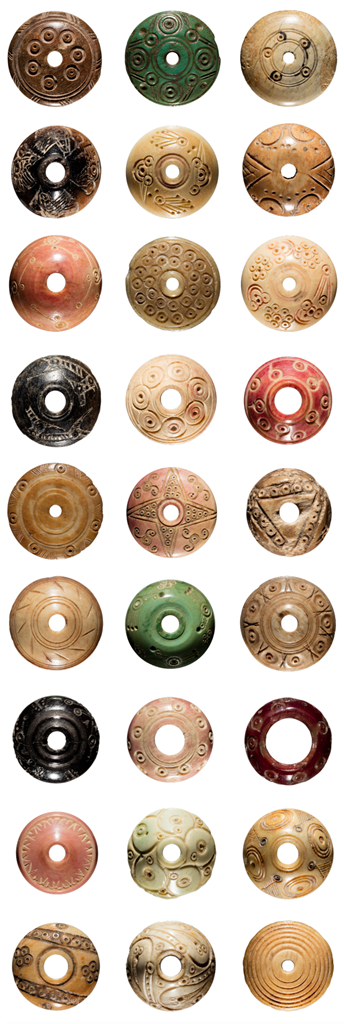
Tumblr theinternetarchive Iranian Spindle Whorls

A spindle is a hand tool for making yarn, basically a long thin stick around which the freshly formed yarn can be wound. A spindle whorl is a weight attached to the bottom of a spindle. Whorls provide more torque and a longer spin time—purely functional, in other words.

Many, many spindle whorls found around the world have been carefully shaped, which is to be expected—you do want your tools not just to work, but work well for the purpose. In addition, so many of extant spindle whorls are also beautifully decorated.

You could perhaps argue that the small surface makes for a quick and easy art project. However, most whorls are round or spherical, which makes for a more challenging surface to decorate.

Spinning must have been an unending task for our predecessors. Spindles—and, by extension, spindle whorls—were the most basic, utilitarian tool you could imagine. And yet, we find innumerable people throughout history wanting to decorate their whorls. Little details like this make me love humanity all over again, despite all the awful we’re also capable of.

Images by The Cleveland Museum of Art, mashup via theinternetarchive on Tumblr

The Vivid Colors of the Dome of the Rock

We often picture history in muted terms, at least in the West. We think of the white marble statues of Greece and Rome, the gray stone of medieval castles, the dull brown cloth of historical costumes. It can be hard to remember how much color has been lost to age, weathering, even deliberate destruction. (A few useful examples here and here.) For an alternative view, it helps to look at examples that go far back in history but have been maintained and restored. One good example is the Dome of the Rock in Jerusalem.

Originally completed in 692 CE, the shrine has continued to be an important Islamic site ever since. Its original design was colorful, and in the following centuries it was elaborated with tiles, mosaics, and metalwork. Several major restoration projects in the past several centuries have kept the colors vibrant. While individual details of the decor may not go back to the original construction, the overall effect gives us a sense of how richly colorful the built environment of the past could have been.

Tiled exterior wall of the Dome of the Rock, photograph by Godot13 via Wikimedia (Jerusalem; construction 692, tiles restored 1552; glazed tile; tiles by the workshop of Abdullah Tabrizi)


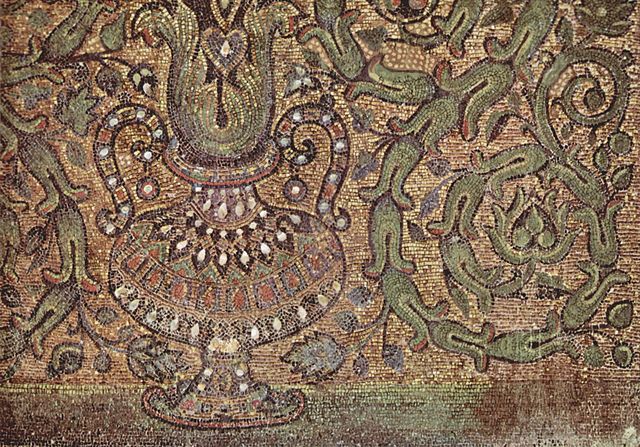
Interior mosaic, photograph by the Yorck Project via Wikimedia (Jerusalem; originally 692, later restored; glass, mother of pearl, and stone mosaic)


Dome interior, photograph by Virtutepetens via Wikimedia (Jerusalem; originally 692, later restored; metal and enamel)


The Dome of the Rock was a monument that was meant to make a statement. Other buildings of the time were not necessarily so dizzyingly colorful, but the shrine preserves a variety of visual culture we have very few other examples of. Even if nothing else exactly like it was ever built, many buildings once existed with just as bright an array of colors that are now long gone. When imagining what places in the past might have looked like, or when imagining new worlds inspired by them, remember that gray stone and white plaster are not the only options.

History for Writers looks at how history can be a fiction writer’s most useful tool. From worldbuilding to dialogue, history helps you write.

Six Kings

When Islam first stepped onto the world stage in the seventh century CE, it came as a surprise to the great powers of the day, the Byzantine (or Eastern Roman) Empire and the Sassanian Persian Empire. A powerful religious, political, and social movement sprang up from among the Arabs, the fragmented desert-dwelling peoples who had been pushed back and forth by the wars between Rome and Persia for centuries.

Muslims of the early Islamic period were aware that they were stepping into a world of powerful forces, and some examples of early Islamic art reflect the desire to stake a claim for Islam’s place in the world. For example, a wall painting from an early Islamic palace, in modern-day Jordan, shows how early caliphs positioned themselves in relation to the larger world.

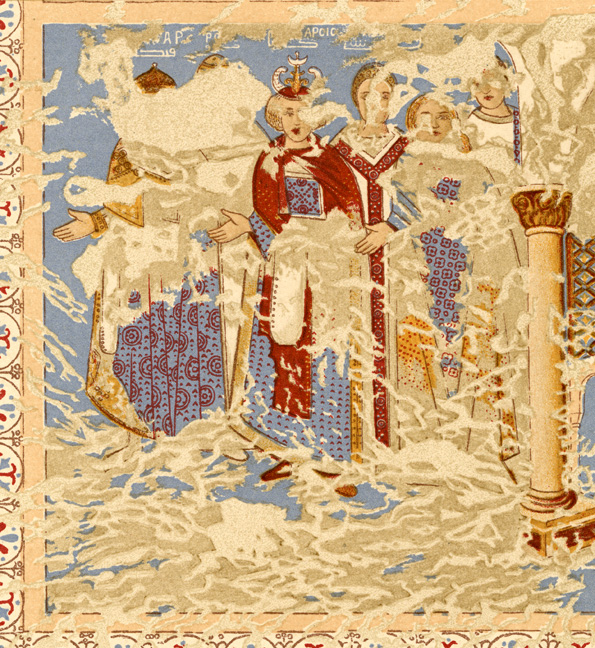
This painting, known as the “Six Kings” painting, is in very poor condition today, partly because of some European travelers who saw it in the early twentieth century and tried to chisel it off the wall and take it with them. (This is why we can’t have nice things.) Working from the painting in its current damaged state and an impressionistic copy made by those travelers, though, we can get a sense of what the original looked like.

Six Kings painting, photopgraph by Ghazi Bisheh via Wikimedia (Qasr Amra, Jordan; 710-740 CE; wall painting)

Copy of Six Kings painting via Wikimedia (1907; by Alois Musil)

Six royal figures stand together, all gesturing toward the caliph’s throne. The six figures were originally labeled in both Arabic and Greek. While not all of them can be identified now, we can tell that they include the Byzantine emperor, the Sassanian Persian emperor, the Visigothic king of Spain, and the king of Axum, a nation in what is today Ethiopia that was a powerful political and commercial state at the time.

This painting comes from the early 700s, a time when Islam was barely a century old but the caliphate had already become a major world power. By placing these figures on the wall, the caliphs were placing themselves among the great powers of the day, even positioning themselves as leaders of a world whose boundaries stretched from Spain to Persia and Constantinople to the horn of Africa. That was no small claim for such a young polity to make. The message was clear: Islam had arrived and was ready to be taken seriously as a world power.

Out There is an occasional feature highlighting intriguing art, spaces, places, phenomena, flora, and fauna.