We don’t usually think of cities as places where food is grown. Farmland is a rural thing, and the harvest must be brought to urban markets so that city-dwellers can eat. But urban agriculture is nothing new. The destruction of the Roman city of Pompeii by Vesuvius in 79 CE preserved the evidence of extensive food production inside the city walls. One place where ancient Pompeians could get fresh, super-local food was the house known today as the House of the Ship Europa. (The name comes from a detailed graffito on the house wall depicting a sailing ship with that name.)
This house sits among other houses on the southern side of the city. From the outside, it doesn’t look much different from the dwellings around it. On the inside, though, the house owners had made good use of the space they had for growing a variety of foods.
At the rear of the house, a large walled garden space stood open to the sky. Gardens were not uncommon in Pompeii, and many houses had open courtyards for leisure, but not all were as carefully planned as at this house. Archaeologists studied the layout of the garden, pollen deposits preserved under the volcanic ash, the types of planting pots and tools kept in the space, and even the shapes left in the ground by tree roots to determine how this garden was planted and what grew there.
The core of the garden was laid out in regular rectangular planting plots which match the ways Roman agricultural writers like Cato and Varro recommended planting grapevines. The roots of one large tree were identified as a filbert, a tree which is often planted at the edges of vineyards in modern Italy. The pollen samples from the site had an unusually high amount of grass pollen compared with other Pompeian gardens; while in other houses grasses were weeded out out flower beds or kitchen garden plots, at the House of the Ship Europa, grassy paths were allowed to grow between the grape vines.
Smaller tree roots were found in regular rows along the walls. Since young fruit and nut trees are typically grown by grafting branches from the desired species onto rootstock that may come from a different kind of tree, we cannot tell from the roots alone what smaller trees were planted in this garden. The rootstocks would have been suitable for plums, peaches, cherries, figs, olives, or almonds, and some or all of these foods may have been grown at the house. Elsewhere in the garden were a number of large perforated ceramic pots whose shape and size match the types of planting pots Roman writers recommended for growing citrons, a citrus fruit and ancestor of the lemon.
The burnt remains of filberts, grape seeds, figs, beans and dates were scattered in the layer of volcanic ash that covered the garden. Most of these plants could have been grown at the house, but date palms do not produce fruit in the climate of Italy, so the dates must have been imported. Perhaps the Europa celebrated on the wall of the house was a trading ship belonging to the family. The house may have functioned as a store selling both their own locally grown fruits and nuts and some imported produce from elsewhere in the Mediterranean.
The House of the Ship Europa gives us an idea of what kinds of foods were grown within the walls of Pompeii and were part of the diet of city’s residents. The city was not just a place of residence, but also an agricultural landscape, and we must imagine that other ancient cities were as well.
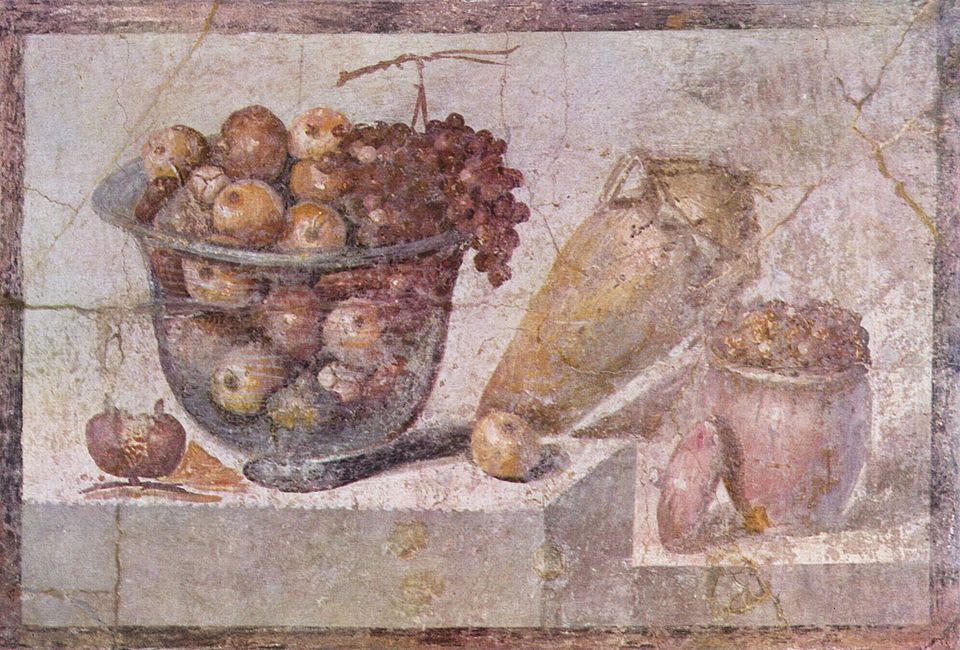
Image: Fresco of fruits, photograph by the Yorck Project via Wikimedia (House of Julia Felix, Pompeii; c. 70 CE; fresco)
Out There highlights intriguing art, places, phenomena, flora, and fauna.
I find that this fall I need to go all out on coziness to try and offset some of the horrible in the world. My comfort browsing therefore includes several of the core aesthetics: cozycore, naturecore, forestcore, summercore, hobbitcore, cottagecore, and more.
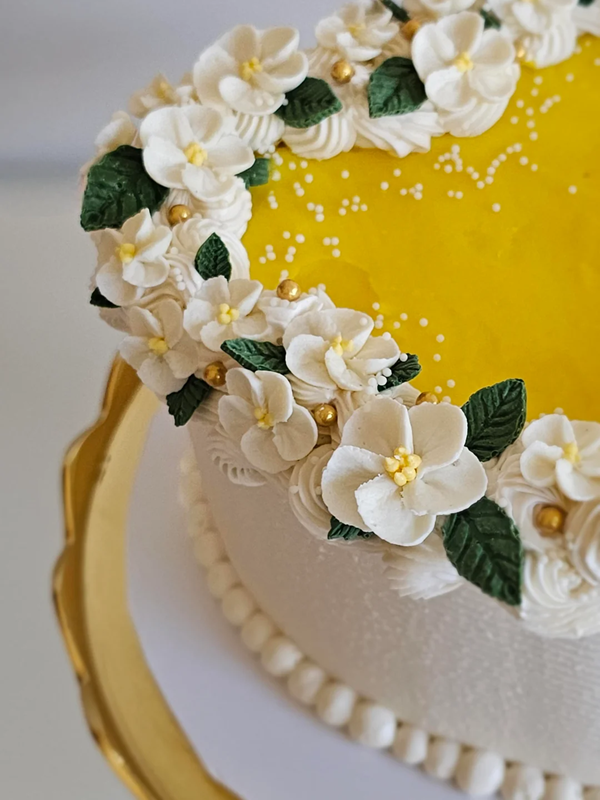
In addition to comfy things, now and then you find something simply stupendous. For instance, Reddit user Green-Cockroach-8448 makes just incredible, absolutely jaw-dropping cakes. Here are two examples that I adore:
The incredible thing is that she bakes as a hobby, not professionally. These results definitely do put some professional efforts to shame, they’re so astounding. My gast is thoroughly flabbered.
With these mouth-watering treats we wish a Happy Thanksgiving to our readers in the U.S.!
A lot of international foods are available now in Finland that may have been hard to find decades ago, but one food that is still elusive is bagels. While there are some bakeries making good bagels here, they are few and far between, and certainly not as convenient as our neighborhood bagel shop was back when we lived in Massachusetts. So I have decided to try my hand at making bagels myself.
I started by looking through my cookbooks. Astonishingly, there’s not a single bagel recipe in any of the cookbooks on my shelf. Even my trusty old Joy of Cooking let me down here, so to the Internet it was! Fortunately, there’s no end of bagel recipes online. After looking at a number of recipes, I settled on one that seemed straightforward and clear, this New York-style bagel recipe from the Sophisticated Gourmet. (One thing I particularly appreciated about this recipe is that it gives both American and metric units. I’ve gotten used to doing conversions, but it’s nice when you don’t have to.) With that recipe as a base and a few tweaks to suit my own kitchen, I made my first test batch of bagels.
And they were good!
So, here’s my process, in case you want to try the same. This recipe is for a plain white wheat bagel without inclusions or toppings. Adjust as you like to make your own preferred type of bagel.
This coming weekend is Ropecon, the major role-playing convention in Finland and one of the highlights of our year. Eppu and I always attend, whether it’s to play games, run games, catch up with friends, attend talks and workshops, or disco the night away.
As part of our Ropecon routine, once the weekend is over and we’ve recovered a bit, we compare notes and write down things we’ve learned from the experience to make the next year’s con easier, more manageable, or more fun. Here’s a few of the things I’ve learned over the years that have made my con experience better.
Since we live close enough to the convention site to go there and back again each day, here are some handy ways to manage home life for the weekend:
Make one big pot of soup or some other warm dish (chili, borscht, beef stew, etc.) and one big bowl of salad to leave in the fridge over the weekend. We can dip into one or both whenever we’re at home and need a low-effort meal.
Run and empty the dishwasher the morning of the first day of the con. Then just pile in dishes as you use them over the weekend and run it when it gets full and you have time.
Have a big piece of paper that says CLEAN on one side and DIRTY on the other; leave it on top of the dishwasher with the appropriate side up. When you’re half asleep in the morning and in a rush to get to your first panel, it saves time and brain power to not have to stop and think about when the dishwasher was last run or emptied.
Have a good store of salty snack foods on hand (chips, pretzels, peanuts, etc.), because you will be sweaty and dehydrated and need a quick electrolyte restorer.
Wash and chop a big pile of vegetables like cucumbers, carrots, cherry tomatoes, peppers, etc. on the day before the con for easy-to-grab healthy snacking, too.
Some advance prep also makes the at-con experience easier:
Make a daily schedule for the con with an hour-by-hour breakdown of what you want to do, including room numbers. If you’re not sure what you’ll be doing at any given time, write down all the possibilities you’re considering. Share this schedule with anyone you want to meet up with at the con, so they have an idea of where to look for you and when you’ll be free.
Write out your contact information (and your partner’s) and make that your phone lock screen for the weekend.
Leave a comfortable change of clothes in the bathroom at home every morning before you leave for the con, since you might want an immediate shower and change as soon as you get home.
Leave an empty drying rack in the bathroom, too, so you have an easy place to hang sweaty gear to dry before putting it in the laundry.
And some notes for making the con experience as fun and comfortable as possible:
If you have one warm, full meal a day, you can get through the rest of the day by snacking when you have free time. Make sure to drink plenty of water as well.
Pack a change of clothes in a bag with a zipper closure and leave that at the coat check in case you need to change during the con. Include a dry wash cloth in a plastic bag, so you can wipe yourself down if necessary.
There will always be someone at a game who needs to borrow dice, so bring an extra set for lending out.
For games that I run, print up a sign with the game name in big, visible letters that can stand on the table so players can easily find me.
If you’re on your way to Ropecon or have another con in your future, I hope you have an easy and wonderful time!
How It Happens looks at the inner workings of various creative efforts.
Kangina are traditional, ecological, and effective northern Afghani mud-straw containers for keeping fresh fruit good longer. They work best with a particular type of grapes with thick skins and a late harvest.
Freshly formed bowls are first baked in the sun for a few hours. The fruit is then placed inside, another bowl is placed on top, and the join sealed with more mud.
The kangina are then stored in a cool, dry place for up to five or six months. To open, you gently crack the kangina halves apart. (Seen, for example, in this Voice of America video.)
Definitely not quick or low-effort, but still an impressive way to preserve fruit and introduce variety into your winter diet, isn’t it? Perhaps not the best containers for a party of intrepid D&D adventurers to carry with them, either, but certainly an inspired method of storing food they could run into while resting between quests.
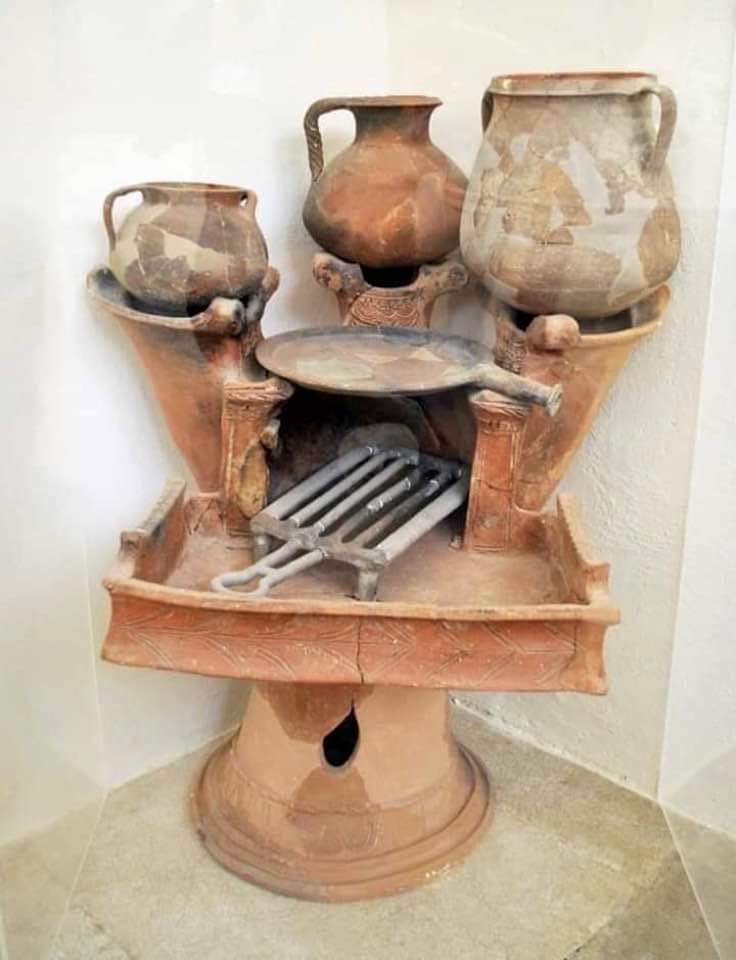
Look at this amazing ancient multi-tier clay cooker:
There seems to be frustratingly little information available online. I haven’t been been able to track down full details for this apparatus, but some sources call it an anthrakia. Considering that anthrakia means ‘a heap of burning coals’ it sounds at least plausible (but as I said I don’t know). Apparently it’s from 500 BCE or so (although one source says 2nd c. BCE), and was found on the island of Delos, Greece.
Delos was one of the most sacred places of ancient Greece—claimed to be the birthplace of Artemis and Apollo—and a busy trade center for centuries if not millenia. It looks like the only images of this cooker come from the Archaeological Museum of Delos. No-one seems to have posted the associated text, though, so I still don’t know quite as much as I’d like.
Such an ingenious arrangement, though, isn’t it? The oven has space for a hand-held grill and an area at the front for raking coals into (I assume). Above the oven, there is an opening to rest a frying pan on. As if that’s not enough, above that to the back of the cooker there are tube-like stands for three cooking pots, through which the pots also have access to heat from the oven. You could have five dishes cooking at the same time. And it looks like the cooker is also portable.
It’s impressive both from the point of view of functionality and design—the oven-stove-grill combo seems to have been made as one piece. (Or possibly two pieces, if the pedestal that looks like an upside-down plant pot was made separately.)
Not bad for a 2,000+ year-old kitchen gadget, right? I can almost hear the sizzling of frying food.
With that, I’ll wish our readers in the U.S. a Happy Thanksgiving! 🙂
We just discovered that our recipes for the Riders of Rohan were referenced in a piece of Middle Earth fanfiction over on Archive of Our Own. The story is called “she had a spirit and courage at least the match of yours” by shOokspeared, and it’s a lovely little slice-of-life tale following Éowyn on a visit to the Shire in the days of peace after the War of the Ring. In a letter home to her husband Faramir, Éowyn mentions enjoying the familiar tastes of braised beef and saffron and cream pancakes for lunch with her Hobbit friends one day.
We’re astonished and delighted to see that our work is still interesting and useful to others!
“One small bite is enough to fill the stomach of a grown man.”
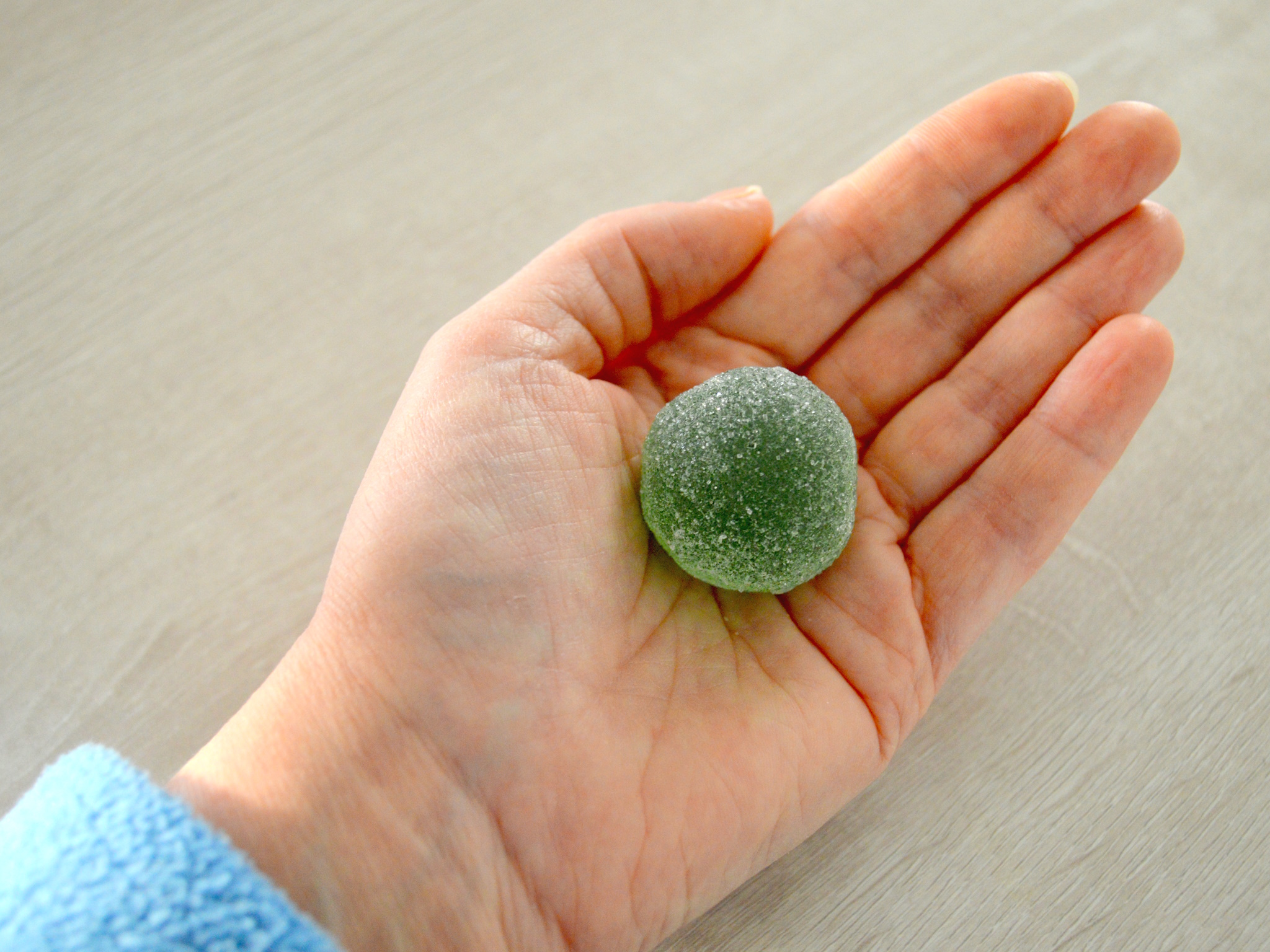
That’s actually not too terribly far from the truth. 😀 It’s quite possible to inadvertently overdose yourself on them—these suckers are surprisingly large. See for yourself:
Since I’m a nerd who never wondered about this candy before, I had to read a bit more. 🙂
Fazer is an old Finnish company that makes biscuit and grain products, confectionery, and other candy. In addition, they run a chain of popular cafes. One of their seasonal products is pear-flavored marmalades or jelly candy called vihreät kuulat (green balls).
(Marmalades are not one of Fazer’s international brands, which was tough for me when we were still living in the U.S.—I could only get my green ball fix when visiting Finland at the right time of the year, or if someone sent or brought them as a gift.)
Apparently Fazer has been making jelly candies for Christmas since the end of 1800s, when the founder Karl Fazer brought a recipe home from St. Petersburg, where he had been studying. The green ball format and flavor has been for sale since 1929.
Besides Christmas, the second big season for green balls is Easter (although I have to admit that’s escaped my notice thus far). Altogether Finns eat some 25 million green balls a year. These days there are also green ball flavored chocolate and cookies, and I’ve even seen spreadable jelly.
Woo, only 6 years to their centennial! I hope they’ll make something special. 🙂
I gather that Becky Chambers’s new Monk & Robot series has gotten a mixed reception. Broadly speaking people either love it or are frustrated by it. Since I love Chambers’s Wayfarers series, I thought I’d check the new series out.
I’m still not yet sure what, exactly, to think except to say I see why the dichotomy has arisen. Here’s one section that I found simply mind-boggling:
“The wagon’s lower deck quickly lost any semblance of organization, evolving rapid-fire into a hodgepodge laboratory. Planters and sunlamps filled every conceivable nook, their leaves and shoots constantly pushing the limits of how far their steward would let them creep. Stacks of used mugs containing the dregs of experiments both promising and pointless teetered on the table, awaiting the moment in which Dex had the brainspace to do the washing-up. A hanging rack took up residence on the ceiling and wasted no time in becoming laden to capacity with bundles of confettied flowers and fragrant leaves drying crisp. A fine dust of ground spices coated everything from the couch to the ladder to the inside of Dex’s nostrils, which regularly set bottles rattling with explosive sneezes.”
– Becky Chambers: A Psalm for the Wild-Built
The section starts quite well, and I see why the word cozy is applied to the series. Then, sadly, it gets worse. I don’t even terribly mind the mess in a food-prep space (dirty dishes to the ceiling and a coating of dust), as it could conceivably be just eccentric. (I mean, I prefer a clean home myself since I’m allergic to dust, and plant dust doesn’t help, but to each their own.)
But. Dex is “regularly” sneezing “explosive[ly]” all over the space where they mix the teas they’re offering to people they serve as a tea-monk.
Excuse me? SNEEZING—REGULARLY—ON DRINKS THEY SERVE TO OTHERS?!?
Disgusting is an understatement! The exact opposite to cozy. Ew! Ew, ew, ew, eww!
I do get that getting a book to print takes a good long while (a highly technical term, that). I wasn’t able to find out when Chambers started to write A Psalm for the Wild-Built, but the publishing deal was announced in July 2018 and the first book published in July 2021. In the acknowledgments for the sequel, A Prayer for the Crown-Shy, she writes that she finished book 1 “just before lock-down started” and handed in book 2 “three months before I was eligible for my first [covid vaccination] jab”. It is therefore possible that it was not feasible to change the text.
Still, I should think that it’s not too much of a stretch to NOT SNEEZE ON FOODS AND DRINKS. In real life or in fiction. With or without a pandemic behind you (i.e., having been filled to the gills with information about cough etiquette and sneezing hygiene).
EWWWWWWWWW!!!
Chambers, Becky. A Psalm for the Wild-Built. New York: Tordotcom, 2021, p. 22-23.
Image by Eppu Jensen
Serving exactly what it sounds like, the Quotes feature excerpts other people’s thoughts.
Latin, like any foreign language, can be confusing sometimes, especially when so many Latin words have been adopted into other languages and often changed in the process. Still, it’s hard to think of a Latin word more misunderstood than vomitorium. The popular image is that Romans had rooms in their houses where they went to purge themselves mid-orgy so they could go back and keep eating. It’s an entertaining image (for certain values of entertainment), but it’s also completely false.
The word vomitorium is a form of vomitorius, derived from the verb vomo, meaning “to vomit.” In normal usage, vomitorius refers to emetics, substances used to induce vomiting for medical purposes. Pliny the Elder uses the word in this sense to describe the medicinal properties of some sort of plant (the exact plant is unclear, but it seems to be something in the allium family).
There is a plant with leek-like leaves and a reddish bulb that the Greeks call “bulbine.” It is considered very effective in treating wounds, so long as they are recent. The bulb that is called “vomitorius” because of its emetic effect has dark, glossy leaves that are longer than those of other types.
Pliny the Elder, Natural History 20.40
(My own translations)
Only one extant source uses the word vomitorium in reference to an architectural feature, and it was not a room for vomiting. The passage is from the Saturnalia by Macrobius, a late Roman writer. The Saturnalia is a fictional account of a dinner party conversation, a popular genre among Greek and Roman writers. In this case, the diners spend a good deal of time talking about the origins and usage of various words, particularly those connected with eating and digestion. Vomitorium comes up in a discussion of metaphorical and poetic uses of vomo:
Lucilius said in his fourteenth book:
“If there were no praetor hanging around bugging me
that wouldn’t be bad, I tell you. He’s the one disemboweling me.
In the morning every house vomits a wave of sycophants.”
That’s well said, and it’s an old expression, too, for Ennius says:
“And the Tiber river vomits into the salt sea”
And so nowadays we talk about “vomitoria” in the theatre, through which crowds of people pour in to get to the seats.
Macrobius, Saturnalia 6.4.2-3
Macrobius is describing the monumental entrances of public buildings that were built to accommodate large flows of people, such as we typically find on Roman theatres and amphitheatres. They look something like this:
Vomitorium of the Colosseum looking outward, photograph by Ank Kumar via Wikimedia (Rome; 80 CE; stone)
Vomitorium of the Roman amphitheatre in Bordeaux looking inward, photograph by Michaël Van Dorpe via Wikimedia (Bordeaux; 3rd c. CE; stone)
It’s hard to say how formal or widely used the term was. We don’t have any mention of it from Roman texts on architecture. It certainly carries more than a whiff of aristocratic disdain for the crowds of ordinary folks who had to jostle their way into the seats, unlike Macrobius and his upper-crust set who could count on reserved seating. Still, it must have been a word that late Roman aristocrats like Macrobius would recognize, or else there would be no reason to bring it up in a discussion of etymology and poetry. In modern times, architectural historians have taken Macrobius’ bit of upper-class slang and turned it into a technical term for describing the wide entry passages of Roman public buildings, and you’ll find it in more than one scholarly work on Roman architecture, but there’s no evidence that the people who designed, built, or used those structures referred to them as such.
Now, it’s not entirely clear how we got form a misapplied architectural term in historical scholarship to the idea of upper-class Romans pausing mid-party to go to a separate room and throw up, but somewhere along the way there are probably a couple generations of bored school kids enlivening their Latin lessons with overactive imaginations and gross-out humor. They may well have gotten inspiration from some of the more revolting passages in Latin literature. In one such passage, the philosopher Seneca laments the maltreatment of enslaved household workers who are made to stand silent and hungry while the man of the house overindulges:
For this reason, I laugh at those who think it is unseemly to share a meal with their slaves. Why should it be, when it is only haughty habit that has a crowd of slaves standing around while the lord dines? He eats more than he can handle and in his overpowering greed stretches out his belly until it can no longer do its job, then he has to work harder to get it all out than he did to put it in. And all this time, the poor slaves cannot move their lips, not even to speak.
Seneca, Moral Letters 47.2
Another, even more explicit example comes from Suetonius’ biography of the emperor Claudius:
He rarely left the dining table until he was gorged and sloshed, and as soon as he was on his back and snoring, a feather was slipped into his mouth to get him to unburden his stomach.
Suetonius, The Lives of the Caesars, “The Deified Claudius” 33.1
Both of these passages pretty clearly describe elite Romans overeating and then inducing themselves or being induced to vomit. It would be a mistake, however, to take either of these passages as evidence that self-purging was a normal enough part of Roman life to require a dedicated room.
Seneca is condemning the greed, vanity, and inhumanity of wealthy Romans. The point of his imagery is the revolting contrast between the master who eats more than he can handle and the slaves who get nothing to eat at all. Seneca is not describing the real behavior of a real person but concocting a repulsive mental image to make a philosophical point. Suetonius, on the other hand, is describing a real person’s real behavior, but that person was not a typical Roman. The Roman elite found Claudius eccentric and off-putting, a fact Suetonius illustrates with multiple anecdotes. What Suetonius describes here is not the lifestyle of an average Roman aristocrat but a weird, gross habit of a weird, gross person.
Both of these passages are meant to disgust the audience, but neither was written with modern sensibilities in mind. They were meant to be disgusting to an audience of elite Romans. Seneca and Suetonius wrote about self-purging Romans not because it was something Romans did but because it was something their Roman readers would cringe at. If a mid-feast vomit had been a common enough practice to warrant making it a special feature of the home, these passages would have had no force.
Now, none of what I’ve explained here should be taken to mean that no Roman ever induced a post-feast hurl, nor even that there were no Romans who made a habit of it. People do a lot of strange things, and people of any culture or time can have a troubled relationship with food, but a few people acting strangely does not amount to a cultural practice. The idea of the vomitorium as a purging room is a bizarre pile-up of misunderstood slang, schoolkid humor, and a pruriently selective reading of sources. The ancient Romans weren’t any more likely to be intentionally losing their dinners than anyone is today, and they certainly didn’t build rooms for it.
History for Writers looks at how history can be a fiction writer’s most useful tool, from worldbuilding to dialogue.







 Co-Geeking


_09.jpg)

You must be logged in to post a comment.