In addition to the two acts, I was surprised to find that Finns have had their fingers in other countries’ Eurovision pies, too: besides Erika Vikman’s stage show, designer Ari Levelä has participated in creating the visuals for Austria and Cyprus, and Estonia’s song Espresso Macchiato is co-written and produced by Finnish songwriter Johannes Naukkarinen. It is indeed a very exciting Eurovision year for Finland!
The grand finale takes place late tonight, 22.00 / 10 p.m. our time, and it’s going to run at least four hours. (Gosh, I almost have a headache from the mere thought of staying up that late!)
I’m really torn. I really hope KAJ wins, because Bara bada bastu is so joyful, cozy, and sweet, exactly what the world needs right now. But only if KAJ guys get to keep their quirkiness, happiness, and wholesomeness, because it’s part of their charm, and you can’t do that if you’re sleep deprived and exhausted and harangued by media and fans alike. Plus, it would give Sweden their 8th Eurovision win, pushing them ahead of Ireland (both have seven wins ATM), which as a Nordic person I would LOVE.
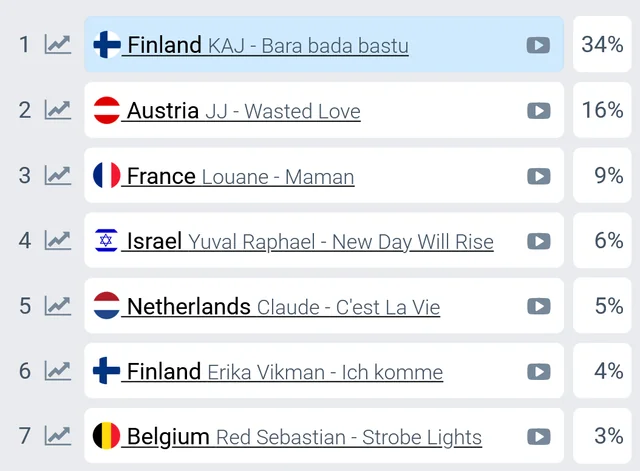
At the same time, though, Erika Vikman’s win would be stupendous—it would be the second time Finland wins, the first win for a female solo artist from Finland, and a win for female empowerment. It’s a catchy song with a great beat at the end, and a challenging tune (i.e., meant for a skilled singer). Apparently, after Thursday’s second semifinal there’s been a surge of interest; some have even wondered whether she might really turn out to be this year’s dark horse.
Moreover, Erika’s is an act where a grown-up woman dresses and sings how she wants, instead of a serving of bare female flesh centered around stereotypical male sexual desire (i.e., a slip of a girl decked up in barely-there sparkly cover-ups furiously gyrating and tossing her hair). (*cough* Cyprus 2018, Cyprus 2019, Cyprus 2021 *cough*) Acts are acts, sure, but like KAJ’s, Erika’s seems to contain a certain amount of authenticity that people respond to.
Ohwell. In the end, I suspect I’ll just be overjoyed that Finland has two such strong contenders this year. Following Käärijä’s second place in 2023, recent years have been exceedingly good from the point of view of Finnish Eurovision fans, and that’s not something to sneeze at. 🙂
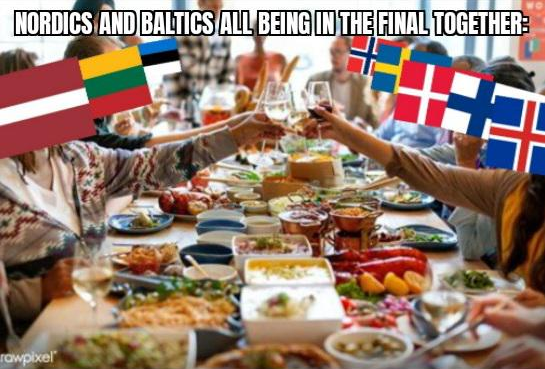
As a cherry on top, all of the Nordic countries (Finland, Sweden, Norway, Denmark, and Iceland) AND all of the Baltic countries (Estonia, Latvia, and Lithuania) qualified for the grand final. All at the same time, for the first time. Yay for us smaller countries in the north! 🙂
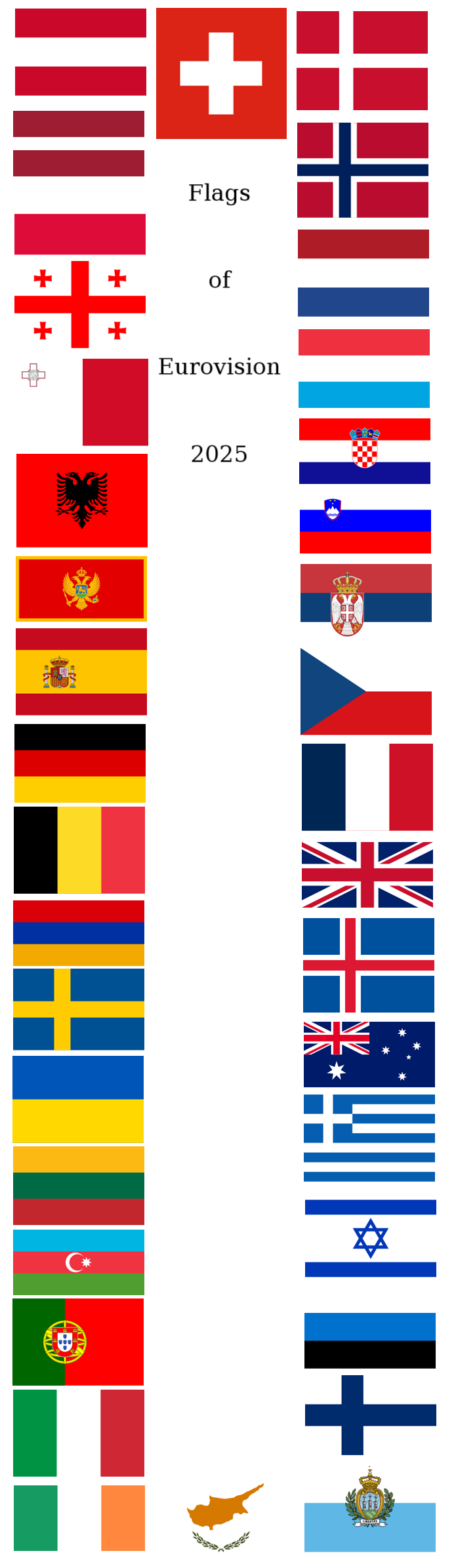
Every year when we watch the Eurovision Song Contest, I find myself distracted from the music and stage shows by all the European flags. I enjoy seeing all the different combinations of colors and designs, and every year I find myself thinking: “I wonder if I could organize the Eurovision flags in such a way that they flow from one to the next with similar colors and patterns?” Well, this year I finally decided to try it, so here it is! My Eurovision 2025 flag carousel, starting with this year’s host, Switzerland, and circling through the flags of all the other participating countries!
Why did I make this? No good reason. Just because I wanted to.
Should you care? I really can’t think of any reason why you would.
But if you’re a fellow fan of flags, I hope you enjoy it!
(A super-short recap of his post: the song Bara bada bastu, ‘Just having a sauna’, despite representing Sweden, is in fact performed by the Finnish comedy group KAJ. As a result of KAJ’s popularity, Swedes and Finns are finding a new spirit of Eurovision togetherness, and it has also brought some international recognition to the little-known Swedish-speaking minority in Finland.)
Here, as a companion post, is a listing of cultural references in KAJs song and in the performance.
I’m pulling some of this from my own experience growing up in Finland, but others from online commentary, or my Swedish-Finnish friends’ stories. This list is, therefore, likely not to be complete. Additions are very welcome!
KAJ—which rhymes with the English word guy—is made up of Kevin Holmström, Axel Åhman, and Jakob Norrgård, who all originally hail from Vörå, Ostrobothnia, Finland. The idea behind the song is to gently poke fun at how Swedes view Finns and our culture. Here we go! 🙂
Bara bada bastu by KAJ is the song representing Sweden in the Eurovision Song Contest 2025, and it’s been shaking things up in Sweden, Finland, and the Eurovision bubble as a whole. If you haven’t been following the run-up to Eurovision 2025, you may not know the story of Bara bada bastu and why it matters so much to so many people. Here’s a short introduction to get you caught up.
Finland, Sweden, and Swedish-speaking Finns
Finland and Sweden have a long and complicated history, grounded in the fact that what is today Finland was conquered by Sweden in the Middle Ages and ruled as part of the Swedish kingdom for centuries. Until recently, Finland was largely a poor and undeveloped area compared with metropolitan Sweden. The elite in Finland were traditionally Swedish transplants or had close social ties to Sweden. As a result, the typical Finnish stereotype of a Swede is a stuck-up, rich dandy, while the Swedish stereotype of a Finn is an uncultured, violent drunk. It is an old joke in Finland to say (of a hockey game, or some other equally serious contest) “I don’t care who wins as long as Sweden loses.”
Relations are not purely hostile. The two countries also have a history of cooperation and mutual support. Sweden supported Finland’s self-defense against and recovery from Russian invasion in World War II, and it has long been a commonplace that Finland is Sweden’s first line of defense. Despite this solidarity, there is still a lingering antagonism. When Finland and Sweden joined NATO in response to Russian aggression in Ukraine, it was important to both sides that they join together. It was also important to Finns that Finland was accepted into the alliance first.
Caught in the midst of this sibling rivalry are the Swedish-speaking Finns. Finland has a minority population who speak Swedish as their mother tongue, mostly concentrated in the cities in the south and along the western coast and islands. They make up about five percent of the population. Some are descended from the old Swedish aristocracy, but most of them these days are just ordinary folks, not much different from other Finns. Because of this population and Finland’s historical ties to Sweden, Swedish is the second official language in Finland, and Finnish-speakers are required to learn Swedish in school (just as Swedish-speakers are required to learn Finnish). Many Finnish-speaking Finns resent this language requirement, and some turn that resentment against their Swedish-speaking neighbors. Swedish-speaking Finns are stereotyped in much the same way as Swedes: rich, snobby, and stuck-up. While Swedish-speaking Finns are subject to this sort of low-level resentment and caricaturing at home, they are practically invisible to the rest of the world. Even in Sweden, not everyone knows that some of their Finnish neighbors speak Swedish as their first language.
The Eurovision Song Contest
Leaving aside the world of frosty Finns and snooty Swedes for a moment, let me introduce you to the next thing you need to know about: the Eurovision Song Contest. The Eurovision Song Contest (commonly just called Eurovision) is an annual multinational extravaganza in which countries from around Europe and beyond (G’day, Australia!) compete in putting on musical performances. The exact format and rules have changed frequently since the contest was first held in 1956, but if you’re not up on Eurovision, here are the essentials you need to know.
Every participating country sends one stage act with a song (not longer than three minutes).
Every country chooses its competing act in whatever way it likes. Many production and performance teams are international, and while at least some members of the overall team usually come from the country they are representing, nothing requires the artists appearing onstage to come from or be in any way connected with that country. (Write this down! It’ll be important later!)
The participating acts compete against one another in two semifinals. The viewing audience votes a set number of acts from each semifinal into the four-hour grand final, where they join a small set of acts from countries who get an automatic place by paying the major costs of the broadcast (currently: France, Germany, Italy, Spain, and the United Kingdom).
After all the acts have performed in the grand final, two sets of votes are collated. In each participating country, a jury made up of music industry professionals awards points to their top ten favorite songs. The top song gets 12 points, the second 10, and rest from 8 down to 1. The viewing audience in each country also gets to vote on their favorite songs, with points awarded in the same way. (Neither juries nor audience are allowed to vote for their own country.)
The points are announced onstage in dramatic fashion, and the country with the most combined points wins.
Traditionally, the winning country each year hosts the next year’s contest, although exceptions are sometimes made (such as in 2023, when Ukraine won the contest, but because of the ongoing war, the runner-up, United Kingdom, stepped in as host).
The Eurovision Song Contest has been a venue for good-spirited competition between nations, using music to foster both national pride and international solidarity in much the same way the Olympic Games use sports. It has also created its own subculture with traditions, factions, customs, and quirks of its own.
One of the long-running truisms of Eurovision is that juries and audiences tend to favor different kinds of songs. Conventional wisdom says that juries like serious songs that demonstrate artistic virtuosity and range, while audiences like wacky stage hijinks, fun gimmicks, and a danceable beat. Neither assumption is entirely borne out by the voting results, but Eurovision acts often try to court one set of votes or the other. The way points are divided often means that a song that would have won on the strength of audience votes doesn’t win because the juries favor something else, sometimes to ire of some fans who feel their favorite was cheated.
Finland has traditionally done quite poorly in Eurovision. The country has only one win to its credit, 2006, when the monster metal band Lordi unexpectedly pulled off a win in what is seen as the audience rebelling against a contest they felt had grown stale with too much bland, predictable pop music.
Finland has become a semi-reliable source of audaciously weird contributions to Eurovision, most of which fall absolutely flat in the voting results, but which appeal to some parts of the audience by standing out against a background of highly-polished pop.
Sweden, on the other hand, is a Eurovision powerhouse, with a current total of seven wins to its credit. Highly-polished pop is Sweden’s Eurovision bread and butter, and they pull it off better than most other countries, earning frequent recognition from juries. Sweden is home to a major pop music industry, and Swedish composers, lyricists, and choreographers are frequently found working on other countries’ Eurovision entries.
Recent Eurovision history
With the stage set, we turn to the recent history of the Eurovision Song Contest to see how these deeply-rooted forces have played out to lead us to this year.
In 2012, the Eurovision Song Contest was hosted in Azerbaijan and won by the Swedish singer Loreen with her song Euphoria. While Euphoria leaned a little to the weird side for Sweden, it was still highly produced and sung in English, making it easy for an international audience to follow. Euphoria swept both the audience and the juries.
Sweden took home the trophy again just three years later in 2015, when Austria was hosting. The singer Måns Zelmerlöw won with his song Heroes. Like the usual Swedish entry, Heroes was an immaculate pop anthem with a clever stage show, but it caught the heart of Europe. While Italy and Russia did better in the audience vote, Heroes soared with the juries, and Måns’s telegenic charisma won over even those fans who didn’t place Sweden first.
The next year, 2016, Sweden hosted the contest. Måns returned to the stage not just as a performer but as co-host of the festivities along with comedian Petra Mede. The 2016 show was carried off brilliantly and established Måns as not just a beloved past winner but one of the contemporary faces of the contest. He reappeared in several following contests as part of the general entertainment and the interval acts that fill up time while votes are counted. (2016 also gave us Peace Peace, Love Love, a loving parody of the contest itself, performed by Petra and Måns.)
In the following years, Finland and Sweden continued their usual patterns. Swedish songs routinely scored well with juries, and Finland’s songs occasionally excited some fans while mostly ending up near the bottom of the vote tallies. Then came Käärijä.
Finland chooses its Eurovision act with a televised national contest called Uuden Musiikin Kilpailu (New Music Contest, abbreviated UMK). In 2023, a young Finnish rapper/singer known as Käärijä had a runaway victory at UMK with his song Cha Cha Cha and quickly became a sensation among Eurovision fans. Cha Cha Cha was a challenging song: unabashedly weird, sung in Finnish rather than internationally-friendly English, and reflecting in complicated ways on Finnish alcohol and dance culture, but something about it spoke to a wide and adoring audience in Europe.
Sweden selects its competitor with Melodifestivalen (Melody Festival, casually known as Melfest or Mello), a multi-week tournament of songs which finally crowns a winner after several rounds. In 2023, Loreen returned to Eurovision by winning Melfest with Tattoo, a smooth jury-pleasing vocal performance.
Going into Eurovision 2023 (hosted in the United Kingdom on behalf of Ukraine), Finland was in the strange position of audience favorite. The outpouring of fan love for Käärijä and Cha Cha Cha was unheard-of in Finland’s Eurovision history. It quickly became clear that Tattoo was also gathering momentum. In the final voting tally, Finland came out way ahead with the audience, but the juries showed Finland much less love and delivered the victory to Sweden.
The 2023 contest felt like an encapsulation of the Finland-Sweden relationship: Finland the scrappy, weird underdog went up against Sweden the polished, practiced former winner, and the juries swung for Sweden. In the days after the contest there was a lot of resentment from Eurovision fans who felt the juries had cheated Käärijä of a win and the audience of their favorite. Finns felt deflated, and losing to Sweden rankled especially hard. Unkind things were said. In time, tempers cooled, and Finns and Swedes got back to the usual routine of quiet mutual disdain.
The 2024 contest, hosted again by Sweden, did what it could to soothe tempers. The Swedish hosts (Petra Mede again and actress Malin Åkerman) had plenty of self-deprecating jokes about Sweden’s Eurovision obsession, and Käärijä himself performed in one interval act.
It was a turbulent contest, however. Protesters demonstrated against Israel’s participation, and there were rumors about the Israeli delegation at the contest harassing other performers. The biggest cause of discontent, however, was when the Dutch performer, Joost Klein, an audience favorite and one of the leading contenders for victory, was suddenly booted from the contest after an altercation with a camera operator. The details of the incident are murky, but it was widely seen as an overreaction by Eurovision’s governing body. The live audience at the event was vocal with its displeasure, and in the aftermath many Finns enjoyed some schadenfreude at Sweden’s expense.
When do we get to the sauna brothers?
We’re almost there! I promise!
Finally we come to 2025. This year, Finland selected Erika Vikman’s Ich komme (I’m coming) to represent the country. Ich komme is a pumping, upbeat song celebrating a woman’s sexual desire. Sexiness is no stranger to the Eurovision stage, but it traditionally caters to the male gaze. Ich komme, though plenty sexy, is very clear in being about a woman’s own joy in her body and does it without disparaging men, either, a novelty for Eurovision. After UMK, Ich komme gathered some positive buzz, and, while probably not a winner, looks like it may do well at the contest.
And then came this year’s Melfest. As usual, it was a smörgåsbord of well-known Swedish pop music talent, but the star attraction was the return of Måns Zelmerlöw. Måns competed with Revolution, another highly-polished pop anthem in the same spirit as his winning Heroes.
Other great names in Swedish music filled the roster, including John Lundvik, a former Eurovision contestant who came close to winning in 2019. And then there was KAJ.
KAJ is a Finnish comedy group made up of three Swedish-speaking Finns from one of the smaller municipalities on Finland’s west coast. The group takes its name from the first letters of its performers’ names: Kevin, Axel, and Jakob. Although they were locally popular, they were not well known even on the national stage, and were practically unheard-of outside of Finland. KAJ was invited to join Melfest by one of the festival’s producers, and the trio figured it might be a good way to increase their name recognition and maybe score a few more gigs in Sweden but without much hope of anything more. KAJ joined the contest with Bara bada bastu (Just having a sauna), a light-hearted but sincere tribute to the joys of relaxing in sauna after a long day, performed in their own regional dialect of Finland Swedish. KAJ and Måns went up against each other in one of the last rounds of the competition and both passed through to the final.
KAJ stood out from the other performers in the final. Surrounded by media-sexy pop stars and their slickly-produced English-language international hits, the performers in KAJ were self-consciously nerdy, unfashionably authentic, and the only contestants so gauche, so outré, so utterly unsophisticated as to show up to the Swedish song-selection contest and sing in Swedish! Yet the audience loved them! When the votes were counted (Melfest uses a voting system similar to Eurovision’s), it came down to KAJ and Måns. It felt like Käärijä and Loreen all over again: the weird, provincial Finnish nobodies singing a niche but heartfelt little song in their own language up against Eurovision royalty with a whole national pop music industry behind him belting out a focus-group-perfect anthem in English.
And then the impossible happened: KAJ won! The juries broke just barely in Måns’s favor, but the Swedish audience went for KAJ by a million votes, giving KAJ the most audience votes in Melfest history! In this year’s Eurovision Song Contest, Sweden will be represented by a little-known humor group from Finland!
(Måns was less than gracious about his loss. One might have forgiven him for a few unguarded comments in the heat of emotion after a tense contest, but in the weeks since the Melfest final Måns’s wife has announced a divorce with allegations of abuse and drug use that have tarnished Måns’s reputation. Many Swedes are relieved that he will not be representing them on the international stage, especially not with the bitter aftertaste of 2024’s contest.)
The effects of the win have been remarkable to witness. Coming after the rancor of 2023 and chaos of 2024, Swedes and Finns are finding a new spirit of Eurovision togetherness. KAJ’s win has gone some way to patch over old resentments and break down timeworn stereotypes. It has also brought some international recognition to the little-known Swedish-speaking minority in Finland.
This year’s Eurovision Song Contest will be held in Switzerland in the middle of May. We will see what the rest of Europe makes of Ich komme and Bara bada bastu. At this moment, the boys in the sauna are running strong for the top spot, and if they win, then for once Finns will be just as happy for Sweden’s victory as the Swedes are.
An occasional feature on music and sound-related notions.
“At the beginning of May of 2023, I was completely burned out. Then I watched Eurovision and this awesome Finnish dude with a bowl cut, a lime green bolero, and a name that’s a multi-level pun (Käärijä = wrapper) reminded me why I love performing and gave me some desperately needed inspiration with a song called ‘Cha Cha Cha.’ […]
“We had a fun day in the recording studio and I hope that fans of Käärijä, of which I am one, will catch the small details musically, in the translation effort, and in the accompanying lyric video.
“It’s my sincere hope that Käärijä fans who know nothing about Star Trek or Klingon enjoy this acoustic cover as much as my nerdy Trekkie fans.”
Wow—they got the spirit down pat! I mean, Klingons aren’t my cup of tea, but as far as I can tell, bang on. And how amazing is it that cha means ‘torpedoes’ in Klingon?
Cha cha cha! 🙂
Hey, look! We found a thing on the internet! We thought it was cool, and wanted to share it with you.
This week Käärijä is represening Finland in the Eurovision Song Contest with Cha Cha Cha. Here’s his performance at the Uuden musiikin kilpailu (New Music Competition) where the song was chosen.
Käärijä – Cha Cha Cha | Finland | National Final Performance | Eurovision 2023 by Eurovision Song Contest via YouTube
Here’s a link to the Finnish lyrics. I’ve tried my hand at translating them into English in a way that fits the rhythm and rhymes of the song:
What a week it’s been, the days behind have just been crawling.
Pina coladas and the open road are now calling.
The night is young, so listen, it’s time to get plastered.
This frozen shell around me has got to get shattered.
Grab my drink with both hands and get loaded, I’m like
cha cha cha, cha cha, cha cha!
Blow off tomorrow, just go out and get totaled, I’m like
cha cha cha, cha cha, cha cha!
I wanna lose my mind, forget all my cares, I’m like
cha cha cha, cha cha, cha cha!
And I’ll keep going til I’m out of my chair, I’m like
A couple pina coladas are down already.
Still my face is like a mask, unmoving and steady.
The night is young, so listen, it’s time to get plastered.
This frozen shell around me has got to get shattered.
The floor is calling me, my inhibitions need numbing.
I’m like cha cha cha, watch out, I’m coming!
Grab my drink with both hands and get loaded, I’m like
cha cha cha, cha cha, cha cha!
Blow off tomorrow, just go out and get totaled, I’m like
cha cha cha, cha cha, cha cha!
I wanna lose my mind, forget all my cares, I’m like
cha cha cha, cha cha, cha cha!
And I’ll keep going til I’m out of my chair, I’m like, woah.
And now I’m dancing free,
I’m like cha cha cha,
and I’m not afraid of this world, you see,
I’m like cha cha cha,
when I pour champagne all over me.
Cha cha cha, and it’s getting hard to see,
and now I slur my speech when I hand the keys to this other me.
Cha cha cha, and you know that I’m not like this usually,
oh no, but I am today, but I am today.
And now I’m dancing free,
I’m like cha cha cha,
and I’m not afraid of this world, you see,
I’m like cha cha cha,
when I pour champagne all over me.
I’m like cha cha cha,
cha cha cha, cha cha, cha cha-ah-ah
I’m like cha cha cha,
cha cha cha, cha cha, cha cha,
cha cha cha, cha cha, cha cha.
Here’s hoping we’ll see Käärijä go all the way to the final!
An occasional feature on music and sound-related notions.
Have you ever asked yourself: “I wonder what it would be like if there were a Eurovision-style song contest in Azeroth?” No? Just us? Well, okay then.
If you’re not familiar with the Eurovision Song Contest, it’s an annual competition in which countries around Europe (and a few beyond) present songs in a wide variety of styles and genres. It’s good for inventive songs, wild stage shows, and good-spirited competition among nations. What if we had the same thing in the lands of World of Warcraft? Here are our ideas of what songs might represent the various realms and lands of the Shadowlands.
Oribos – La Forza by Elina Nechayeva (Estonia, 2018)
An ethereal, soaring, operatic melody from Estonia in 2018 befitting the mystical city surrounded by The Inbetween. (Probably helps if you like opera.)
In English, the Italian lyrics start something like “You know in the night for me / There is a star / It lights up my way / For eternity / It is my guide / In the immensity / That never leaves me” (someone else’s translation). Very apt!
Bastion – Visionary Dream by Sopho Khalvashi (Georgia, 2007)
Georgia’s Eurovision contribution from 2007 is a hypnotic song. Among its lyrics: “I will fly away / To reach the heights I’ve ever dreamed / Beneath the sun / No sense of time and space.” Sounds like Bastion to us.
Maldraxxus – Hard Rock Hallelujah by Lordi (Finland, 2006)
Finland won in 2006 with this hard rock song. It’s got monsters, pyrotechnics, and a head-banging beat. What else could you hope for from the Necrolords of Maldraxxus?
Ardenweald – Spirit in the Sky by KEiiNO (Norway, 2019)
Norway’s song from 2019 has a magical fairy-tale feel and features a yoik performance evoking the spirits of the northern lights. It feels like something the Night Fae of Ardenweald would be into.
Revendreth – It’s My Life by Cezar (Romania, 2013)
In 2013, Romania blessed us with this levitating falsetto vampire drama king. If that’s not right for the Venthyr of Revendreth, I don’t know what could be.
The Maw – Hatrið mun sigra by Hatari (Iceland, 2019)
Content note: The Icelandic group Hatari is described on the official Eurovision site as “Award-winning, anti-capitalist, BDSM, techno-dystopian, performance art collective”. The music pretty much matches that description—in English, the song name apparently translates “hate will prevail”. Be warned.
The lyrics start with “The revelry was unrestrained / The hangover is endless / Life is meaningless / The void will get us all” (someone else’s translation), and the stage show includes chains and spikes. Yep; as bleak as playing through The Maw.
Torghast – Warrior by Nina Sublatti (Georgia, 2015)
Representing Georgia for the 2015 contest we find another Eurovision song where the lyrics and stage show seem to fit WoW uncannily well (Sublatti’s outfit certainly does!) and certainly suit the desolation of Torghast.
Korthia – Higher Ground by Rasmussen (Denmark, 2018)
The Belgian entry from 2003 is sung in an imaginary language and also has a bit of an otherworldly quality to it, making it the perfect song for Zereth Mortis.
Finally, as an honorable mention, if there is a Eurovision song for the Shadowlands expansion as a whole, it’s Sweden’s Heroes from 2015.
Shadowlands – Heroes by Måns Zelmerlöw (Sweden, 2015)
Any favorites among these or other Eurovision songs, or suggestions for additional WoW zone pairings? Do share!
P.S. The 2022 Eurovision Song Contest semifinals are finished, and the final is held this Saturday, May 14, in Turin, Italy, should you want to follow along.
Of Dice and Dragons is an occasional feature about games and gaming.
As winter takes hold around here, we turn our thoughts to the far north, to lands of snow, reindeer, and northern lights. We’ll leave you with a couple of examples of yoik, a distinctive Sámi musical tradition. Songs featuring yoik have twice made it to the finals of the Eurovision Song Contest. The first was the Norwegian song “Sámiid ædnan” from 1980, performed by Sverre Kjelsberg and Mattis Hætta.
Sámiid ædnan – Norway 1980 – Eurovision songs with live orchestra via escLIVEmusic1
The next one was “Spirit in the Sky,” also from Norway, performed by KEiiNO in 2019.
KEiiNO – Spirit In The Sky – Norway – National Final Performance – Eurovision 2019 via Eurovision Song Contest
We’re vacationing for the rest of the year. See you in 2020. Happy New Year!
An occasional feature on music and sound-related notions.
 Co-Geeking
You must be logged in to post a comment.