Celebrating Hidden Youth With Rhodopis

161121bendisHidden Youth comes out today! Among the many short stories in this collection about young people from marginalized groups in history is my story, “How I Saved Athens from the Stone Monsters,” about the adventures of two flute girls, one Egyptian and one Thracian, on one strange and terrifying night in ancient Athens. I hope you’ll consider picking up the collection, not just for my story but for all the other amazing work in it.

My story was inspired in part by the Egyptian and Thracian immigrant communities we know existed in Classical Athens. There were temples in the city to both the Egyptian goddess Isis and the Thracian goddess Bendis. But Athens wasn’t the only place Egyptians and Thracians crossed paths.

A famous Thracian courtesan named Rhodopis worked in Naucratis, the Greek trading city in Egypt in the 6th century BCE. She seems to have been a larger-than-life character whom people liked to tell stories about. It was apparently widely believed in antiquity that one of the three great pyramids at Giza was built for her by her lovers. Another fanciful story about her is the closest ancient equivalent to the story of Cinderella:

They say that one day, when Rhodopis was bathing, an eagle snatched her sandal from her serving maid and carried it away to Memphis. There the king was administering justice in the open air and the eagle, flying over his head, dropped the sandal in his lap. The king, moved by the beauty of the sandal and the extraordinary nature of the event, sent all through the country to find out whose it was. She was found in Naucratis and conducted to the king, who made her his wife.

– Strabo, Geography 17.1.33

(My own translation)

While this is obviously just a bit of a fairy tale, Rhodopis was a real person. One of her lovers was Charaxus, the brother of the lyric poet Sappho. Sappho evidently didn’t think much of the relationship. A fragment of one of Sappho’s poems throws a little shade the courtesan’s way (referring to Rhodopis as Doricha—it was not unusual for courtesans to use several different names):

O, Aphrodite, may she find you too bitter for her taste,

and don’t let her go boasting:

“What a sweet thing Doricha has got herself into

this time around!”

– Sappho, fragment from Oxyrhynchus papyrus 1231.1.1.(a)

(My own translation)

Herodotus reports that the rich offering Rhodopis made at Delphi at the end of her life to celebrate her good fortune—an enormous pile of iron roasting spits—was still to be seen there in his day. (Herodotus, Histories 2.135)

Rhodopis sounds like she would have been an interesting person to hang around with, and Hidden Youth is one more reminder that interesting people were everywhere in history, not just in the places we expect.

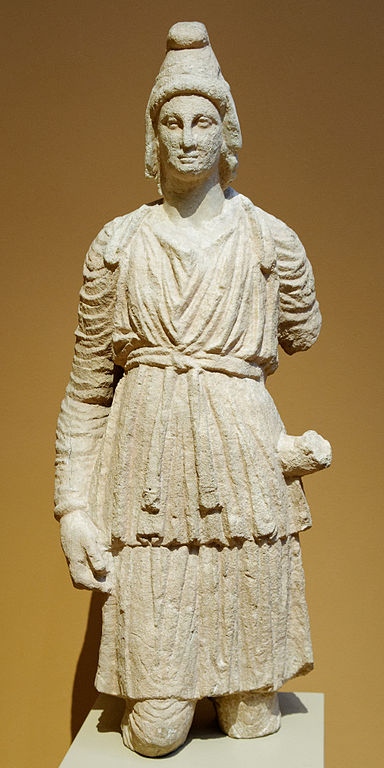
Image: Greek statue of Bendis, photograph by Marie-Lan Nguyen via Wikimedia (Cyprus, currently Metropolitan Museum of Art, New York; 3rd c. BCE; limestone)

Announcements from your hosts.

Ancient d20s

If you’re a role-playing gamer, you probably recognize the profile of a twenty-sided die, or d20, right away: the collection of triangles making up a bumpy sphere by which we invoke the capricious god of random numbers. This shape (technically known as an “icosahedron”) has been in use a lot longer than Dungeons & Dragons has been around. Here’s an example from Roman-period Egypt which has the names of Egyptian gods marked on its faces in demotic, an Egyptian script.

161103dakhleh
Dakhleh die showing “Isis” face via Martina Minas-Nerpel, “ A Demotic Inscribed Icosahedron from Dakhleh Oasis,” Journal of Egyptian Archaeology 93 (2007), 137-48 (Dakhleh Oasis, Egypt, currently Valley Museum, Kharga, Egypt; 1st c. CE; limestone)

Here’s another example from Egypt. This one has Greek letters on each of its faces.

Icosahedron via Metropolitan Museum of Art (Egypt, currently Metropolitan Museum; 2nd c. BCE - 4th c. CE; serpentine)
Icosahedron via Metropolitan Museum of Art (Egypt, currently Metropolitan Museum; 2nd c. BCE – 4th c. CE; serpentine)

It’s possible that these dice were used for some kind of game, but more likely they were used for divination. The die with the names of gods may have been used to determine which god a person should pray to for help. The Greek letters probably corresponded to a list of pre-written oracular responses: ask your question, roll the die, and consult the table for the answer, sort of like the ancient version of a magic 8-ball.

Some might say the uses of the twenty-sided die haven’t changed much in a couple thousand years.

Of Dice and Dragons is an occasional feature about games and gaming.

Becoming Egyptian

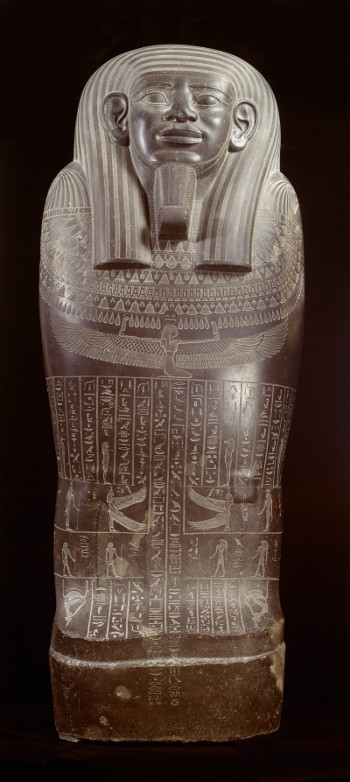
Sarcophagus of Wahibre-em-akhet, via Rijksmuseum van Oudheden (Egypt, possibly Giza, currently Rijksmuseum van Oudheden; basalt; 664-525 BCE)
Sarcophagus of Wahibre-em-akhet via Rijksmuseum van Oudheden (Egypt, possibly Giza, currently Rijksmuseum van Oudheden; basalt; 664-525 BCE)

The sarcophagus of Wahibre-em-akhet, from Egypt in the seventh or sixth centuries BCE, is a typical Egyptian sarcophagus, not for a king but for a man of wealth and status in Egypt’s Twenty-Sixth Dynasty. The Egyptian iconography is easily recognized: the long beard and braided wig of the portrait; the conventional Egyptian ways of depicting eyes, ears, and other features; the winged protective goddesses; the hieroglyphic text. There is nothing about this sarcophagus to suggest its owner was anything other than a native Egyptian, born and bred, from a people who had lived in the Nile valley since time immemorial. Nothing, that is, until you read the hieroglyphic text and find out that Wahibre-em-akhet’s parents were named Alexicles and Zenodote; both are Greek names.

We know nothing else about Wahibre-em-aket or his parents. We can’t say definitively where they came from, where they grew up, what language or languages they spoke, or how they identified themselves in daily life. It seems very likely, though, that we are looking at someone who was born to Greek parents but lived as an Egyptian.

Wahbire-em-akhet’s family probably had connections to Naukratis, a Greek city founded in Egypt with royal permission. The original settlers of Naukratis were Greek mercenaries who had served the Egyptian pharaohs in their war for freedom from the Assyrian empire. Alexicles may have been one of those mercenaries or the descendant of one. The mercenaries and their descendants continued to serve the kings of Egypt and seem to have gradually assimilated into Egyptian culture. One gang of soldiers left graffiti on the temple of Abu Simbel in upper Egypt while on campaign, including a soldier who identified himself as Psammatichus, son of Teocles, another Egyptian-named son of a man with a Greek name.

Whatever role he played, Wahibre-em-akhet must have done well for himself to afford such a fine sarcophagus. Like many other later-generation immigrant communities, the Greeks in Egypt probably found that assimilating to local customs, names, and languages was useful for getting ahead. They were not the first people to do so. We tend to think of Egypt as isolated, even xenophobic, but Egypt was also a powerful and wealthy kingdom that needed foreign trade connections and could afford to supplement its army with mercenaries from abroad. Greeks, Carians, Jews, Nubians, and Libyans are all well documented as traders and soldiers in Egypt. Many other peoples certainly found their way to the Nile valley as well. As they assimilated into the local culture, adopting Egyptian names and presenting themselves according to Egyptian traditions, these peoples become hard to discern in the archaeological record, but the occasional find like Wahibre-em-akhet’s sarcophagus reminds us that they were still there.

Thoughts for writers

Traditional histories have conditioned us to think of ancient cultures as discrete units: this is Greek, that is Egyptian, that over there is Persian, and the other thing in the corner is Etruscan. It’s useful to be reminded that the lived experience has always been more complicated. Wahbire-em-akhet was, in some ways, both Egyptian and Greek. Most likely his parents were, too. They must have faced many of the same challenges and intersections that immigrant families still face today.

People like Wahbire-em-aket and his parents existed in history. They belong in our stories, too. There is nothing new about multiculturalism.

History for Writers looks at how history can be a fiction writer’s most useful tool. From worldbuilding to dialogue, history helps you write. Check out the introduction to History for Writers here.

Connections: Denmark and Egypt

More than 3,500 kilometers separate the tombs of the Valley of the Kings in Egypt from the village of Ølby in Denmark, but thousands of years ago they were connected by trade.

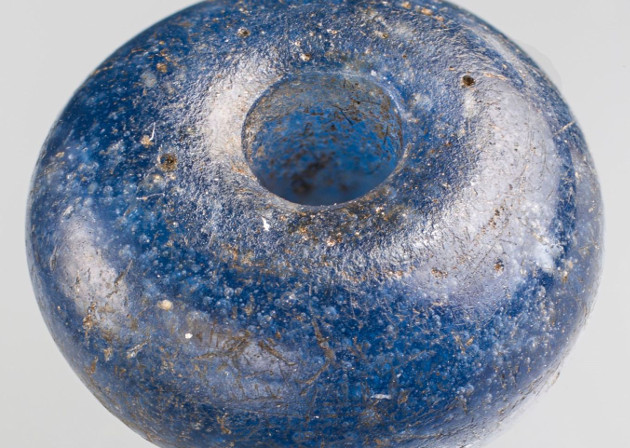
160523mapRecent archaeological work has identified a blue glass bead found in a bronze age woman’s grave in Ølby as originally Egyptian. In fact, based on the composition of the glass, researchers have suggested that the glass bead was made in the same workshop that produced the blue glass inlay on Pharaoh Tutankhamun’s gold funerary mask. Similar beads are known from several other Danish burials. In an age when glass-making as a skill known only in a few regions, colorful glass beads were as precious as gemstones.

160523glassGlass beads like these could have come to Denmark in exchange for amber from the shores of the Baltic Sea. Amber was highly prized in the ancient Mediterranean and not just as jewelry. It was sometimes fashioned into amulets for warding away evil or burned like incense. (The Roman naturalist Pliny the Elder complained about his fellow Romans’ superstitions about it; see: Pliny, Natural History 37.11.)

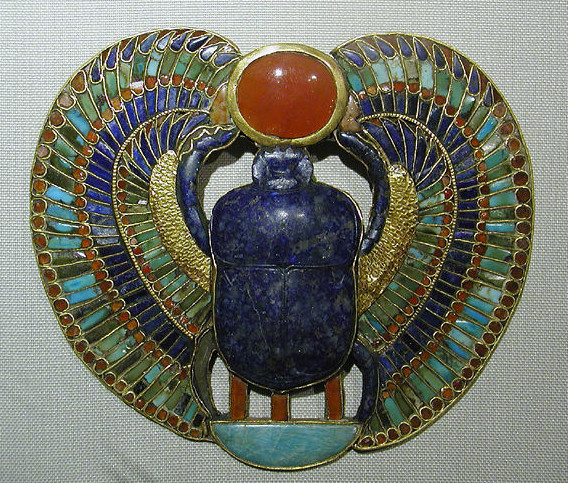
Amber has not been found in large quantities in Egypt, but it was used in some jewelry. In fact, one of the pectorals (pendants worn over the chest as amulets) wrapped up in the linen with Tutankhamun’s mummy is set with a piece of amber.

160523scarabIt’s unlikely that many Danes traveled to Egypt or Egyptians to Denmark in the bronze age. More likely both amber pieces and glass beads were carried short distances by chains of traders in between. Small, easily portable, but high-value objects like beads and gemstones are perfectly suited to this sort of down-the-line trade. A ship that was wrecked off the coast of Turkey around the same time as Tutankhamun’s burial (known as the Uluburun or Kaş Shipwreck) may have been part of that trade network. The ship, whose home port may have been in northern Syria or on Cyprus, was carrying both blue Egyptian glass and Baltic amber when it went down. Also in the ship’s cargo, interestingly, was a gold scarab inscribed with the name of Nefertiti, queen to Tutankhamun’s father Akhenaten (though she was not Tutankhamun’s mother).

Thoughts for writers

The evidence of archaeology is always a bit haphazard in nature. So much is unpredictable about what artifacts survive and what gets found. We are lucky to have the evidence from both the tombs of Tutankhamun and the woman in Ølby, as well as the Uluburun shipwreck, to help us trace out the lines of connection between Egypt and the Baltic. There is no question that connections between different peoples in the distant past were deeper and stronger than we know, but the evidence to document those connections has been lost.

Historians (at least those of the responsible sort) are limited by evidence, but fiction writers don’t have to be. When building your fictional worlds, let the fragments of evidence from our own inspire you to imagine far-flung connections and enterprising traders. Connections like these have always been important.

Images: Map by Erik Jensen based on Portable Atlas. Blue glass bead, detail of photograph by Roberto Fortuna and Kira Ursem via Haaretz (Ølby; 14th c. BCE; glass). Scarab pectoral, photograph by Jon Bodsworth via Wikimedia (tomb of Tutankhamun; 14th c. BCE; gold, glass, and precious stones)

History for Writers is a weekly feature which looks at how history can be a fiction writer’s most useful tool. From worldbuilding to dialogue, history helps you write. Check out the introduction to History for Writers here.

Quotes: Archers String Their Bows Only When They Need Them

This was how Amasis managed the affairs of the Egyptians: from dawn until midday he handled all the matters that were brought before him; the rest of the day he gave over to drinking and joking with his companions.

His advisers, being vexed by his behavior, admonished him: “Majesty, it is not right that you should behave so foolishly. You should be seated on your august throne throughout the day conducting affairs of state. Thus the Egyptians would be certain that they are ruled by a great man and you would have a better reputation. What you do now is not at all kingly.”

But he replied: “Archers string their bows only when they need them. If they were kept strung all the time, bows would snap and be of no use when needed. It is the same with people: if you try to be serious all the time and not allow yourself a share of relaxation, you will surely either go insane or fall dead of a stroke. Knowing this, I take both business and leisure in turn.”

– Herodotus, The Histories 2.173


The Egyptian king Amasis, as reported by Herodotus, giving some good advice about making time for yourself.

Why White Horus Bothers Me More Than Black Heimdall

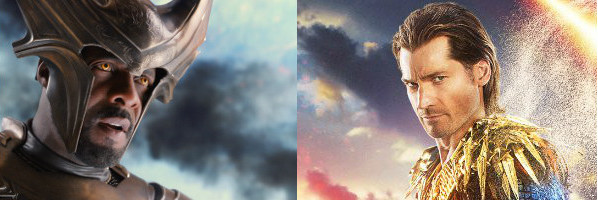
In 2011’s Thor, Idris Elba, despite not looking typically Norse, plays the Norse god Heimdall. In 2016’s Gods of Egypt, Nikolaj Coster-Waldau, despite not looking typically Egyptian, plays the Egyptian god Horus. The casting of Elba as Heimdall surprised me the first time I saw the movie, but it has never bothered me as a fan or as a historian. Coster-Waldau as Horus really bothers me and I think it’s worth taking a minute to explain why.

160310HeimdallHorus

I have nothing against Coster-Waldau as an actor. I haven’t seen Gods of Egypt and don’t plan to, so I have nothing to say about his performance in this particular role, but he’s not the problem here. The problem is in the casting of the movie as a whole.

Continue reading

Fantasy Religions: Interacting With the Divine

151130sacrificeIn the previous installment in the fantasy religions series, we looked at how people following traditional religious customs often perceive the divine around them in physical, tangible forms. Today we turn to the question: how do you interact with such divine forces?

There’s an old joke that says a young man went to his priest one day and declared: “I’m an atheist! I don’t believe in god!” And the priest replied: “Do you think He cares?”

It’s a good joke, but in the doctrines of Christianity, as in the other modern monotheisms, Judaism and Islam, belief matters a great deal. Believing in a god and a certain set of ideas about that god and humanity’s relationship to him/her/it is what defines membership in the religions we are most familiar with in the modern west. Not that everyone is in lockstep about their beliefs: modern religions can have enormous debates about what to believe, but belief is still at the center.

In most traditional religions, belief is a non-issue. As we saw before, peoples following traditional religions see the divine presence in the physical world in a literal, not metaphysical way. To an ancient Gaul, Belenus was not just the god of the sun, the sun itself was Belenus. To say to an ancient Gaul: “I don’t believe in Belenus” would be like saying: “I don’t believe in the sun.” Their response would probably not be: “Do you think he cares?” but: “Well, what do you think is shining on you, idiot?” There were no professions of belief in traditional religions, no creeds or catechisms, no inquisitions or doctrinal schisms.

Continue reading

Dynastic Race Theory and Why Revision Is Essential

151109steleThe words revision and revisionism, when it comes to history, have a bad smell. They are lobbed as insults against people who propose new ways of understanding things that already have a conventional explanation. “We had it right the first time, stop monkeying with it” is the implied retort. Revision, however, is essential to the study of history. No matter how well we think we understand something, our grasp of history is always partial and conditional. New evidence, new ideas, and new questions applied to the known sources frequently yield new results and we often discover that our conventional explanations, while not wrong, are incomplete. And sometimes they are just wrong.

Here’s an example. As the European study of ancient Egyptian history developed in the 1800s, European colonialism was also spreading across Africa. For scholars who supported the imperialist agenda, or at least accepted its intellectual framework (and there were those who didn’t, but they were a minority), ancient Egypt presented a problem. Imperialist thinking declared that Africans were incapable of reaching a high level of culture without the help of superior white men, and therefore European colonization of Africa was not just a profitable venture but a moral imperative. Yet there could be no denying that ancient Egypt had been a high culture. How could both things be true?

Continue reading

Looking at Cleopatra

In this age of selfies and Instagram, we are very aware of how consciously we all create the image of ourselves that we show to the world. The people of antiquity were no less self-conscious about their public image. Look at these two sculptures of Cleopatra VII.

Cleopatra VII Philopator is the famous Cleopatra, Queen of Egypt and lover of both Julius Caesar and Marcus Antonius. She was the last of the Ptolemaic dynasty in Egypt, founded by Ptolemy I, one of the generals of Alexander the Great. The Ptolemies ruled Egypt for almost three hundred years, arguably the first European colonial state in Africa. Like other Macedonian dynasties in the relics of Alexander’s short-lived empire, Ptolemy and his heirs took a pragmatic approach to ruling over a large population that did not share in their Hellenized Macedonian culture. They embraced a kind of cultural bilingualism in which they presented themselves in very different ways to different audiences.

151008marble
Portrait head of Cleopatra VI, photograph by Louis le Grand via Wikimedia (Altes Museum, Berlin; 40-30 BCE; white marble)

This marble head of Cleopatra is sculpted in a Hellenistic style and presents the queen in a Greek cultural context. White marble was favored for sculpture in the Greek world because it reacts to light in ways similar to human skin, making marble sculpture appear more naturalistic. Details like the soft rendering of the mouth, the detailed delineation of the hair, and the slightly off-center tilt of the head are drawn from the artistic repertoire of late Classical and Hellenistic portrait sculpture. This statue asserts Cleopatra’s Greekness and her participation in the broader Mediterranean cultural world. It was probably displayed in Alexandria, the Ptolemaic capital, which had a cosmopolitan population largely made up of Macedonians and Greeks, along with substantial Jewish and Persian communities and a variety of other peoples, but few ethnic Egyptians. It was meant to be seen by an audience that would recognize and appreciate the way this portrait fit into the larger history of Hellenistic ruler portraiture.

Statue of Cleopatra VII, late 1st c. BCE, Hermitage Museum St. Petersburg, basalt, photograph by George Shuklin
Statue of Cleopatra VII photograph by George Shuklin via Wikimedia (Hermitage Museum, St. Petersburg; late 1st c. BCE; basalt)

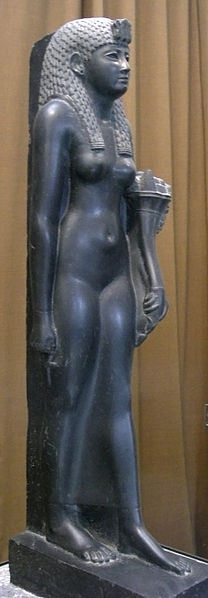
This basalt statue of Cleopatra uses not only an Egyptian artistic style, but an almost entirely Egyptian iconographic vocabulary. Many different stones were used for Egyptian portrait sculpture, but basalt was a popular one since the stone is very hard and durable, giving a sense of permanence especially to royal portraiture. Cleopatra is presented here as an Egyptian pharaoh. She wears a wig adorned with the royal uraeus and carries an ankh in her right hand. The cornucopia in her left hand is a Greek symbol, but its connotation of bounty is similar to the ankh’s symbolism of life. Also note that one of her feet is advanced. Egyptian women were typically depicted with feet together and men with one foot advanced, but the adoption of masculine traits to represent a ruling queen is also traditionally Egyptian. This statue was intended for an Egyptian audience and meant to convey Cleopatra’s commitment to ruling over her Egyptian subjects through the forms and structures that they had long been accustomed to.

The Ptolemaic monarchs were aware that their power rested on two precarious premises: that the people of Egypt would accept rulers who were not themselves ethnically Egyptian and that other Mediterranean, African, and Asian powers would respect as equals a royal house of comparatively recent vintage. These sculptures show the confidence with which Cleopatra balanced those two needs and reinvented her image for two different audiences.

(Sadly, there’s not an ostrich to be seen.)

The Visual Inspiration occasional feature pulls the unusual from our world to inspire design, story-telling, and worldbuilding. If stuff like this already exists, what else could we imagine?

Add Eight Ostrich Teams and Call It a Procession

Or: Some History behind Ostrich Riding, Part 3 of 7

Background: I ran into two historical images from California with ostriches used as transportation. That got me wondering about the history of ostrich riding. And that lead me down quite a rabbit hole.

I’ve divided my findings into separate posts (find them with the ostrich riding tag). Warning: serious early history and language nerdery ahead in Serious Academic Voice.

TL;DR – Tracing ostrich riding to a 3rd century BCE tomb find (a statue of Arsinoe II) from Egypt doesn’t hold up. The use of various ostrich products in human material culture dates back thousands of years. A few ancient depictions involve humans handling ostriches; however, extant sources don’t tell us whether ostriches were merely hunted or whether they were also tamed in the ancient world. The most promising source seems to be a description of a magnificent parade put together by Arsinoe II’s husband-brother Ptolemy II. This Grand Procession included eight chariots drawn by pairs of ostriches, and the ostriches may have been ridden by boys in costumes.

Below is the long story.

Continue reading