Quotes: I Didn’t Want to See Helpless Humans

Murderbot, the sardonic human-machine construct Security Unit who was designed to fight and kill but would rather just watch media, reflects on what makes a good story:

The latest show I was watching had started out good but turned annoying. It was about a pre-terraform survey (on a planet with completely the wrong profile for terraforming anyway, but I didn’t care about that part) that turned into a battle for survival against hostile fauna and mutant raiders. But the humans were too helpless to make it interesting and they were all getting killed. I could tell it was heading toward a depressing ending, and I just wasn’t in the mood. […] I didn’t want to see helpless humans. I’d rather see smart ones rescuing each other.

Murderbot, in Rogue Protocol

Me too, Murderbot. Me too.

Wells, Martha. Rogue Protocol. New York: Tom Doherty Associates, 2018, pp. 22-23.

Light Academia: Love of Optimism, Joy, and Happy Endings

I posted about dark academia about a year ago when I learned of the phenomenon. Time for a sibling post of sorts: since then, I’ve discovered the style light academia.

According to Aesthetics Wiki, light academia favors positive themes in general, “focusing on optimism, sensitivity, joy, gratitude, friendship, motivation, and happy endings.” (Naturally still associated with the love of learning.)

Etsy HeatDigitalClub Watercolor Light Academia Clipart Bundle Sm

Apparently, the term was coined on Tumblr already in 2019. (Man, I must’ve been hanging around the wrong side of Tumblr not to have heard about it then!) Also, apparently cottagecore can overlap with light academia, as can a romanticized view of coffee shops as places for people-watching and studying.

Sounds like neutrals, earthy colors, white, gold, and pastels are especially favored. One article lists movies and shows with light academia aesthetics, including classics like Little Women, but also newer productions like Bridgerton, the 2005 version of Pride & Prejudice or the 2022 Netflix adaptation of Persuasion. There are, of course, playlists and recommended activities or crafts. Some people even sell light academia mystery boxes on online platforms! I’ve found out that there are also other, established flavors I hadn’t heard of before: green academia and chaotic academia.

(Good grief, I feel officially old! At least there doesn’t seem to be any academia cores.)

While I love reading, knowledge, and learning, I confess I’m a little perplexed by this dissecting of various aspects of campus / university life into separate aesthetics. (Not to even mention the fact that Finnish universities by and large look quite different from these Anglo-American-style ones.) But I guess that’s what we humans do—we create endless groupings out of the same elements.

Image: light academia watercolor clipart by Anna Zhar at HeatDigitalClub on Etsy

Quotes: Gwladys or Ysobel or Ethyl

Complaining about “kids these days” with strangely-spelled names is a well that never runs dry. It’s also an older habit than many who indulge in it would think. Here’s a bit from a 1930 P. G. Wodehouse story where Bertie Wooster’s Aunt Dahlia chides him for falling in love with a young lady with an eccentrically-spelled name.

‘Yes, Aunt Dahlia,’ I said, ‘you have guessed my secret. I do indeed love.’

‘Who is she?’

‘A Miss Pendlebury. Christian name, Gwladys. She spells it with a “w”.’

‘With a “g”, you mean.’

‘With a “w” and a “g”.’

‘Not Gwladys?’

‘That’s it.’

The relative uttered a yowl.

‘You sit there and tell me you haven’t enough sense to steer clear of a girl who calls herself Gwladys? Listen Bertie,’ said Aunt Dahlia earnestly, ‘I’m an older woman than you are – well, you know what I mean – and I can tell you a thing or two. And one of them is that no good can come of association with anything labelled Gwladys or Ysobel or Ethyl or Mabelle or Kathryn. But particularly Gwladys.’


P. G. Wodehouse, “The Spot of Art”

The next time someone gets in a snit about Kaytlynn, Jaxson, or Alexzandre, you can let them know they’re part of a tradition at least a century old.

Wodehouse, P. G. “The Spot of Art.” Very Good, Jeeves. First published 1930. Reprinted in The Jeeves Omnibus. Vol. 3. London: Hutchinson, 1991, p. 460.

Quotes: Her Backstory Unfolded Pretty Much as I Typed It

In the acknowledgements for her novella Thornhedge, author T. Kingfisher talks a little about the process of writing this particular story.

–T. Kingfisher in the acknowledgements for Thornhedge
Kingfisher Thornhedge

I’m not a fiction writer, but I do recognize the phenomenon of suddenly uncovering details from role-playing. It’s delightful to just suddenly realize a pertinent, obscure, or particularly distinguishing detail about your character.

(This kind of serendipitous discovery also makes me think any algorithmically generated (“AI”) content won’t be replacing the most original types of human-generated content terribly soon, nor will machine translation replace human translators in a hurry. Oh, make no mistake, people will try to replace human creators with machines. But at least thus far we’re still more sophisticated when it comes to pure innovative leaps or getting smoother translations.)

There have been many times I’ve wished to be able to tap into the unconscious mulling process or consciously force a creative leap, but of course it doesn’t work that way. It makes the moments when it does happen all the more precious, doesn’t it? 🙂

Kingfisher, T. Thornhedge. London: Titan Books, 2023, p. 122.

Image by Eppu Jensen

Quotes: And Then It Leaves You Alone

The Finnish Independence Day is tomorrow, on December 6. In honor of a day of rest, here’s a quote celebrating the most important things in life for this Finn—food, clothes, books, and tea:

Current Reading Babel

“Professor Lovell spoke with uncharacteristic warmth. ‘It’s the loveliest place on earth.’

“He spread his hands through the air, as if envisioning Oxford before him. ‘Imagine a town of scholars, all researching the most marvellous, fascinating things. Science. Mathematics. Languages. Literature. Imagine building after building filled with more books than you’ve seen in your entire life. Imagine quiet, solitude, and a serene place to think.’ He sighed. ‘London is a blathering mess. It’s impossible to get anything done here; the city’s too loud, and it demands too much of you. You can escape out to places like Hampstead, but the screaming core draws you back in whether you like it or not. But Oxford gives you all the tools you need for your work – food, clothes, books, tea – and then it leaves you alone.’”

– Professor Lovell in Babel: An Arcane History by R.F. Kuang

Well—cold-sensitive, erudite, reclusive Finn or not, I do have to add a few carefully selected people into that mix. But otherwise it sounds very good. 🙂

Kuang, R.F. Babel: An Arcane History. New York: Harper Voyager, 2022, p. 23.

Image by Eppu Jensen

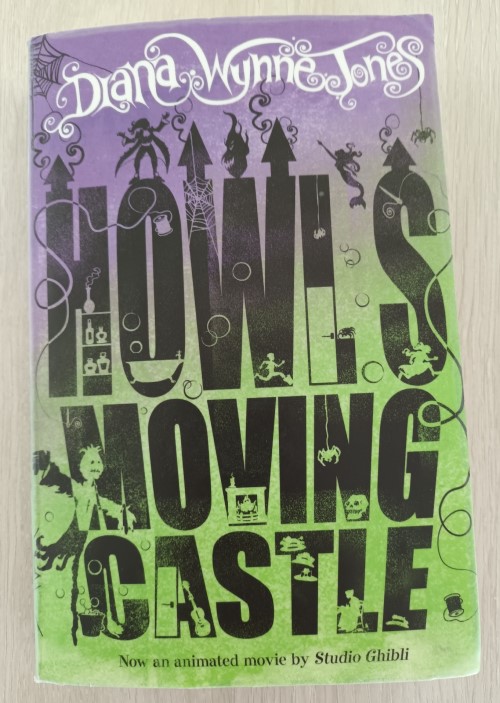
Diana Wynne Jones: Howl’s Moving Castle

I’ve been looking for cozy, comfortable fantasy reads lately, and I’ve seen several recommendations of Diana Wynne Jones’s Howl’s Moving Castle. Until recently, I had known this name only for the Studio Ghibli animation (which I have never watched either), and I was surprised to discover that it was a novel first. I have read and enjoyed some of Jones’s short stories, so I was hopeful about picking up this novel. Alas, my hopes were soon dashed.

The story follows Sophie, a young hatter who is cursed by the Witch of the Waste to turn into an old woman and to be unable to tell anyone about the curse. Sophie goes in search of someone who can not only break the curse, but recognize that there is a curse to break without her having to tell them. She ends up in the small cottage of the wizard Howl, which is enchanted to look like a mobile castle on the outside. Howl seems to take no notice of Sophie, but his pet fire demon Calcifer recognizes the curse and agrees to help her if she will in turn help him break his contract with Howl, which, for magical reasons, he can’t talk about either. So Sophie settles in as a sort of freelance housekeeper to Howl and his apprentice Michael, while keeping her eyes open for anything she can learn about Howl and Calcifer’s contract.

So far so fairy tale. It’s a strong beginning with a promising cast of characters an interesting set of problems for them to unravel. And then nothing happens. Nothing continues to happen for two-hundred pages, until the last twenty pages when all the plot that didn’t happen in the rest of the novel suddenly comes crashing in like five trains trying to run on the same track at once.

It’s not that the characters don’t do anything for all that time—there are trips to the royal palace, covert visits to sisters, and a jaunt to modern Wales, but none of them make any sense or accomplish anything for the characters. Indeed, most of what the characters do is senseless. Over and over again the novel repeats that Sophie does or says something “without knowing why.” Jones, of course, knows why, and most of these nonsensical acts turn out to be coincidentally relevant in the finale, but far too much of what happens in the story happens because the author is setting up what she thinks is a clever ending, not because it makes sense given what motivates the characters and what they know or think they know at the time.

Indeed, it turns out in the end that Howl knew about Sophie’s curse all along. So did her sisters, not to mention the powerful magic-worker one of her sisters was studying under, and they were all trying to help break the curse. In fact, almost everyone Sophie encounters over the course of the novel knew about her curse and was trying to help her all along, but none of them ever bothered to tell her so. Why not? For no reason I can see other than that it would have broken the dramatic tension before Jones was ready.

Although the story mostly takes place in Howl’s small cottage, I found the atmosphere more stifling than cozy. Howl is an irresponsible jerk who makes everyone around him clean up his messes (both literal and figurative) while he moons over one lady or another. He is moody and mean, given to sulking when he doesn’t get his way, and never shows appreciation for how much work the people around him are doing to keep him afloat. Sophie falls in love with him at the end of the novel, as a fairy tale demands, but for no reason that I can fathom.

The only interesting thing I can point to in the novel is how it cleverly remixes themes and elements from The Wizard of Oz. There is a living scarecrow, a wicked witch in a castle, a humbug of a wizard from our world lost in a fantasy land, and a girl in search of a way back to her familiar life. She even eventually acquires a faithful dog and magical traveling footwear. For all these echoes of Oz, the story never feels like a pastiche or homage; it reimagines and recombines these elements to form an entirely different story. If only that story were any good, it would be an impressive narrative feat.

Howl’s Moving Castle left a bad enough taste in my mouth that I think I’ve been put off Jones for a good while. Maybe someday I’ll give her other works a try, but I need to cleanse my palate a bit first.

Image by Erik Jensen

ICBIHRTB – pronounced ICK-bert-bee – is short for ‘I Can’t Believe I Haven’t Read This Before’. It features book classics that have for some reason escaped our notice thus far.

A New Translation to Honor the 50th Anniversary of Tolkien’s Passing

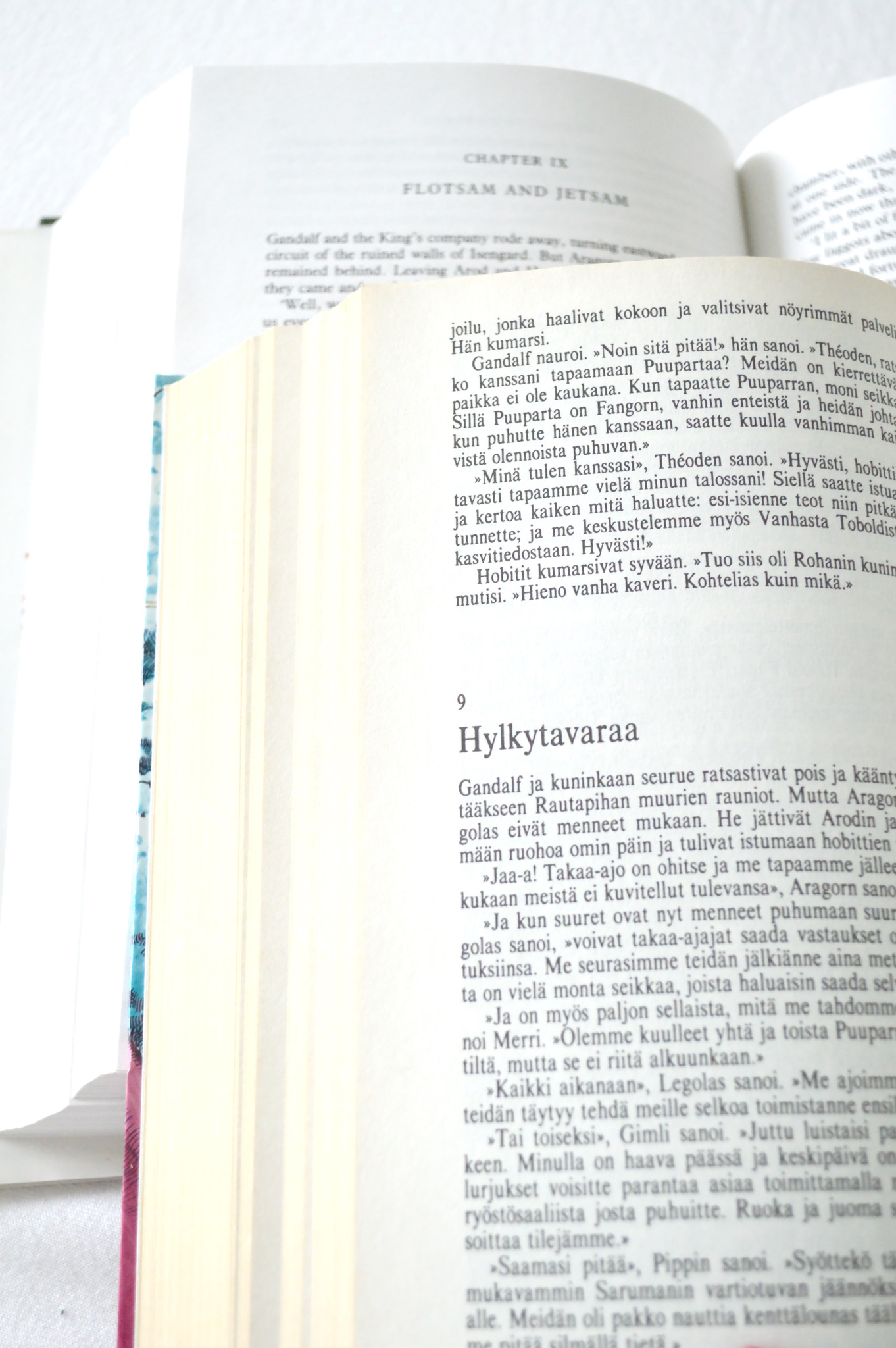
J.R.R. Tolkien died on September 02, 1973, exactly 50 years ago this Saturday. Also 50 years ago this year saw the publication of The Fellowship of the Ring in a Finnish translation. In celebration, a new, improved Finnish translation of the whole trilogy will be published this September.

Often a translation, especially of a fictional work, seems less good—less satisfying, skillful, expressive, vivid, what have you—as the original.

In my experience, however, there is one exception—and perhaps you guess the connection? The Finnish translation of The Lord of the Rings trilogy.

Issuu Screencap WSOY TSH tarkistettu suom lukunayte kansi

The prose for Taru sormusten herrasta is by Kersti Juva and Eila Pennanen; the poems were translated by Panu Pekkanen. It was Juva’s first job as translator. In fact, Juva did most of the work while Pennanen supervised the first two books, and Juva got solo credit for the prose in The Return of the King.

The translation is wondrous. Somehow in the Finnish version, the Hobbits seem more homey, the Dwarves more earthy, and Elves more ethereal than in the original. The desolate areas feel more despondent, and darkness deeper. I’d also say that Pekkanen’s poetry translations wipe the floor with Professor Tolkien’s—having first read the Finnish, I was, frankly, disappointed in the English-language poems in the LotR.

I’m sure some of my appreciation of Taru sormusten herrasta comes down to nostalgia and sense of wonder—I first read the trilogy when I was in my early teens, an impressionable age if there ever was one. Some of it, I’m also sure, comes down to reading my native language.

These days, however, after decade+ of higher ed in and on the language plus daily use with a fellow language nerd, my English is quite as good as my Finnish. I can and do recognize the skill in Tolkien’s writing, plus many of the references and nuances, including some of the Old English. (Though not being a mainstream literature person, I’m sure I also miss other connections—my degree in English is primarily in the language, not lit.)

I’ve been reading in foreign-for-me languages for about 35 years now. Most of my non-native-language reading has been in English, either as original or translations. Some has been in Swedish, German, or Estonian, all translations of works I’ve previously read in the original language. While I can’t boast university education in the field of translating, I’d call myself an educated hobbyist. And as such, I can see the quality of Juva’s work. Erik and I have even read the first 400 pages or so of Fellowship out loud to each other, first a sentence in English and followed by the same passage in Finnish. You really do see Juva and Pekkanen’s skill in the text.

LotR and TSH Side by Side

This new, improved version of Taru sormusten herrasta is also by Kersti Juva. In interviews she’s said the focus of the new version is to polish the language and to weed out the uncertainties a newly-minted translator (herself) wasn’t yet able to see her way past.

Sounds ever so good to me! In fact, I already have a preorder in. 🙂 Also, the celebratory edition looks to be a gorgeous, gorgeous book, with the famous LotR illustrations by Tolkien himself.

Image: screencap from a sample of the newly revised Finnish translation of The Lord of the Rings trilogy by WSOY via Issuu. LotR and TSH side by side by Eppu Jensen.

Review: Blindsight by Peter Watts

Recently I’ve been trying to read more SFFnal classics among my normal selection. I can’t remember why I added Blindsight by Peter Watts (published in 2006) onto my library holds list. When it finally became available and I started to read, I discovered that one of the characters is called Jukka Sarasti (which is a Finnish name), so perhaps that was it.

Content note: spoiler alert!

Current Reading Blindsight

The novel’s events start in the year 2082. A first contact situation arises after thousands of unknown devices burn up in Earth’s atmosphere in a coordinated manner and radio signals are detected near a Kuiper belt object.

Earth sends a ship captained by an AI (called the Captain) to investigate. Theseus is crewed by five augmented humans or transhumans, including their leader, a genetically reincarnated vampire (Sarasti). When the crew wakes from hibernation they discover that Theseus was rerouted mid-flight to a new destination in the Oort cloud. Orbiting a previously undetected rogue gas giant is an enormous, constantly growing object, presumably a vessel, which the crew dub Rorschach.

The Theseus crew begin studying Rorschach with telemetry and excursions despite some very hostile environmental conditions. Additional challenges are posed by psychological effects (hallucinations) and extremely fast, multi-limbed organisms on Rorschach, and on Theseus the crew’s aggravation with the narrator, synthesist Siri Keeton. Eventually relations between Theseus and Rorschach culminate in physical attacks, and only one crew member, Keeton, is sent back to Earth in an escape pod with copies of the information collected before Theseus detonates its payload to destroy Rorschach.

What was especially delightful is that—setting aside Sarasti, who as mission commander and a predator is kind of outside the crew anyway—Theseus’s crew consists of two men and two women, and everyone is described the same way regardless of the configuration of their bodies. Skills and personalities are what matter most. (This is especially enjoyable after reading certain other classic SF novels, which I will leave unnamed to languish in their stifling obsolescence.)

Another interesting detail is that Susan James, the linguist in the crew, actually carries three other personalities or cores in her head, all working and socializing in harmony, and collectively referred to as the Gang by the rest of the crew.

Blindsight turned out to have one suprisingly topical detail. The Gang figure out that despite conversing with the Theseus crew seemingly normally, Rorschach doesn’t really understand the communication. This sounds very much like the recent discussion of Chat-GPT and other AI engines, doesn’t it?

One of the strengths of Blindsight is that it fuses elements from both the so-called hard sciences and the social sciences. Surely SFF (and all storytelling, for that matter) is at its strongest when it’s questioning our perceived realities or possible realities, starting from what makes humans tick. I’m quite tired of SFF that takes bland “and then they went to x and did y” travel narratives and merely cloaks them in fancy wrappings.

Alas, Blindsight has quite a few horror elements and closes with a rather despondent situation. Despite being skillfully written and constructed, it’s therefore not for me.

Blindsight was followed (in 2014) by the novel Echopraxia to make up the Firefall duology.

ICBIHRTB—pronounced ICK-bert-bee—is short for ‘I Can’t Believe I Haven’t Read This Before’. It features book classics that have for some reason escaped our notice thus far.

Quotes: Bottles Rattling with Explosive Sneezes

I gather that Becky Chambers’s new Monk & Robot series has gotten a mixed reception. Broadly speaking people either love it or are frustrated by it. Since I love Chambers’s Wayfarers series, I thought I’d check the new series out.

Current Reading A Psalm for the Wild-Built

I’m still not yet sure what, exactly, to think except to say I see why the dichotomy has arisen. Here’s one section that I found simply mind-boggling:

“The wagon’s lower deck quickly lost any semblance of organization, evolving rapid-fire into a hodgepodge laboratory. Planters and sunlamps filled every conceivable nook, their leaves and shoots constantly pushing the limits of how far their steward would let them creep. Stacks of used mugs containing the dregs of experiments both promising and pointless teetered on the table, awaiting the moment in which Dex had the brainspace to do the washing-up. A hanging rack took up residence on the ceiling and wasted no time in becoming laden to capacity with bundles of confettied flowers and fragrant leaves drying crisp. A fine dust of ground spices coated everything from the couch to the ladder to the inside of Dex’s nostrils, which regularly set bottles rattling with explosive sneezes.”

– Becky Chambers: A Psalm for the Wild-Built

The section starts quite well, and I see why the word cozy is applied to the series. Then, sadly, it gets worse. I don’t even terribly mind the mess in a food-prep space (dirty dishes to the ceiling and a coating of dust), as it could conceivably be just eccentric. (I mean, I prefer a clean home myself since I’m allergic to dust, and plant dust doesn’t help, but to each their own.)

But. Dex is “regularly” sneezing “explosive[ly]” all over the space where they mix the teas they’re offering to people they serve as a tea-monk.

Excuse me? SNEEZING—REGULARLY—ON DRINKS THEY SERVE TO OTHERS?!?

Disgusting is an understatement! The exact opposite to cozy. Ew! Ew, ew, ew, eww!

I do get that getting a book to print takes a good long while (a highly technical term, that). I wasn’t able to find out when Chambers started to write A Psalm for the Wild-Built, but the publishing deal was announced in July 2018 and the first book published in July 2021. In the acknowledgments for the sequel, A Prayer for the Crown-Shy, she writes that she finished book 1 “just before lock-down started” and handed in book 2 “three months before I was eligible for my first [covid vaccination] jab”. It is therefore possible that it was not feasible to change the text.

Still, I should think that it’s not too much of a stretch to NOT SNEEZE ON FOODS AND DRINKS. In real life or in fiction. With or without a pandemic behind you (i.e., having been filled to the gills with information about cough etiquette and sneezing hygiene).

EWWWWWWWWW!!!

Chambers, Becky. A Psalm for the Wild-Built. New York: Tordotcom, 2021, p. 22-23.

Image by Eppu Jensen

Serving exactly what it sounds like, the Quotes feature excerpts other people’s thoughts.

Star Wars: A Personal Reflection

Star Wars Day is coming soon (May the Fourth be with you!), so I’ve been thinking about how I got into that universe. My route in was a bit odd.

I’m a little bit too young to have been caught up by the original movies. I wasn’t even born yet for the first one. I vaguely remember when The Empire Strikes Back was a thing. Return of the Jedi is the first movie trailer I can actually remember seeing on tv. Even if I had been old enough to go to the movies, though, I wouldn’t have gone to see Star Wars then. It just wasn’t a thing I was interested in.

That doesn’t mean I wasn’t aware of Star Wars. Star Wars merchandise was all over my childhood. Friends had Star Wars lunchboxes and t-shirts. I saw the posters and the toys. Before I was reading on my own, I could recognize Darth Vader and Yoda. Some of the neighborhood kids staged a recreation of a scene from Return of the Jedi. (As the youngest of the group, I was cast as an Ewok. I had no idea what that meant, but all it required me to to was run around and scream unintelligibly, which was about the limit of my acting ability at that age.)

Star Wars lunch box (not mine). Photograph by jeffisageek via Flickr under Creative Commons

When I did discover science fiction, it wasn’t Star Wars but old reruns of the original Star Trek that lit up my young brain. I was completely hooked on Star Trek and, with the stubborn, stupid loyalty of the very young, decided that there was only room in my life for one Star franchise. For years I scoffed at the Star Wars memorabilia around me and snootily dismissed anyone else’s interest in the movies.

I was nearly in junior high before I finally decided to give Star Wars a try. Oddly enough, though, my first experience of Star Wars was not with the movies themselves. In my school library I found a set of picture books that told the story of the original trilogy movies (the only movies there were at the time) illustrated with stills from the films. My memory of the books is hazy, but at a best guess they were The Star Wars Storybook, The Empire Strikes Back Storybook, and the Return of the Jedi Storybook. I decided to give them a shot.

To my surprise, I enjoyed them, enough to hop on my bike, ride over to the local video rental shop, and check out the movies themselves. It was a weird experience. In a sense, I felt like I had always known these stories. I certainly couldn’t remember a time when I hadn’t known that there were heroes named Luke and Leia who fought a villain in a black helmet while accompanied by a couple of shiny droids. Reading the books filled in the details of a story that already felt familiar. By the time I actually saw Star Wars on screen, I knew who the characters were and what was going to happen. Watching those movies for the first time already felt like revisiting old friends.

Weirdly, one thing that wasn’t spoiled for me until I read the books was the Skywalker family tree. I can still remember the shock of finding out that Darth Vader was Luke’s father and then that Leia was his sister. That may be hard to believe in today’s world of fan sites and social media, but I made it through more than a decade of knowing who those characters were without knowing how they were related. Somehow, in all the years of my childhood, I never heard any of my friends who were into Star Wars put on a deep voice and say “Luke, I am you father.”

Star Wars has a special place in modern pop culture because it is special. It is one of the few stories we all know, even if we’ve never seen it. Whether you love it or not, and however you may feel about the prequel and sequel trilogies or any of the vast outpouring of other media in the Star Wars universe, it’s a story that we all have our own stories about.

In Seen on Screen, we discuss movies and television shows of interest.