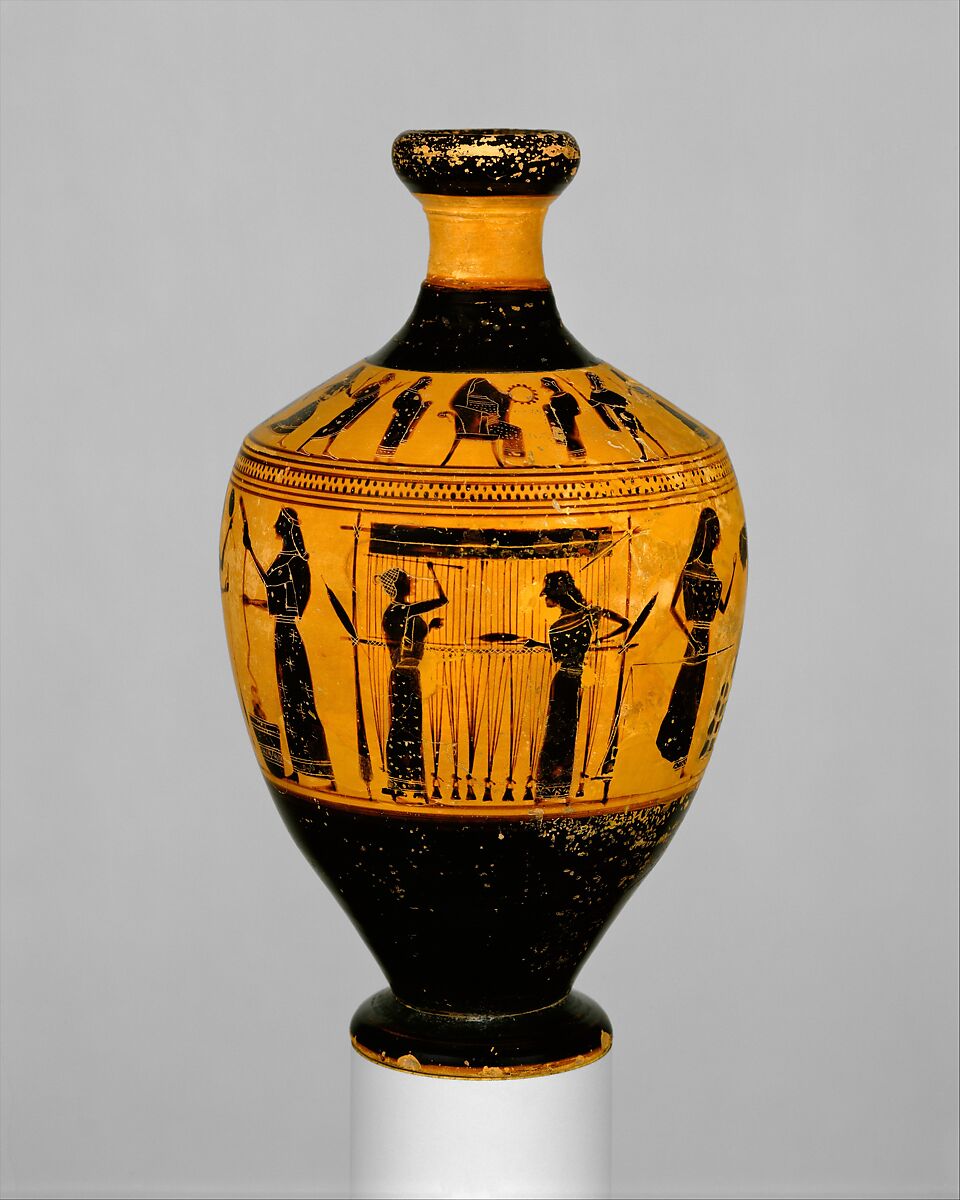
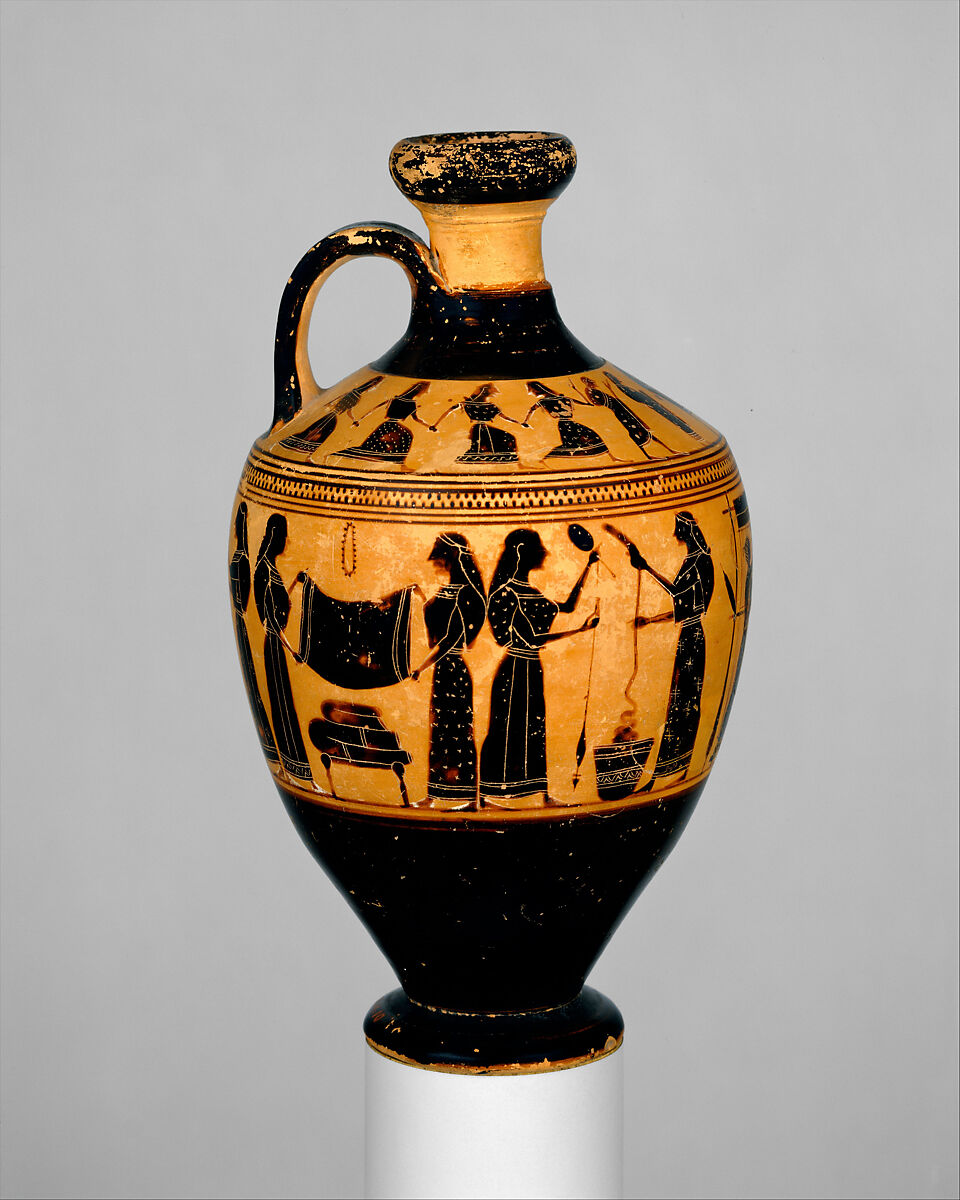
In ancient Greece, as in many pre-industrial societies, textile work was primarily the domain of women, and since ordinary women and their lives rarely appealed to ancient Greek artists as a subject, we have few artistic depictions of women doing the work that filled much of their lives. That fact is one of the things that makes this vase so interesting. The decoration on the main body of this vase depicts many different stages of textile work, including spinning thread, weaving, folding the finished cloth, as well as weighing and perhaps dyeing it. All of these activities were part of the daily life of most women in ancient Athens, where this vase was painted.
Textile work on a black figure lekythos, via Metropolitan Museum (made in Athens, currently Metropolitan Museum, New York; 550-530 BCE; glazed pottery; attributed to the Amasis painter)
As we discussed in our series about textile production, making cloth and making clothes took up an enormous amount of time. It’s interesting to speculate on why someone might have chosen such a theme for a piece of tableware in their home. Was this a commission for a family who was in the textile business, not just producing for home use? Was it meant to celebrate the unsung daily labor of Athenian women by putting it in the same artistic frame as the deeds of gods and heroes? Was it a marketing ploy to try to appeal to a feminine audience?
Textile work on a black figure lekythos, via Metropolitan Museum (made in Athens, currently Metropolitan Museum, New York; 550-530 BCE; glazed pottery; attributed to the Amasis painter)
Whatever the artist’s intent may have been, this is a wonderful piece to have surviving from antiquity.
Out There highlights intriguing art, places, phenomena, flora, and fauna.
Thousands of years ago, the Sahara desert was not the dry, sandy place it is now. There was a time when northern Africa was wet and green. Most of what we know about climate changes in the past comes from the study of geology and paleontology, but one small indicator of a wetter ancient Sahara comes from the people of the time themselves.
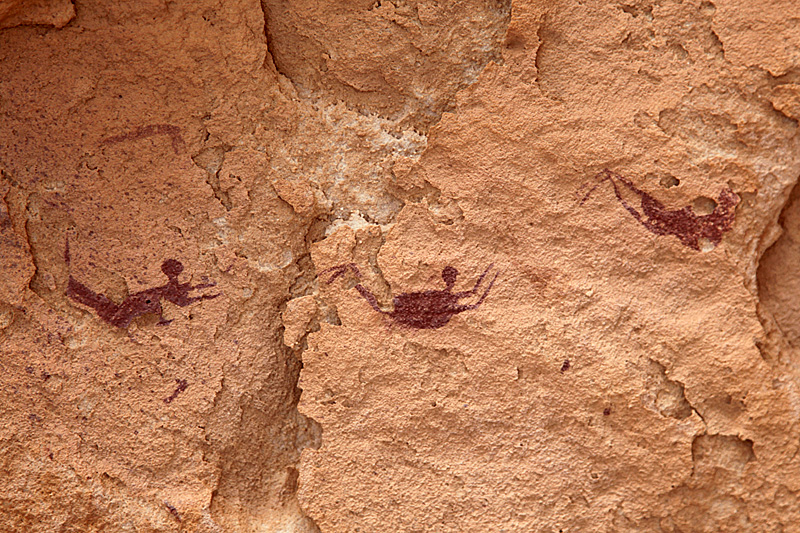
There are numerous rock paintings and carvings in the Sahara, showing that people once lived in places that are now inhospitable desert. Several pieces of rock art show animals that could not survive in the Sahara in its modern desert state. One interesting painting, from a cave in southwestern Egypt, shows people floating or swimming in water.
Swimmers from the Cave of Swimmers, photograph by Ronald Unger via Wikimedia (Wadi Sura, Egypt; c. 8000-5000 BCE; rock painting)
Anthropologists have speculated that the swimmers represent souls of the dead floating in the primordial waters of the afterlife, in an early version of what would become the mythology of ancient Egypt. Whether this speculation is true or not, however, it must be the case that floating in water was something the people of the ancient Sahara could imagine, an experience that is hardly possible in the region today.
Out There highlights intriguing art, places, phenomena, flora, and fauna.
Winter is upon us here in the northern hemisphere. We’re settling in for cold days and long, dark nights. Here’s how the winter season was imagined in late Roman Britain.
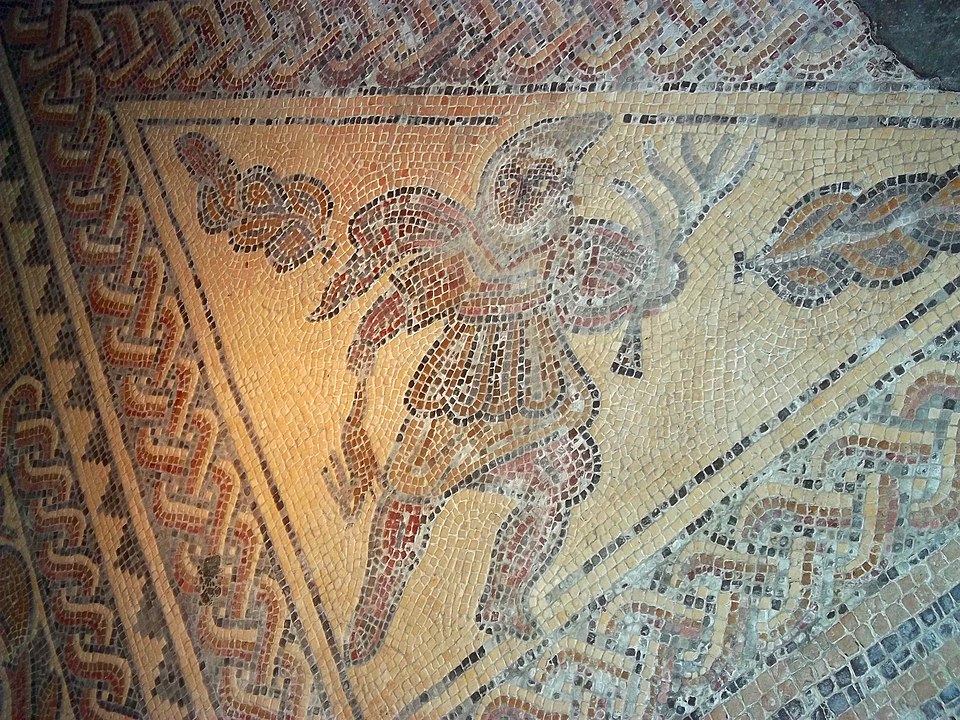
This figure comes from a floor mosaic at Chedworth Villa in western Britain. Each corner of the mosaic had a little allegorical figure representing one of the seasons. Winter appears bundled up in warm layers with a hooded cloak, carrying a hare in one hand (the reward of a hunt), and a symbolic leafless branch in the other.
Wishing you a warm, cozy, and cheerful winter season!
Image: Winter from Chedworth dining room floor, photograph by Pasicles via Wikimedia (Chedworth Roman Villa; 4th c. CE; mosaic)
Out There highlights intriguing art, places, phenomena, flora, and fauna.
The Roman writer Vitruvius had some opinions about public art, expressed here in a critique of the city of Alabanda in western Anatolia, modern-day Turkey:
The people of Alabanda are sharp enough when it comes to affairs of state, but they have been found foolish for their mistakes in lesser matters, since the statues in their gymnasium are all arguing lawsuits, but the ones in their forum are holding the discus, running, or playing ball.
Vitruvius, On Architecture 7.5.6
(My own translation)
Vitruvius’ gripe about the statues in Alabanda may seem odd at first. Why is it foolish to have statues of people playing ball in the forum? Why shouldn’t there be statues of people pleading cases in the gymnasium? Vitruvius’ point is that the statues the Alabandans chose for their important public spaces didn’t match the functions of those spaces.
The gymnasium was a place for the men of the city to socialize and spend their leisure time, but above all to exercise and improve their bodies. The forum was a public space that served many functions, but importantly among them it served as a courtroom for trying legal cases. Vitruvius was clearly of the opinion that art in public spaces should mirror the functions of those spaces: statues of lawyers belong in the forum, and statues of people playing sports go in the gymnasium. In his opinion, the Alabandans made the foolish mistake of setting up the right statues in the wrong places.
Vitruvius’ text is a useful indicator that people in antiquity thought about the visual culture around them and had opinions about the appropriateness of particular subjects, themes, or styles for particular spaces. You couldn’t just slap any old statue anywhere you liked; there were rules to be followed, and the Alabandans had failed to follow them.
At the same time, Vitruvius’ remark is also useful evidence that not everyone shared the same opinions. Vitruvius may not have appreciated the Alabandans’ choices for public statuary, but the Alabandans clearly saw no problem with them. Maybe they thought that lawyers arguing in court should be inspired by the vigor of athletes or that people exercising in the gymnasium should be reminded to also improve their minds like the great orators of the past. We don’t know for sure, but it’s good to be reminded not only that people in the past had opinions about the world they lived in, but that those opinions could and did differ. What one person considered an artistic mistake was for someone else a sensible decorating plan.
When we read ancient sources, it is important to remember that they represent one person’s perspective, not necessarily a universal ideal.
Serving exactly what it sounds like, the Quotes feature excerpts other people’s thoughts.
“Ouroboros Steak is a DIY meal kit for growing gourmet steaks from of one’s own cells. It comes as a starter kit of tools, ingredients and instructions that enable users to culture their own cells into mini steaks, without causing harm to animals.
“Commissioned for the exhibition Designs for Different Futures at the Philadelphia Museum of Art, the project is a critical commentary on the lab-grown meat industry and critiques the industry’s claims to sustainability.”
Err, what? Art? Product? Gourmet?!?!?!? What the fuck did I just read???
I… just… What?!? I can’t even decide whether the name is clever or artsy-fartsy pseudo-intellectual crap. Or whether the project might be just a boredom-induced crude joke??? If it were, it would be in highly, EXTREMELY poor taste to not take the health implications of cannibalism into account DURING a pandemic. Unless that’s supposed to be a part of the project???
Just can’t fathom this, in any shape, size, or form!
The Villa Farnese is a gorgeous Renaissance palace in central Italy, built in the early 1500s and richly elaborated with sculptures and frescoes. One of the rooms in the villa features a map of the world filling the wall at one end, with detailed maps of the continents on the other walls, under a ceiling decorated with constellations. Standing in this room, the magnates of the villa could see the whole world, as it was known to scientists and cartographers of the day.
The map room at Villa Farnese, photograph by Etienne (Li) via Wikimedia (Caprarola, Italy; completed 1574; fresco; by Giovanni Antonio de Varese)
Looking at this space, it occurs to me that a room like this would make an excellent setting for a scene in a fantasy or historical story. Many such stories play out over long distances, and knowing how one territory or city relates to the others around it as well as to the shapes of the land can make a huge difference in understanding the stakes and possibilities in play.
Africa, from the map room at Villa Farnese, photograph by Jean-Pierre Dalbèra via Wikimedia (Caprarola, Italy; completed 1574; fresco; by Giovanni Antonio de Varese)
In a visual medium like tv or movies, it could be very helpful to have a visual in the background while characters are discussing important movements or plans, but even in text, putting your characters in such a place could give you an opportunity to describe them looking at the map, tracing routes of travel or the borders between nations, and arguing for their plans.
Europe, from the map room at Villa Farnese, photograph by Ulrich Mayring via Wikimedia (Caprarola, Italy; completed 1574; fresco; by Giovanni Antonio de Varese)
Maps make everything better!
History for Writers looks at how history can be a fiction writer’s most useful tool, from worldbuilding to dialogue.
The sculpture of the death Laocoon and his sons is one of the mot famous works of ancient art. Carved from several pieces of marble that were fitted together with metal pins, it represents a dramatic moment from the legends of the Trojan War. When the Greeks carried out their ruse, pretending to withdraw from Troy but leaving behind a giant wooden horse, the Trojans were skeptical. While some Trojans wanted to bring the horse within their walls, the priest Laocoon warned the Trojans not to trust the Greeks. The god Poseidon, who favored the Greeks, sent a serpent from the sea to kill Laocoon and his sons, which convinced the Trojans to reject Laocoon’s advice and bring the horse behind their walls, unwittingly sealing their city’s doom.
This marble statue, depicting that dramatic mythological moment, has a dramatic history of its own. It was found in pieces in the soil of an Italian vineyard in 1506 and quickly gained attention. One of the first people to see it was the artist Michelangelo. Classical scholars noted that the Roman author Pliny had described with admiration a similar statue of Laocoon, and believed that this work was the very one that had impressed Pliny. The fragments were acquired by Pope Julius II for display in the Vatican palace. Several of the major artistic names of the Italian Renaissance worked on restoring the fragments and carving replacements for parts that were missing, among them not only Michelangelo but Raphael and Bramante.
In some ways, the Laocoon was the perfect sculpture for time in which it was discovered. Interest in relics of Greco-Roman art was growing, and the rich and powerful were starting to regard the acquisition and display of antiquities as a useful mark of status. Among those antiquities, large-scale marble sculpture was the most highly prized. The belief that the Laocoon statue was the very same one that Pliny had praised conferred upon it a special aura of authenticity. It was not just any ancient statue, but an ancient statue with a known origin and history, whose quality was vouched for by one of the great names of Roman literature.
At the same time, while the authentic antiquity of the sculpture was crucial to its value as a collector’s prize, it was also particularly suited to contemporary tastes. The fine delineation of the figures’ musculature in a pose of high emotional drama was perfectly adapted to the interests of artists of the Italian Renaissance. Even though it was a product of pagan Rome, the subject and its execution had resonances for a Christian audience. The agony of Laocoon’s body in a moment of divine intervention made a parallel to the agony of Jesus on the cross. The slithering serpent attending on a moment of fateful choice echoed the tale of Adam and Eve. For a Christian pontiff who was also a powerful political figure and a connoisseur of Classical art, it is hard to imagine a more perfect sculpture.
(The sculpture was so perfect for Julius, in fact, that one scholar has suggested that it was not an actual ancient sculpture but a forgery by Michelangelo himself. The evidence for this idea is weak, however, and it has not found wide acceptance among scholars.)
Yet, as perfectly adapted as the Laocoon sculpture was to the time in which it was discovered, times change, and the sculpture has changed with them. Since the Pope’s artists first reassembled the sculpture pieces and created their own replacements for the missing parts, the Laocoon has not remained the same. Over the past five centuries, artists and restorers have repeatedly gone back to the sculpture and changed it, readjusting the positions and postures of the figures, creating new replacements, and treating the surface. The position and postures of the two smaller figures has been changed. The angle of the main figure’s arm has been revised. Traces of paint were cleaned away to make the marble gleaming white. The Laocoon that we can see today in the Vatican Museums is, in important ways, not the same sculpture that came out of the vineyard soil in 1506.
Whenever we look at an artifact from the past, we must bear in mind that what we are seeing is usually not what the object originally looked like. The Laocoon statue is perhaps an extreme case, given how much attention it has garnered since it was first excavated, but we always remake relics of history to better fit what we in the present think the past should look like. Julius and his artists wanted a complete and glorious masterpiece of Classical art, so they made one out of the pieces from the vineyard. Today we want an instructive and historically accurate piece of sculpture, so we have removed many of the replacement pieces carved by the pope’s artists and rearranged the original pieces in ways that we think are more authentic. Yet since long before 1506, no one has seen what the Laocoon sculpture originally looked like, and no one in the future ever will.
Thoughts for writers
Just as Michelangelo and his fellow sculptors reimagined a relic of the past, whenever we look to the past to inspire our writing, we are always creating our own version of it for our own needs. However much we may seek and value historical accuracy, we are telling stories in and for our own times; they will always reflect what we believe and value about ourselves. This is a strength of fiction and fantasy, not a weakness. The important thing is to be thoughtful and purposeful about how we use and reimagine history when we look to it for inspiration and not let our unexamined, unthinking biases shape how we understand it.
Image: Laocoon and his sons, photograph by Wilfredo Rafael Rodriguez Hernandez via Wikimedia (found at Rome, currently Pio Clementino Museum, Vatican; 1st c. BCE-1st c. CE; marble; believed to be by Agesander, Athenodorus, and Polydorus of Rhodes)
History for Writers looks at how history can be a fiction writer’s most useful tool, from worldbuilding to dialogue.
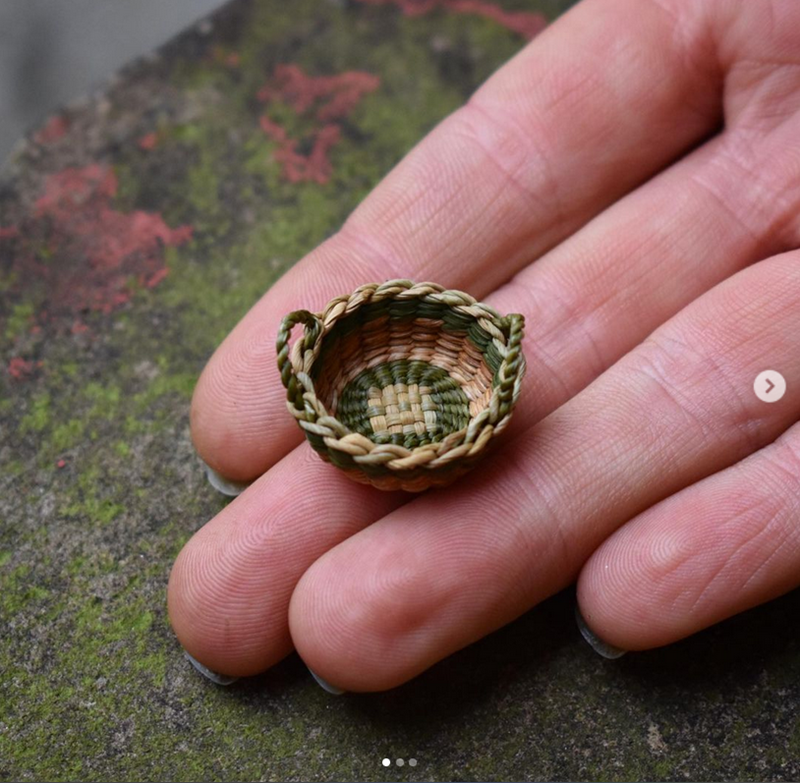
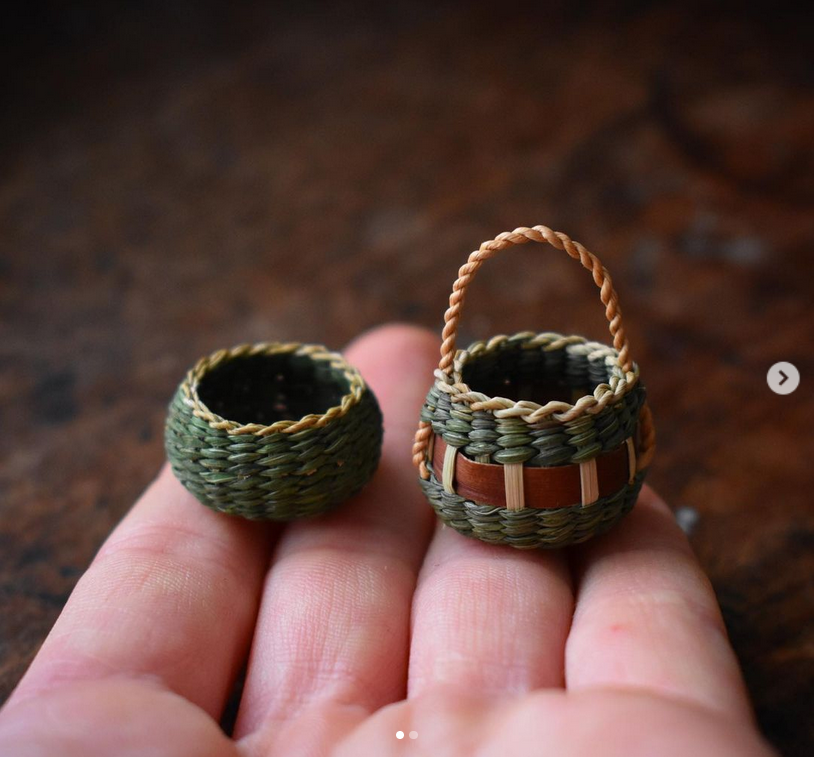
Artist Suzie Grieve harvests materials from the local woodlands and fields in the Lake District, U.K., with a focus on the weeds and invasive species, and weaves baskets out of the fibers. And they are very neat and beautiful:
The twist? Some of her baskets are not just neat and beautiful, and they’re not just small, they’re tiny. T I N Y!
Even if these baskets were of a more typical size, they would be impressive: the careful selection of materials to create stripes from naturally different colors, the planning and placement of patterns to create a pleasing whole, and the high quality of the work.
Then you shrink everything down to mere millimeters and centimeters, and the challenge grows larger. MUCH larger! I’ve done enough small-scale sewing to comprehend some of the challenges involved when scaling down the size of a project.
This is seriously impressive work requiring skill, imagination, and dedication. Kudos!
Cats (or at least most cats) may not like water, but this one might have kept an ancient sailor safe on the waves.
Scaraboid, photograph by The Trustees of the British Museum. Outline illustration and collage by Erik Jensen. (Found Naukratis, currently British Museum; 600-570 BCE; glazed composition) (CC BY-NC-SA 4.0)
The cat is part of the decoration on the underside of a small talisman found at the site of the ancient city of Naukratis in Egypt. Talismans of this type are called scaraboids because they are similar in shape and size to scarabs, but do not have the traditional scarab markings on their domed top.
The cat is a hieroglyph, one of three on the bottom of the object. Reading from right to left, the feather represents the sound i, the cat represents m (from the Egyptian word for cat, miu), and the sun disc represents n (from the word niut, meaning town or city, which the sun disc sometimes stood for). Put together, these hieroglyphs spell imn, a form of the name of the Egyptian god Amun. Many other scarabs and similar talismans from Naukratis contain forms of the name of Amun.
Amun was an important god in ancient Egypt, at times regarded as the king of the gods. Among his other functions, he was worshiped as a god of air and winds who protected sailors and other travelers on the sea. A talisman of Amun was an appropriate thing for an ancient sailor to carry around.
Naukratis is an interesting place to find a talisman like this. Naukratis was a Greek city founded inside Egypt by permission of the Egyptian kings. It was originally built as a home for Greek mercenaries serving in Egypt, but it quickly became a port for Greek and other foreign merchants who wanted to trade in Egypt. Most of the sailors who came through Naukratis were not Egyptians, yet there seems to have been a thriving trade in Egyptian and Egyptian-themed talismans, many produced in local workshops. It is likely that the intended customer for this scaraboid was not an Egyptian but a visiting Greek.
On one hand, the prominence of the cat on this talisman makes it seem like a bit of tourist kitsch designed to appeal to foreigners. Domestic cats were not yet common in most of the ancient Mediterranean, and Greeks associated them with Egypt. Including a cat in the talisman made it extra Egypt-y for a Greek audience. On the other hand, Naukratis amulets include many different hieroglyphic ways of spelling names of Amun, not all of which use cats or other specifically Egyptian symbols. Even if some pieces were made as tourist souvenirs, there also seems to have been a market for talismans referencing the Egyptian sailors’ god, even in a place where most of the sailors were not Egyptian.
This talisman and others like it are an interesting window into the multicultural world of Naukratis, where Greek sailors hoped for protection from an Egyptian god and cats were good protectors against the dangers of the sea.
History for Writers looks at how history can be a fiction writer’s most useful tool, from worldbuilding to dialogue.
We’ve probably all seen endless examples of stereotypical fantasy Elves: those slim, tall, tranquil, ethereal, Art Nouveau-esque figures that glide effortlessly through a major convocation or battle field carnage alike. The type that for example various Weta artists immortalized for Peter Jackson’s Lord of the Rings and Hobbit trilogies.
I’ve been hankering for something slightly different for a while. (At least in depictions of taller Elves; ElfQuest Elves and other Elves smaller in stature already start with some variety.) Here’s what I’ve come across.
Some illustrators make their Elves with non-stereotypical weaponry or gear. Pavel Hristov’s Steppe Elf carries a whopper of an axe and chews on a stalk of grain. There are also tassels hanging from the piece of cloth on his waist; those don’t seem to go with the Elf stereotype.
This Elven marksman explorer by L3monJuic3 has more typical weaponry—bow and arrow—but unlike her, stereotypical Elves are rarely seen carrying backpacks loaded with mundane items like shovels and cauldrons. Elves do typically eat and presumably have other bodily needs, right, even in the more highfalutin high fantasy worlds?
I cannot think off the top of my head any tinkerer nor wanderer type Elves (except for Drizzt Do’Urden in Forgotten Realms), but I don’t consider myself terribly well-read as far as fantasy goes. Anyway, for me these alternative takes were delightful.
Closest to my heart, however, are illustrations of Elves in non-stereotypical environments, especially among birches, in addition to ones showing different body shapes and happy demeanors.
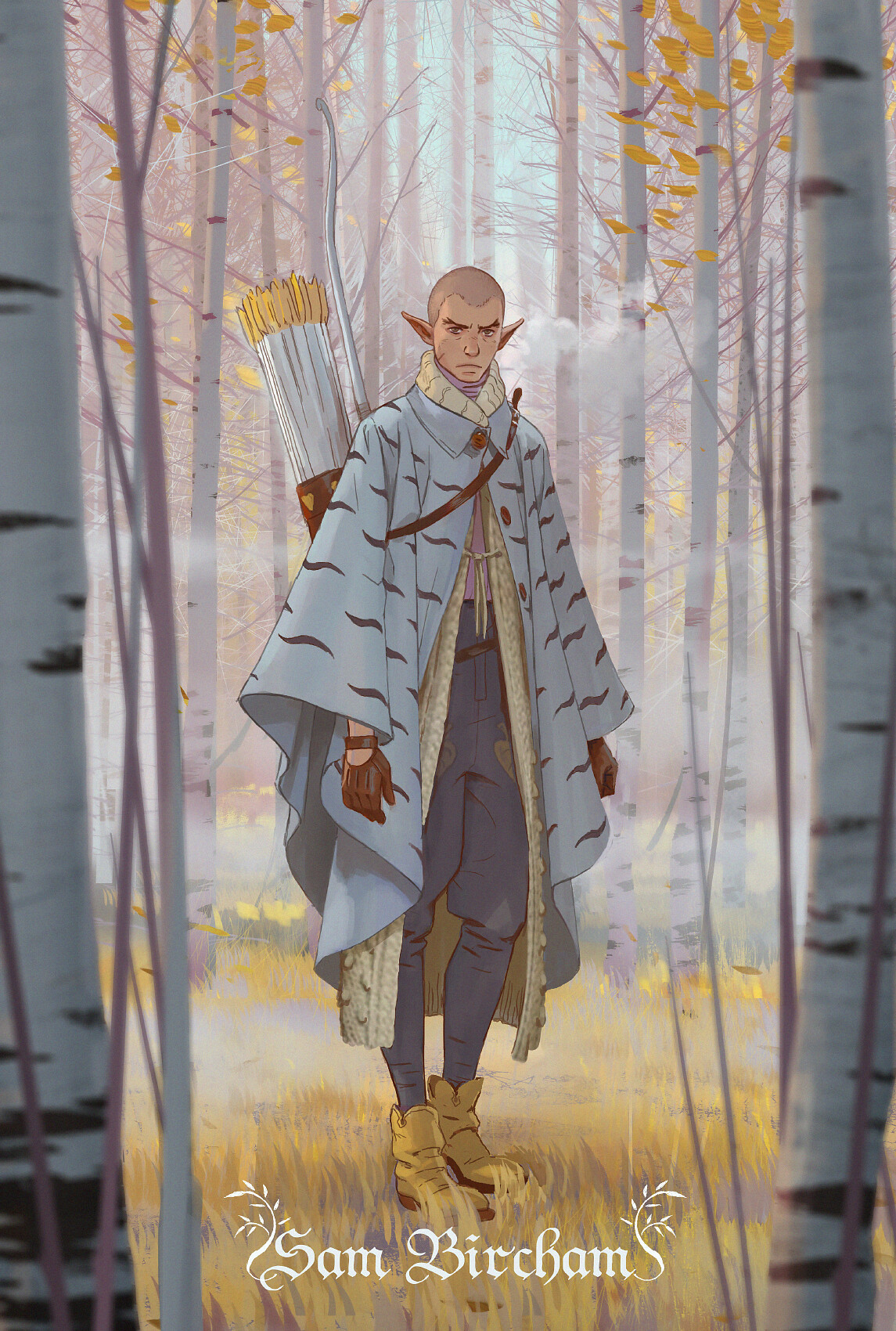
This birchwood Elf by Andrius Matijosius may be a little scruffy-looking, but I love how his cape mimicks birch bark and arrows resemble leaf-topped trunks.
The Gate of Forest Elf Castle by ZAHD&ART also features fall colors. I love this birch-lined alley. A forest of birches with their white trunks lined up always looks so striking.
Moving to physical characteristics. Un Lee’s illustration of an Elf company is marvellous! Lee wanted to create a varied group much like the Dwarves in the Hobbit but with Elves instead.
Besides uniform body shapes, stereotypical Elves come in a fairly narrow range of moods. This portrait of an ancient Elf by eccentric_bee is serene on the surface, yes, but it looks to me that there’s joy underneath that’s often missing in depictions of Elves. Love it!
In Making Stuff we share fun arts and crafts done by us and our fellow geeks and nerds.







 Co-Geeking


_(40968585594).jpg)


You must be logged in to post a comment.