A Concordance of Polybius and What AI Can and Can’t Do for Historians

Boosters of large language models (LLMs) and other kinds of so-called artificial intelligence make big claims about what the technology can do for us, sometimes referencing the benefits brought by other inventions like the Internet or mass production. I rarely find such arguments convincing when applied to my field, history. An experience from my graduate student days may help illustrate why.

When I was a graduate student in the early 2000s, I wanted to write about the Greek historian Polybius and his idea of what constituted Italy. Polybius lived and wrote in a time when the Roman state had fought a century of wars to conquer and defend the Italian peninsula. The idea of Italy as a single thing that could be defined and found on a map was still somewhat new and up for debate. I was interested in seeing where the boundaries of what Polybius called Italy lay, as a reflection of how the Roman elite whose society he moved among thought about their empire and its place in the world.

The obvious place to start was to search the text of Polybius’ Histories for references to Italy, but remember that this was the early 2000s. Search engines for the internet were still in their adolescence, and while there were some projects under way to digitize Classical texts and make them searchable, they still had their limitations. To get the information I needed, I went to the library and found a concordance of Polybius.

A concordance is a type of scholarly reference work that was common in the days before texts became searchable. It is a list of every word used in a particular text (such as Polybius’ Histories) and the context in which it is used. To find every instance when Polybius used the word Italy (or Ἰταλία in Greek), I just had to open the volume to the letter iota, scan down to Ἰταλία, and start going through the references to find which ones were worth looking up in my copy of Polybius and which ones were not useful for my research.

The work that went into creating such a concordance was enormous. The surviving text of Polybius’ Histories runs into the hundreds of pages in a modern printing. Someone had to go through the Greek text and catalog every single word (not to mention dealing with the issues of differing texts in different manuscript traditions, scribal errors, and emendations), then compile all those references into one enormous volume. All of this work was done by hand in the days before computers. The book that I laid out on the table in front of me when I was writing that paper represented thousands of work-hours, a significant chunk of some previous scholar’s working life. (I was lucky to have chosen a research question about a well-known author whose work had been concordanced by scholars of past generations. If I had wanted to check the work of some more obscure author or uncatalogued fragments, I would have had to sit down and scan every page myself.)

If I wanted to research the same question today, I could simply load a copy of the Greek text, type the word into a search box, and have the results in seconds.

Technologies like searchable electronic text have not only changed what questions scholars are able to ask, they have changed the meaning of scholarly work altogether. The kind of rote mechanical labor that went into creating something like a concordance of Polybius used to be a staple of an academic historian’s life. While scholars have always aimed to make new discoveries and present new interpretations of the evidence, up to the late twentieth century it was understood that as a working historian, you would spend a significant amount of your productive life just reading through texts and assembling data a piece at a time, either for your own research or to make a tool for others to use.

These days, although there are still times when searching doesn’t help and you still need to just go through the text line by line, a significant amount of what historians used to do is now automated. Indexed, searchable texts with good metadata have taken the place of a lot of the more cumbersome old scholarly tools in much the same way that electronic databases have replaced the old card catalog system.

This is a change I fully approve of. I have no nostalgia for the old days. I am not shaking my cane at the clouds complaining about kids these days who don’t have to use a concordance in the snow uphill both ways. Making basic information more readily available and easier to probe in new and unexpected ways leads to better questions and more interesting arguments about history, and both scholarly and non-specialist audiences benefit from the wealth of new research that modern tools have made possible.

Now, some have tried to present artificial intelligence as a new revolution in scholarship parallel to the development of searchable catalogs and texts. Just as searchable texts allow us to skip the tedious and unrewarding work of slogging through sources word by word gathering references by hand, so an LLM can save us the tedious work of reading through the existing literature finding the answers to questions so we can spend more time focusing on our own research interest. I find this argument unpersuasive for two reasons.

First, the LLM services which currently exist and promise to perform this kind of operation are not up to the task. They may have scanned all the relevant literature that I would want to consult in my research (and there is a good chance that they have not, but let us suppose for a moment that they have), but they have no understanding of it. They do not know how to separate different threads of argument, how to weigh different theoretical approaches or contrast older and newer scholarship, or how to critically assess evidence. They do not actually know anything, they just slap together text in a way that fits the models they’ve been fed. A search engine may produce wrong results, depending on how well the text it’s searching has been coded or how accurate a search term one uses, but these errors at least point to specific data points that can be checked. An LLM produces authoritative-sounding nonsense with as much facility as truth. It saves no time or effort to use an LLM for research, since everything it produces is suspect, and it does not present its sources for checking.

Second, the tedious work of reading through existing literature is a vital part of scholarship. We have to understand the arguments made by scholars in the past and the bases on which they made them if we are going to do any better at tackling the same questions ourselves. Historical research depends on extensive reading of sources and prior scholarship, not just as a way of assembling data but in order to actually understand our subjects. It is not the same as the rote work of compiling all the words used in a text. There is no royal road to historical understanding, and this part of the research process cannot be automated away.

No one makes concordances any more, and hardly anyone uses them. Search technology saves us labor and frees up scholars’ time to do the more interesting and more important work of engaging with evidence and contemplating new questions. The human work that searches replaced was work that we could well do without. The work that LLMs promise to replace is essential, and they can’t do it for us effectively anyway.

Light Academia: Love of Optimism, Joy, and Happy Endings

I posted about dark academia about a year ago when I learned of the phenomenon. Time for a sibling post of sorts: since then, I’ve discovered the style light academia.

According to Aesthetics Wiki, light academia favors positive themes in general, “focusing on optimism, sensitivity, joy, gratitude, friendship, motivation, and happy endings.” (Naturally still associated with the love of learning.)

Etsy HeatDigitalClub Watercolor Light Academia Clipart Bundle Sm

Apparently, the term was coined on Tumblr already in 2019. (Man, I must’ve been hanging around the wrong side of Tumblr not to have heard about it then!) Also, apparently cottagecore can overlap with light academia, as can a romanticized view of coffee shops as places for people-watching and studying.

Sounds like neutrals, earthy colors, white, gold, and pastels are especially favored. One article lists movies and shows with light academia aesthetics, including classics like Little Women, but also newer productions like Bridgerton, the 2005 version of Pride & Prejudice or the 2022 Netflix adaptation of Persuasion. There are, of course, playlists and recommended activities or crafts. Some people even sell light academia mystery boxes on online platforms! I’ve found out that there are also other, established flavors I hadn’t heard of before: green academia and chaotic academia.

(Good grief, I feel officially old! At least there doesn’t seem to be any academia cores.)

While I love reading, knowledge, and learning, I confess I’m a little perplexed by this dissecting of various aspects of campus / university life into separate aesthetics. (Not to even mention the fact that Finnish universities by and large look quite different from these Anglo-American-style ones.) But I guess that’s what we humans do—we create endless groupings out of the same elements.

Image: light academia watercolor clipart by Anna Zhar at HeatDigitalClub on Etsy

Quotes: And Then It Leaves You Alone

The Finnish Independence Day is tomorrow, on December 6. In honor of a day of rest, here’s a quote celebrating the most important things in life for this Finn—food, clothes, books, and tea:

Current Reading Babel

“Professor Lovell spoke with uncharacteristic warmth. ‘It’s the loveliest place on earth.’

“He spread his hands through the air, as if envisioning Oxford before him. ‘Imagine a town of scholars, all researching the most marvellous, fascinating things. Science. Mathematics. Languages. Literature. Imagine building after building filled with more books than you’ve seen in your entire life. Imagine quiet, solitude, and a serene place to think.’ He sighed. ‘London is a blathering mess. It’s impossible to get anything done here; the city’s too loud, and it demands too much of you. You can escape out to places like Hampstead, but the screaming core draws you back in whether you like it or not. But Oxford gives you all the tools you need for your work – food, clothes, books, tea – and then it leaves you alone.’”

– Professor Lovell in Babel: An Arcane History by R.F. Kuang

Well—cold-sensitive, erudite, reclusive Finn or not, I do have to add a few carefully selected people into that mix. But otherwise it sounds very good. 🙂

Kuang, R.F. Babel: An Arcane History. New York: Harper Voyager, 2022, p. 23.

Image by Eppu Jensen

Dark Academia: A Moody Celebration of Higher Ed and Cultivation

Have you heard of the style dubbed dark academia? According to Wikipedia, dark academia is “a literary and social media aesthetic and subculture concerned with higher education, writing/poetry, the arts, and classic Greek and Gothic architecture.”

Sounds very geeky and nerdy, doesn’t it? (Apparently, again according to Wikipedia, a number of genre novels are, indeed, cited either as inspiration for or popular among the subculture.)

Well, it seems dark academia is now sufficiently popular that mainstream sites have started catering to its fans. While digging into it, I’ve seen clothing, books (of course), movies (ditto), and PC wallpapers for sale. There are also beginner’s guides, playlists for studying, recommended emoji combos, mood guides, critiques, and opinion pieces. (You know a thing has made it when opinion pieces appear!)

I found dark academia when a DIY / thrifting / home decorating blogger I follow and admire, Sarah Ramberg, published her own take on it for the October 2022 challenge in their Thrift the Look series. Here’s one view of her vignette:

Sadie Seasongoods Dark Academia Challenge

Ramberg used mostly thrift store items to outstanding effect. The crystal skull is in fact a thrifted vodka bottle, and it looks stunning. (It’s my favorite element in her recreation, in fact.)

While dark academia (like its kissing cousin steampunk) is not quite my cup of tea, I found it an interesting version of literary appreciation.

Image by Sarah Ramberg at Sadie Seasongoods

In Here highlights interesting spaces created by our fellow geeks all over the world.

Quotes: Sometimes They Develop Entire Research Articles Around Something They Overheard on the Bus

Idle browsing brought me to CD Covington’s article at Tor.com about linguists and the movie Arrival, which is based on Ted Chiang’s short scifi piece “Stories of Your Life”.

“A linguist’s job is to think about language and how it works. Linguists enjoy that and often have conversations about which dialect features they personally have, or sometimes they develop entire research articles around something they overheard on the bus. This is what we do. Not everyone thinks about how language works or is even interested in the subject. So it’s not surprising that Weber is frustrated because he doesn’t think there’s any progress happening, when Dr. Banks knows she’s made considerable progress.” [original emphases]

– CD Covington

Yup—I can attest. I take such geeky, unabashed pleasure over thinking and talking about my favorite linguistic features…! 🙂

(Find my posts about Arrival here.)

Serving exactly what it sounds like, the Quotes feature excerpts other people’s thoughts.

Gleaned from Bodleian Libraries Workshop on Ultramarine Blue

Did you know that the Bodleian Libraries at the University of Oxford have a Tumblr micro blog? I didn’t until just recently. And oh my, it’s a treasure trove!

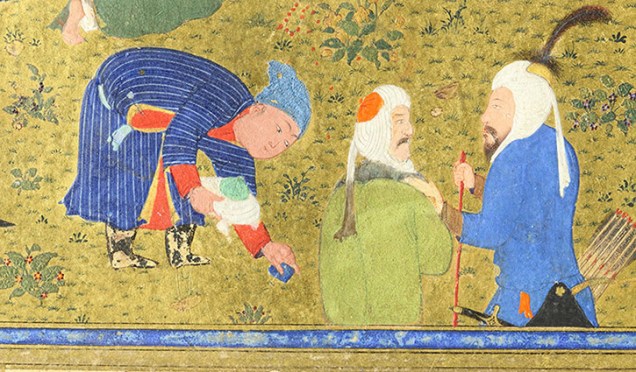
Bodleian Libraries Ultramarine Young Man Blue Rock Bodl MS Elliott 287 fol34a

A short post gives a few tantalising details on lapis lazuli, the mineral that was ground down to get bright blue pigment for example for illuminating Medieval manuscripts:

“In his travels Marco Polo vividly described the cold province of Badakhshan, a prosperous land where horses that descended from Alexander’s horse Bucephalus were once bred and where priceless rubies and the finest lapis lazuli were found.

“Since ancient times lapis lazuli has been sourced in this remote region, north-east of modern Afghanistan, and exported over vast distances. Its mines on the steep Hindu Kush Mountains, above the Valley of the Kokcha River, can only be reached through a tortuous and dangerous route.

“Lapis lazuli consists of a large number of minerals, including the blue mineral lazurite, the white mineral calcite and golden specks of iron pyrites.

“A laborious process transforms this composite mineral into the pigment ultramarine; various grades of ultramarine can be obtained, from the purest extremely expensive deep blue, composed mostly of lazurite particles to the pale grey so-called ultramarine ash.”


Tumblr Bodleian Libraries Ultramarine Workshop Screencap

The conservators at Bodleian (Anita Chowdry, David Margulies and Marinita Stiglitz) learned how to make pigment from scratch in a two-day workshop, and shared their notes in a longer post.

Bodleian Libraries Ultramarine Detail Bodl MS Arab d98 fol1b

Both the historical process and conservators’ efforts are fascinating! Did you know, for instance, that before explosives were developed, lapis lazuli was mined with the help of large fires and cold water?

Visit the Tumblr post for more photos, and read more in the Bodleian blog post “Exploring Ultramarine”.

Found via MedievalPOC on Tumblr.

Images via Bodleian Libraries: Young man picks a blue rock, Bodleian Library, MS. Elliott 287, fol. 34a. Workshop image collage screencapped from Tumblr. Detail of Bodleian Library, MS. Arab. d. 98, fol. 1B.

How It Happens is an occasional feature looking at the inner workings of various creative efforts.

An Extant Map as Evidence of Native American Cartography

In the U.S., and indeed more widely in the Anglo-American world, Meriwether Lewis and William Clarke are known for their two-year expedition of the Louisiana territory (purchased from France in 1803) and the land beyond the “great rock mountains” in the west.

Less commonly remembered in cursory mentions is the extent of Lewis and Clarke’s interactions with local Native Americans. (Apart from Sacagawea, who is known at least in the U.S.) The whites didn’t just exchange gifts or talk about trade or clash with the local population; they received invaluable help and information (like when the expedition wintered with the Mandan people in present-day North Dakota).

Now it seems that western historians need to re-evaluate that extent.

According to The Jefferson Watch, cartographers have identified at least ten places in the journals of Lewis and Clarke where the captains talk about the maps by Native American hosts to help them figure out the lay of the land.

Christopher Steinke, at the time a graduate student at the University of New Mexico, found one of those maps at the archives of the Bibliothèque nationale de France (BnF) in Paris. It was drawn by Inquidanécharo, a chief of the Arikara (in French, Ricara), who was apparently also known as Too Né.

LudditeLabs on Twitter did some of the heavy lifting and linked to the BnF digital copy of the map:

BnF Gallica Inquidanecharo Map Missouri Valley

An article by Steinke is available at JSTOR, where this abstract comes from:

“The Bibliothèque nationale de France contains a hitherto unnoticed map attributed to Inquidanécharo, a Ricara chief. Lewis and Clark knew him as Too Né, an Arikara village leader who accompanied them upriver to the Mandan and Hidatsa villages in 1804. The map, which Too Né showed to playwright and artist William Dunlap when he visited Washington in 1806, is the most detailed surviving Indian representation of the Great Plains from this period. It invites scholars to reorient early American exploration and cartography from indigenous perspectives. Too Né interpreted his map as a work of history and cartography and situated the American explorers in the historical and religious landscape of the Arikara people.”

In “Here is My Country”, Steinke outlines some of the main features of Inquidanécharo’s map, and recounts some history surrounding it. He also lists a few other Native American maps from the eighteenth and early nineteenth centuries.

What most struck me, though, is that Native American maps seem to have contained more information than just geographical details—they also depicted cultural connections and ethnographical information.

I knew Native Americans used symbols and pictograms, and had to have—like people everywhere—a way of talking about and remembering locations outside their immediate surroundings. I had no idea, however, that Native American cartography was as polished or wide-reaching as it was (a hint for the Finnish school system), let alone that their maps might still be extant. Fascinating!

Found via bluecorncomics on Twitter.

This post has been edited to correct a typo.

In Live and Active Cultures we talk about cultures and cultural differences.

Quotes: Discover Not Just the Abstract Thought

“As he watched the TV, he remembered a lecture in his second year of college by a professor of environmental science. The gist had been that institutions, even individual departments in governments, were the concrete embodiments of not just ideas or opinions but also of attitudes and emotions. Like hate or empathy, statements such as ‘immigrants need to learn English or they’re not really citizens’ or ‘all mental patients deserve our respect.’ That in the workings of, for example, an agency, you could, with effort, discover not just the abstract thought behind it but the concrete emotions.”

– Control (John Rodriguez)

That… sounds like sociology or anthropology. Clearly environmental science has more connections with humanities / social sciences than I’ve previously thought!

VanderMeer, Jeff. Authority (Southern Reach Trilogy 2). New York, NY: Farrar, Straus and Giroux, 2014, p. 147.