Placing Heaven in a Bowl

Bowl enameled in green and purple with intricate metalwork
Modern minakari bowl, photograph by Interesting009 via Wikimedia

This gorgeous bowl is an example of a style of enamel work known as minakari (also spelled meenakari or mina-kari), which literally means “to place heaven into an object.”

The style was developed in Persia under the Safavid kingdom in the sixteenth and seventeenth centuries CE. Artists of that time took enameling techniques from Europe and China and used them to create works whose intricate designs and vivid colors drew on the rich legacy of Persian and Islamic art.

Minakari works are still being produced today, especially in and around the city of Isfahan. “Placing heaven in an object” seems like a good enough description to me.

Out There is an occasional feature highlighting intriguing art, spaces, places, phenomena, flora, and fauna.

More Trailers and Clips for Black Widow

The original release date for the Marvel Cinematic Universe movie Black Widow was, unfortunately, eaten up by the pandemic. Out for round two, we have a new long trailer.

Marvel Studios’ Black Widow | New Trailer by Marvel Entertainment on YouTube

Mostly recycled footage, but a few entirely new clips. Unlike the earlier ones, this trailer seems to underline Natasha’s connection to the Avengers: glimpses gleaned from the rest of the MCU stories are pasted in, and the Avengers’ theme swells in both in the beginning and at the end. I wonder how much the pandemic might have affected the decision to include them?

I also wonder whether the shorter clips linked to below, ranging from half a minute to three quarters, released in June 2021, might have to do with the careful re-opening of our movie theaters and wanting to drum up more interest, yet not going overboard in case theaters need to be closed again? (I certainly do not envy health care officials who have to make those hard calls.)

Let’s Go | Marvel Studios’ Black Widow by Marvel Entertainment on YouTube

Got This | Marvel Studios’ Black Widow by Marvel Entertainment on YouTube

Spy | Marvel Studios’ Black Widow by Marvel Entertainment on YouTube

Control | Marvel Studios’ Black Widow by Marvel Entertainment on YouTube

Finally, Marvel has uploaded a short film clip titled “In Pursuit”:

“In Pursuit” Film Clip | Marvel Studios’ Black Widow by Marvel Entertainment on YouTube

Okay, apart from the falling bit, it feels good to see an all-female team chased by an all-female team. The gender of the action heroes shouldn’t matter, if you ask me, but since we still live in a world where it does, I’m going to be rooting for Black Widow

…as long as it’s actually good—2005 Elektra, I’m looking at you!

Hey, look! We found a thing on the internet! We thought it was cool, and wanted to share it with you.

First Trailer for Eternals

The Western world is vaccinating their citizens furiously against covid-19, and societies are clamoring to retun to normal. It’s therefore no surprise that we’re seeing more movie-related news.

The first trailer for Eternals has been out over a month now:

Marvel Studios’ Eternals | Official Teaser by Marvel Entertainment on YouTube

Part of Marvel’s Cinematic Universe, it apparently follows a group of immortal, human-shaped beings who’ve lived on Earth for centuries in secret, until something (or someone?) forces them to come out of hiding.

As opposed to the first Shang-Chi and the Legend of the Ten Rings trailer, there is at least one reference to the rest of the MCU, as bare and uninformative as it is, but I still don’t have a good idea of how these people connect to the rest of the characters we know.

Whether I’ll want to watch this is still up in the air; maybe the second trailer will give us more to go on. A talented, big-name cast should be interesting to see and Ramin Djawadi’s music awesome, if nothing else. Oddly (since I’m not especially keen on the early history of the Near East), one of the things I would enjoy seeing more of is Babylon and the Ishtar Gate, of which we see a short glimpse in the trailer.

At this writing, Eternals is set to release on November 05, 2021.

Hey, look! We found a thing on the internet! We thought it was cool, and wanted to share it with you.

A Contradictory Coin

Two faces of an ancient Roman coin, one showing a bearded man wearing a radiate crown, the other showing a young men wearing a wreath.


Palmyrene Antoninianus, photograph by Classical Numismatic Group via Wikimedia (270-272 CE; bronze and silver)

What’s so contradictory about this coin? Well, there’s a story behind it.

In the third century CE, the Roman Empire wasn’t doing well at all. Between 235 and 284, the empire suffered civil war and political chaos as numerous general claimed the imperial title with the backing of their troops, only to be assassinated and replaced with another general. At the same time there was an economic collapse and an outbreak of deadly disease that depopulated the great cities of the Mediterranean.

In this fifty years of crisis, the emperors were mostly concerned with securing their own power and fighting off rivals. People looked to more local powers to handle the ordinary business of governance. With such chaos and weakness at the top, some of these local powers began to operate as effectively independent states.

One such state was the empire of Palmyra. Palmyra was a city in the eastern Mediterranean, in what is today Syria. It had long been an important stop on caravan routes that connected the Mediterranean with Mesopotamia and India beyond. The Palmyrene noble Odaenathus helped to support the Roman position in the region during a flare-up of conflicts with the Parthian Empire to the east. With weakness at the top of the empire, Odaenathus began to rule Palmyra with more and more independence over the course of the 260s. After his death in 267, his wife Zenobia, ruling on behalf of their young son Vaballathus, began an ambitious campaign of conquest that made Palmyra the ruling city of a de facto empire covering much of the Roman East.

While effectively operating as an independent power, Palmyra maintained a show of loyalty to the Roman Emperor at the time, Aurelian. In the early 270s, Zenobia issued coins like this one, bearing the image of Aurelian on one side and Vaballathus on the other. The text of the coin names Aurelian as emperor and calls Vaballathus only a general of the Romans. Since coins could circulate more widely than most other works of public art, these coins represented one of Zenobia’s best efforts to convey the message to Aurelian that she and her son were still loyal.

But the very existence of these coins belies the message they send. The minting of coins was an imperial prerogative, one closely tied to the power of the emperor himself. Rome allowed some of the cities under its rule to mint their own low-value bronze coinage for local trade, essentially small change to make it easier for people to do their day-today business in the market. Palmyra evidently had the right to mint such coins, although surviving evidence suggests that the Palmyrenes had never exercised that right on any large scale.

This coin is different. It is the type of coin known to scholars today as an “Antoninianus.” (We don’t know what, if anything, ancient people called them.) An Antoninianus was a high-value coin typically made of a combination of bronze and silver. Its face value was equivalent to several days’ pay for a legionary (although extreme inflation in the third century seriously eroded the coins’ actual value), and they were largely minted by the emperors to pay the troops who had put them into power. Coins of such value had a strong historical connection to the recruitment and pay of armies.

By minting coins of this type, Zenobia effectively declared her intention to lead armies independently of the Roman emperors. No matter what image she put on the coins, the very act of minting them was tantamount to announcing a rebellion.

Aurelian was not fooled by the display of loyalty. In 272 he attacked Palmyra, captured Zenobia, and reconquered the territory she had claimed. After another outbreak of rebellion in Palmyra the next year, Aurelian captured the city and destroyed it.

An object as seemingly simple as a coin can have complicated and even contradictory intentions behind it.

History for Writers looks at how history can be a fiction writer’s most useful tool. From worldbuilding to dialogue, history helps you write.

Beautiful, Breathtaking Planetary Embroidery by Ophélie Trichereau

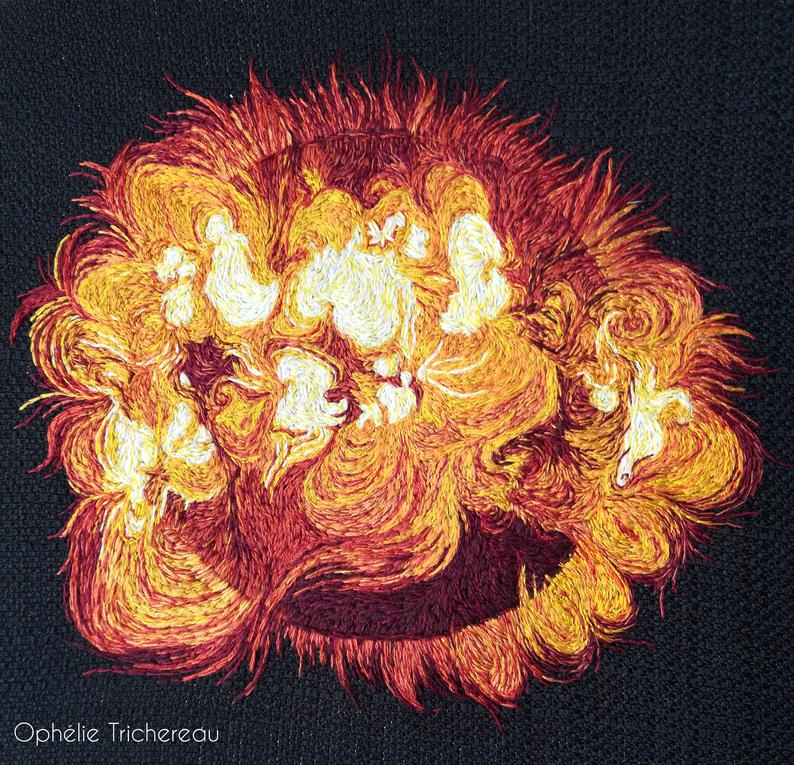
Scotland-based French artist Ophélie Trichereau illustrates fantastic visions in gouache and watercolor. It is her embroideries, though, that I find most impressive, especially the planetary ones. Below are a few of my favorites.

At this writing, she has two different views of Jupiter available. I like this one:

Etsy Ophelie Trichereau Jupiter

Here’s Callisto:

Etsy Ophelie Trichereau Callisto

Last but certainly not the least, the Sun:

Etsy Ophelie Trichereau Sun Embroidery

So impressive! Every shade of every color is carefully selected, and shapes created with the stiching make the whole even more expressive. The intricacy of the patterns means they can’t be a fast project to create, but, then again, is anything worth doing worth doing sloppily? Trichereau’s effort really shows. Kudos!

See more of Trichereau’s work on Etsy or via LinkTree.

Found via N.K. Jemisin on Twitter.

In Making Stuff occasional feature, we share fun arts and crafts done by us and our fellow geeks and nerds.

Worldbuilding for Democracy

Whether playing a game of thrones or awaiting the return of the king, fantasy literature tends to have a lot of monarchies. This is true in part because the genre grew out of literary traditions created to justify the power of kings and aristocrats and in part because royal families lend themselves so well to drama (it seems to be the only job the British royals have left, for one example).

It doesn’t have to be that way, though. There’s plenty of room for fantasy to explore societies without kings or thrones. Many cultures in the past have had alternatives to monarchy. Most famous may be the democracies of ancient Greece, but other ways of sharing power out among multiple individuals, families, or factions can be found around the world, in places like the early city-states of Sumer, the medieval cantons of Switzerland, and the Haudenosaunee (Iroquois) Confederacy in North America. Not all of these societies operated in ways we would recognize as fully democratic today (for instance, Greek democracy excluded women, immigrants, and slaves), but they all represent functional alternatives to a monarchy or entrenched aristocracy.

These forms of governance came about as the result of particular social, historical, and geographic circumstances. If you want to build a democratic society (even in such a loose sense) into your fantasy worldbuilding, here are a few approaches to consider.

Friends don’t let friends start monarchies

Small-scale societies are usually egalitarian and tend to resist individual claims to power. In societies small enough that people all know each other or are bound together by ties of family and friendship, personal relationships matter more than formal structures of power. One person trying to put themselves above others in such a culture is a threat to the stability of those relationships and can expect little support. With the rest of society so closely bound together by ties of kinship and affection, resistance is easy to organize. Monarchies only work in societies large enough that most people are strangers to one another.

Poor lands make poor kings

One of the defining features of monarchy is that it consolidates wealth in one or a few people’s hands. This isn’t just a perk of the job (although, as Mel Brooks said, it’s good to be the king), it’s necessary for keeping a monarch in power. Kings justify their power in many ways, sometimes by providing the benefits of stability and order to the people they rule over, sometimes by cloaking themselves in religious ideology, but at the base of it all is a threat: do what I say or my soldiers will come burn your house and take your stuff. That threat only works if the soldiers will actually back it up, and while a good king may earn the personal loyalty of his troops, you can’t eat loyalty. An army big enough to keep a monarchy in power will fall apart if it doesn’t get paid, and maybe even turn on the monarch themselves. A monarchy can only sustain itself in a place where it can command enough economic resources to be sure of being able to pay its army in a crisis. In regions that don’t have that kind of wealth, or whose wealth is difficult for any one faction or family to control, monarchies tend not to last long.

The divided are hard to conquer

“Divide and conquer” is all well and good, but when the landscape itself divides people, it is hard for even a conqueror to maintain control. Fragmented landscapes that limit the movement of troops and supplies make it hard for would-be rulers to assert control. They also tend to foster a strong sense of local identity that limits a monarch’s ability to command the people’s loyalty. Many different kinds of landscape can have this quality, such as those divided into many small islands or mountain valleys, or lands broken up by marshes and forests. Wherever people are used to being isolated and having to rely on themselves and their neighbors, they tend to create societies that distribute power rather than relying on a distant and unfamiliar king.

We are struggling together

The points above have a common thread: the smaller a society is, the more likely it is to be democratic. The bigger a society gets, the weaker the forces keeping it egalitarian and the more likely that someone will succeed in establishing a durable monarchy. Large-scale democracies tend to arise from a particular historical experience: when lots of small societies find themselves having to work together. When several tribes, clans, islands, or cities of comparable wealth and power have to coordinate their efforts, such as to resist pressure from an invading empire or to control valuable natural resources, compromises have to be made. A single leader is unlikely to get everyone on board without making concessions to ensure the sharing of power and resources. These arrangements can take many forms, such as governance through a council representing all members or rules of succession that guarantee no single family line has a lock on power.

Many different forces can be at work at once in any given culture. Small mountain villages that are egalitarian because of their small size and poverty may band together in a democratic league to coordinate their response to pressure from a nearby kingdom in the lowlands. Once that league is well established, it might expand to take in some of that kingdom’s outlying cities, even pull together an army to conquer the flatlands for itself while still preserving its democratic basis. What happens to such a democracy when it comes to rule over people accustomed to the claims of monarchy? How do people used to being ruled by kings adapt to being part of a league where they have a voice of their own? There are lots of good stories to explore in fantasy that don’t revolve around kings and crowns.

History for Writers looks at how history can be a fiction writer’s most useful tool. From worldbuilding to dialogue, history helps you write.

On the Move

You may have noticed that we’ve been posting less often recently. Also, usually in the beginning of June we write a blog anniversary post, but this obviously isn’t one. This year, we just don’t have the requisite spoons, because we’re moving. Not just houses. Not just states. Not just countries. Continents.

My Finland in the Sky

Gosh, even saying that out loud wearies me out. A trans-Atlantic move is challenging at the best of times, never mind during a pandemic.

If you have well-wishes to spare, we’d appreciate it if you sent one our way. Please and thank you.

Announcements from your hosts.

Quotes: I Wouldn’t Want to Suddenly Make a Fool of Myself

How nice that you feel so sure of my affections.

I wouldn’t want to suddenly make a fool of myself

Go ahead, chase that cheap, wool-spinning

whore rather than Servius’ daughter Sulpicia.

I have people who care about me, and their greatest worry

is that I might fall into bed with some worthless nobody.

– Sulpicia, Poems 4

(My own translation)

Sulpicia is among the few female writers whose work has come down to us from antiquity. She was a Roman poet writing in the late first century BCE. Her surviving poems chart a tempestuous love affair with one Cerinthus. Like the lovers described in poetry by her male contemporaries, we cannot be sure whether Cerinthus was a real person or just a literary invention.

Sulpicia’s poetry relates in interesting ways to the major philosophical movement among Romans of her time: Stoicism. Stoicism was an originally Greek school of thought that emphasized emotional steadiness through the ups and downs of life. This idea appealed to Romans, who traditionally valued discipline and dispassionate self-control. Many Romans among the elite espoused versions of Stoic philosophy as a guiding principle.

Controlling one’s emotions first requires observing and understanding them. This is where Sulpicia’s poetry fits in. Her poems are like little gems of precisely observed emotion. This one captures the cold, controlled anger that comes of holding in a rage that is about to explode. Another poem expresses the exasperation of a young person at well-meaning but clueless relatives.

While other Romans were exploring Stoicism as a philosophical idea, Sulpicia was turning it into art.

Serving exactly what it sounds like, the Quotes feature excerpts other people’s thoughts.

Quotes: Time Belonged to a Higher Realm

There’s a lot (a lot!) I liked about Karen Lord’s scifi novel The Best of All Possible Worlds. This snippet, for instance, puts words to a childhood wonder I remember from elementary school when learning math:

Karen Lord The Best of All Possible Worlds

“Standard Time was invented by Sadiri pilots. Most Sadiri procedures and quantification followed straight lines and linear progressions, created for the convenience of the ten-fingered. But Time… Time belonged to a higher realm. It could not be carried in human hands, not while it constantly carried human minds. It was all circles, wheels within wheels, a Standard year of three hundred sixty Standard days coiled up in twelve months, which in turn were composed of the small whirlings of twelve hours day and twelve hours night, tiny spinning minutes and seconds, ever-cycling breaths and blinks and beats.

“To be described as having a pilot’s mind was both curse and compliment; it could mean being unable to tell the difference between prophecy, memory, and mere déjà vu.”

– Karen Lord, The Best of All Possible Worlds

I just couldn’t fathom why the decimal system is different from time measurements, and remember that for a time trying to reconcile them was very confusing. But time—heh, heh—helped with that, of course, along with more advanced classes, in addition to a certain amount of shrugging and just getting on with life.

It’s intriguing when a book serendipitously reminds you of thoughts you thought were long buried, isn’t it?

Lord, Karen. The Best of All Possible Worlds. New York: Ballantine Books, 2013, p. 40.

Serving exactly what it sounds like, the Quotes feature excerpts other people’s thoughts.

Even Heroes Take Time Off

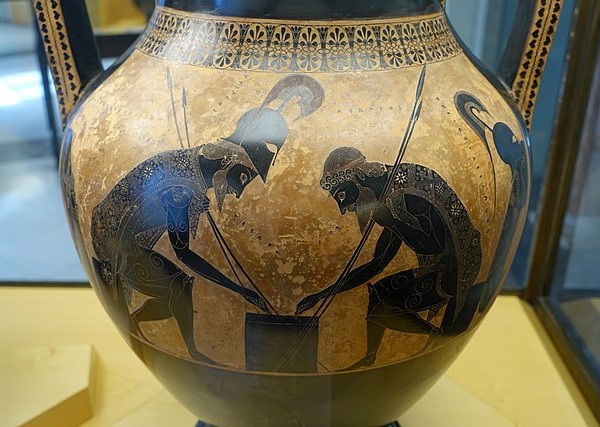
Heroes don’t spend all their time being heroic. They need time off, too. That was the idea behind this beautiful vase by the ancient Athenian painter Exekias.

On one side, we see Achilles and Ajax, two of the great Greek warriors of the Trojan War, putting aside most of their armor for a while and playing a board game. Achilles is winning, as Exekias lets us know because he has given us the score: beneath Achilles’ head is the word “four,” beneath Ajax’s, “three.” According to literary tradition, Achilles’ tent was at one end of the Greek line, Ajax’s at the other, so this was not just a casual pick-up game; one or the other of the heroes must have crossed the entire Greek camp so they could play.

Amphora, Achilles and Ajax playing a game, photograph by Daderot via Wikimedia (Athens, currently Vatican Museums; c. 540-530 BCE; black-figure pottery; by Exekias)

On the other side of the vase, the twin heroes Castor and Pollux return home. They are welcomed by their parents, Tyndareus and Leda. On the left, Pollux leans down to greet a dog who jumps up, excited to see him.

Amphora, Castor and Pollux return home, photograph by M. Tiveros via Classical Art Research Centre (Athens, currently Vatican Museums; c. 540-530 BCE; black-figure pottery; by Exekias)

Exekias was an innovative artist. He was one of the first vase painters to show mythic heroes not in the midst of action but at ease, among the familiar surroundings of everyday life.

If you’ve been feeling the weight of the past year, take some inspiration from heroes: play a game, say hello to family, play with a pet. If it’s good enough for Achilles, Ajax, Castor and Pollux, it’s good enough for you, too.

Out There is an occasional feature highlighting intriguing art, spaces, places, phenomena, flora, and fauna.