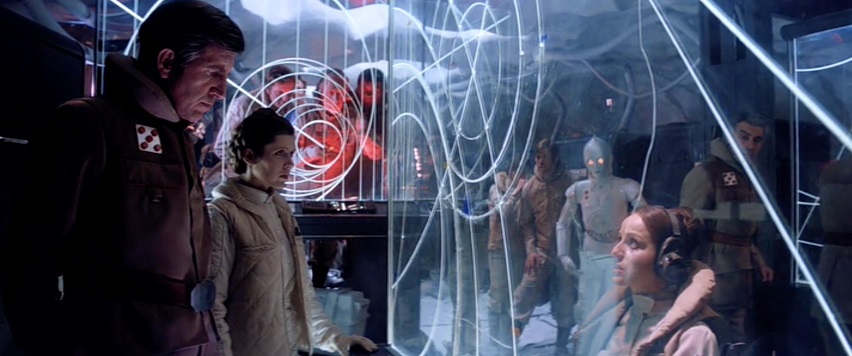
Star Wars and the Classics, Part II: The Original Trilogy

151216vaseYesterday we looked at how classical literature offers interesting ways of looking at the Star Wars prequel movies. We continue today with the original movies.

Episode IV: A New Hope – Homer, the Odyssey, Books 14-22

Episode IV can be read, from a certain point of view, as an essay in heroism. In particular, we see three different kinds of heroes: the always-was-a-hero, the becoming-a-hero, and the choosing-to-be-a-hero.

Leia is the always-was. She is a hero from the beginning of the movie straight through to the end. We never see her stop being heroic, even when being rescued. She has been part of the rebellion literally since she was born and even the destruction her homeworld doesn’t stop her.

Luke is the becoming. He starts as just a farmboy who dreams of far-off adventure. When he discovers his true heritage he strives to live up to the legacy of his father Anakin the great Jedi. Much is expected of him and he does his best to be the hero that people like Obi-Wan and Leia need him to be.

Han is the choosing-to-be. He’s a smuggler and scoundrel who isn’t in it for the rebellion. He just wants to do a job and get paid. He could have just flown away from Yavin with his hold full of cash and nobody would have been surprised. Instead, he decides to come back and help Luke blow up the Death Star.

The same three kinds of heroes appear in the Odyssey. In Book 14, Odysseus has just made it safely home to Ithaca but is still in disguise, getting the lay of the land and figuring out how to deal with the suitors who have been gorging themselves in his hall. The next few books follow Odysseus as he gathers allies, makes plans, and finally confronts the suitors in the final battle in Book 22.

Odysseus is here the always-was. He is a veteran of the great war at Troy and a cunning warrior. He begins the epic as a hero and never falters. Nothing stops him in his determination to get home and reclaim his place as king. Books 14-22 show him as a steady, crafty commander, biding his time and waiting for the right moment to strike.

Odysseus’ son Telemachus is the becoming. As the epic begins, he is just entering manhood and starting to take his first tentative steps into his father’s old role. For Telemachus, the Odyssey is all about proving that he is a worthy son to a heroic father that he knows only through stories. In this stretch of the epic he finally meets his father and proves that he can live up to his example.

The choosing-to-be hero of the Odyssey is Eumaeus, swineherd to Odysseus’ house and one of the servants who remains loyal to Odysseus, even when his master has been gone for twenty years. The sensible thing for Eumaeus to do would have been to abandon Odysseus and suck up to the suitors, like many of the other servants do, to secure his place in the household when Penelope eventually marries one of them. Instead, he sticks by his old master and helps him take back his home.

Continue reading

Star Wars and the Classics, Part I: The Prequels

151215stormStar Wars takes many of its cues from mythology and classical history. Here’s some recommended reading if you want to see how themes from the classics found their way to a galaxy long ago and far, far away.

Episode I: The Phantom Menace – Homer, the Iliad, Book 1

I can still remember my feeling of anticipation when I first sat in the theatre to watch The Phantom Menace. We’d waited years to get the story of Anakin Skywalker’s fall from grace. We were going back in time to a more civilized age, a golden age of Jedi knights and the sophistication of the galactic republic.

The screen went dark. John Williams’s fanfare blasted from the speakers. The opening text began to scroll up from the bottom. This was everything we had been waiting for!

So what’s this crap about taxation of outlying trade routes? Huh? What is this, Accounting Wars?

The story began. We saw Jedi sitting in a conference room waiting for some cowardly bureaucrats to come and talk turkey. My heart sank in disappointment. (And we hadn’t even gotten to Jar-Jar Binks yet.)

It took many more years and several viewings of Episode I for me to appreciate what George Lucas was doing in this movie. There is a point here and it’s an important one: momentous events don’t start out looking momentous. Terrible things happen because no one is paying close enough attention to stop them when they’re small enough to be managed; only when they roll out of control do people realize what’s happening. Of course the fall of the galactic empire started because of a minor trade dispute and a lonely boy from a desert planet in the middle of nowhere. It could have started in any number of ways, but they all would have seemed just as trivial.

(Mind you, this doesn’t actually make Phantom Menace any better as a movie. It’s still plagued by terrible dialogue, wooden acting, and disturbing racial caricatures. But as a storytelling choice, it’s interesting.)

The classic mythic example of small causes leading to momentous and terrible events is the Trojan War. While pieces of the story are told in many different sources, there’s no single work that covers the entire war. Book 1 of the Iliad, however, puts us in the middle of the action to watch the last act of the war unfold. I’ve written about Book 1 of the Iliad here before, but it’s one of those texts that rewards going back to again and again.

As the Iliad opens, the Trojan war has already been going on for ten years. What we witness here is the conflict between two of the Greek captains, Achilles and Agamemnon. It begins when Agamemnon refuses to ransom a captive woman back to her father. By the end of the book, Achilles has withdrawn his forces from the fighting, which will swing the war in the Trojans’ favor, leading to the near defeat of the Greek forces, the death of Achilles’ friend Patroclus, and Achilles slaying the Trojan prince Hector in madness and grief. The death of Hector robbed the Trojans of their best warrior and sealed the fate of Troy. And it all flows from a dispute over the ransoming of a prisoner from an outlying village.

Continue reading

Stadi Wars – The Empire Attacks Helsinki

Helsingin Sanomat, the largest Finnish daily, celebrates the impending Star Wars: Episode VII – The Force Awakens premier with a special piece. Titled Stadi Wars (stadi being a slang name for Helsinki), it shows what the city would look like if the Empire were to attack Helsinki.

Helsingin Sanomat Stadi Wars Senate Square
What if the Senate Square in Helsinki were attacked by the Empire via Helsingin Sanomat

Apart from photos, video, and 3d-renderings of Imperial transports, Helsingin Sanomat interviewed a member of The Finnish Reserve Officers’ Federation and got his opinion on how the Finnish army would fare against stormtroopers.

Even if you don’t read Finnish, the page is worth a visit for the very cool photos of Imperial walkers and ships set against a modern cityscape.

Images, video and graphics by Boris Stefanov, Uolevi Holmberg, and Petri Salmén via Helsingin Sanomat

In Making Stuff occasional feature, we share fun arts and crafts done by us and our fellow geeks and nerds.

Travel: Small Groups on Foot

151214BoromirDespite what you may have heard from certain Gondorian captains, one does sometimes have to simply walk into Mordor.

In the first installment of the travel series we looked at some basic issues involved in travel in a pre-industrial world. Today we tackle the kind of travel that most people did most of the time in the pre-modern world: overland journeys by foot in small groups (or alone). We have a few basic questions to ask: How far could they go? How fast could they get there? How much stuff could they take with them? And what did it take to make the journey successfully?

Continue reading

The Empanada Strikes Back

Empanadas are often savory and filled with meat, but for our Star Wars rewatch I made this sweet variety filled with caramel and apple.

The Empanadas Strike Back

Crust

Ingredients

  • 1 cup milk
  • 3/4 cup butter or shortening
  • 1 package dry yeast
  • 3 cups flour
  • pinch of salt
  • pinch of cinnamon

Heat the milk in a saucepan until bubbles form on the top.

Add the butter and let stand 10 minutes until butter is melted.

Stir in the yeast and let stand another 10 minutes.

In a large bowl, combine the flour, salt, and cinnamon. Make a well in the center and pour in the milk mixture. Stir until it forms a ball.

Turn out onto a floured surface and knead well, adding flour as needed.

Let rise in a warm place for 30 minutes to an hour.

Punch down the dough, turn it out on a floured surface for another quick knead, then divide into sixteen small balls. Flatten these balls out into six-inch circles and place them on parchment paper on baking sheets.


Filling

Ingredients

  • 1/2 cup sugar
  • 2 tablespoons water
  • 2 tablespoons cream
  • 2 medium apples

You will want to fill and bake your empanadas as soon as the filling is ready, so preheat the oven to 425 F / 220 C while you work.

Peel, core, and finely dice the apples.

Place the sugar and water in a shallow saucepan and stir until the sugar is well dissolved.

Put the pan on medium heat. Large bubbles will eventually give way to smaller bubbles. Stir gently as the sugar mixture begins to brown.

When the caramel has reached a golden brown, add the cream and mix well.

Add the apple pieces and stir well.

Place a generous tablespoonfull of filling centered on one half of each dough circle. Fold the dough over and press the edges together with your fingers, then crimp the edge with the tines of a fork.

Bake for 20 minutes or until beginning to brown. You can continue to cook them as they are until golden brown (about five more minutes) or take them out, glaze them with egg, and return them to the oven to finish baking.


Image by Eppu Jensen

Geeks eat, too! Second Breakfast is an occasional feature in which we talk about food with geeky connections and maybe make some of our own. Yum!

Our Star Wars Rewatch Project: Episode V

The Star Wars rewatch returns with Episode V – The Empire Strikes Back.

1. Best Fight

Eppu: As Han and Leia et al. are trying to flee Hoth, Millennium Falcon vs. three Imperial destroyers and their T.I.E fighters. You can tell that the special effects technology had taken a huge leap forwards in between A New Hope and The Empire Strikes Back. Spin it!

Erik: Snow speeders vs. imperial walkers on Hoth. The fight feels like a desperate, doomed rearguard action, but even in doomed rearguard actions there is room for heroism.

2. Best Line

Erik: “Luminous beings are we, not this crude matter.” An elegant description of the Force from a more civilized age, before the dark times, before the midichlorians.

Eppu: There are so many fantastic lines in Episode V, it’s really hard to choose! I guess it’ll have to be “Who’s scruffy-looking?” by the one, the only Han Solo, delivered as if that’s the most insulting term in Leia’s outburst. Also, C-3PO’s “Sir, it’s quite possible this asteroid is not entirely stable.” is fantastic, and one of Leia’s shiny moments that I really like is “You’re not actually going into an asteroid field?”.

QuotesGram Norma Rapier Whos Scruffy Looking

3. Best Minor Character

Eppu: Rebel officer Toryn Farr, played by Brigitte Kahn. Incredibly, she’s the only other woman besides Leia to have a line in Episode V. (WTF, Lucas?!?) I’m terribly fond of her line for no discernible reason and, in fact, use it in daily life – “Stand by ion control. Fire!”

FANGirl Blog Hoth-3-ESB

Erik: General Rieekan who commands the rebel forces on Hoth. Plainspoken, understated, and you can tell that he cares about the people under his command. He’s exactly the sort of person who should be in charge of a military operation.

4. Best Reveal

151210YodaErik: The strange old hermit on Dagobah is Yoda, former head of the Jedi council. Frank Oz gives the character such life that you can tell he’s not just playing the fool to test Luke’s patience (although he’s totally doing that, too), but that Yoda is wise enough to take a childish delight in rummaging through Luke’s luggage and playing with his flashlight. It’s a test and a lesson wrapped up in one.

Eppu: A three-way tie: 1) this funny, disheveled character on Dagobah turns out to be Yoda; 2) Lando is actually not a traitor, but looks out for his people – his decisions are often the least worst in tough situations; 3) Darth Vader = Luke’s father. Having seen the original trilogy young, when the Internet didn’t yet exist (so no spoilery rumors through there) and having grown up a non-native speaker of English (didn’t pick it up from the zeitgeist), the latter was a surprise to me. [I think. It’s too long ago to remember for sure.]

5. Best Save

Eppu: R2-D2 tweaking the hyperdrive on Millennium Falcon to allow for our POV characters to flee the Cloud City.

Erik: The Millennium Falcon dodging TIE fighters and star destroyers as it escapes from Hoth. Now we know that Han isn’t just all talk when it comes to his piloting skills.

6. Best Visual
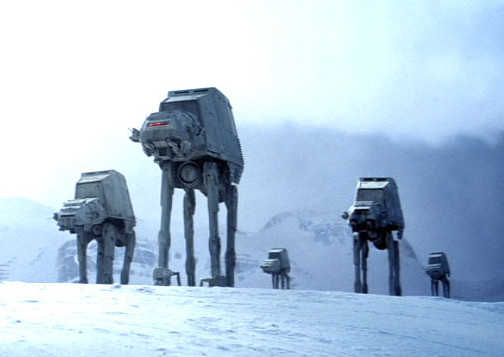
151210atatErik: The pan up from an enormous foot landing on the ice of Hoth to see an imperial AT-AT walker, then zooming out to see more of them coming. Even on a small screen, it’s a great “Oh crap” moment.

Eppu: Vader standing on top of the stairs in Cloud City’s carbon freezing room, silhouetted against blue, with reddish light on the stairs below. Emily Asher-Perrin in her write-up at Tor.com calls The Empire Strikes Back “a shockingly beautiful film”, and it fully is. The lighting, especially, is breathtaking; love it. Also, Cloud City against a red sky / sunset.
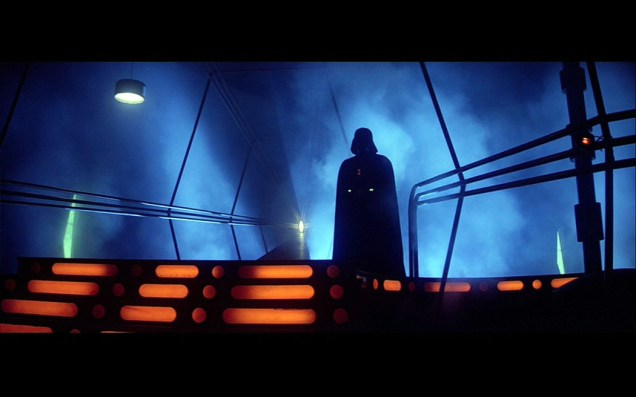
Vader Cloud City carbon freeze room

Extra: Best Response

Eppu: One of Leia’s brilliant lines – although terribly frustrating for her – is “I am not a committee!”. He’s awfully dry and (sadly) played as a comic relief, but I like a lot of C-3PO’s retorts, too (e.g. “Of course I’ve looked better!” and “R2-D2, you know better than to trust a strange computer.”).

Erik: “Yeah, you’re a real hero.” Han to Lando, when Lando tries to dodge the blame for letting the empire set a trap for Han and Leia in Cloud City. It says a lot about how Han’s character has changed since we first met him in the cantina at Mos Eisley.

Images: Who’s scruffy-looking? by Norma Rapier via QuotesGram. Ion control via FANGirl Blog. “Mine!” via Walden. AT-ATs on Hoth via Star Wars Technical Commentaries. Vader in Cloud City via TheForce.net

In the Seen on Screen occasional feature, we discuss movies and television shows of interest.

Two Finnish Authors on The A.V. Club’s Best of 2015

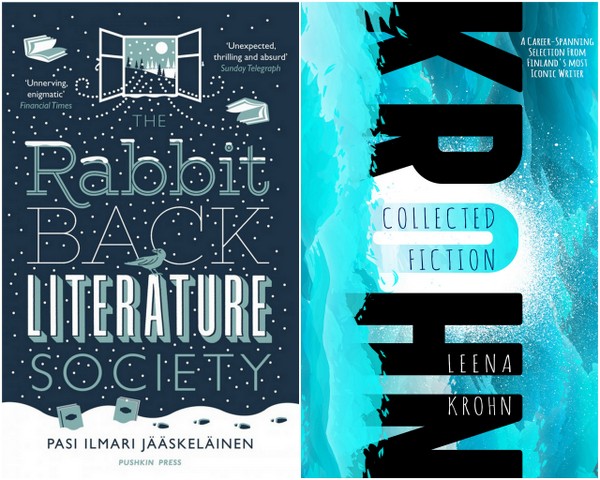
Two Finnish authors made it onto The A.V. Club‘s favorite books of the year. Their Best of 2015 list includes Leena Krohn’s Collected Fiction, a whopper of an anthology (at 800+ pages in hardcover) edited by Ann and Jeff VanderMeer, and The Rabbit Back Literature Society by Pasi Ilmari Jääskeläinen.

Jaaskelainen Krohn Covers

Keeping company to Krohn and Jääskeläinen on the Best of 2015 list “[a]fter a stellar year for the written word” are renowned authors like Ta-Nehisi Coates, Judd Apatow, and Paula Hawkins. Congrats, both!

For a taste of their writing, try Jääskeläinen’s Where the Trains Turn (orig. Missä junat kääntyvät, 2000), published in November 2014 by Tor.com, or Krohn’s Lucilia Illustris, published in December 2015 by Electric Literature.

Found via Helsingin Sanomat.

Images: The Rabbit Back Literature Society via Pushkin Press. Collected Fiction via Cheeky Frawg Books

Ostrich for Breakfast, Ostrich for Lunch, Ostrich for Dinner

Or: Some History behind Ostrich Riding, Part 6 of 7

Background: I ran into two historical images from California with ostriches used as transportation. That got me wondering about the history of ostrich riding. And that lead me down quite a rabbit hole.

I’ve divided my findings into separate posts (find them with the ostrich riding tag). Warning: serious early history and language nerdery ahead in Serious Academic Voice.

TL;DR – Tracing ostrich riding to a 3rd century BCE tomb find (a statue of Arsinoe II) from Egypt doesn’t hold up. The use of various ostrich products in human material culture dates back thousands of years. A few ancient depictions involve humans handling ostriches; however, extant sources don’t tell us whether ostriches were merely hunted or whether they were also tamed in the ancient world. The most promising source seems to be a description of a magnificent parade put together by Arsinoe II’s husband-brother Ptolemy II. This Grand Procession included eight chariots drawn by pairs of ostriches, and the ostriches may have been ridden by boys in costumes.

I had hoped to find a nice, neat selection of ancient texts putting the Greek word for ‘ostrich’ in context, but even a cursory look reveals that the history of the word strouthos is complex. At best, we can say that there are no immediate red flags either in the original Greek or modern English translations for Arsinoe II’s statue or Ptolemy II’s Grand Procession. The poem Berenice’s Lock was said to contain further evidence of ostriches as mounts in Ptolemaic Egypt after Arsinoe II’s death. Instead, what we seem to have is a case of poetic ambiguity translated with poetic license and taken uncritically as evidence.

Some centuries after Arsinoe II and Ptolemy II, ostrich riding may appear in the Roman Empire. Claims in some secondary sources turn out unverifiable, however. Researching primary sources helps but a little: on one hand, many of these texts either have problematic histories or their authorship or accuracy may be questionable; on the other, ostriches tend to appear in context of fighting in gladiatorial games, not being ridden or raced. Surviving visual art only confirms the appearance of ostriches in hunting and arena scenes the Roman territories, not riding or chariot-pulling. A description in the life of Emperor Firmus comes closest, but Historia Augusta, the source of his life, is considered unreliable.

Below is the long story.

Continue reading

New Kaurismäki Film: The Girl King

The Girl King movie posterI’ve been vaguely aware of the Swedish-Finnish movie production The Girl King (Finnish title Tyttökuningas), which is remarkable for having been largely (according to some sources, almost entirely) filmed in Turku, Finland, including the local castle. It’s one week from opening night now, and reviews and interviews are starting to roll out. Yay!

The movie is about Queen Kristina of Sweden (1626-1689), of the Vasa lineage, directed by Finland’s famous Mika Kaurismäki. In the main roles we’ll see Malin Buska, Sarah Gadon (whom I liked in Belle), and Michael Nyqvist (familiar from the Swedish version of The Girl with the Dragon Tattoo series). A description from Kaurismäki’s website says:

“Mika Kaurismäki is currently developing a feature film project about the Swedish Queen Kristina, starring Swedish actress Malin Buska. Set in the 17th century, the film paints a portrait of an extravagant and atypical queen, who was the ruler of her country from the age of seven until her startling abdication at 28.

“The film is scripted by Canadian award-winning screenwriter Michel Marc Bouchard and the cinematography will be by renowned Christopher Doyle (In the Mood for Love, Hero).”

Queen Kristina and René Decartes

At the time of Kristina’s life, Finland was a part of Sweden, and Turku (Åbo in Swedish) was the oldest and largest city in Finland. The Turku Castle dates from late 13th century, but it was still inhabited and garrisoned at the time; in the modern period, it’s been restored to its Renaissance state, so it’s an appropriate location even though Kristina didn’t actually live there. (Tidbit gleaned from a news article in Yle uutiset: Kristina’s parents visited Turku early in 1626, and it’s said that she was conceived at the Turku Castle.) Also, kuningatar Kristiina has a special place in the Finnish memory because of her efforts to end the 30 years’ war which was hard on Finland, and because she at the suggestion of one of her statesmen (and twice Governor General of Finland), Per Brahe, founded the first Finnish university in 1640.

The official trailer (with Finnish subtitles) is out, and looking gorgeous:

Tyttökuningas (The Girl King) -elokuvan virallinen traileri via LeffatByFSFilm

Frock Flicks has a interview with the costume designer, Marjatta Nissinen, and a review that includes insights into the costuming. There’s also a documentary on the costuming, with background information from Kaurismäki and closeups of some of the outfits in the latter half (Finnish with English subtitles):

Dressing The Girl King -documentary by Film City Turku and Länsi-Suomen elokuvakomissio via Scene Turku

As an early history geek who lived in Turku for a number of years, I’m very curious to see The Girl King – for freaking once I get the native advantage in location spotting! 😀

Historical Turku Mashup
Turku historical mashup, clockwise from top: 1700s-1800s houses at Luostarinmäki; bell tower of the cathedral seen from the river Aura; Vanha Suurtori with empire style and neoclassical houses; closeup of the cathedral bell tower. Center: Turku Castle

But seriously, what I can see of the sets and locations, especially the Renaissance floor of the castle, looks fantastic. Here’s hoping that The Girl King will have a reasonably wide release in the U.S.!

Images: Poster via Lark Theater. Queen Kristina & René Decartes via Frock Flicks. Turku historical mashup by Eppu Jensen

In the Seen on Screen occasional feature, we discuss movies and television shows of interest.