Looking at Cleopatra

In this age of selfies and Instagram, we are very aware of how consciously we all create the image of ourselves that we show to the world. The people of antiquity were no less self-conscious about their public image. Look at these two sculptures of Cleopatra VII.

Cleopatra VII Philopator is the famous Cleopatra, Queen of Egypt and lover of both Julius Caesar and Marcus Antonius. She was the last of the Ptolemaic dynasty in Egypt, founded by Ptolemy I, one of the generals of Alexander the Great. The Ptolemies ruled Egypt for almost three hundred years, arguably the first European colonial state in Africa. Like other Macedonian dynasties in the relics of Alexander’s short-lived empire, Ptolemy and his heirs took a pragmatic approach to ruling over a large population that did not share in their Hellenized Macedonian culture. They embraced a kind of cultural bilingualism in which they presented themselves in very different ways to different audiences.

151008marble
Portrait head of Cleopatra VI, photograph by Louis le Grand via Wikimedia (Altes Museum, Berlin; 40-30 BCE; white marble)

This marble head of Cleopatra is sculpted in a Hellenistic style and presents the queen in a Greek cultural context. White marble was favored for sculpture in the Greek world because it reacts to light in ways similar to human skin, making marble sculpture appear more naturalistic. Details like the soft rendering of the mouth, the detailed delineation of the hair, and the slightly off-center tilt of the head are drawn from the artistic repertoire of late Classical and Hellenistic portrait sculpture. This statue asserts Cleopatra’s Greekness and her participation in the broader Mediterranean cultural world. It was probably displayed in Alexandria, the Ptolemaic capital, which had a cosmopolitan population largely made up of Macedonians and Greeks, along with substantial Jewish and Persian communities and a variety of other peoples, but few ethnic Egyptians. It was meant to be seen by an audience that would recognize and appreciate the way this portrait fit into the larger history of Hellenistic ruler portraiture.
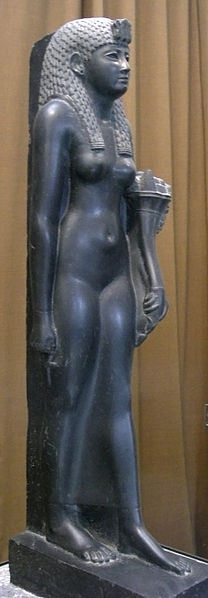
Statue of Cleopatra VII, late 1st c. BCE, Hermitage Museum St. Petersburg, basalt, photograph by George Shuklin
Statue of Cleopatra VII photograph by George Shuklin via Wikimedia (Hermitage Museum, St. Petersburg; late 1st c. BCE; basalt)

This basalt statue of Cleopatra uses not only an Egyptian artistic style, but an almost entirely Egyptian iconographic vocabulary. Many different stones were used for Egyptian portrait sculpture, but basalt was a popular one since the stone is very hard and durable, giving a sense of permanence especially to royal portraiture. Cleopatra is presented here as an Egyptian pharaoh. She wears a wig adorned with the royal uraeus and carries an ankh in her right hand. The cornucopia in her left hand is a Greek symbol, but its connotation of bounty is similar to the ankh’s symbolism of life. Also note that one of her feet is advanced. Egyptian women were typically depicted with feet together and men with one foot advanced, but the adoption of masculine traits to represent a ruling queen is also traditionally Egyptian. This statue was intended for an Egyptian audience and meant to convey Cleopatra’s commitment to ruling over her Egyptian subjects through the forms and structures that they had long been accustomed to.

The Ptolemaic monarchs were aware that their power rested on two precarious premises: that the people of Egypt would accept rulers who were not themselves ethnically Egyptian and that other Mediterranean, African, and Asian powers would respect as equals a royal house of comparatively recent vintage. These sculptures show the confidence with which Cleopatra balanced those two needs and reinvented her image for two different audiences.

(Sadly, there’s not an ostrich to be seen.)

The Visual Inspiration occasional feature pulls the unusual from our world to inspire design, story-telling, and worldbuilding. If stuff like this already exists, what else could we imagine?

Add Eight Ostrich Teams and Call It a Procession

Or: Some History behind Ostrich Riding, Part 3 of 7

Background: I ran into two historical images from California with ostriches used as transportation. That got me wondering about the history of ostrich riding. And that lead me down quite a rabbit hole.

I’ve divided my findings into separate posts (find them with the ostrich riding tag). Warning: serious early history and language nerdery ahead in Serious Academic Voice.

TL;DR – Tracing ostrich riding to a 3rd century BCE tomb find (a statue of Arsinoe II) from Egypt doesn’t hold up. The use of various ostrich products in human material culture dates back thousands of years. A few ancient depictions involve humans handling ostriches; however, extant sources don’t tell us whether ostriches were merely hunted or whether they were also tamed in the ancient world. The most promising source seems to be a description of a magnificent parade put together by Arsinoe II’s husband-brother Ptolemy II. This Grand Procession included eight chariots drawn by pairs of ostriches, and the ostriches may have been ridden by boys in costumes.

Below is the long story.

Continue reading

That’s a Large-Ass Egg, All Right!

Or: Some History behind Ostrich Riding, Part 2 of 7

Background: I ran into two historical images from California with ostriches used as transportation. That got me wondering about the history of ostrich riding. And that lead me down quite a rabbit hole.

I’ve divided my findings into separate posts (find them with the ostrich riding tag). Warning: serious early history and language nerdery ahead in Serious Academic Voice.

TL;DR – Tracing ostrich riding to a 3rd century BCE tomb find (a statue of Arsinoe II) from Egypt doesn’t hold up. The use of various ostrich products in human material culture dates back thousands of years. A few ancient depictions involve humans handling ostriches; however, extant sources don’t tell us whether ostriches were merely hunted or whether they were also tamed in the ancient world.

Below is the long story.

Continue reading

How Easy It Is to Be Wrong about Early History on the Internet

Or: Some History behind Ostrich Riding, Part 1 of 7

Background: I ran into two historical images from California with ostriches used as transportation. That got me wondering about the history of ostrich riding. And that lead me down quite a rabbit hole.

I’ve divided my findings into separate posts (find them with the ostrich riding tag). Warning: serious early history and language nerdery ahead in Serious Academic Voice.

TL;DR – Tracing ostrich riding to a 3rd century BCE tomb find from Egypt is rubbish, but the concept is, indeed, ancient.

Below is the long story.

Continue reading

Dún Aonghasa

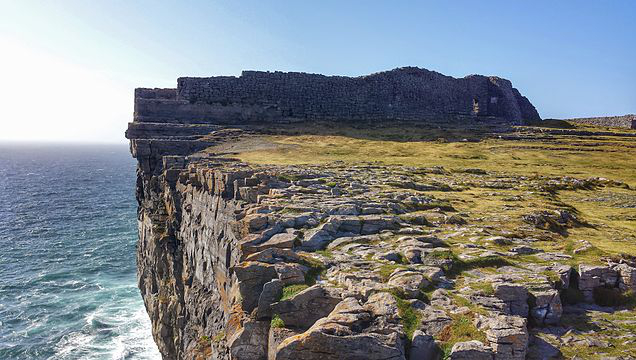
Aerial view of Dún Aonghasa. Photograph by Ronan Mac Giollopharaic
Aerial view of Dún Aonghasa, photograph by Ronan Mac Giollopharaic via Wikimedia

While doing some research on northern European hillforts recently, I found myself looking at some pictures of Dún Aonghasa (also known as Dun Aengus). It’s an impressive site. The fort is a series of concentric half-rings backing up onto 100-meter cliffs on the island on Inishmore off the western coast of Ireland. The earliest construction on the site has been dated to around 1100 BCE. Later additions were made around 500 BCE. It is one of the largest well-preserved examples of a type of structure that was built throughout northern and western Europe, from Spain to Sweden, in the prehistoric era.

The "cheveaux de frise," a barrier of jagged stones set up to slow down attackers. Photograph by Herbert Ortner
The “cheveaux de frise,” a barrier of jagged stones set up to slow down attackers, photograph by Herbert Ortner via Wikimedia

There has been disagreement in the scholarship about the function of Dún Aonghasa and similar forts. While often identified as fortified settlements, some have suggested that they were actually sites of religious ritual. It has to be said that if Dún Aonghasa and sites like it were religious sanctuaries, they were amazingly well-defended ones. I think it is more likely that sites that were originally built for defense were centuries later repurposed as ceremonial sites, much like how medieval castles built for defense have centuries later become museums and tourist attractions.

The walls of Dún Aonghasa and the cliffs of Inishmore. Photograph by Jal74
The walls of Dún Aonghasa and the cliffs of Inishmore, photograph by Jal74 via Wikimedia

It may be hard to believe that such an enormous fortification was built in so remote a place, but forts like Dún Aonghasa were once fairly common across western and northern Europe. Most, however, have been lost to decay, erosion, and the reuse of stones. It is only in remote places like Inishmore that they still survive.

Thoughts for writers

Just a simple thought today: the world is full of interesting possibilities. Fortresses don’t have to look like medieval castles. Religious sites don’t have to look like cathedrals or Greek temples. History is huge and there are amazing things out there to inspire your imagination.

History for Writers is a weekly feature which looks at how history can be a fiction writer’s most useful tool. From worldbuilding to dialogue, history helps you write. Check out the introduction to History for Writers here.

Visual Inspiration: Ostrich Riding

Last week, I shared the image of an ostrich cart. There must’ve been random serendipity rays in the air, because this week I happened on a photo of someone actually riding an ostrich:

Man riding an ostrich at the Cawston ostrich farm, South Pasadena, California. Via Elle Decor, June 2014, p. 67.

Cawston ostrich farm. Postcard by Detroit Photographic Company; South Pasadena, California, unknown date. From the collection of Marc Walter, published in An American Odyssey: Photos from the Detroit Photographic Company, 1888-1924, by Marc Walter and Sabine Arqué (Taschen, 2014). Found in Elle Decor magazine, June 2014, p. 67.

Huh. I used to think that the various tallstrider or hawkstrider type mounts in World of Warcraft were based more on fantasy than fact. I’m sure large birds come with a host of training and handling issues, but apparently it’s not as far-fetched as I thought. On the other hand, having grown up two hours south of the Arctic Circle and traveled in Lapland multiple times, seeing reindeer doesn’t make me bat an eye. Just goes to show how our experiences influence our sense of normal. 🙂

The Visual Inspiration occasional feature pulls the unusual from our world to inspire design, story-telling, and worldbuilding. If stuff like this already exists, what else could we imagine?
Visual Inspiration: Ostrich Carts

Ostrich pulling a cart at the Los Angeles Ostrich Farm. Via William H. Hannon Library, Loyola Marymount University.


Ostrich pulling a cart at the Los Angeles Ostrich Farm. Postcard by unknown; Lincoln Park, Los Angeles, California, 1919. From the Werner von Boltenstern Postcard Collection; Department of Archives and Special Collections, William H. Hannon Library, Loyola Marymount University. In public domain.

Why do fantasy stories so often employ equines as beasts of burden, when you could breed large birds for the task? In our world, humans do have a long history with the horse family, but who’s to say that in another, more SFFnal one you couldn’t find giant versions of armadillos, capybaras, or rats used for transportation? Or faster, large-scale chameleons?

The Visual Inspiration occasional feature pulls the unusual from our world to inspire design, story-telling, and worldbuilding. If stuff like this already exists, what else could we imagine?