When a Walrus Shows up at Your Door

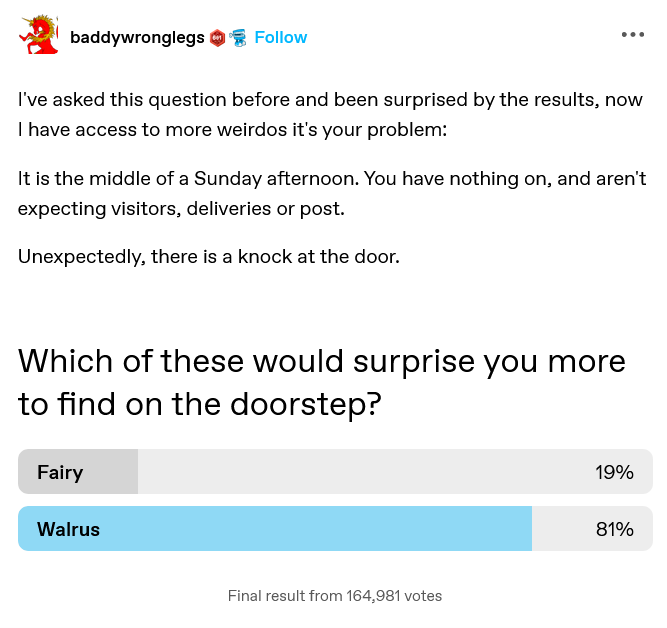
There’s been a thing going on in the past month on the Internet about fairies and walruses. If you’re not in the loop, it all started with a poll posted on tumblr by user baddywronglegs that asked respondents to consider which one they would be more surprised to find at their front door, a fairy or a walrus?

The fun of this poll is that it pits two very surprising (in most parts of the world) things against one another, but those things are surprising in two different ways. Fairies don’t exist, but if they did, it would be perfectly plausible for one to knock on your door. Walruses do exist, but the idea that one would survive the trip out of the Arctic, make it to your front door, and knock is beyond belief. What’s more surprising: the most unsurprising surprising thing or the most surprising unsurprising thing?

But, then, surprising things do happen sometimes. Like walruses showing up where they have no business being. A lost walrus found itself on the shores of southeastern Finland in the summer of 2022. It didn’t knock on any doors, but it did take a nap between some beached rowing boats, literally rolled around on someone’s yard in the grass, and posed in front of an emergency vehicle.

Yes, Finland is an Arctic country in the sense that we straddle the Arctic Circle, even though most of our land area is south of it. We do not, however, currently have any coastline in the north; all of our salt water access is to the south and west, i.e., to the Baltic Sea. Visits like this are, therefore, extremely rare. The walrus had to travel all the way around Scandinavia, through the Danish Straits (Kattegat and Skagerrak), and east along the Gulf of Finland to reach Hamina and Kotka.

(Alas, the poor thing turned out to be famished, and died in the middle of an attempted rescue en route to the Wildlife Hospital of Korkeasaari Zoo in Helsinki. It’s since been preserved and it’s on display at the Finnish Museum of Natural History.)

Wikimedia Antti Leppanen Haminan mursu

It’s quite staggering that we live in a place where, theoretically—very much in theory, but nevertheless—a walrus could turn up on the yard! (No sign of fairies, though.)

Images: Screenshot of tumblr post by baddywronglegs. Stuffed walrus in the Natural History Museum of Helsinki by Antti Leppänen via Wikimedia (CC BY 4.0).

Envisioning Persepolis

Persepolis was the ceremonial capital of the Achaemenid Persian Empire. While other cities such as Babylon, Susa, and Ecbatana had royal residences and centers of administration, Persepolis was the symbolic heart of the empire. It was here that one of the central rituals of Achaemenid rule was carried out, the annual presentation of gifts from the peoples of the empire to the king.

Early Persian kings, like Darius I and Xerxes I, built up the palace at Persepolis into an impressive monument suitable for the ceremony. Persepolis was meant to be both imposing and welcoming, asserting the king’s power while also embracing the diverse peoples of the empire in a peaceful ritual in which they were treated as valued members of the empire, not defeated subjects.

It was in part because of Persepolis’ symbolic significance that Alexander the Great burned the palace in his conquest of Persia. The site of the palace was not reoccupied but was left in ruins, which has allowed modern archaeologists to reconstruct the Achaemenid palace in significant detail.

The stills below come from a video exploring a digital reconstruction of the palace, which can be viewed on Wikipedia.

In a wide view, we see the palace complex as it stood at the edge of the hills. The large columned hall in the center is the apadana or throne room where the king received the delegations of gift-bearers from around the empire. To the left is the Gate of All Nations, through which the procession of gift-bearers entered the complex, and to the right are the buildings of the treasury where the ceremonial gifts were stored after the ritual was completed.

A view of Persepolis, still from a video by ZDF/Terra X/interscience film/Faber Courtial, Gero von Boehm/Hassan Rashedi, Andreas Tiletzek, Jörg Courtial via Wikipedia

From a ground-level view we see the Gate of All Nations, erected by Xerxes, which gave admission to the courtyard before the apadana.

The Gate of All Nations, still from a video by ZDF/Terra X/interscience film/Faber Courtial, Gero von Boehm/Hassan Rashedi, Andreas Tiletzek, Jörg Courtial via Wikipedia

Another ground-level view gives us an idea of what it would have been like to approach the apadana, with some human and animal figures for scale.

The north porch of the apadana, still from a video by ZDF/Terra X/interscience film/Faber Courtial, Gero von Boehm/Hassan Rashedi, Andreas Tiletzek, Jörg Courtial via Wikipedia

The whole video is well worth a watch. It can be quite valuable to try to imagine ancient spaces not as the ruins we find them in today but as living places filled with life and activity.

Love Beyond Death

It is a beautiful thing to imagine that the love we feel in life might last beyond death. This Etruscan sarcophagus lid expresses that hope.


Sarcophagus lid via Museum of Fine Arts, Boston (found Vulci, currently Museum of Fine Arts, Boston; 350-300 BCE; marble)

This fine piece of sculpture adorns the top of a sarcophagus inscribed with the names of Thanchvil Tarnai and her husband Larth Tetnies. The couple are shown together, nude under a sheet, facing one another in a loving embrace. This is not the only Etruscan sarcophagus to depict the deceased as a loving couple sharing a couch, but it is one of the most intimate.

Sometimes, it may be hard to imagine finding someone you could even share a lifetime with, let alone someone you would want to spend eternity beside. If you find the right person, though, it’s sweet to think that your love could last that long.

Living Vicariously Through Social Media: Ringneck Snakes

I’m not a great friend of cold-blooded critters in general. The ringneck snake (Diadophis punctatus), however, does fall close enough to my sense of cute to bring up. Especially the juveniles—soooo small!

Flickr Tony Iwane Pacific Ringneck Snake

Even the adult ringnecks are quite small and slender, about 21-36 cm (8″-14″) long. The belly and underside are bright yellow, orange, or red, and there often is a ring of the same color around the neck. The 14 non-poisonous subspecies are found in much of the United States, central Mexico, and south-eastern Canada in a wide variety of habitats.

Apparently, the coloring can also shift along the length of the body, like on the prairie ringneck snake in the photo below.

Flickr Peter Paplanus Prairie Ringneck Snake

This type would be especially handsome as a ginormous fantasy version, perhaps even as a rideable creature, a little like the sandworms on Dune or oliphaunts in The Lord of the Rings with war-towers on their backs.

Images: Pacific ringneck snake by Tony Iwane on Flickr (CC BY-NC 2.0). Prairie ringneck snake by Peter Paplanus on Flickr (CC BY 2.0).

Visual Inspiration: Greater Blue-Eared Starling

The greater blue-eared glossy-starling (Lamprotornis chalybaeus) is a common bird in parts of Africa. It’s as handsome as handsome gets—absolutely gorgeous!

iNaturalist petermcintyre Greater Blue-eared Starling

This stunning starling breeds in a band of land stretching from Senegal in the west coast all the way east to Ethiopia, and south again through eastern Africa to northeastern South Africa, northern Botswana, southern Namibia, and northern Angola. They live in subtropical forests, savanna, and shrublands.

I’ve always found the English name starling lovely—certainly lovelier than the Finnish one (kottarainen)—but the looks of the common starling haven’t, sadly, quite lived up to the name in my mind. Now, the greater blue-eared starling is quite something else! It would be so remarkable to see a turquoise-blue murmuration in a fantasy production, wouldn’t it?

Found via Herps and Birds on Tumblr.

Image by petermcintyre via iNaturalist (CC BY-NC 4.0)

Winter Count

As a historian, its always fascinating to me to encounter the historiographic practices of another culture. Every culture has reasons to remember the past, and finds its own solutions to the problems posed by the limitations and fallibility of human memory. While written narrative histories have been privileged in the Western world, they are not the only way of preserving the past.

The winter count is a tradition of the Lakota, Kiowa, and several other indigenous nations of the North American plains. Customarily painted on buffalo hide, the winter count records years with one or two pictographic symbols representing major events of the year. These documents served as an aid to memory so that important past events could be recalled and put in relation to one another. In more recent times, some were also created on fabric or paper.

Copy of a Kiowa winter count for 1889-1892 via Wikimedia (previously Smithsonian Museum, now lost; 1890s; ink on buckskin; copy by Ankopaaingyadete of his original work on paper)

We know of winter counts dating from as early as the late seventeenth century and some still being kept in the early twentieth century. Not many have survived intact to today. Like many cultural objects created by indigenous North Americans, winter counts were sometimes destroyed by white settlers and at other times taken by collectors as anthropological curiosities. Some of those that no longer survive were photographed or copied, and in some cases, while the images have been lost, written descriptions survive.

There’s more than one way to preserve historical knowledge. Here’s one idea to keep in mind when thinking about how we know about the past and how people in a culture different from our own might relate to historical memory.

Living Vicariously Through Social Media: Rainbow Eucalyptus Trees

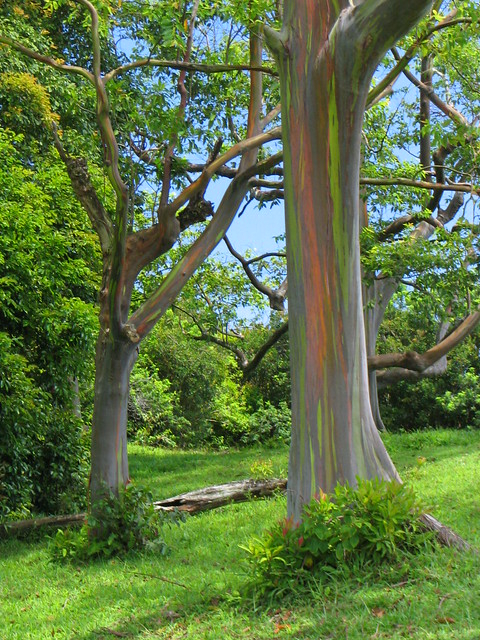
Rainbow eucalyptus trees (Eucalyptus deglupta) shed their bark at a strip at a time, and the tree trunks look stripy as a result. That’s not all, however—the stripe colors can vary surprisingly much. A freshly revealed area will look bright pale green, which then darkens and changes to orange, red, brown, and grey or blue.

Flickr spencer9 Rainbow Eucalyptus
Flickr Jean-Francois Schmitz Rainbow Eucalyptus

Rainbow eucalyptuses are native to the Philippines, Indonesia, and Papua New Guinea, but have been planted elsewhere in suitable climates.

Amazing, aren’t they? I wonder whether the Weta artists looked at rainbow eucalyptus trees as an inspiration for their saturated, weird Mirkwood trees for the Hobbit movies. (They talked about the design in the behind-the-scenes documentaries; the movies as released are too dark to see the colors properly, if memory serves.)

Images: Two eucalyptuses by spencer9 via Flickr (CC BY-NC 2.0). Closeup by Jean-François Schmitz via Flickr (CC BY-NC-ND 2.0).

Out There is an occasional feature highlighting intriguing art, spaces, places, phenomena, flora, and fauna.

A Dragon Crawls Down from the Ceiling to Make a Fireplace

A dragon fireplace. A DRAGON. Fireplace!

Twitter Into the Forest Dark Dragon Fireplace

Ok, thinking about it a little longer than half a second, it’s not surprising that there are a number of dragon designs for fireplaces and stoves for both indoors and out, in addition to firepits, fireplace screens, and andirons.

This particular one must be custom work and as such, it cannot be inexpensive. But, dang, is it handsome or what?

By unknown. Found and image via Into the Forest Dark on Twitter.

Out There highlights intriguing art, places, phenomena, flora, and fauna.

A Greco-Scythian Gorytos

Here’s a beautiful work of art. This is a golden decorative panel from a gorytos, a combination quiver and bowcase that was used widely among ancient peoples of the steppes and the Iranian plateau. This example was found in Melitopol in southeastern Ukraine.

Gorytos, photograph by VoidWanderer via Wikimedia (found Melitopol, currently Kyiv; 4th c. BCE; gold)

Scythian artisans were expert metalworkers, and the Scythian elite valued high-quality metalwork, especially in gold, as emblems of status. This panel was made by Greek crafters serving the Scythian market. The central panel shows scenes from the life of Achilles, a Greek hero whose legends were sometimes associated with Scythia and whose warrior prowess was appealing to Scythian tastes. The outer panels feature decorative scenes of animals hunting, a popular motif in Scythian metalwork.

This piece is not just a beautiful work of art, it’s also an example of how art and artisans in antiquity crossed boundaries and bridged cultures.

Out There highlights intriguing art, places, phenomena, flora, and fauna.

Visual Inspiration: Whiskered Treeswifts

Whiskered treeswifts (Hemiprocne comata) live in various subtropical or tropical forests in Southeast Asia.

Macaulay Library David Cathy Cook Whiskered Treeswift

They remind me of swallows, but are more colorful. Especially the combination of grey plus blue in the wings and back appeals to me.

Setting personal color preferences aside, wouldn’t it be so much more interesting to read a secondary world fantasy story with, say, messenger birds that look like whiskered treeswifts rather than the uninspired and unoriginal corvids?

Yes, corvids are AMAZING birds, but they’re used EVERYWHERE. Could they not be replaced by something else in a fantasy story? Or at least made vibrantly colored?

Image by David and Cathy Cook via The Cornell Lab of Ornithology, Macaulay Library

The Visual Inspiration occasional feature pulls the unusual from our world to inspire design, story-telling, and worldbuilding. If stuff like this already exists, what else could we imagine?