Winter is Coming, and He’s Got a Hare to Share

Winter is upon us here in the northern hemisphere. We’re settling in for cold days and long, dark nights. Here’s how the winter season was imagined in late Roman Britain.

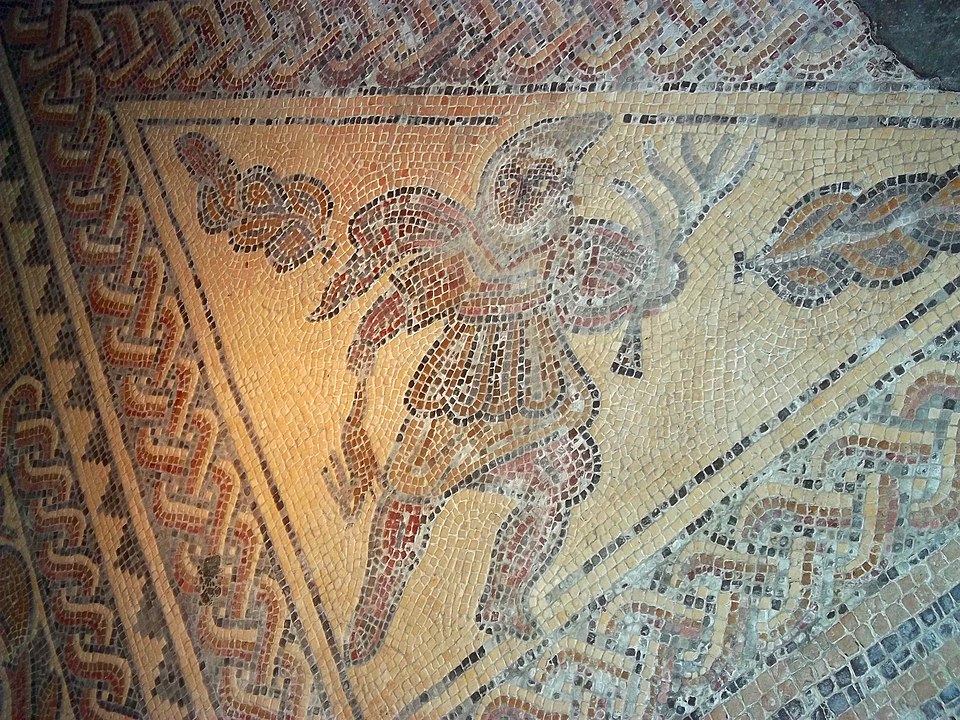
This figure comes from a floor mosaic at Chedworth Villa in western Britain. Each corner of the mosaic had a little allegorical figure representing one of the seasons. Winter appears bundled up in warm layers with a hooded cloak, carrying a hare in one hand (the reward of a hunt), and a symbolic leafless branch in the other.

Wishing you a warm, cozy, and cheerful winter season!

Image: Winter from Chedworth dining room floor, photograph by Pasicles via Wikimedia (Chedworth Roman Villa; 4th c. CE; mosaic)

A Peek into Color Gothic Aesthetics

I was browsing a ren faire board the other day for research. Someone there was asking for inspiration and advice, saying they usually dress “quite gothic”, which I somehow misread as “white gothic”.

That would be really interesting, I thought, and wanted to check whether it’s a thing… And of course it is! Known as white goth or ice goth: instead of the ubiquitous black, dressing only (or mostly) in white, but spiky or moody, sometimes puffy or lacy or ruffly, too.

Then I poked around some more. I already knew that various flavors of goth aesthetic exist, of course, but I was specifically interested in color-based ones. Apart from red and purple goth, less immediately obvious colors such as pastel goth (especially pink goth looks big), blue, and green goth do seem to exist. Yellow, orange, and brown goth seem marginal (with varying levels of recognition), but there doesn’t seem to be gold, silver, or bronze goth, per se.

Color Goth Styles Mashup

The most intriguing find, I think, emerged from my yellow goth search. There seems to be some interest in dressing styles inspired by bugs, including bees. One seller on Etsy even used both the word bee and goth in their sweater description. (Personally, I couldn’t call that sweater goth style, but you do you.) Below is a bee-inspired ensemble by EJ on Pinterest that the user labeled as “yellow Y2K goth outfit”:

Pinterest EJ Yellow Y2K Goth Outfit

So, there’s bee goth now? Bee core? (Buzz core???)

Live and learn!

Images: Mashup by Eppu Jensen: red and black outfits by hystericb0y on Tumblr; purple goth by sabikuma on tiktok, found via peri on Pinterest; blue goth by dogmaz on Tumblr; green goth via Yasmin on Pinterest; white goth via Mabel Manley on Pinterest. Yellow Y2K goth outfit (bee goth) by EJ on Pinterest.

ESA’s Video Flying Over Xanthe Terra on Mars

The European Space Agency has released a new three-plus-minute Mars flyover video based on images transmitted by the Mars Express orbiter.

According to Phys.org,

ESA’s Mars Express takes viewers on a flight over Xanthe Terra, a highland region just north of the equator. The film is a mosaic created from images taken during single-orbit observations by Mars Express’s High Resolution Stereo Camera (HRSC). The images were combined with topography information from a digital terrain model (DTM) to create a three-dimensional view of the Martian landscape. The main feature in this video is Shalbatan Vallis, a 1300 km-long (~800 mi) outflow channel that transitions from the Southern Highlands to the Northern Lowlands.

ESA Xanthe Terra Mars Express Screencap

(Note: The image above is merely a screencap; follow the text links to see the video on ESA’s site.)

There are two amazing things about this video. First, as large as the area clearly is, compared to the rotating image of the planet in the very beginning, the features we see are completely dwarfed by Valles Marineris (the huge canyon south of Xanthe Terra). And second, the amount of detail is surprisingly ample. I wonder how much an exogeologist would be able to deduce?

I’ve said it before, and I’m sure I’ll say it again: it is a very good time to be a space geek. 🙂

(Also interesting to me, at least, is that since the video is silent, my brain started playing the main theme from the movie Gravity. Space imagery must be accompanied by majestic music now?)

Found via File 770.

When the So-Called High Art Falls Entirely Flat

I’m not a huge high art aficionado, but at times it can be fun to visit a museum. Then there’s art I do not understand. At all.

Content note: this post contains one f bomb.

Case in point: the Ouroboros Steak, a project designed by Andrew Pelling, Orkan Telhan, and Grace Knight. On the Design Museum website, the project is described like this:

“Ouroboros Steak is a DIY meal kit for growing gourmet steaks from of one’s own cells. It comes as a starter kit of tools, ingredients and instructions that enable users to culture their own cells into mini steaks, without causing harm to animals.

“Commissioned for the exhibition Designs for Different Futures at the Philadelphia Museum of Art, the project is a critical commentary on the lab-grown meat industry and critiques the industry’s claims to sustainability.”

Judging by the museum website metadata, the… product… is also listed for the 2020 Beazley Designs of the Year competition.

Err, what? Art? Product? Gourmet?!?!?!? What the fuck did I just read???

I… just… What?!? I can’t even decide whether the name is clever or artsy-fartsy pseudo-intellectual crap. Or whether the project might be just a boredom-induced crude joke??? If it were, it would be in highly, EXTREMELY poor taste to not take the health implications of cannibalism into account DURING a pandemic. Unless that’s supposed to be a part of the project???

Just can’t fathom this, in any shape, size, or form!

(WHAT?!????)

Image via Designmuseum.org

Imagine Being Surrounded by Maps

The Villa Farnese is a gorgeous Renaissance palace in central Italy, built in the early 1500s and richly elaborated with sculptures and frescoes. One of the rooms in the villa features a map of the world filling the wall at one end, with detailed maps of the continents on the other walls, under a ceiling decorated with constellations. Standing in this room, the magnates of the villa could see the whole world, as it was known to scientists and cartographers of the day.

The map room at Villa Farnese, photograph by Etienne (Li) via Wikimedia (Caprarola, Italy; completed 1574; fresco; by Giovanni Antonio de Varese)

Looking at this space, it occurs to me that a room like this would make an excellent setting for a scene in a fantasy or historical story. Many such stories play out over long distances, and knowing how one territory or city relates to the others around it as well as to the shapes of the land can make a huge difference in understanding the stakes and possibilities in play.

Africa, from the map room at Villa Farnese, photograph by Jean-Pierre Dalbèra via Wikimedia (Caprarola, Italy; completed 1574; fresco; by Giovanni Antonio de Varese)

In a visual medium like tv or movies, it could be very helpful to have a visual in the background while characters are discussing important movements or plans, but even in text, putting your characters in such a place could give you an opportunity to describe them looking at the map, tracing routes of travel or the borders between nations, and arguing for their plans.

Europe, from the map room at Villa Farnese, photograph by Ulrich Mayring via Wikimedia (Caprarola, Italy; completed 1574; fresco; by Giovanni Antonio de Varese)

Maps make everything better!

Kangina: Half a Year’s Worth of Fresh Grapes from a Pile of Mud

Kangina are traditional, ecological, and effective northern Afghani mud-straw containers for keeping fresh fruit good longer. They work best with a particular type of grapes with thick skins and a late harvest.

Wikipedia Voice of America Kangina

Freshly formed bowls are first baked in the sun for a few hours. The fruit is then placed inside, another bowl is placed on top, and the join sealed with more mud.

Atlas Obscura Stefanie Glinski Kangina Pile

The kangina are then stored in a cool, dry place for up to five or six months. To open, you gently crack the kangina halves apart. (Seen, for example, in this Voice of America video.)

Definitely not quick or low-effort, but still an impressive way to preserve fruit and introduce variety into your winter diet, isn’t it? Perhaps not the best containers for a party of intrepid D&D adventurers to carry with them, either, but certainly an inspired method of storing food they could run into while resting between quests.

Images: Grapes in a kangina by Voice of America via Wikipedia. A storage pile of kanginas by Stefanie Glinski via Atlas Obscura.

Repurposing Old Wind Turbine Blades as Bike Shelters

Apparently, for a good long while, retired wind turbine blades were difficult to deal with. (Sounds like recyclable blades have since been created.) They were made of materials that can’t easily be recycled and are bulky to just dump.

Repurposing used blades has been an obvious solution. But as what? Among others, they’ve been turned into utility poles, playground equipment, bridge girders, and park benches, for example. In addition, in Aalborg, Denmark, sections of old, disused wind turbine blades have been set up as bike shelters.

WEF Siemens Gamesa Turbine Bike Shelter

This is an older project by now, but I thought it clever and worth noting. Also, it’s cool how the shape of the repurposed section nods just a tiny bit towards the Art Nouveau spirit.

Image by Siemens Gamesa, found via World Economic Forum

Winter Light, Summer Light

One of the things I love so much about living in Finland is the light. In every time of the year, the sunlight is beautiful, but the winter light and the summer light are so different from one another that it can be striking to see.

One day last winter we had a particularly beautiful day of clear skies and sunlight after a big snowstorm. I tramped out in our local woods and took a few pictures of the winter light on the snowy trees. Now that midsummer is here, I went back and took pictures of the same scenes to compare the summer and winter light.

Every season has its own special beauty.

Images by Erik Jensen

Living Vicariously Through Social Media: Red Lights in the Vatican

In his work, video director, photographer, and art director Aishy plays with color and light. One of his most striking projects is the Red Lights: Vatican series. Interior views from St. Peter’s Basilica in Vatican City become striking and very different from their everyday state.

Instagram Aishy St Peters Basilica Dome

Aishy’s work is often described as having a sci-fi or cyberpunk flair. However, what his Vatican photos remind me of is how ancient Mediterranean statues and buildings in their original state were not the bland off-white or grey we currently know, but vibrantly painted.

Instagram Aishy St Peters Basilica Vault

And to get back to the cyberpunk idea: wouldn’t it be more interesting—or at the very least less ubiquitous—if your next dystopia were not visually mostly black or grey, but eyeball-bustingly garish in color? Surely that could also be quite dystopic, right?

There are some specific examples I can think of. The throne room in Star Wars: Episode VIII – The Last Jedi, for starters, looks magnificently arresting. I’m just a little tired of red (or the combination of red and black). Sure, it’s a strong color often linked to strong emotions, but it tends to be overused. How about orange instead, like the Las Vegas of Blade Runner 2049? Or in Jupiter Ascending? Perhaps purple, turquoise, or chartreuse?

Just tone down the use of those ever-present blacks and greys, thanks.

(As a sidenote, the ancestry festival in Star Wars: Episode IX – The Rise of Skywalker delighted me for its happy colors, even if the planet itself was another desert.)

Images by Aishy via Instagram: Dome. Vaulted ceiling.

Ancient Greek Clay Cooker for Multiple Dishes

Look at this amazing ancient multi-tier clay cooker:

Imgur TheRainbowegoSweet007 Delos Cooker

There seems to be frustratingly little information available online. I haven’t been been able to track down full details for this apparatus, but some sources call it an anthrakia. Considering that anthrakia means ‘a heap of burning coals’ it sounds at least plausible (but as I said I don’t know). Apparently it’s from 500 BCE or so (although one source says 2nd c. BCE), and was found on the island of Delos, Greece.

Delos was one of the most sacred places of ancient Greece—claimed to be the birthplace of Artemis and Apollo—and a busy trade center for centuries if not millenia. It looks like the only images of this cooker come from the Archaeological Museum of Delos. No-one seems to have posted the associated text, though, so I still don’t know quite as much as I’d like.

Such an ingenious arrangement, though, isn’t it? The oven has space for a hand-held grill and an area at the front for raking coals into (I assume). Above the oven, there is an opening to rest a frying pan on. As if that’s not enough, above that to the back of the cooker there are tube-like stands for three cooking pots, through which the pots also have access to heat from the oven. You could have five dishes cooking at the same time. And it looks like the cooker is also portable.

It’s impressive both from the point of view of functionality and design—the oven-stove-grill combo seems to have been made as one piece. (Or possibly two pieces, if the pedestal that looks like an upside-down plant pot was made separately.)

Not bad for a 2,000+ year-old kitchen gadget, right? I can almost hear the sizzling of frying food.

With that, I’ll wish our readers in the U.S. a Happy Thanksgiving! 🙂

Image via TheRainbowegoSweet007 on Imgur