“It’s What My Character Would Do”

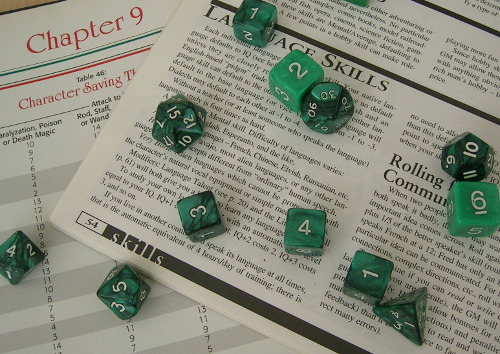
This phrase is sometimes brought out by players in tabletop role-playing games to justify actions that are harmful (or at least annoying) to the rest of the party: “It’s what my character would do.”

My answer to that is: “Then your character wouldn’t be a member of this party.”

Role-playing is, of course, an important part of the game. We take on the personalities, histories, and motivations of characters who are not ourselves and tell stories about them. Sometimes, those motivations can lead to situations where characters come into conflict. There’s nothing necessarily wrong with having conflict, stress, or even outright hostility among the characters in a game, but when conflict between characters becomes conflict between players, that’s a problem that needs to be resolved.

Adventures are, after all, as Bilbo Baggins put it, nasty uncomfortable things that make you late for dinner. The characters in a role-playing game are very often not having a good time, but the players should be. Some players thrive on intra-party conflict; others abhor it. Sorting out what is and isn’t acceptable at your table is an important part of a session 0 conversation. You can have whatever rules suit your group, and if everyone at the table enjoys playing out character conflict, then go for it, but a good player should not be playing in a way that makes other players’ experience worse.

People who like intra-party conflict will sometimes claim that avoiding conflicts is a betrayal of role-playing. “In this situation,” they say, “my character would attack their character. It’s what my character would do.” But this attitude itself reflects a shallow approach to the role-playing aspect of the game.

Role-palying isn’t just about actualizing your own character’s deepest wishes; it’s also about exploring the dynamics of the group as a whole. Players need to remember that they are not just playing a character with a background and motivations, they are playing a character who has agreed, under some terms, to travel, fight, and work with a group of other characters. It may be an alliance of convenience, they may be working together with gritted teeth and watchful eyes, but they have agreed to work together all the same. Playing out how they manage to keep working together even when their interests collide is a greater and often more interesting role-playing challenge than deciding to do something even though it pisses off your fellow players. If you can’t play your character in a way that allows your fellow players to enjoy the game, then your character wouldn’t be a member of that party to begin with.

Keeping a role-playing game going isn’t always easy. It takes a good-faith effort by everyone at the table to make sure that everyone else is having a good time, even when things get rough for the characters they’re playing. Your goal as a player should always be to make sure the game is good for everyone, and sometimes that means putting in the effort to figure out how your character would decide to put the good of the group ahead of their own interests. It’s what your character would do.

Image by Erik Jensen

Of Dice and Dragons talks about games and gaming.

I Know You’re a Barbarian, But What Am I?

The ancient Greeks had certain stereotypes about the people they called barbaroi: Romans were brutes; Scythians were drunkards; Persians were perverts, and so on. Like all ethnic stereotypes, these conventional views were based on prejudices and assumptions rather than truth. Not everyone necessarily believed in or agreed with these stereotypes, but they were recognizable elements of Greek culture in the same way that “French are cowards” or “Italians are reckless drivers” are recognizable stereotypes today. But what stereotypes did other peoples have for the Greeks? We don’t have very many sources that offer non-Greek views of the Greeks, but there are some hints that suggest that the common view of the Greeks, and Athenians in particular, is that they talked too much.

The Greek historian Herodotus reports a story that a Scythian named Anacharsis had traveled in Greece and come home to Scythia with a pointed opinion on the Greeks:

In fact, I have heard a story told by the Peloponnesians about Anacharsis, who was sent by the king of the Scythians to Greece to learn about our ways. When he returned, he told the king that all the Greeks strive for wisdom except the Spartans, but the Spartans are the only one who talk and listen thoughtfully.


Herodotus, Histories 4.77

Since the Spartans were famous for being people of few but well-chosen words, the point of the anecdote is that other Greeks talked to much and said too little. We can compare the story of Anacharsis visiting Greece with Herodotus’ account of the Greek scholar Hecataeus visiting Egypt and getting a lesson from the priests there about Greek pretensions:

The scholar Hecataeus was once in Thebes and recounted his genealogy back to the sixteenth ancestor, which he made out to be a god. The priests of Zeus did the same thing for him that they also did for me, though I made no such claims about my ancestry. They led me into the hall of the temple and counted out the wooden statues that were there, which equaled the number they had already told me. Every high priests erects a statue of himself there during his lifetime. Pointing to these statues and counting as they went, the priests showed me that each was the son of the man before him, from the one who most recently passed away back to the earliest of them all. When Hecataeus claimed to be descended from a god in the sixteenth generation, they did not believe that was possible. They instead traced the ancestry of the priests by counting the statues, each one a piromis, the son of a piromis (piromis being their word for a gentleman), counting back three hundred and forty-five statues, and not a one of them a god or demigod.


Herodotus 2.143

The stories of Anacharsis and Hecataeus both come to us from a Greek source, so neither is a direct report of a foreign view of the Greeks, but it is interesting that they seem to have the same point. Anacharsis approved of the Spartans because they were careful with their words. Hecataeus got put in his place by the Egyptian priests because he had made an outrageous claim before listening to people who knew better. In both cases, the Greeks would have been better off if they talked less and paid attention more. Since Herodotus was widely-traveled and had spoken with people of many different cultures, he may be giving us something reflecting an authentic perception of the Greeks by outsiders.

The richest source we have for outside views of the Greeks is the Romans. The Roman perspective is complicated because so many Romans admired and identified with Greek culture, but when we hear negative views of the Greeks from Roman sources, they often tend the same way: Greeks, and Athenians in particular, talk too much.

The Greek antiquarian Plutarch, in his life of the Roman politician Cato the Elder, reports that Cato’s opinion of the Greeks as long-winded and superficial:

He dealt with the Athenians through an interpreter, although he could have spoken to them himself […] He said that the Athenians were astonished at the speed and punch of his [Latin] words, for what he said briefly [in Latin] took the interpreter many words to say [in Greek]. It was his opinion that on the whole, the words of Greeks came from their lips, those of Romans from their hearts.


Plutarch, Life of Cato the Elder 1.12

The Roman satirist Juvenal gives a similar anti-Greek attitude to his character Umbricius:

Quick-witted, damned audacious, always ready with a

speech, and they can out-talk Isaeus [a famous orator]. What do you

suppose that one is? He’s brought us a bit of everything:

schoolteacher, professor, surveyor, painter, wrestling coach,

seer, tight-rope walker, doctor, magician—your hungry little Greek

does it all! Tell him to fly and up he goes!


Juvenal, Satires 3.73-78

While we don’t know what words non-Greeks would have used for the Greeks, parallel to the Greek word barbaros for non-Greek-speakers, there’s a good chance it was something along the lines of “blabbermouth” or “bore.”

History for Writers looks at how history can be a fiction writer’s most useful tool, from worldbuilding to dialogue.

A Retirement Transmog for My Priest

At the end of Shadowlands, I was planning to retire my holy priest. He’s the first character I ever played, so I’m never going to delete him, and he will always be holy specced, but I don’t do group play any more where a healer would be needed, and leveling up a holy priest has been a slog for a long time. I put together a nice transmog for him to wear and was thinking about where I was going to leave him to enjoy his retirement.

Then the talent changes in Dragonflight made leveling as a holy priest pretty okay, so he’s come back out of retirement after all, but I thought I’d share his transmog anyway. Here you go!

And here’s the pieces it’s composed from.

Image: World of Warcraft screencap

Of Dice and Dragons talks about games and gaming.

Thoughts on Dungeons & Dragons: Rules and Options

Not long ago I found myself reflecting on my history playing Dungeons & Dragons. It’s been a bit of an odd road. I first started playing in the days of Advanced Dungeons & Dragons in the late 80s, continuing on with the 2nd edition of AD&D in the 90s. I then had a break from the game until I started playing again with a group of friends in grad school in the mid-aughts. Version 3.5 of the game had come out by then, but we kept playing with the 2nd edition rules. I then had a long hiatus from D&D until 2021, when I started playing 5th edition.

In some senses, the long break from the game was good, since I lost a lot of gaming muscle memory in the meantime and didn’t have as much to fight against when learning the new edition. On the other hand, missing out on so much of the ongoing development of the game also meant having to make some big adjustments to my basic approach to running games when I started up again. I’ve been thinking for a while about how to put that shift into words, and I think I can sum it up best like this:

Advanced Dungeons & Dragons was designed for people who like rules. 5th edition Dungeons & Dragons was designed for people who like options.

In AD&D, the rules spell out very clearly what a character can and cannot do. A DM’s job is to apply those rules consistently and fairly so that players can do their best to overcome challenges while staying within those rules. Fighters can’t be sneaky; that’s a Thief thing. Magic Users have to figure out their spells at the beginning of every day, then they have to make the best of their choices. Characters get XP from killing monsters and finding treasure; they’ll level up when they reach the right amount on the chart and not before.

In 5th edition, players have lots of options for how to approach any given challenge, and the rules have a lot of flexibility built into them to allow for alternative solutions. A DM’s job is to present the players with interesting challenges that push them to be creative. Fighters can be sneaky if they roll well on Stealth. Spellcasters have spell slots they can use for any spell they have prepared. A DM has options, too. You can use XP for leveling if you want, or you can just say: “You completed the adventure and saved the day. Everyone gets a level!”

Neither way of gaming is wrong. Some players thrive on the challenge of a tightly prescribed set of rules—chess hasn’t survived for thousands of years by being wacky and unpredictable. They want and enjoy a game with fixed parameters, where failure has a real cost and victory comes through precise tactical execution. That’s the gaming experience that AD&D delivers, but I’ve learned in the past couple years that it’s not the gaming experience I enjoy best. I’m happy with 5th edition’s flexibility and willingness to let players figure out their own ways of engaging with the challenges an adventure presents them with.

It used to be my job as DM to make my players play by the rules. Now it’s my job to make them make the most of their options. I like this way better, but that doesn’t the other way bad; it’s just a different way of playing.

Image by Erik Jensen

Of Dice and Dragons talks about games and gaming.

A Roman Holiday (with Crocodiles)

When you go on vacation, you want to make sure you get the best experience. If you’re rich enough, other people will do it for you. That was just as true in the past as it is today. Here’s a fragment of a letter that has survived on papyrus from the Ptolemaic period in Egypt about preparations for a tour of the Faiyum oasis.

A Roman senator, Lucius Memmius, was touring Egypt in the late second century BCE. Someone in Alexandria wanted to make sure that Memmius had a good trip, so instructions were sent on ahead to make sure everything was ready for the important guest.

From Hermias to Horos, greetings. Attached is a letter to Asclepiades. Make sure that these instructions are followed. Be well. Year 5, 17th of Xantikos, 17th of Meikheir (March 5, 112 BCE)

To Asclepiades.

Lucius Memmius, a Roman senator who holds a position of great worth and honor, is making a grand expedition from the city [of Alexandria] to the Arsinoite nome to see the sights. See that he is properly welcomed, and take special care to see that lodgings are furnished along with landing places at the proper locations […] Make sure that the welcoming gifts listed below are ready to be handed over to him at the landing places, and that the furnishings for the lodgings, the usual morsels for Petesouchus and the crocodiles, the equipment for visiting the Labyrinth, the […] and the offerings and supplies for the household sacrifice are provided. In all respects, take the greatest care that everything should be prepared for his enjoyment, and be zealous […]

P. Tebt. (Papyri from Tebtunis) 1.33

(My own translation)

It looks like Memmius’ itinerary included watching crocodiles being fed and visiting the Labyrinth, a sprawling ancient temple complex whose walls and passageways were famous in antiquity.

It’s also interesting to note that, although Hermias wanted to make sure that special care was taken for Memmius’ visit, Memmius was evidently following an established tourist route. Hermias does not need specify where lodgings should be prepared for him or what equipment is needed for visiting the Labyrinth. The crocodile feeding was apparently a customary spectacle. Asclepiades clearly knew what to do to receive an important visitor, Hermias just wanted to make sure he did it. Faiyum tourism was evidently an established practice at the time.

History for Writers looks at how history can be a fiction writer’s most useful tool, from worldbuilding to dialogue.

A Greco-Scythian Gorytos

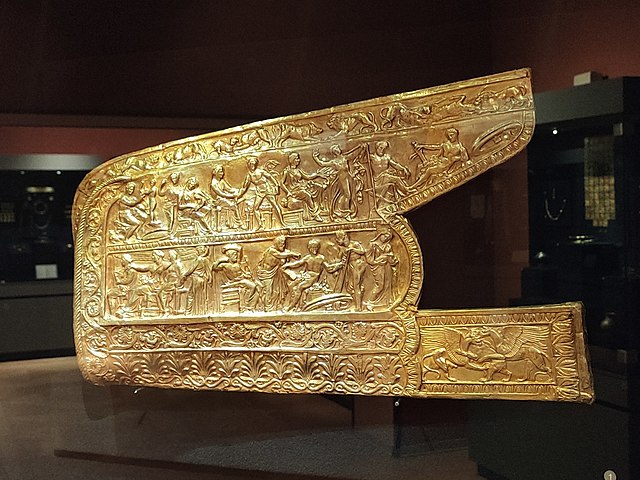
Here’s a beautiful work of art. This is a golden decorative panel from a gorytos, a combination quiver and bowcase that was used widely among ancient peoples of the steppes and the Iranian plateau. This example was found in Melitopol in southeastern Ukraine.

Gorytos, photograph by VoidWanderer via Wikimedia (found Melitopol, currently Kyiv; 4th c. BCE; gold)

Scythian artisans were expert metalworkers, and the Scythian elite valued high-quality metalwork, especially in gold, as emblems of status. This panel was made by Greek crafters serving the Scythian market. The central panel shows scenes from the life of Achilles, a Greek hero whose legends were sometimes associated with Scythia and whose warrior prowess was appealing to Scythian tastes. The outer panels feature decorative scenes of animals hunting, a popular motif in Scythian metalwork.

This piece is not just a beautiful work of art, it’s also an example of how art and artisans in antiquity crossed boundaries and bridged cultures.

Out There highlights intriguing art, places, phenomena, flora, and fauna.

Cha Cha Cha in English

This week Käärijä is represening Finland in the Eurovision Song Contest with Cha Cha Cha. Here’s his performance at the Uuden musiikin kilpailu (New Music Competition) where the song was chosen.

Käärijä – Cha Cha Cha | Finland | National Final Performance | Eurovision 2023 by Eurovision Song Contest via YouTube

Here’s a link to the Finnish lyrics. I’ve tried my hand at translating them into English in a way that fits the rhythm and rhymes of the song:

What a week it’s been, the days behind have just been crawling.

Pina coladas and the open road are now calling.

The night is young, so listen, it’s time to get plastered.

This frozen shell around me has got to get shattered.

Grab my drink with both hands and get loaded, I’m like

cha cha cha, cha cha, cha cha!

Blow off tomorrow, just go out and get totaled, I’m like

cha cha cha, cha cha, cha cha!

I wanna lose my mind, forget all my cares, I’m like

cha cha cha, cha cha, cha cha!

And I’ll keep going til I’m out of my chair, I’m like

A couple pina coladas are down already.

Still my face is like a mask, unmoving and steady.

The night is young, so listen, it’s time to get plastered.

This frozen shell around me has got to get shattered.

The floor is calling me, my inhibitions need numbing.

I’m like cha cha cha, watch out, I’m coming!

Grab my drink with both hands and get loaded, I’m like

cha cha cha, cha cha, cha cha!

Blow off tomorrow, just go out and get totaled, I’m like

cha cha cha, cha cha, cha cha!

I wanna lose my mind, forget all my cares, I’m like

cha cha cha, cha cha, cha cha!

And I’ll keep going til I’m out of my chair, I’m like, woah.

And now I’m dancing free,

I’m like cha cha cha,

and I’m not afraid of this world, you see,

I’m like cha cha cha,

when I pour champagne all over me.

Cha cha cha, and it’s getting hard to see,

and now I slur my speech when I hand the keys to this other me.

Cha cha cha, and you know that I’m not like this usually,

oh no, but I am today, but I am today.

And now I’m dancing free,

I’m like cha cha cha,

and I’m not afraid of this world, you see,

I’m like cha cha cha,

when I pour champagne all over me.

I’m like cha cha cha,

cha cha cha, cha cha, cha cha-ah-ah

I’m like cha cha cha,

cha cha cha, cha cha, cha cha,

cha cha cha, cha cha, cha cha.

Here’s hoping we’ll see Käärijä go all the way to the final!

Star Wars: A Personal Reflection

Star Wars Day is coming soon (May the Fourth be with you!), so I’ve been thinking about how I got into that universe. My route in was a bit odd.

I’m a little bit too young to have been caught up by the original movies. I wasn’t even born yet for the first one. I vaguely remember when The Empire Strikes Back was a thing. Return of the Jedi is the first movie trailer I can actually remember seeing on tv. Even if I had been old enough to go to the movies, though, I wouldn’t have gone to see Star Wars then. It just wasn’t a thing I was interested in.

That doesn’t mean I wasn’t aware of Star Wars. Star Wars merchandise was all over my childhood. Friends had Star Wars lunchboxes and t-shirts. I saw the posters and the toys. Before I was reading on my own, I could recognize Darth Vader and Yoda. Some of the neighborhood kids staged a recreation of a scene from Return of the Jedi. (As the youngest of the group, I was cast as an Ewok. I had no idea what that meant, but all it required me to to was run around and scream unintelligibly, which was about the limit of my acting ability at that age.)

Star Wars lunch box (not mine). Photograph by jeffisageek via Flickr under Creative Commons

When I did discover science fiction, it wasn’t Star Wars but old reruns of the original Star Trek that lit up my young brain. I was completely hooked on Star Trek and, with the stubborn, stupid loyalty of the very young, decided that there was only room in my life for one Star franchise. For years I scoffed at the Star Wars memorabilia around me and snootily dismissed anyone else’s interest in the movies.

I was nearly in junior high before I finally decided to give Star Wars a try. Oddly enough, though, my first experience of Star Wars was not with the movies themselves. In my school library I found a set of picture books that told the story of the original trilogy movies (the only movies there were at the time) illustrated with stills from the films. My memory of the books is hazy, but at a best guess they were The Star Wars Storybook, The Empire Strikes Back Storybook, and the Return of the Jedi Storybook. I decided to give them a shot.

To my surprise, I enjoyed them, enough to hop on my bike, ride over to the local video rental shop, and check out the movies themselves. It was a weird experience. In a sense, I felt like I had always known these stories. I certainly couldn’t remember a time when I hadn’t known that there were heroes named Luke and Leia who fought a villain in a black helmet while accompanied by a couple of shiny droids. Reading the books filled in the details of a story that already felt familiar. By the time I actually saw Star Wars on screen, I knew who the characters were and what was going to happen. Watching those movies for the first time already felt like revisiting old friends.

Weirdly, one thing that wasn’t spoiled for me until I read the books was the Skywalker family tree. I can still remember the shock of finding out that Darth Vader was Luke’s father and then that Leia was his sister. That may be hard to believe in today’s world of fan sites and social media, but I made it through more than a decade of knowing who those characters were without knowing how they were related. Somehow, in all the years of my childhood, I never heard any of my friends who were into Star Wars put on a deep voice and say “Luke, I am you father.”

Star Wars has a special place in modern pop culture because it is special. It is one of the few stories we all know, even if we’ve never seen it. Whether you love it or not, and however you may feel about the prequel and sequel trilogies or any of the vast outpouring of other media in the Star Wars universe, it’s a story that we all have our own stories about.

In Seen on Screen, we discuss movies and television shows of interest.

Are You Aware of National Velociraptor Awareness Day?

Were you aware that tomorrow—April 18—is National Velociraptor Awareness Day? I wasn’t, but now I am. So, consider today National “National Velociraptor Awareness Day” Awareness Day.

In case you were worried that we would not be taking this important holiday with the seriousness it deserves, let us put those fears to rest.

And that’s all we have to say on the subject.

Cartoon by Erik Jensen

Some things are just too silly not to share!

Visual Inspiration: Steller’s Sea Eagle

Here’s a bird of prey with a different look. The Steller’s sea eagle has white bands at the front of its wings, on its legs, and on its tail. It also has a short, thick yellow-orange beak.

Steller’s sea eagle at rest on ice, photograph by Michael Pinczlits via Wikimedia

The normal range of this eagle is along the coasts of northeast Asia from the arctic to Japan, but in recent years there have been sightings as far away as Texas and Nova Scotia.

Steller’s sea eagle hunting, photograph by Julie Edgley via Wikimedia

I’d love to see more birds like this in media, not just the usual suspects like the bald eagle and red-tailed hawk.

Visual Inspiration pulls the unusual from our world to inspire design, story-telling, and worldbuilding. If stuff like this already exists, what else could we imagine?