Stories in which Being Good is Smart

I’ve been thinking a bit lately about how to describe the kind of stories I want to experience, whether on the page or the screen. I’ve long known that I enjoy stories about characters solving problems. But that’s not the only thing I look for in fiction.

I enjoy reading about people who are good to one another, kind, compassionate, and generous. I don’t enjoy stories in which kindness is portrayed as weakness, or in which the most manipulative, cruel, or ruthless characters prosper at the expense of others. I want to see how being kind and treating others well is the best way to go about solving problems. I like stories in which being a good person isn’t just the right thing to do, it’s the smart thing to do.

I don’t mean stories with a moralistic bent, in which some outside force (be it divinity, fate, or just the author’s guiding hand) intervenes to reward virtue and punish vice. I don’t want to see good people win just because they are good. I want to see them win because complicated problems can’t be solved by one person acting alone, no matter how devious or ruthless they may be. Big problems only get solved by people working together, and the best way to get people working together is to treat them decently.

Here are a few my favorite stories on page and screen that fit what I’m looking for.

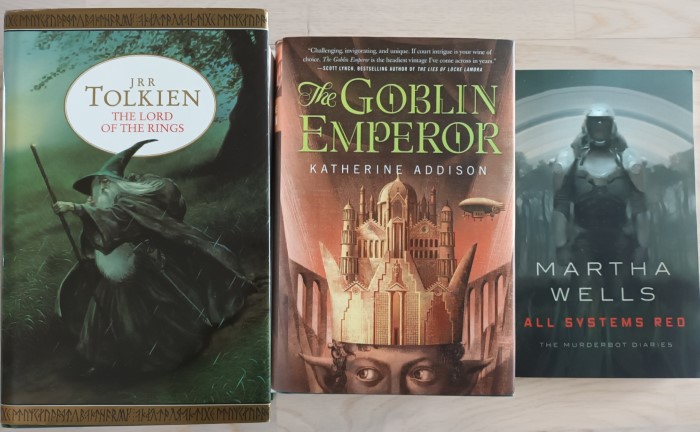
J. R. R. Tolkien’s The Lord of the Rings is a tale of cosmic good and evil, but one that plays out on the individual level. The forces of good ultimately triumph because many individual people, some of them quite small and unimportant, choose the good of others over their own safety or comfort. Katherine Addison’s The Goblin Emperor follows Maia, a neglected half-goblin prince, as he is thrust by circumstance onto the throne of an Elvish empire. Maia is surrounded by devious plotters and dangerous revolutionaries, but he keeps his throne and his head by listening to others, finding trustworthy allies, and being compassionate to the weak and vulnerable. In Martha Wells’s Murderbot Diaries series, the sarcastically self-named Murderbot is a human/machine construct designed by a ruthless ultra-capitalist corporation to fight and kill, but who would rather just be left alone to watch media. Over the course of the stories, it discovers humans who are not ruthless ultra-capitalists, whom it ends up learning to trust and value.

Star Trek is all about characters being good. Deep Space Nine pushes its characters to the limits of the universe’s hopeful utopianism through trauma and war, but ultimately finds them trusting one another, working together, and finding compassion even for their most implacable enemies. In Doctor Who, the wandering Time Lord stumbles into one disaster after another, but approaches them all with a spirit of hope and understanding, asking questions always and shooting never. Downton Abbey follows the inhabitants of the titular manor, both the family upstairs and the staff downstairs, through the tumultuous social changes of the early twentieth century. All the characters have their flaws, and some can be quite vicious, but the series follows how the characters come to rely on one another, and how even the most mercenary of them learn that kindness and compassion are vital for surviving in a changing world.

These are the kinds of stories I want more of: people being good or learning to be good, not just because it’s the right thing to do, but because it works.

Images by Erik Jensen

Archaeology and Intentionality

One of the themes that guides a lot of what I post here is that thinking historically is good practice for thinking fictionally. As an example of what I mean by that, let me present the question of intentionality in archaeology.

Much of what we know about ancient cultures comes from archaeology. For all that we can learn from texts, there are many things, peoples, and experiences that were either never written about, or for which the texts have been lost. Individual artifacts can be interesting in their own right, but we often get the most valuable insights from studying objects found together as a group. When we examine groups of artifacts, though, it is essential to begin by asking questions about intentionality: were these objects intentionally grouped together by the people who used them, and was that group of objects intentionally placed where it was discovered? How we answer those initial questions determines a great deal about what further questions we can ask.

When thinking about groups of artifacts, there are two important terms to start with: assemblage and deposition. In archaeology an assemblage is a group of objects found together in the same place. Deposition is the process, whether through human or natural action, by which those objects came to rest in that place. Questions of intentionality are important for how we analyze both assemblages of artifacts and the processes of deposition that left them for us to find.

Assemblages can be either intentional or unintentional. Sometimes we find groups of objects that were purposefully grouped together by the people who used them. In other cases, the objects in an assemblage are not connected except by happenstance. Similarly, some acts of deposition were intentional, while others were not. Recognizing the differences between intentional and unintentional assemblages and depositions is crucial for asking the right questions about the things we find.

For example, the objects placed in a grave were purposefully chosen by the family and friends of the deceased and intentionally deposited. We can pose questions about why these objects were chosen for this person, what it meant for the people who gave them to see them buried, and what the whole assemblage conveys about the person they were deposited with.

The goods we find on a shipwreck, on the other hand, were deliberately chosen, and share an important facet of their history, but they were not intended to end up where we find them. We can pose useful questions about how and why the people who laded this ship choose this particular set of cargo and equipment for their voyage, much as we can ask questions about why mourners chose particular objects to go into a grave. On the other hand, we also have to keep in mind that the ship’s crew expected it to reach port safely, not go down and leave its cargo on the bottom of the sea. If we want to understand the objects found on the ship, we have to consider their intended destinations once they were offloaded from the ship, which were probably numerous and varied.

We also find assemblages of objects that were not intentionally put together by the people who lived with them, some deliberated deposited and some not. The objects we find in an ancient settlement’s rubbish heaps were deliberately disposed of, but not purposefully chosen to go together as a set. Such finds are useful for understanding how the people of that settlement used and disposed of their material goods, but we have to be careful not to assume that the things we find in such a deposit were used by the same people, in the same households, or even within the same timeframe. In fact, looking at what kinds of goods people discarded and how they changed over time can tell us a lot about the life of the place they were found in.

The debris we find in the silt of a disused drainage ditch, by contrast, was neither purposefully assembled nor deliberately deposited. Such finds are useful in examining what kinds of objects were casually lost in a particular place that were too insignificant to their owners to be worth the effort of searching for or retrieving, which in turn tells us about the economic life and material culture of the settlement.

The important thread that unites all of these possibilities is that they require us to think about the people of the past as people, individuals who made choices about what to do with the things around them, just as we do. The habits of thought we apply to archaeology and history are ones that also serve us well when writing fiction: just as we have to think about people in the past as people, we have to think about our characters as people with intentions and desires, too. In a work of fiction, everything is intentional from the author’s point of view, but not everything is intentional from the characters’ point of view. Thinking about what choices characters make, and when they are making a choice at all, is a helpful habit to have.

Image: Dishes from the Helmsdale Hoard, photograph by Erik Jensen (found Helmsdale, Scotland; currently National Museum of Scotland, Edinburgh; 200-400 CE; bronze)

Role-Playing Around the Campfire

In table-top role-playing, there are opportunities everywhere to let players role-play their characters and build the narrative of the group. Even the humble act of camping for the night in the wilderness can be rich with openings for some character work. Some players will seize these opportunities for themselves, but sometimes it helps to have the DM nudge the character-building along.

Stopping to camp for the night is usually downtime to be passed over quickly. If wilderness survival is an important part of your campaign, maybe you have everyone scratch a batch of rations off their inventory. The party decides who’s going to keep watch and in what order. You might have some nighttime encounters planned for them, but soon enough it’s time to refresh everyone’s daily powers, heal some hit points, and carry on with the next day’s adventure. But it can also be a low-stakes chance for players to think about and play with their characters, both as individuals and as a party.

If your players don’t naturally take the initiative to role-play, here are some ways you can encourage them.

Set the scene

Filling in the details of the world gives your players something to react to, and that’s equally true if it’s an angry dragon in a crumbling old stone tower or a patch of berry bushes by the side of a little woodland stream. When your party decides to stop for the night, take a moment to fill in the scene around them. Draw in as many sensory details as you can:

“You find a good spot to camp in a small clearing amidst old pine trees. The ground is covered in dry, rust-colored fallen needles that crunch under your feet. The roots of the trees spread across the clearing, making little pockets that each of you can curl up into. At the edge of the woods, you spot some buckberry bushes. You hear small nocturnal critters rustling in the underbrush in the woods, unbothered by big folks like you passing through. The smell of pine pitch is in the air, a sharp topnote over the earthy, mossy scent of the forest underneath. The rays of the setting sun fade from golden to red to purple as you settle in.”

You can encourage players to help fill in scene themselves, if you like. See if anyone wants to check out the area before settling in, and invite them to describe what they would like to find—within reason. Unexpected chests of gold hidden under leaves are probably out of the question (depending on what your campaign is like), but if the druid would like to turn up some edible mushrooms, or the ranger wants to hunt some small game, or the rogue would like to climb a tree and find a comfortable perch in the branches, those can be good things to add to the scene.

A simple but useful way to both build the scene and encourage some role-play is to ask every player: “Your character finds something at this campsite, something perfectly ordinary and normal to find in this environment, but that makes them happy. What do you find?”

Prompt some action

You don’t have to gloss over the business of setting up camp. Ask each player what they’re doing to help make camp for the night. Or maybe prompt them by asking: “Who’s going to make the campfire? Who’s making dinner, and what are you making? Who’s setting up the tents? Who’s fetching water? Who’s taking care of the horses? Everyone tell us how your task goes.”

It can be good to tie the small actions of making camp to the bigger actions of the adventures before. Was there a big fight? Maybe the barbarian is really starting to stink of old sweat and needs a wash. Did the wizard cast a big spell? Maybe channeling all that magical energy was rough on their robes and they need to do a little patching. Was there a lot of riding, hiking, or climbing? Everyone’s sore, someone is getting blisters on their feet or has cuts on their hands from scrambling over rocks—not the sort of thing that costs hit point or needs proper healing, but something to take care of once there’s a chance to sit down.

Ask some backstory questions

The downtime between adventuring days is a good opportunity to give everybody a chance to reflect on their character’s personality and backstory. You can help this along with a few leading questions, like:

  • “As you chew on your trail rations, you daydream about the best meal you ever had. What does your character wish they were eating right now?”
  • “You’ve settled in, and you’ve got time to kill. What’s a funny story your character could tell the group that they haven’t shared before?”
  • “What do you do to entertain yourselves and each other while waiting for sleep?”
  • “Darkness is falling, and you know you need sleep to face the dangers ahead, but what’s keeping your character awake? What are you afraid of or worrying about?”
  • “You fall asleep dreaming about what you’re going to do with your share of the treasure once this quest is over. What comes into your minds?”

Add some complications or events

Even if no big threats are coming the party’s way tonight, little things can still go wrong. You can throw one or two minor annoyances at the party and see how they react. Try something like:

  • The ground is wet from rain and it’s hard to get a fire going.
  • The underbrush is dry and parched, and your fire gets out of control and starts to burn some nearby bushes.
  • The water available nearby is mucky and foul-smelling. It’s safe to drink and wash with, but not pleasant.
  • A small critter is attracted by the smell of your food and tries to get into one character’s pack.
  • A large browsing herbivore comes wandering through your camp in the night, doing no harm but knocking over tents and scattering campfire ashes.
  • A pack of local carnivores goes rushing by in the night chasing some prey. One of them stops and sniffs around the camp, but doesn’t attack.
  • A thunderstorm develops in the night and drenches the party in cold rain.

On the other hand, characters can have interesting reactions to things that are good or neutral. Maybe give them something nice to respond to, like:

  • Even a cursory search around the campsite turns up enough wholesome mushrooms, sweet berries, edible roots, and other wild foods to make a tasty and filling meal for everyone.
  • A curious local critter comes upon your camp and investigates with some amusing but harmless antics like sniffing everyone’s food or hopping up on one character’s shoulder.
  • Strains of haunting music echo faintly through the wilderness. If the party goes looking for the source, it disappears.
  • Ribbons of beautiful aurora light dance in the starlit sky.
  • A thunderstorm passes by the night nearby but not over the party. Peals of thunder shake the air and flashes of light illuminate the night, but no harm comes to the encamped characters.
  • An ethereal spirit appears out of the darkness and comes to the edge of the firelight. After observing the party for a moment, it makes a simple gesture of blessing and vanishes.

You can set these events in motion as soon as the party makes camp, or you can let them play out over the course of the night. A couple of touches like this can help make even an ordinary night in camp memorable.

You may not want to role-play every nighttime camp in as much detail as this. It’s a bit of interstitial downtime to give players a chance to flesh out their characters in between battles and quests, but it can get tiring if you do it all the time.

Also, if you have a particularly threat-wary party (or if you have a habit of interrupting their downtime with danger), it might be a good idea to let everyone know up front that this is a role-playing opportunity, and it’s safe to let their guard down a bit. Otherwise everyone might just spend their time role-playing being very on edge and waiting for the next fight.

Enjoy your next camping scene!

Image: Campfire in NB by Martin Cathrae on Flickr (CC BY-SA 2.0)

A Name for an Amazon

Amazons, the bold warrior women who figure in Greek myths, are imaginary, but the myths about them likely had their origin in Greek experiences with actual fighting women in the cultures around the shores of the Black Sea. Ethnographic and archaeological evidence shows that women who trained with weapons and fought in battle were known in many of the cultures in the region, and the association of mythic Greek Amazons with horses and bows also matches the realities of life on the Black Sea steppes.

Greek literature and art records numerous Amazon names. Most of these names are Greek, and they are descriptive of relevant Amazon traits, such as Hippolyta (“She who sets the horses loose”), Melanippe (“Black horse”) or Antiope (“She who confronts”). These names may have been simply invented by Greek writers in the same way that fantasy authors today concoct suitable names for their characters. There is evidence, however, that some of the Amazon names recorded in Greek art might be actual names from languages spoken around the Black Sea.


Greek vase fragment via the J. Paul Getty Museum (made Athens, currently Getty Museum, Malibu; c. 510 BCE; glazed pottery; painted by Oltos)

This Greek pottery fragment shows Amazons riding into battle against the Greek hero Heracles (who appears accompanied by the god Hermes on the other side of the cup). We can recognize the riders as Amazons from their clothing and the bowcases they carry. Text in Greek letters surrounds them, although it is painted in a dark color that is difficult to see. Most of the text is fragmentary and hard to reconstruct, but one word seems to be a complete name. The text PKPUPES can be read by the head of the leftmost rider, evidently her name.

“Pkpupes,” at first glance, may look like mere gibberish. It certainly isn’t Greek. Many scholars in the past dismissed this and similar texts as nonsense words written by semi-literate vase painters. Maybe “pkupupes” was just an attempt at an onomatopoeic for the pounding of a horse’s hooves. It may, however, be something more significant.

Dense clusters of hard consonants like “pkp” are a common feature of languages spoken today in the Caucasus Mountains east of the Black Sea. “Pkpupes” is, in fact, fairly easy to read as an attempt to render a name in Circassian, a cluster of closely related languages of the northwestern Caucasus, with the letters of ancient Greek, which did not perfectly match up to the sounds of the original language. English doesn’t have all the right letters to easily represent the sounds of Circassian either, but a reconstructed Circassian name that would be rendered in English something like “Pqp’upush” is perfectly intelligible. This name is composed of several elements, the first referring to the body, the next to covering, and the final one connoting worthiness. Altogether, the name would mean “Worthy to wear armor,” a suitable name for a warrior woman.

Greeks had extensive contact with peoples around the Black Sea. Many Greeks migrated to the region, and people from the area also settled in Greece. The painter of this vase signed his name “Oltos,” which is not a typical Greek name, and he may have been an immigrant himself. He and other ancient vase painters may well have known people who spoke foreign languages or had ancestors from the Black Sea region who could recommend appropriately authentic names for Amazon characters. It may even be that some of the obviously Greek Amazon names like Hippolyta or Antiope were not invented by Greeks but are Greek translations of authentic names, in the same way that the names of many indigenous Americans in recent history have been translated into English, like Sitting Bull or Red Cloud.

The Amazons of Greek myth remain mythical, but we have evidence for some history behind that myth, maybe even the names of some real warrior women from the edges of the world known to the Greeks.

Source

Adrienne Mayor, John Colarusso, and David Saunders, “Making Sense of Nonsense Inscriptions Associated with Amazons and Scythians on Athenian Vases,” Hesperia 83, no. 3 (July-September 2014): 447-93.

An Autumnal Druid Transmog

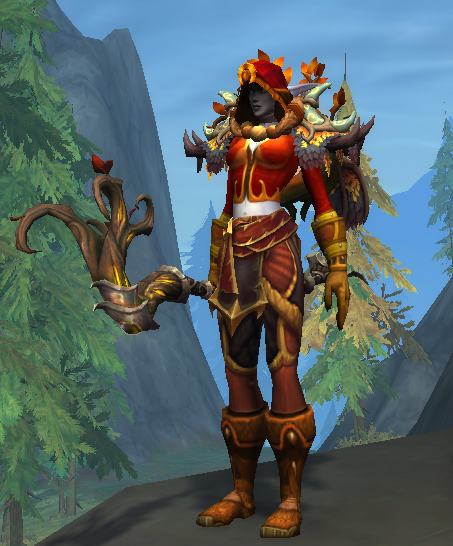
The beginning of autumn is upon us. Trees are putting on their fall colors as the days grow shorter and the night chill begins to bite. What’s a druid to do but put together an autumn-themed transmog? This includes a few of the beautiful woodsy leafy pieces from the Emerald Dream zone mixed with some other gear.

Here’s a link to the pieces in the set.

Image: World of Warcraft screencap

Quotes: Innumerable Shapes of Letters

There’s an old law of probability often phrased that if an infinite number of monkeys sat at an infinite number of typewriters pressing random keys for an infinite amount of time, they would at some point type out Shakespeare’s Hamlet. The point is that, given a large enough scope of opportunity, things that are very unlikely but not impossible can and do happen.

One of the earliest known expressions of this idea comes from the Roman statesman and philosopher Cicero, although Cicero takes the negative view. He poses the idea as a thought experiment to reject materialist philosophies, like Epicureanism, which held that the world was not created by the gods but was the product of random collisions of matter:

How can anyone look on these things yet convince themselves that certain solid and discrete bodies are carried by force and gravity, and the beautiful and exquisite world is made by the fortuitous arrangement of these bodies? If someone thinks this is possible, I don’t see why they shouldn’t also think that innumerable shapes of the twenty-one letters, made out of gold or whatever material, could be tossed down on the ground so that one could read the words of Ennius’ Annals in them. For myself, I doubt that chance could make a single verse out of them.

Cicero, On the Nature of the Gods 2.93

(My translation)

As unlikely as it is that just tossing letters down on the ground once will yield any comprehensible lines from Ennius’ early Roman historical epic, the infinite monkey theory tells us that if we threw an infinite number of letters an infinite number of times, some verses of Ennius would eventually emerge, not to mention lines from Cicero himself, or any other text that could be written in the Latin alphabet.

One might say that Cicero’s mistake was an insufficiency of monkeys.

The Amazing Colors of an Ancient Perfume Bottle

So much of what survives of ancient art has lost the colors it originally held—statues have lost their paint, pigments have faded, textiles have weathered. One of the few materials that holds its color well over time is glass. Just look at this ancient Greek glass perfume bottle and see!

This type of bottle, called an alabastron, was used to store small quantities of valuable liquids like perfumed oil. Like this one, they typically had pointed or rounded bottoms and were kept in wooden or metal stands or hung from loops. The bright colors of this bottle are made from layers of colored glass and gold, bent around one another and blown into shape.

The swirling colors of this bottle almost make me think of 1960s psychedelia. It can be startling to find an ancient object that has kept its color and be reminded that it was created and used in a world that was equally colorful.

Image: Alabastron via Metropolitan Museum of Art (found Greece, currently Metropolitan Museum, New York; 1st c. BCE; glass)

Cults and the Cult of Bacchus

Cults are a staple of modern fantasy. When you need a shadowy organization for your hero to go up against, whether they’re protecting an ancient secret or scheming to bring about the end of days, you can’t go wrong with a cult.

There are plenty of modern examples of secretive organizations that draw in forlorn or gullible people and condition them to submit to the will of charismatic leaders. Such organizations can serve as models for imagining fictional cults, but if you want to write a cult in a fantasy setting, it can be helpful to look at ancient examples. One of the oldest documented examples of a secretive religious organization in conflict with larger society is the ancient Roman cult of Bacchus.

The cult of Bacchus emerged in southern and central Italy in the late third century BCE. It was centered on the worship of the god Bacchus, a version of the Greek Dionysus associated with wine, fertility, and ecstatic release. The Italian Bacchus also borrowed some traits from the Roman god Liber, connected with grapevines, wine, fertility, and freedom. The worship of Dionysus, Bacchus, and Liber was well established as part of the state religion of the Roman republic, which by this time had solidified its control over the whole of the Italian peninsula. The cult of Bacchus was a new religious movement that drew on older traditions but offered its followers new ways of celebrating them.

Followers of this movement practiced their worship in secret, not as part of the state-sanctioned public religion. Only initiated members of the cult were allowed to join in. Unlike traditional Roman religious celebrations, which maintained distinctions between social classes and had separate roles for men and women, initiates of Bacchus included people of all genders and classes who mixed together indiscriminately in their rites. Celebrations were raucous nighttime affairs that featured feasting, drinking, music, and dance.

The Roman elite was scandalized by the popularity of this religious movement. All the surviving sources describing its activity come from this hostile perspective and include lurid suggestions that the Bacchic revelers were practicing magic, engaging in wild sexual frenzies, and scheming at poisonings and other nefarious deeds. Despite these unfavorable sources, there is no reason to think that the cult of Bacchus was actually so outrageous. Seen in the context of the time, we may actually find the cult appearing in a much more favorable light.

To understand the cult of Bacchus, we need to set aside both the hostile attitude of the Roman elite and many of our modern associations with the term cult. While we associate the term today with secretive, manipulative organizations, cult, in its historic use, refers simply to the set of practices that are appropriate to the worship of a particular god or divine entity. All ancient gods received cult from their worshipers, from the official ceremonies for gods of the state to the everyday rituals that attended family and household spirits. Although the cult of Bacchus carried out its rituals in private, there is no indication that the organization was manipulative or coercive, or that members were isolated from the rest of society. In fact, in many ways, the cult offered a positive experience for its members.

Italy in the late third century BCE was recovering from the devastation of the second Punic War. From 218 to 204 BCE, the Carthaginian army led by Hannibal operated largely unchecked in Italy. The effects of war were far-reaching. Many young people from Rome’s Italian subjects were called up to fight in Rome’s legions, some never coming home again. Roman and Carthaginian armies alike ravaged farms up and down the peninsula. In the aftermath of the war, many small farms faced ruin, and a lot of Italian families had little choice but to sell their land to the aristocratic elite at whatever price they could get and move into cities like Rome looking for any work they could find to scrape together a living. Italy in the late third and early second centuries BCE had a vast population of poor people barely getting by, dislocated by war and poverty from their ancestral homes, and resentful of the elite who had come out of the war riding high on plunder and foreign slaves.

The cult of Bacchus offered relief from the pressures of life—if not a hope for a better world, at least a temporary distraction from the troubles of this one. It helped people who had been displaced from deeply rooted ties of family and community find new connections outside the limitations of gender and class. For people who had little joy in their lives and faced a hard daily grind just to eat, the appeal of a celebration full of food, music, and dance was strong. It’s not hard to understand why the cult gained a following in post-war Italy.

It’s also not that hard to see why the Roman aristocracy reacted with such alarm and hostility. The Second Punic War had hit Rome hard. Even though the Romans emerged victorious over Carthage in the end, a generation of potential recruits for Rome’s armies was killed or wounded in the fighting. Rome’s resources were stretched to the limit. What’s more, the war exposed weaknesses in Rome’s hold on Italy. Hannibal’s strategy was to deny Rome resources and fighting power by helping its subjects in Italy rebel. Not all of Italy took Hannibal up on his offer, but enough cities did, especially the Greek cities of southern Italy, to make the Roman elite nervous about their ability to maintain control of the peninsula. Since the cult of Bacchus particularly appealed to the southern Italian Greeks, it doesn’t take much to see why the Roman aristocracy in the years after the war saw disaffected poor Italians gathering together in secret and challenging established social lines as a dangerous thing that needed to be stamped out. The Roman state aggressively suppressed the cult of Bacchus, the first documented example in Western history of a religious movement persecuted by the state.

The cult of Bacchus may not fit the mold of the classic sinister fantasy cult, but understanding the context in which it arose and the forces which drew people to it can help with the worldbuilding for a story in which a cult may not be so benign. Desperate times drive people to find community, relief, and happiness in whatever ways they can. The cult of Bacchus was in reality a benevolent organization that provided much-needed fellowship, but unscrupulous people and organizations can take advantage of the same needs for darker ends.

Image: A scene of Bacchic revelry from a Roman sarcophagus, photograph by Wolfgang Sauber via Wikimedia (currently Anatalya Archaeological Museum; 2nd c. CE; marble)

Quotes: I Didn’t Want to See Helpless Humans

Murderbot, the sardonic human-machine construct Security Unit who was designed to fight and kill but would rather just watch media, reflects on what makes a good story:

The latest show I was watching had started out good but turned annoying. It was about a pre-terraform survey (on a planet with completely the wrong profile for terraforming anyway, but I didn’t care about that part) that turned into a battle for survival against hostile fauna and mutant raiders. But the humans were too helpless to make it interesting and they were all getting killed. I could tell it was heading toward a depressing ending, and I just wasn’t in the mood. […] I didn’t want to see helpless humans. I’d rather see smart ones rescuing each other.

Murderbot, in Rogue Protocol

Me too, Murderbot. Me too.

Wells, Martha. Rogue Protocol. New York: Tom Doherty Associates, 2018, pp. 22-23.

A Homebrew Alchemy System for Dungeons & Dragons

In one of the Dungeons & Dragons games I DM for, there is a player who is very into the idea of gathering herbs and brewing magic potions. The base game as written doesn’t have much in the way of rules for alchemy, so we’ve just been winging it for the better part of a year. That worked, but it wasn’t as satisfying as either of us would like, so I finally sat down and brewed up a set of rules for herb-gathering and alchemy. Here’s what we’re playing with now. Feel free to use this or adapt it, if it seems like it might be a fun addition to your own games.

Alchemy

An alchemical system for Dungeons & Dragons, 5th edition.

Harvesting herbs

To collect herbs, you must be in an environment where wild plants grow. The DM will determine whether there is anything available for you to gather. Specific environments may give you advantage or disadvantage to your roll, at the DM’s discretion. Gathering herbs takes an hour.

Roll a Nature check to see whether you successfully collect herbs and how much. If you have an Herbalism kit and the proficiency to use it, you may add your proficiency bonus to the roll

Once you have harvested an area, whether you successfully gathered herbs there or not, the plants need a month to regrow before you can harvest the same area again (unless they are affected by magic that causes plant growth).

Nature checkHerbs collected
Less than 11None
11 – 151 batch
16 – 202 batches
21 – 253 batches
26 or more4 batches

For each batch of herbs you collect, roll 1d6 to determine what type of herbs you find. (You can also choose to target a specific kind of herbs when you harvest. If you do, you make your harvesting roll at disadvantage, but all herbs you collect are of the kind you want.) Keep track of how many batches of herbs you have of each type.

1d6 rollHerb type
1bark
2berries
3fungi
4leaves
5roots
6seeds

Making potions

To make potions, you must have enough herbs of the right types (1 batch of each type listed on the table below, unless the chart calls for more). Some potions require special ingredients, to be determined by the DM. Each brewing attempt consumes the given amount of herbs and takes one hour.

Roll an Arcana check to attempt to make each potion. If you have proficiency with Alchemist’s supplies, you may add your proficiency bonus to the roll. If you do not have alchemical equipment, you have disadvantage on the check. Whether the check succeeds or fails, the herbs are consumed. The DC for the check depends on the rarity of the potion you are trying to make:

Potion rarityArcana DC
Common10
Uncommon15
Rare20
Very rare25
Legendary30
  • If you succeed on your Arcana check by 4 or less, you make 1 potion of the chosen type.
  • If you succeed on your Arcana check by 5 to 9, you make 1d4 potions of the chosen type.
  • If you succeed on your Arcana check by 10 or more, you make 1d6 potions of the chosen type.

(A DM might also allow a Medicine check in place of an Arcana check, or let proficiency with a Poisoner’s kit apply to the roll, depending on what kind of potions the character is brewing.)

PotionRarityHerbs required
AntitoxinCommonBark, berries, seeds
Oil of EtherealnessRareBark, leaves x3, roots
Oil of SharpnessVery rareFungi x4, leaves x2, roots x2
Oil of SlipperinessUncommonBark, leaves, roots, seeds
Philter of LoveUncommonBerries, fungi, leaves, roots
Potion of Animal FriendshipUncommonBerries, leaves, roots, seeds
Potion of ClairvoyanceRareFungi, leaves x2, roots x2
Potion of ClimbingCommonBark, leaves, roots
Potion of DiminutionRareFungi, leaves x3, roots
Potion of FlyingVery rareBark x2, leaves x4, roots x2
Potion of Gaseous FormRareBark, leaves 2x, roots, seeds
Potion of Giant Strength (Hill)UncommonBark, leaves 2x, roots
Potion of Giant Strength (Stone/Frost)RareBark 2x, leaves 2x, roots
Potion of Giant Strength (Fire)RareBark 2x, leaves 2x, roots
Potion of Giant Strength (Cloud)Very rareBark 3x, leaves 3x, roots
Potion of Giant Strength (Storm)LegendaryBark 4x, leaves 4x, roots, special
Potion of GrowthUncommonBark, leaves 2x, seeds
Potion of HealingCommonBerries, leaves, seeds
Potion of Greater HealingUncommonBerries 2x, leaves, seeds
Potion of Superior HealingRareBerries 2x, leaves, seeds 2x
Potion of Supreme HealingVery rareBerries 3x, leaves 2x, seeds 2x
Potion of HeroismRareBark, berries, leaves, roots, seeds
Potion of InvisibilityVery rareLeaves 3x, roots 2x, seeds
Potion of InvulnerabilityRareBark 2x, leaves, roots, seeds
Potion of Mind ReadingRareFungi, leaves, roots 2x, seeds
Potion of PoisonUncommonFungi 2x, roots, seeds
Potion of ResistanceUncommonBark, berries, roots, seeds
Potion of SpeedVery rareFungi 2x, leaves 2x, roots 2x
Potion of Water BreathingUncommonBark, berries, leaves, roots
Restorative OintmentUncommonBark, berries, seeds 2x
Sovereign GlueLegendaryBark 2x, fungi, leaves 2x, roots 4x, special
Universal SolventLegendaryBerries, fungi 3x, leaves, seeds 2x, roots 2x, special

The table above includes only items listed in the Systems Reference Document released by Wizards of the Coast under Creative Commons. If you want to expand this table to include other potions and items, you can apply the following principles:

Determine how many ingredients the potion requires. The number of ingredients depends on the rarity of the potion.

RarityIngredients
Common3
Uncommon4
Rare5
Very rare6 – 7
Legendary9 plus a special ingredient

Determine which ingredients are needed. The table below gives some general suggestions, but feel free to choose whichever ones feel right for the potion in question.

IngredientFunction
barkprotection, endurance
berrieshealing, strength
fungiharm, power
leavestransformation, deception
rootscreation, discovery
seedsrestoration, growth

Images: Algorithmically generated images made with Night Cafe: alchemist’s workshop, forest, potion bottle