“[T]he Pima of Central Arizona have historically embedded in their landscape the stories, histories, and lessons of their way of life and culture. Thus, the Pima, when they wish to remind someone of their past, or of a lesson they would like that person to remember, make what seem to white people abstract references to locations on their territory, such as ‘Trail Goes Down between Two Hills.’ The target of their comments, however, will know what they mean.”
– Matthew Barlow, Griffintown: Memory and Identity in an Irish Diaspora Neighbourhood, 11
Historian Matthew Barlow here cites the work of anthropologist Keith Basso on how memory can be embedded in a landscape to explain how the Irish-Catholic population of Montreal imbued the working-class neighborhood of Griffintown with meanings important to their identity as Irish-Canadians, such that even after the neighborhood was redeveloped, Irish-Montrealers could invoke generations worth of memories by reference to churches, pubs, streets, and other landmarks.
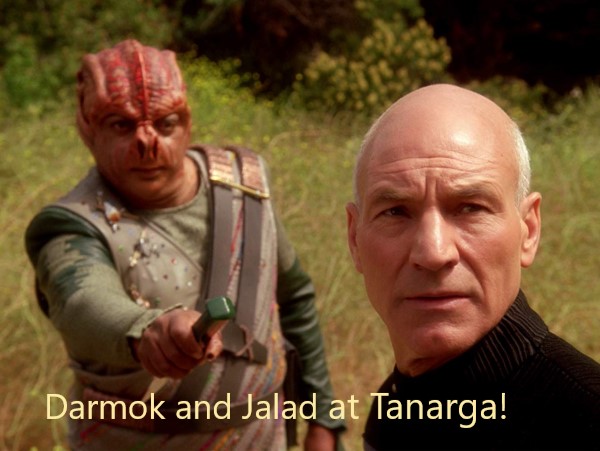
It’s a fascinating way of thinking about how we relate the landscape we live in, but, of course, the first thing I thought of was:
Image: Still from Star Trek: The Next Generation episode “Darmok” via IMDb, text added by Erik Jensen
Serving exactly what it sounds like, the Quotes feature excerpts other people’s thoughts.
The great mystery novelist P. D. James has noted that Jane Austen’s novel Emma has all the essential elements of a mystery novel: the plot revolves around secrets which are revealed at the climax but to which the heroine and the readers have been given clues all along. I think we can extend that idea further and say that most of Austen’s novels are, in spirit, mysteries.
The plots of most of Austen’s completed novels are about heroines becoming wiser about themselves and the world, usually by discovering things that make them reevaluate the people around them. Elizabeth Bennet discovers that Wickham is a scoundrel and Mr. Darcy has an honorable soul under his proud manner. Marianne Dashwood discovers that Willoughby is a scoundrel and her sister Elinor has feelings as deep as her own. Catherine Morland discovers that Northanger Abbey is not a Gothic haunted house. Other discoveries and reevaluations made by the heroines and other characters also propel the plots along. Darcy learns that Jane Bennet was actually in love with Bingley all along. John Thorpe learns that Catherine was not in line for a fortune after all. Anne Elliot learns that William Elliot is responsible for her friend’s financial difficulties.
Austen also leaves some clues hidden in plain sight, unremarked upon in the novels but waiting for the clever reader to put together for themselves. Why is Mr. Darcy in such an ill humor when Lizzie first meets him at the Meryton ball? Austen never lays it out for us, but once you know his history it becomes clear that only a few months have passed since his beloved younger sister Georgiana nearly eloped with the scheming Mr. Wickham. Of course the sight of young women his sister’s age freely dancing with men they have barely met puts him in a sullen mood, and it is this mood rather than his natural character on which Lizzie first judges him.
Austen’s great literary innovation, the “free indirect style” in which the narrator stands apart from the point of view character but reflects their judgments and perceptions in the narration, represents a careful balance between objectivity and subjectivity that is important in mystery writing. The job of a mystery author working in the classic style is to present the reader with all the necessary facts to resolve the mystery themselves, but to obscure those facts in such a way that the reader does not get ahead of the detective in working out what happened. Austen’s free indirect style achieves precisely this goal, letting the readers in on what is going on in the world around her characters but coloring the facts with the main characters’ own perceptions and biases.
Austen framed her social satires and ethical critiques in the genre of romantic novels since those were popular in her day. I sometimes wonder, if she were alive and writing today, would she have chosen to write mysteries instead?
Image: Portrait of Jane Austen via Wikimedia (National Portrait Gallery, London; c. 1810; pencil and watercolor; by Cassandra Austen)
Story Time is an occasional feature all about stories and story-telling. Whether it’s on the page or on the screen, this is about how stories work and what makes us love the ones we love.
The hoplite was the definitive soldier of ancient Greece. Hoplites are interesting not just for how they fought but for the social conditions that created them and the consequences that the hoplite style of warfare had for ancient Greek society.
A hoplite was a heavily-armored infantry soldier equipped with a large, round shield and a thrusting spear a little over two meters in length. While the shield and spear were the two crucial pieces of equipment, most hoplites also wore heavy armor including a helmet, breastplate, and greaves (armor for the shins). Altogether this armor weighed as much as 30 kilograms. Weighed down by so much equipment, hoplites were slow-moving and not adept at maneuvering. A lone hoplite was easy prey for a more mobile skirmisher or cavalry soldier. Hoplites were only effective when fighting as a group.
Hoplites fought in a tightly-packed formation called a phalanx. Their equipment was designed to be most effective in this formation: the center of the large round shield rested at the elbow, meaning that only half of a hoplite’s shield was protecting their body. The other half of the shield protected the soldier standing to their left, while they were sheltered by the shield of the soldier to their right.
The phalanx formation was designed first and foremost to offer as much protection as possible to the soldiers fighting in it. As long as the phalanx kept its order, casualties were low. When phalanges fought, they clashed head-on in a massive shoving match that was usually quickly resolved when one side lost its nerve, broke formation, and fled. Fleeing hoplites typically dropped their heavy shields to get away faster, but once one phalanx started to flee, the soldiers of the opposing phalanx were ill-equipped to give chase. The goal of a hoplite battle was to drive the enemy from the field, not kill them.
In order to fight effectively, hoplites needed several things in addition to their equipment. First of all, they needed lots of training. Maintaining the phalanx formation while advancing into the fray and clashing with opposing forces was difficult. Even more important, it required cohesion among the individual hoplites. A formation that depended on every individual in it standing firm and protecting those around them could only work when those in it felt they could trust and rely on their fellow soldiers. That kind of unit cohesion could be created in several ways. Spartans created it through a brutal indoctrination into a culture of conformity. Companies of mercenary hoplites created it through shared experience in the field. But in most Greek cities, the solidarity of hoplite warfare was intertwined with democracy.
Hoplites appear quite suddenly in Greek history around 650 BCE, so suddenly that they seem to have been a deliberate innovation rather than a gradual development out of earlier traditions. There were other dramatic changes happening in Greek society at the time. For centuries, Greek society had been dominated by aristocratic families who monopolized both control of farmland and political power, but the growth of overseas trade undermined their authority. Some ordinary people began to get rich off of trade with the larger Mediterranean world and to demand more of a say in how things were run.
In many places, aristocrats who were on the outs took advantage of popular discontent to put themselves forward as sole leaders who could keep the other aristocrats in check and represent the interests of the common people. The Greeks called these rulers tyrants, a word that did not originally have the negative connotations it carries today. These tyrants organized the people into a political force that could overwhelm the old aristocracies, and it seems likely they were also responsible for organizing them into a military force for the same purpose. The old aristocrats had relied on followings of professional warriors to compete with one another and protect their power. The hoplite phalanx was made up not of professional soldiers but farmers, crafters, merchants, and other ordinary folks who paid for their own armor and took time away from their livelihoods to train together. Their cohesion and solidarity overwhelmed the aristocrats’ paid fighters.
The tyrants, backed by their hoplite forces, enjoyed a brief ascendancy, but most soon revealed themselves as little more than ambitious opportunists who had little real commitment to making life better for their supporters. The ordinary people turned against them. The experience of solidarity in common cause that had been instilled by the hoplite style of fighting became the core of a new way of organizing society, and after ousting their tyrants most Greek cities embraced forms of government that allowed for broad citizen participation. It is significant though that Greek democracy was always centered on the hoplite phalanx. People who did not have a role in the phalanx—women, the poor, slaves, resident foreigners—rarely had any role to play in Greek democracy.
Thoughts for writers
Human societies are complex systems. Their various parts interlock and affect one another. The ways in which people fight are shaped by the societies they live in, and shape them in turn. If your story has characters fighting in a particular way, you should construct your world to reflect the origins of that fighting style and its consequences. It is possible to have a hoplite phalanx without democracy (Sparta), and it is possible to have a democracy without a hoplite phalanx (medieval Iceland), but understanding how each one supported the rise of the other in ancient Greece will help you construct fuller and more believable alternatives.
Image: Chigi Vase, reconstructed frieze via Wikimedia (7th c. BCE; painted pottery)
History for Writers is a weekly feature which looks at how history can be a fiction writer’s most useful tool. From worldbuilding to dialogue, history helps you write. Check out the introduction to History for Writershere.
We’re back at it again, rewatching and rating another season of new series Doctor Who. Here’s our take on season 9.
“The Magician’s Apprentice” – 4
“The Witch’s Familiar” – 3
“Under the Lake” – 6.5
“Before the Flood” – 6.5
“The Girl Who Died” – 4
“The Woman Who Lived” – 4.5
“The Zygon Invasion” – 2
“The Zygon Inversion” – 2
“Sleep No More” – 1
“Face the Raven” – 1.5
“Heaven Sent” – 5
“ Hell Bent” – 2
This season is a real come down, with an average rating of just 3.5, the lowest yet. There are some reasons why many of this season’s episodes don’t rate very well. The showrunners made the interesting choice of making almost every episode in the season a two-parter. (Only “Sleep No More” stands alone.) This has the potential of allowing for more expansive and complex storytelling, which pays off in “Under the Lake” / “Before the Flood,” but in other cases, like “The Magician’s Apprentice” / “The Witch’s Familiar” and “The Zygon Invasion” / “The Zygon Inversion,” what we get is an episode-and-a-half worth of story with the Doctor filibustering to fill out the time.
The lowest-rated episode of the season is “Sleep No More,” which is trying to be a claustrophobic monsters-in-space horror story with a twist, but which can’t escape the absurdity of its premise. Doctor Who has managed to make a lot of mundane things scary, from children in gas masks to angel statues to repeated words, but this was a stretch too far. It doesn’t matter how much first-person shaky-cam footage you use or how much running through darkened hallways your characters do, there is just no way to make the crud that builds up at the corner of your eye when you sleep scary.
Special mention goes to the “Zygon Invasion / Inversion” two-parter, for being not only badly written and poorly paced but also having some troubling undertones. This pair of episodes picks up on the 50th anniversary special which ended with a colony of Zygons—shape-changing aliens that can mimic other life forms—settled on Earth in human form. Here, a splinter group of Zygons refuses to maintain the charade and begins waging a violent campaign against humans and conforming Zygons. The episode ends with the rebel Zygons agreeing to remain in human form. On one hand, the reversion to the status quo is necessary if the series is not prepared to deal with the ongoing consequences of a world full of humans finding themselves living next to starfish-like aliens. On the other hand, the implications of telling a group of immigrants that they can’t live openly and must hide their identity by conforming entirely to the culture of their new home is unsettling in these days of rising nativism and anti-immigrant hate. This is not the open-hearted, compassionate Doctor Who that we are used to.
The best episodes of the season are the two-parter “Under the Lake” and “Before the Flood,” both at 6.5. In this episode, the Doctor and Clara find themselves in an underwater station where a crashed alien ship is killing the crew and turning their ghosts into transmitters. It’s an intriguing mystery that develops slowly as the Doctor pieces together the clues. This episode is reminiscent of the season 2 two-parter “The Impossible Planet” / “The Satan Pit,” with the Doctor facing off against an ancient evil that uses written language to infect the crew of the station.
This is as far as we’ve gotten in our Doctor Who rewatching project. We’ll update with season 10 when we get around to it, and we’re looking forward to the upcoming season 11 and checking out Jodie Whittaker’s take on the wandering Gallifreyan.
This just wasn’t the season for us. How did it work for you? Feel differently about the season as a whole or an episode in particular? Let us know!
In no particular order. Spoiler warnings in effect.
Erik’s random thoughts:
This was an excellent follow-up to the original Ant-Man, making the story deeper and more complex while keeping the wild fun caper tone.
As others have noted, it really should have been called The Wasp and Ant-Man. It’s Hope’s movie. Scott is the sidekick this time around, and that’s great.
Although Hope’s Wasp suit is form-fitting, it doesn’t overtly sexualize her in the way a lot of other Marvel women’s costumes do. The same goes for Ghost’s suit. I hope this is a sign of things to come.
Luis on truth serum (“It’s not truth serum”) may be the funniest thing to come out of the MCU yet.
In a media landscape oversaturated with father-son stories, it was a very welcome change to have a movie about fathers and daughters, husbands and wives, mothers and daughters, and found family, with nary a father-son story in sight.
Eppu’s random thoughts:
I found Ant-Man & the Wasp more enjoyable than Ant-Man (which I did like!) in many respects. The pacing felt more even, the villain slightly less corny, the cinematography as good or better, to mention a few.
AM&tW also felt more aware of itself in that it actively upended or joked about some conventions (e.g., some of the chase sequences, the long-running truth serum gag, even the name of Scott and Luis’ security company).
The antagonist setup was refreshingly different. Instead of one ham hock of a megalomaniac we’re treated to two forces grappling with Scott, Hope, and Hank: a woman trying to cope with years of pain and exploitation, plus a wannabe megalomaniac more in line with the usual cheesy MCU villain. Thankfully, the latter is used sparingly and isn’t allowed to lord it over everyone else.
The action sequences did so many funny and inventive things with size. I’ll also hazard a guess that the studio has improved their software since Ant-Man—at least to my untrained eye, the CGI looked smoother.
I loved how Cassie, Maggie, and Paxton’s family unit had—literally—embraced Scott. His cardboard fort / tunnel system treasure hunt with Cassie was so awesome! We tend not to see enough fathers enthusiastically play with their daughters on the big screen, let alone in superhero movies, so a big Thank You to the writing team for that.
I also loved the amount of screentime Hope got, and that there was no father-son story but a mother-daughter one and two father-daughter stories. You could even argue that Bill and Ava’s relationship amounted to an adoptive/adopted parent-child one (for the lack of a better term), or was moving in that direction by the end.
It was a funny flick, too. I sniggered all the way through.
Michael Peña’s Luis—oh, man! I don’t know how he can deliver the hyperspeed lines so fluently. He’s amazing! It was also nice to see how the ex-con gang worked together and that Dave and Kurt got a bit more development.
There’s one detail that stuck to my mind as a little too close to railroading: the countdown clock on Janet’s rescue window. Although, there’s plenty of Pym particle physics that’s merely handwaved aside, so it’s not like it’s alone in the MCU.
Finally, my two cents on the two stingers. The first one gave me the kind of genuine “Oh, shit” reaction that the end of Infinity War wasn’t able to. The second stinger felt cheaper, almost perfunctory.
I realize I’m several years late to this particular party, but I have a huge problem with the originally aired final episode of the sitcom How I Met Your Mother. It’s not just that I don’t like what the episode did to the main characters and their relationships; it’s that the final episode undid much of what I liked about the series as a whole.
How I Met Your Mother is the story of five friends and their adventures as the main character, Ted, tries to find Miss Right, as told in retrospect by an older Ted to his children. A lot of the charm of the series is the way it plays with the idea of story-telling and memory: episodes often tell events out of order or literalize old Ted’s slips of memory and half-truths (a person whose name Ted can’t remember is just called Blah-Blah, all flashbacks to college-age characters smoking pot have them eating sandwiches instead, etc.). But beyond this narrative playfulness, one of the things I appreciate most about the series is that it undercuts three of the big toxic tropes about relationships that pervade so much of popular culture. Unfortunately, all three of these tropes are snapped right back into place by the final episode.
At its best, How I Met Your Mother showed that:
1. Women do not exist to serve men’s emotional needs
Robin and Lily, the main female characters of the series, are not just emotional props for the men in their lives but are fully-rounded characters with lives, careers, ambitions, desires, and foibles of their own. The Mother, who finally turns up in the last season, is also a well-developed character with her own quirks, history, and emotional life. Although they all have relationships with men, none of them exists solely to serve the needs of a man’s emotional fulfillment.
In the final episode, however, Lily is largely absent, the Mother—having given Ted the children he wanted but that Robin couldn’t have—swiftly dies of a convenient cancer of the plot, and Ted is finally free to pursue Robin at last, who gamely falls into his arms. From three full and interesting characters, the women of the series are at the end reduced to a nonentity, a plot device, and a cereal-box prize.
2. Men and women can be friends
When Ted and Robin split up after a brief early relationship, they don’t just go their separate ways. After an understandable period of awkwardness and division, they remain part of the same group of friends and develop a comfortable, even intimate friendship. They rely on one another, confide in one another, and look out for each other’s well-being. This is what reasonable people do in the real world. The idea that any relationship between a man and a woman must necessarily lead to either romance or heartbreak has robbed the world of too many potential friendships. How I Met Your Mother showed up this lie for what it is.
Until the final episode, when we discover that Ted and Robin’s friendship was just a holding pattern until they were both ready to fall back into each other’s arms.
3. A relationship doesn’t have to be perfect to be good
In fiction, the conservation of narrative detail usually means that any conflict within a couple is a sign that the relationship is either broken and in need of transformative repair or else fatally flawed and doomed to end badly. How I Met Your Mother avoided this trope by showing us how Lily and Marshal have a good, strong, loving relationship despite their conflicts, upsets, and rough patches, just like most real-world couples. The last few seasons show us how Robin and Barney, despite their own individual problems, grow together into a couple that works.
Then the final episode comes around and the need to release Robin to be scooped up by Ted means that Robin and Barney’s marriage has to come apart at the seams. After several years of the characters figuring out how to make their relationship work, one on-screen argument is enough to break it all to pieces.
As I said, I know I’m far from the first person to gripe about the show’s final episode, but the reason it bothers me so much is because it directly undercuts so much of what was good about the series to begin with. Somehow, good things that end up going bad annoy me more than things that are just bad to begin with.
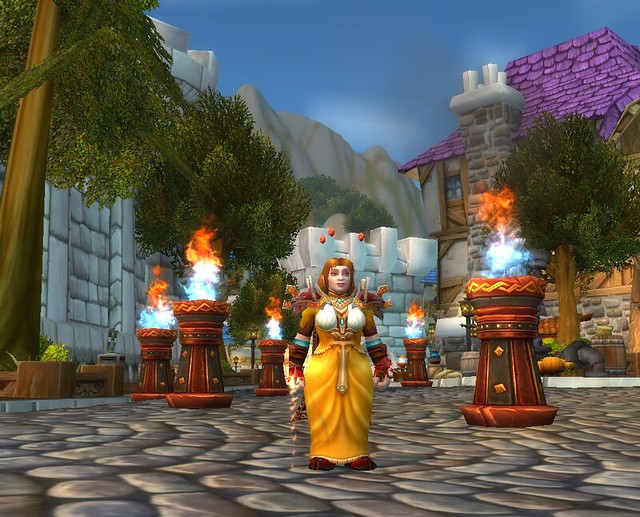
For my Tauren shaman, the Midsummer celebration is very important. It is a time to honor the spirits of the fire, which she does by dancing in her Flamedancer Regalia.
My Gnomish warlock is a different case. You see, when it comes to fire, warlocks are professionals, so the Fire Festival is a bit of a bus-driver’s holiday for her. It’s the one time of the year when people who don’t know what they’re doing try to set things on fire, so if she hung around the festivities she would just find herself screaming at everyone:
“You’ve built that bonfire all wrong! There’s nowhere near enough kindling, the wood isn’t properly seasoned, it’s too close to the tent, and you put it upwind of the dance pole! Does no one here know what they’re doing but me!?”
So, for her, Midsummer is a time to get away from it all and go have her own private little fire way up in the snowy mountains where no one will bother her. She dresses appropriately for the climate in her Aurora-Seeker’s Garb.
I was able to find a decently matching shirt, so it looks like the dress has sleeves (Elegant Robes plus Golden Filigreed Shirt). Otherwise, I pushed the accent colors (headpiece, boots, gloves, shoulders, cloak) more towards red and orange. Finally, I borrowed a red wand and a red flower (Flash Wand, Penelope’s Rose) from my arcane mage’s Love Is in the Air mog.
A cache of administrative documents from the ancient Persian empire reveals an intriguing facet of Persian economic life: female workers were often paid the same amount as their male counterparts. Some women were even paid more than men.
While slavery existed in the Persian Empire, the Persians did not enslave conquered people en masse in the way that other ancient empires like the Assyrians and Romans did. Much basic agricultural and craft labor was done by workers who were paid in rations of grain, wine, beer, and livestock, either for their own consumption or to barter for other goods. Ensuring that everyone got properly paid was the work of administrators who documented the distribution of these commodities from royal and aristocratic estates to the workers who supported the elite. The documents created by these administrators were not intended for posterity, but some survived by chance when Alexander the Great’s army destroyed the palace at Persepolis. The collapse of part of the building protected the archive it contained of about fifty years’ worth of documents. Excavations in the 1930s recovered documents like these two below.
An arashshara was a female supervisor managing a group of pashap, who were workers of some kind. The exact meaning of the term pashap is unclear, but it seems to have applied to agricultural and craft laborers who were supported with monthly distributions of food and supplies. The different levels of rations assigned to groups of workers in these texts probably reflect different ages and levels of responsibility.
1 arashshara of the pashap subsisting on rations at Umpuranush, whose apportionments are set by Irshena, received as rations 30 quarts of wine supplied by Irtuppoya. Month 2, year 22.
– Persepolis Foundation Text 876
(Translations from Maria Brosius, The Persian Empire from Cyrus II to Artaxerxes I. London Association of Classical Teachers Original Records 16, London: 2000. Slightly adapted for clarity)
30 quarts of wine for a month was typical for local supervisors like this one. It was a generous, if not luxurious, standard of pay.
Pashap at Liduma, assigned by Irshena, subsisting on rations, received as rations for one month: 2,615 quarts of grain supplied by Irtuppiya
16 men (each receive) 30 quarts
7 boys 20
5 boys 15
6 boys 10
1 woman 50
34 women 40
1 woman 20
2 girls 20
2 girls 15
9 girls 10
Total: 92 workers.
– Persepolis Foundation Text 847
It is worth noting how many women in the second text were paid as much or more than their male colleagues, and also that the highest paid worker on the list was a woman (probably the arashshara of the workers at Liduma). If we break down the numbers, there are a total of 34 male workers being paid an average of just over 22 quarts of grain a month, while 49 female workers were paid an average of more than 32 quarts.
Other tablets show that this distribution of pay was not universal, but neither was it atypical. Not every woman in Persia was paid as much as a man for her work, but many of them were, and those who were placed in positions of responsibility received pay to match.
If the ancient Persians could do it, what’s stopping us from doing the same today?
History for Writers is a weekly feature which looks at how history can be a fiction writer’s most useful tool. From worldbuilding to dialogue, history helps you write. Check out the introduction to History for Writershere.
We have carried on our rewatching and rating to season 8 of the modern Doctor Who. Here’s our take:
“Deep Breath” – 5.5
“Into the Dalek” – 5
“Robot of Sherwood” – 2
“Listen” – 1.5
“Time Heist” – 5
“The Caretaker” – 3
“Kill the Moon” – 6
“Mummy on the Orient Express” – 6.5
“Flatline” – 5.5
“In the Forest of the Night” – 5
“Dark Water” – 1.5
“Death in Heaven” – 1.5
The average rating this season comes out to exactly 4, which is weak but not terrible. This comes in as the second-lowest-rated season after season 5, at 3.7. This season’s episodes are all over the place, which for Doctor Who is not a bad thing. Not all of the episodes work, but we appreciate the willingness to try out strange ideas, unexpected settings, and dramatically different moods.
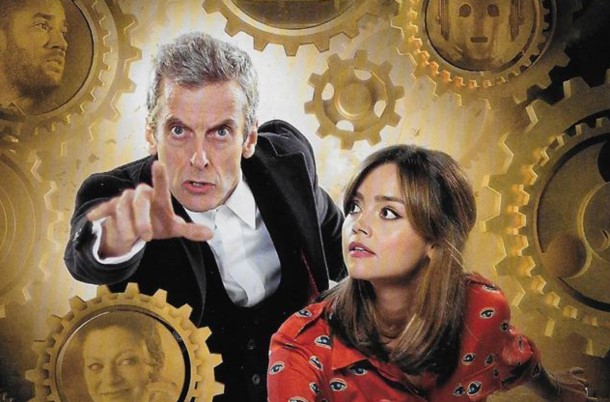
This season also introduces Peter Capaldi as the Doctor, and it’s a bit of a shaky start. Capaldi’s intensity is a nice change from Matt Smith’s quirky detachment, but too often it manifests as anger. As that anger often gets focused on Clara, we have the uncomfortable dynamic of a young woman saddled with the emotional labor of managing a cranky older man’s moods, and one begins to wonder if someone in the production team is having a bit of a temper tantrum about changing gender dynamics in the workplace. Still, straight out of the gate, Capaldi is more convincing as the Doctor than Smith ever was.
Three episodes are tied for our lowest rating of the season, at 1.5. The first is “Listen,” an ambitiously strange episode that tries to recapture the atmospheric spookiness of the classic “Blink,” but falls flat. The Doctor is looking for a creature so good at hiding that no one has ever seen it. This intriguing setup leads to a disjointed series of maybe / maybe-not monster hunts that for some reason revolve around Clara’s fellow teacher and potential boyfriend Danny Pink. Despite some well-written and tensely-directed individual scenes, the episode remains too unfocused and too committed to the is-it-or-isn’t-it schtick to develop any meaningful narrative drive or reach any satisfying conclusion. The pieces of the puzzle lie scattered on the floor, refusing to come together and make a picture.
The other two 1.5s are the obligatory concluding two-parter “Dark Water” and “Death in Heaven,” in which the latest regeneration of the Doctor’s old nemesis, the Master—now female and going by Missy—reveals that she has been hijacking dead people to make liquid cybermen out of their bodies so that she can make the Doctor uncomfortable by… you know, nothing about the plot of these episodes makes any sense, or, really, matters. Michelle Gomez has a blast chewing the scenery as Missy (and provides a valuable canonical precedent for Time Folks gender-flipping during regeneration), but as usual in this series, the Master’s overly contrived plans just come off as a juvenile play for attention. As tends to happen on Doctor Who, putting the whole world in peril actually serves to lower the stakes, rather than raise them, and this season’s ender comes off as more petty than anything else.
At the other end of the scale, “Mummy on the Orient Express” is the best episode of the season, at 6.5. In this episode, a version of the Orient Express train flying through space is plagued by the appearance of a legendary monster only visible to its victims. On one hand, this episode would have benefited from some more development. Unlike on the replica Titanic of “The Voyage of the Damned,” we never get any kind of explanation as to why a space train in the future is a replica of the Orient Express with all the guests wearing period clothing. The guest cast, though excellent, is underused, and the ending leaves a huge plot thread conspicuously dangling. On the other hand, there are a lot of strong elements. The mystery is intriguing and its resolution neatly ties up the clues. The pacing runs along smoothly, and the device of an on-screen timer counting down the mummy’s attack is cleverly used to build tension. For mystery fans, there is also a subtle nod to Agatha Christie’s Murder on the Orient Express, as what seems like a train full of strangers turns out to have been assembled for a very particular purpose.
What’s your take on this season? Does Capaldi do it for you? Is “Listen” just your cup of tea? Not enthused by the mummy on the space train? Let us know!
One of the big recent developments in World of Warcraft is Blizzard’s announced plans to create Classic servers on which players can play “Vanilla” World of Warcraft, that is, the original game as released in 2004. It is something that a fair amount of people want, as demonstrated by the fact that people have been playing homemade versions on pirate servers for years. I first started playing WoW in 2006, shortly before the release of the first expansion. Although I’m not much interested in playing on a Classic server myself, I do feel some nostalgia for the original game as I first experienced it. I’ve been thinking lately about that nostalgia and what it is that makes me remember those early experiences with such fondness.
The Way We Were
Part of my nostalgia for early WoW is separate from the game. I started playing during my last few years of grad school, when I was writing my dissertation. WoW offered a break from the long daily slog of research and writing. I also have fond memories of the tv shows I watched then, the meals that Eppu and I shared, the podcasts I listened to on the commute to and from my adjunct teaching job in the next state over, and other things that distracted me from the work. Also, fairly soon after starting to play, I joined up with a guild (a collection of players who shared an in-game chat channel and played some of the game’s harder content together), and some of my good memories are not so much of the game as of the friends I made through it.
But there is also something about the game itself that stays in my mind. I am nostalgic not just for who I was when I first played WoW but for what WoW was when I first played it, and I’ve been trying to pin down just what it was about the game that made it feel so different from the other games I played then and have played since. The conclusion I’ve come to is: the ideas were good, but the execution was flawed.
2004 was a different time, in gaming terms. While massively multiplayer online role-playing games (MMORPGs) had existed before, in titles like Everquest and Dark Age of Camelot, the MMORPG genre was still relatively new and unfamiliar to most gamers. The Blizzard team that created WoW didn’t have much to go on in figuring out what an MMORPG should be like. Playing through that original game, you can tell that they weren’t working toward a polished vision but were doing their best to translate experiences drawn from single-player games, pen-and-paper role-playing, novels and comic books to a multi-player online format.
Into the Woods
The game world is divided into numerous regions, called zones, each of which has its own map, terrain, and set of quests for characters to complete. Most zones also have their own theme, aesthetic, and background story. One of the zones that my first character encountered early on was Duskwood.
The way is clear, the light is good, I have no fear, no, no one should…
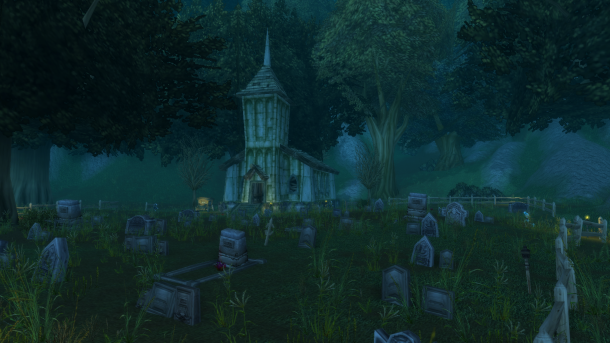
Duskwood was a creepy, dark forest, halfway between fairy tale and Gothic novel. One lone human village, Darkshire, held out against a menacing forest full of werewolves and a decrepit graveyard that spawned undead monsters. The road to Darkshire was a long, lonely path through the woods. Now and then, on either side, your character might see a distant lantern winking in the darkness, but wolves and giant spiders prowling the forest edge encouraged you to stay on the path. Once you got to Darkshire and started doing quests, you began to discover the horrors of the place bit by bit. One long series of quests took you back and forth between the village and the graveyard, doing favors for a crazy old man who lived out there, but if you paid attention to what he was asking you to do it gradually became clear that he had sinister intentions. At the climax of the zone, the old man unleashed Stitches, a fleshy undead monstrosity that lumbered towards Darkshire to attack the town. In your culminating act of heroism before leaving for the next zone, you helped the townsfolk stop Stitches and defend Darkshire.
The aesthetics of the zone were amazing. Everything from the creepy music to the small points of warm light made by the Darkshire torches against the looming forest contributed to the overall feel of Gothic horror. I still remember the thrill of waiting for Stitches to shamble out of the darkness as the NPCs (non-player characters) in the zone called out warnings from the road. The idea of the zone as a sort of Frankenstein by way of “Little Red Riding Hood” was brilliantly conceived.
The locals are restless
The execution, though, was full of flaws, missteps, and poor choices. From the perspective of modern MMORPG design, it is clear to see what Duskwood did wrong. A large part of the zone is taken up with the road into Darkshire, where nothing happens and there are no quests to do or monsters to fight. Once you’ve taken that first trip to town, it’s just wasted space. Another large chunk of the zone is taken up with a mountainous area where higher-level players could sometimes fight a dragon, but which players at the level of the Duskwood quests had nothing to do with. Numerous quests, including the long Stitches chain, sent players repeatedly back and forth from one end of the zone to the other, so that a large part of players’ time in the zone was spent just traveling. Now, there are two ways in which WoW characters can travel faster: by riding a mount, which increases your movement speed, or by taking a flying “taxi” service from one designated flight point to another. In WoW‘s original design, characters at the Duskwood level did not have access to mounts, and there was only one flight point in each zone (Duskwood’s was in Darkshire). That meant that an awful lot of time wasted just running back and forth rather than fighting monsters, completing quests, exploring new areas, talking to NPCs, or anything else more interesting.
The execution of the Stitches quest chain, the core of the Duskwood experience, was also shaky. Getting the full effect of the slowly creeping horror required paying attention to subtle cues from NPCs, something that was easy to ignore when focusing on collecting the right parts from the right monsters to complete the latest quest. If you didn’t know Stitches was coming, you might not realize to stick around in Darkshire and wait for its onslaught. With multiple players in the zone, the Stitches attack would be triggered whenever any player got to the right stage of the quest chain, even if there were other players still on earlier phases. The result was a regular stream of attacks that could get annoying: Stitches was notorious for slaughtering lower-level players on the road to Darkshire (death in the game is not the end for your character, but getting yourself resurrected and ready to get back to questing costs time and in-game money), and, while waiting for Stitches to arrive, some of the NPCs in Darkshire would go on alert and stop responding to characters who were trying to do quests for them.
Many other zones in Vanilla WoW were similar: there were fascinating aesthetic and narrative ideas and you can see what the design team was trying to create, but they didn’t always know how to execute their vision or realize how their design would play out in practical terms.
Goblins, Why Did It Have to Be Goblins…
In the decade-plus since its release, WoW‘s design team has learned an enormous amount as the wider gaming community has developed more collective experience with what works and what doesn’t in an MMORPG. The functional design of more recent zones is much more polished, but that practical experience hasn’t always been put to use in the service of equally good aesthetic and narrative ideas. One place where the ideas failed to live up to the execution is Uldum.
Meow like an Egyptian
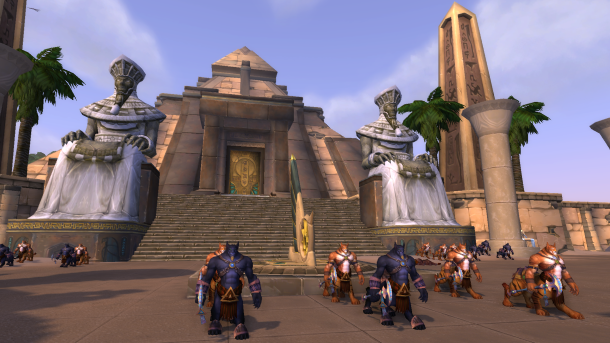
Uldum was one of five zones introduced in the Cataclysm expansion, which came out in 2010. Uldum is a desert zone, a fantasy version of ancient Egypt inhabited by cat people. Compared with old Duskwood, Uldum was polished and smooth: quests were laid out to lead your character in a logical progression around the zone, other players’ actions did not interfere with yours, and crucial story transitions were carefully planned so that the world could change as your character progressed through the story. Half of the zone’s quests revolve around helping the cat people prepare for a civil war. The other half of the zone, though… Well… It’s different.
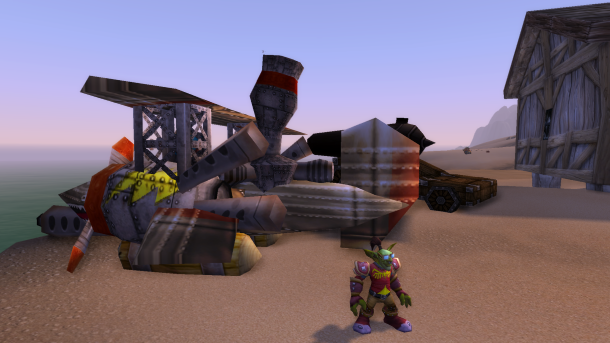
There’s a character in WoW called Harrison Jones. He’s an Indiana Jones parody. Harrison Jones had existed before Cataclysm but he was only used sparingly, in one-off joke quests. In Cataclysm, Harrison Jones took over. Half of Uldum was devoted to an extended parody of The Raiders of the Lost Ark, complete with a Hitleresque goblin antagonist who spoke with an outrageous fake German accent. The questline made extensive use of new technology that allowed the game to render cutscenes—where the game pauses and shows you a short movie—that included your own character in with the NPCs. The execution of this quest chain was flawless, even innovative, but it was still at heart just an over-long Indiana Jones gag.
The Harrison Jones story also thoroughly undercut your character. Rather be the hero of your own story, you became Harrison Jones’s bumbling sidekick. All of the important story moments were up to him, while you were just there to do the grunt work. This storytelling choice did more than make for a boring, aggravating questing experience; it crushed the suspension of disbelief on which the game relies. We play in order to lose ourselves in a fantasy world, to imagine ourselves as heroes whose actions make a difference. Harrison Jones aggressively stomped on that illusion by turning our heroes into unimportant side characters and the game world into one long, tedious joke. The polish of the execution only served to make the hollowness of the idea more obvious. In Duskwood, even though we weren’t any more in control of the story than in Uldum, at least we got to explore it and experience it on our own terms. In Uldum, we’re just along for the ride.
I did Nazi that coming
In Duskwood, as elsewhere in the Vanilla world, the ideas were good, even if the execution was flawed. As the mechanical design of the game has gotten better, we’ve experienced a different kind of flaw. When WoW goes wrong today, it’s less because bad execution gets in the way of a good idea than because good execution exposes a bad idea.
Sunsets and Car Crashes
The difference between Duskwood and Uldum, I think, helps explain why I have such nostalgia for Vanilla WoW. In Vanilla, we had to struggle through a lot of poor mechanical design, but the reward for that struggle was a narrative and aesthetic experience that was bold, creative, and expansive. The experience was a bit like scrambling up a rocky cliff face and seeing a gorgeous sunset from the top. The climb itself wasn’t always fun and we might not want to do it again, but the effort it took was part of the experience that made the sunset worth seeing. Uldum, by contrast, was like driving a brand new car straight into a tree.
In the years since Vanilla, the mechanics of the game have been improved in numerous ways. The experience of playing is now smoother, more reliable, and cleaner than ever. I’m happy with that. I don’t miss the old design’s flaws and missteps. Despite some serious mistakes, like Uldum, the aesthetic vision of the game has not, on the whole, gotten worse. Most of current WoW‘s zones combine smooth mechanical design with a polished, well-developed narrative and artistic sense.
My nostalgia for the original game is not because there is anything wrong with the current game. I wouldn’t trade the current play experience for Vanilla. But the maturing of WoW‘s mechanical design means we have fewer experiences of laboring against bad mechanics to see good ideas shine through. There was something rewarding about old WoW that really can’t be recovered.
Will I ever play on a Classic server? Who knows? Maybe. I might make a new character and putter around a little bit, visiting old quests and NPCs who aren’t around any more, reminiscing about what it was like the first time I walked down a certain road or killed a tough monster. But that’s the problem with nostalgia: you can’t discover something a second time. My nostalgia for Vanilla WoW is tied up with overcoming problems that I’ve now gotten used to not having to deal with at all. If I go back and play original Duskwood again, my experience won’t be about uncovering the secrets at the heart of the dark forest, it’ll be about cursing the designer who made me walk all the way from one end of the zone to the other again, just to be squished by someone else’s Stitches halfway there. I could only consider seriously playing on a Classic server if the improved mechanics of the modern game were brought into it, but that would defeat the purpose of a Classic server.
Still, there are clearly plenty of people who feel differently, enough of them that Blizzard is making servers just for them. I wonder what it is that appeals to those players. What are they nostalgic for that’s worth going back to? What makes playing through the clunky mechanics of the old game worthwhile from their perspective? If you’re one of them, please share. I’d love to hear about what draws you back to Vanilla.
Images: Screenshots from World of Warcraft
Of Dice and Dragons is an occasional feature about games and gaming.







 Co-Geeking
_hires.jpg)