Our Star Wars Rewatch Project: Episode I

Our Star Wars rewatch project begins a long time ago in a galaxy far, far away with Episode I: The Phantom Menace.

1. Best fight

151112JediEppu: Darth Maul vs. Qui-Gon and Obi-Wan on Naboo, hands down. This is how the Jedi fight, not the staid fop-fop-tap of Episode IV!

Erik: Agreed. Whatever else you may say about Phantom Menace, we finally got to see Jedi in their prime fighting a worthy adversary.

2. Best line

Erik: “Her Highness commands you to take her handmaiden with you.” Captain Panaka to Qui-Gon setting out on Tatooine. Less for the line itself than for how Hugh Quarshie delivers it. You can tell that he thinks this is a really, really bad idea, but he’s doing his job of helping the queen do what she wants to do.

Eppu: “What, you think you’re some sort of Jedi, waving your hand around like that?” Watto to Qui-Gon. Delivered in Watto’s bone-dry style, too, it’s hilarious.

3. Best minor character

Pomegranate Seeds Kitster

Eppu: Kitster, one of Anakin’s friends on Tatooine. Very sympathetic young man.

Erik: TC-14, the protocol droid on the trade federation ship. Like C-3P0, more personality than you would expect a droid to have.

4. Best reveal

Erik: When the hangar doors on Naboo open on Darth Maul.

Eppu: The droid army unpacked from the bowels of the transportation drones, unfolding into their full size. I still remember seeing it for the first time.

5. Best save

Eppu: During Queen Amidala’s attack on the palace, Captain Panaka shoots out a window, the group steps out to the ledge, and uses their fancy handguns-cum-harpoon-and-line-shooters to skip to the next floor.

Erik: When Watto tries to back out of a bet, Qui-Gon casually suggests taking the matter up with the Hutts. That’s enough to convince Watto to pay up.

6. Best visual

151112TheedErik: Theed, the capital city on Naboo. Gorgeous landscape and architectural detail.

Star Wars Otoh GungaEppu: The approach to the underwater Gungan city. One of my favorite scenic scenes in the Star Wars universe.

Extra question: Best misdirect

Eppu: Palpatine’s plotting, all of it. Plotwise it’s a step up from the original trilogy, just like the Jedi fights are.

Erik: The opening crawl about conflict over the taxation of outlying trade routes. One of the themes of the prequel trilogy is how momentous events can have tiny beginnings. The taxation of trade routes sounds like the most boring subject for a movie ever, but it leads to the fall of the galactic republic.

Your turn – what’s your Best list for Episode I?

Images: Lightsaber fight via Giphy; Kitster: via fialleril on Pomegranate Seeds; Theed: wookiepedia;  Gungan city: StarWars.com.

In the Seen on Screen occasional feature, we discuss movies and television shows of interest.


Our Star Wars Rewatch Project: Introduction

To prepare for Star Wars: Episode VII – The Force Awakens, we’re Doing a Project. We’ll see all six Star Wars movies in order, roughly one a week, and for each movie, we’ll give our opinion on the following:

  1. Best fight
  2. Best line
  3. Best minor character
  4. Best reveal
  5. Best save
  6. Best visual

For extra fun, Erik decided to make a dessert to go with each movie. We’ll share photos of those, too. Follow the posts with the SW rewatch tag.

And please join us – leave a link for your own posts, or comment with your own Best list!

In the Seen on Screen occasional feature, we discuss movies and television shows of interest.

Headcanon: Underground Hydroponics in The Hunger Games World

From time to time, I get sucked into thinking about the pragmatics of fictional worlds. By that I mean all the mundane details of how people lead their everyday lives, starting from the very basic human (or creature) needs like food, clothing, waste management, and social interaction. Not just who takes care of, say, the laundry and when, but where do they go to do it, how do they get there, what kinds of implements are they expected to bring in themselves and what is shared, how long does it take, what physical motions do they go through, is it a solo activity or a joint effort, and the like.

For me as a visual person, often thinking about everyday activities and movement through spaces tumbles into thinking about what exactly do these various spaces look like. It’s a way to add depth and realism into a story – we are physical beings who love tactile experiences and accumulate all sorts of personal possessions, and if a fictional world ignores that, it makes that world fall flat for me. (Hello, Star Trek!)

The Hunger Games is one of the current ones in my mind because of the approaching Mockingjay – Part 2 premiere and because of an article on Colossal I saw about a World War II era bomb shelter in London that has been turned into an underground farm.

Growing Underground Forgotten Heritage Photo Shoot
Growing Underground on Instagram.

The company running the operation, Growing Underground, produces leafy greens like watercress, basil, coriander, and radish in hydroponic beds lit by LED lamps.

Growing Underground Beds Homepage
Growing Underground.

In the The Hunger Games world, the population of District 13 lives in underground bunkers; the above-ground structures were destroyed by the Capitol. In the Mockingjay novel, Collins mentions various spaces like the armory, the laundry, labs, testing ranges, and farms in passing. She describes these spaces mostly just in very generic terms; e.g., the color of the living compartments is white, and we hear of furniture like dressers and conference tables with individual screens, but that’s about the extent of the detail.

Scenes in the movie Mockingjay – Part 1 show the special weapons lab with a shooting range, the hangar, the bunker, and some hospital and apartment rooms, among others, but I don’t think we’ve seen any underground farms of any kind, nor the poultry farm, for example, that was destroyed in the book version of the bombing of 13 by the Capitol.

Mockingjay1 D13 Collage
Clockwise from top: living quarters, cafeteria, and infirmary at District 13. Images via Jabberjays.net.

The Growing Underground photos of their growing beds fit quite well with Collins’s carefully frugal description and the established Hunger Games visual style. So, in my headcanon, even if we haven’t seen them on screen, District 13’s underground hydroponics now look very much like those of Growing Underground.

Out There is an occasional feature highlighting intriguing art, spaces, places, phenomena, flora, and fauna.

Three Mockingjay – Part 2 Trailers

The Mockingjay – Part 2 premier is approaching! I just finished rereading the novel; now it’s time for rewatching. Here are three trailers:

The Hunger Games: Mockingjay Part 2 Official Trailer – “We March Together”

The Hunger Games: Mockingjay Part 2 Official Trailer – “For Prim”

The Hunger Games: Mockingjay Part 2 Official Trailer – “Welcome To The 76th Hunger Games”

Hey, look! We found a thing on the internet! We thought it was cool, and wanted to share it with you.

Pride & Prejudice & Zombies Trailer

The first Pride & Prejudice & Zombies trailer has been out for a while, and it’s kicking butt bonnet!

PRIDE AND PREJUDICE AND ZOMBIES – Official UK Trailer #1

The movie will be released on February 05, 2016. I’m generally turned off by zombies, but even still, I’ll certainly go see this one. And I’m looking forward to seeing Lily James (whom I know from Downton Abbey) and Lena Heady (Cersei in Game of Thrones) in action. Matt Smith’s Mr. Collins should also be something to see! 🙂

Hey, look! We found a thing on the internet! We thought it was cool, and wanted to share it with you.

Art for Early Editions of Dune

Have you read Dune? If so, you might enjoy this early art by John Schoenherr:

Schoenherr Dune Dawn at the Palace of Arrakeen
John Schoenherr: Dawn at the Palace of Arrakeen.
Schoenherr Dune Stilgar and His Men
John Schoenherr: Stilgar and His Men.


Schoenherr Dune Defeating the Sardaukar
John Schoenherr: Defeating the Sardaukar.

Apparently, Frank Herbert said Schoenherr (1935-2010) was “the only man who has ever visited Dune.” Schoenherr’s paintings of Herbert’s Dune were published first in the Analog magazine and later in a fully illustrated version.

For me, along with John Christopher’s The Tripods, Dune is one of the SFF books I read in my (much) younger days and have kept re-reading over the years. Seeing this early art was certainly a treat!

Found via Dangerous Minds – go visit for more info & pics.

Out There is an occasional feature highlighting intriguing art, spaces, places, phenomena, flora, and fauna.

Happy Halloween!

What’s a party without munchies? Make some mini monster eyeball treats for yours from donuts and candy with this how-to by Ashley Rose at Sugar & Cloth; photo by Jared Smith.

Sugar and Cloth DIY Mini-Monster-Eyeball-Donuts
Ashley Rose at Sugar & Cloth; photo by Jared Smith.

Happy Halloween!

Image by Jared Smith via Sugar and Cloth

This post has been edited.

Geeks eat, too! Second Breakfast is an occasional feature in which we talk about food with geeky connections and maybe make some of our own. Yum!

November 2015: Nordic Book Club in NYC Reads Jääskeläinen

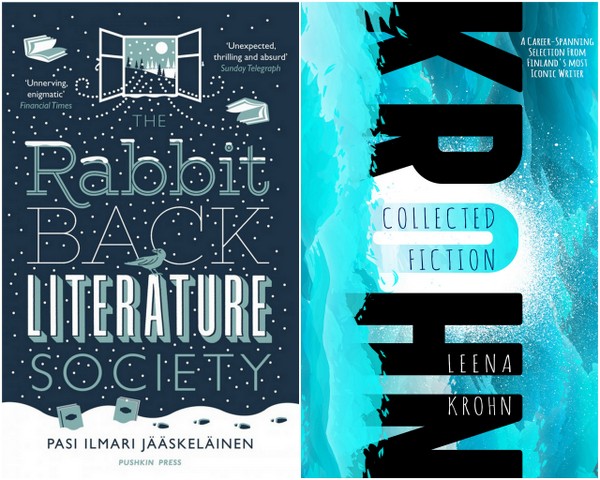
Scandinavia House in New York City runs a new Nordic book club, and this November’s book is The Rabbit Back Literature Society by Finnish author Pasi Ilmari Jääskeläinen.

Jaaskelainen Rabbit Back Lit Soc

Novelist and short-story writer Jääskeläinen writes realistic fantasy (to translate his term reaalifantasia). The Rabbit Back Literature Society, published in 2014 in UK and 2015 in US, is Jääskeläinen’s first novel and the first of his works to be translated into English (from the original Lumikko ja yhdeksän muuta, 2006).

Here’s the publisher’s description:

“Only very special people are chosen by children’s author Laura White to join ‘The Society’, an elite group of writers in the small town of Rabbit Back.

“Now a tenth member has been selected: Ella, literature teacher and possessor of beautifully curving lips.

“But soon Ella discovers that the Society is not what it seems. What is its mysterious ritual, ‘The Game’? What explains the strange disappearance that occurs at Laura’s winter party, in a whirlwind of snow? Why are the words inside books starting to rearrange themselves? Was there once another tenth member, before her?

“Slowly, disturbing secrets that had been buried come to light…

“In this chilling, darkly funny novel, the uncanny brushes up against the everyday in the most beguiling and unexpected of ways.”

The only other piece of Jääskeläinen in English at this writing is Where the Trains Turn (orig. Missä junat kääntyvät, 2000), published in November 2014 by Tor.com.

Apart from Finnish SFF, the book club program for this fall contains Danish contemporary fiction and two Swedish crime thrillers. From scandinaviahouse.org:

“Read and discuss Scandinavian literature in translation as part of Nordic Book Club – ASF’s newest literary series. This season’s selections include Swedish crime thrillers, Danish contemporary fiction, and Finnish fantasy. Discussions typically take place the last Tuesday of the month in the Halldór Laxness Library at Scandinavia House and online at scandinaviahouse.org.”

Jääskeläinen’s book will be discussed on November 24, 2015, at 6 pm at Scandinavia House, 58 Park Ave (Manhattan). The entry is free.

Image: Pushkin Press.

Post edited for style.

Hey, look! We found a thing on the internet! We thought it was cool, and wanted to share it with you.

A Lock of Hair Swept off to the Heavens… on an Ostrich?

Or: Some History behind Ostrich Riding, Part 5 of 7

Background: I ran into two historical images from California with ostriches used as transportation. That got me wondering about the history of ostrich riding. And that lead me down quite a rabbit hole.

I’ve divided my findings into separate posts (find them with the ostrich riding tag). Warning: serious early history and language nerdery ahead in Serious Academic Voice.

TL;DR – Tracing ostrich riding to a 3rd century BCE tomb find (a statue of Arsinoe II) from Egypt doesn’t hold up. The use of various ostrich products in human material culture dates back thousands of years. A few ancient depictions involve humans handling ostriches; however, extant sources don’t tell us whether ostriches were merely hunted or whether they were also tamed in the ancient world. The most promising source seems to be a description of a magnificent parade put together by Arsinoe II’s husband-brother Ptolemy II. This Grand Procession included eight chariots drawn by pairs of ostriches, and the ostriches may have been ridden by boys in costumes.

I had hoped to find a nice, neat selection of ancient texts putting the Greek word for ‘ostrich’ in context, but even a cursory look reveals that the history of the word strouthos is complex. At best, we can say that there are no immediate red flags either in the original Greek or modern English translations for Arsinoe II’s statue or Ptolemy II’s Grand Procession. The poem Berenice’s Lock was said to contain further evidence of ostriches as mounts in Ptolemaic Egypt after Arsinoe II’s death. Instead, what we seem to have is a case of poetic ambiguity translated with poetic license and taken uncritically as evidence.

Below is the long story.

Continue reading