November 2015: Nordic Book Club in NYC Reads Jääskeläinen

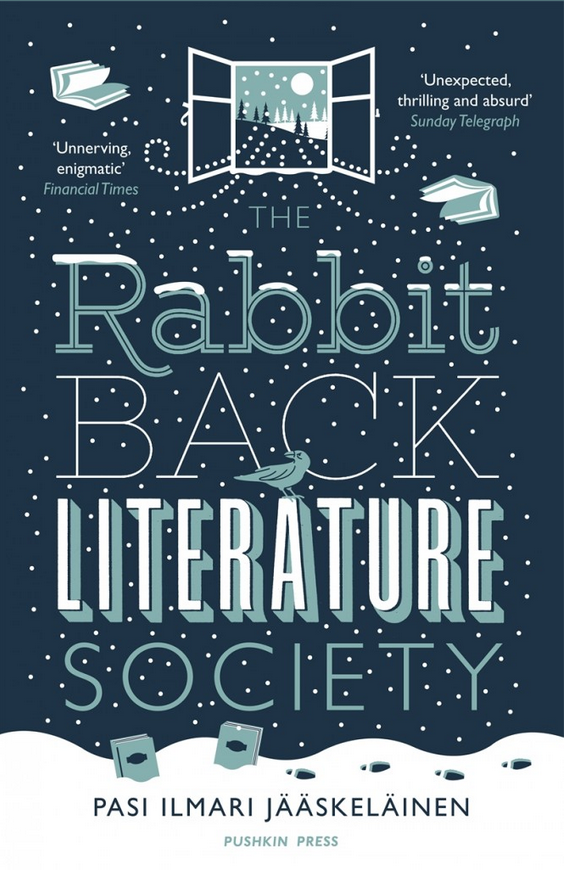
Scandinavia House in New York City runs a new Nordic book club, and this November’s book is The Rabbit Back Literature Society by Finnish author Pasi Ilmari Jääskeläinen.
Jaaskelainen Rabbit Back Lit Soc

Novelist and short-story writer Jääskeläinen writes realistic fantasy (to translate his term reaalifantasia). The Rabbit Back Literature Society, published in 2014 in UK and 2015 in US, is Jääskeläinen’s first novel and the first of his works to be translated into English (from the original Lumikko ja yhdeksän muuta, 2006).

Here’s the publisher’s description:

“Only very special people are chosen by children’s author Laura White to join ‘The Society’, an elite group of writers in the small town of Rabbit Back.

“Now a tenth member has been selected: Ella, literature teacher and possessor of beautifully curving lips.

“But soon Ella discovers that the Society is not what it seems. What is its mysterious ritual, ‘The Game’? What explains the strange disappearance that occurs at Laura’s winter party, in a whirlwind of snow? Why are the words inside books starting to rearrange themselves? Was there once another tenth member, before her?

“Slowly, disturbing secrets that had been buried come to light…

“In this chilling, darkly funny novel, the uncanny brushes up against the everyday in the most beguiling and unexpected of ways.”

The only other piece of Jääskeläinen in English at this writing is Where the Trains Turn (orig. Missä junat kääntyvät, 2000), published in November 2014 by Tor.com.

Apart from Finnish SFF, the book club program for this fall contains Danish contemporary fiction and two Swedish crime thrillers. From scandinaviahouse.org:

“Read and discuss Scandinavian literature in translation as part of Nordic Book Club – ASF’s newest literary series. This season’s selections include Swedish crime thrillers, Danish contemporary fiction, and Finnish fantasy. Discussions typically take place the last Tuesday of the month in the Halldór Laxness Library at Scandinavia House and online at scandinaviahouse.org.”

Jääskeläinen’s book will be discussed on November 24, 2015, at 6 pm at Scandinavia House, 58 Park Ave (Manhattan). The entry is free.

Image: Pushkin Press.

Post edited for style.

Hey, look! We found a thing on the internet! We thought it was cool, and wanted to share it with you.

A Lock of Hair Swept off to the Heavens… on an Ostrich?

Or: Some History behind Ostrich Riding, Part 5 of 7

Background: I ran into two historical images from California with ostriches used as transportation. That got me wondering about the history of ostrich riding. And that lead me down quite a rabbit hole.

I’ve divided my findings into separate posts (find them with the ostrich riding tag). Warning: serious early history and language nerdery ahead in Serious Academic Voice.

TL;DR – Tracing ostrich riding to a 3rd century BCE tomb find (a statue of Arsinoe II) from Egypt doesn’t hold up. The use of various ostrich products in human material culture dates back thousands of years. A few ancient depictions involve humans handling ostriches; however, extant sources don’t tell us whether ostriches were merely hunted or whether they were also tamed in the ancient world. The most promising source seems to be a description of a magnificent parade put together by Arsinoe II’s husband-brother Ptolemy II. This Grand Procession included eight chariots drawn by pairs of ostriches, and the ostriches may have been ridden by boys in costumes.

I had hoped to find a nice, neat selection of ancient texts putting the Greek word for ‘ostrich’ in context, but even a cursory look reveals that the history of the word strouthos is complex. At best, we can say that there are no immediate red flags either in the original Greek or modern English translations for Arsinoe II’s statue or Ptolemy II’s Grand Procession. The poem Berenice’s Lock was said to contain further evidence of ostriches as mounts in Ptolemaic Egypt after Arsinoe II’s death. Instead, what we seem to have is a case of poetic ambiguity translated with poetic license and taken uncritically as evidence.

Below is the long story.

Continue reading

Take the Mirror Empire Quiz

To mentally prepare myself for reading Empire Ascendant by Kameron Hurley, the middle book in the Worldbreaker saga, I took a quiz to find out which character from The Mirror Empire I might be.

Hurley Mirror Empire Cover

I am… Ghrasia Madah:

“You’re a pragmatic defender, with a dim view of stories and mythology, because you’ve been mythologized yourself, and didn’t much like the taste of the world afterward. A hero, a legend, most days you just try to stand very tall so that people don’t notice you aren’t exactly a physical match for the woman they read about in storybooks.

“You fall a bit too hard for young, whip-smart men with mother issues, but after twenty years married to two of the ‘right’ sorts of men, maybe this is nice change.”

I’ll take pragmatic, but otherwise it’s not very accurate. Ghrasia is a tough, no-nonsense, unpretentious, and persistent lady, though, which I appreciate.

Which Mirror Empire character are you?

Q&A is an occasional feature in which we share our responses to quizzes, questions, and quirky ideas for your entertainment.

Statue of Lenin Turned to the Dark Side

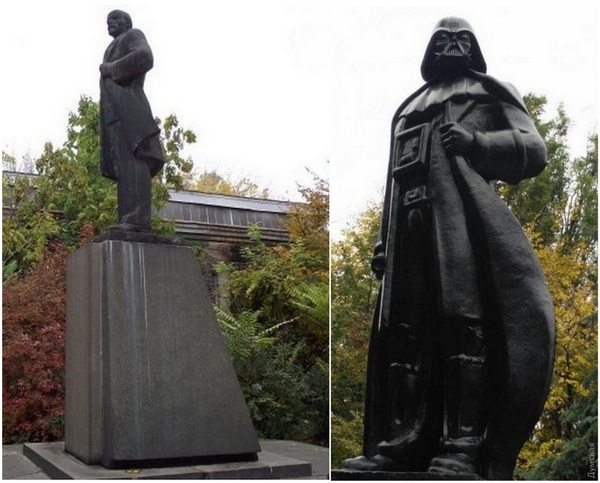
In Odessa, Ukraine, a statue of Lenin fated for demolition instead got a new life – as Darth Vader.

Dumskaya Lenin Vader
Images: Dumskaya.net via Meduza.

The destruction of the statue was called for by a new law that requires the elimination of all landmarks and geographic names dedicated to communist figures. Artist Alexander Milov repurposed the statue and turned Lenin into the dark side. There’s more under Vader’s cloak than a covered-up Lenin’s coat, though: the statue’s head conceals a router delivering Wi-Fi to the immediate area.

Who woulda thunk that Lenin’s pose would be spot on for Vader!

Found via Meduza.

Out There is an occasional feature highlighting intriguing art, spaces, places, phenomena, flora, and fauna.

Two Fan-Made Star Wars: Episode VII Videos

This music-only version of the official The Force Awakens trailer edited by Tim Gonzales is awesome:

The Force Awakens Trailer #3 – Music Only Edit

The soundtrack is very effective – I can actually feel the goosebumps moving along my arms and scalp! Apparently the trailer music is a combination of new composition and previous music; see the write-up by Peter Sciretta at /Film.

And this Han’s flashback video by Nick Skywalk does a fantastic(!!) job cutting in scenes from the original trilogy with the Episode VII trailer:

Han Solo’s Flashback

Eight weeks to go!

Bonus link: There used to be a Playstation video game called Star Wars: Masters of Teräs Käsi, published by LucasArts 1997. Teräskäsi is Finnish and literally means ‘steel hand’. This was news to me, but apparently it’s part – albeit a mostly forgotten part – of the official canon. Yay, Finland! 😉

Hey, look! We found a thing on the internet! We thought it was cool, and wanted to share it with you.

Theodor Kittelsen’s Naturalistic Fantastical Art

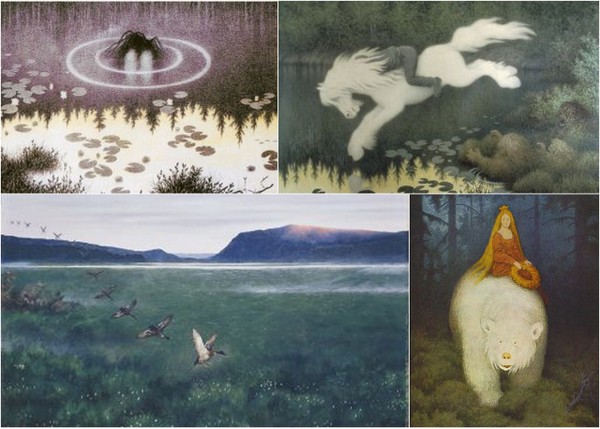
Norwegian Theodor Kittelsen (1857-1914) developed into one of Scandinavia’s most popular artists. He’s especially well known for his nature paintings and illustrations of fairy tales, legends, and trolls.

Trollet_som_grunner_pa_hvor_gammelt_det_er
Theodor Kittelsen: Trollet som grunner på hvor gammelt det er [troll wonders how old it is], 1911. Via Wikimedia Commons.
His art clearly shows how strongly the Norwegian nature inspired him. Kittelsen’s style is said to include aspects naturalism, mysticism, and Art Nouveau.

Kittelsen Collage
Theodor Kittelsen, clockwise from top left: Nøkken [water spirit], 1887–92; Gutt på hvit hest [boy on white horse]; Kvitebjørn Kong Valemon [white bear King Valemon], 1912; 12 villender [12 wild ducks], 1897. Via emmeffe6 on Flickr (one, two, three, four).
The element of a boy on a white horse is connected with water spirit tales. Apparently some näkki water spirits (to use my native Finnish term) can turn into horses to capture humans to pull underwater. I don’t remember that aspect of the näkki stories from my childhood; perhaps there’s a difference between the Scandinavian and Finnish tales.

The landscapes in Kittelsen’s paintings remind me of the Finnish wildernesses a lot. There’s also something solemn and contemplative in the mood of his imagery that makes me connect it with Tolkien’s art and writing, on one hand, and, on the other, with the illustrations of Tove Jansson (see examples of her work on Alice in Wonderland and The Hobbit provided by The Official Moomin site).

Out There is an occasional feature highlighting intriguing art, spaces, places, phenomena, flora, and fauna.

Digital Painting Inspired by The Martian

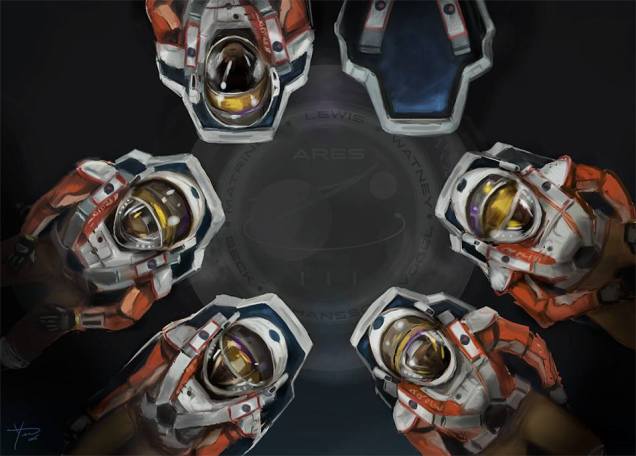
Painter and photographer d. yee was inspired to re-interpret a scene from The Martian as a digital painting:

d. yee.
d. yee.

Says artist:

“Was thinking to use this as a reference for a large format painting (in acrylic). After working on this digital painting over a couple of days I’m starting to rethink the feat. My right hand is not happy.”

Beautiful. Reminds me stylistically of some SF book covers I like. I hope a large format acrylic is coming (and published on their website)!

Out There is an occasional feature highlighting intriguing art, spaces, places, phenomena, flora, and fauna.

“On Second Thought, Let’s Not Go to Camelot”

In honor of its 40th anniversary, Monty Python and The Holy Grail will be re-released on October 14, 2015. The release will be twofold: an anniversary disc version (DVD & Blu-ray) and a limited, one night only theatrical showing.

Co-director Terry Jones goes on YouTube to introduce some never before seen material gleaned from video archives:

Terry Jones introduces the outtakes – Monty Python & The Holy Grail

From the YouTube info:

“Put together after months of searching through the Python archives, scanning the original negatives and reassembling scenes, this video includes extended versions of ‘Sir Robin and the Three Headed Knight’, ‘Get On With It!’, ‘Old Crone’, ‘Wedding Slaughter’, alternative takes from the ‘Constitutional Peasants’ scene, a shorter take from the ‘Black Knight’ scene and some lost silly bits.”

A nifty tidbit from Jones’s intro: the hip amputee who played the Black Knight with his leg cut off also did the voice work for his lines, and did a pretty good job.

Hey, look! We found a thing on the internet! We thought it was cool, and wanted to share it with you.
Sean Bean on the LotR Joke in The Martian

Finland’s national public broadcasting company Yle interviewed actor Sean Bean (article in Finnish; the 4-minute video in English) during his promo tour for The Martian.

Yle Sean Bean Interview
Yle Uutiset.

(Note: I wasn’t able to share the video; you’ll have to follow the link to Yle and play it there.)

Bean mentions that the Lord of the Rings reference – Project Elrond – was something he didn’t know how to react to. My partial transcription from the interview (from ca. 1:50-2:30) picks up with Bean’s answer to how it came about:

“I don’t know. I think it was in the script originally and it stayed in there, and it was very funny ’cause I’ve never been in a f– I was in a film that– then– which was– within a film. So it was very funny. [Laughs.] And, erm, you know, I just kind of listened to it, I didn’t know how to react, really [laughs], to that. It’s an unusual kind of situation I was in. But it was great, it’s great. I love that, it’s nice.”

When asked whether they joked about the reference on set, Bean answered:

“Not really, no, you said it and everyone went, like– [indistinct; laughs.] You know, I couldn’t kind of go, like, ‘Oh yeah, I was in [that]’, you know. But I– So I just kind of– [makes a gesture of playing it cool] went on with it.”

Other questions touch on the large number of team leader roles he’s played or characters who die (which Bean doesn’t seek out, specifically), how Bean built the character of Mitch Henderson with director Ridley Scott, and the kind of roles Bean would like to play in the future.

Serving exactly what it sounds like, the Quotes feature excerpts other people’s thoughts.