Worldcon is in Helsinki this year. As a Finnish-American couple, we are very excited about this! In the coming months, we’d like to offer some practical advice about visiting Finland to our fellow fans who are considering going to the event but haven’t had experience with Finland and Finns before.
Eppu here. First of all, I should note that I didn’t grow up in Helsinki, so I’ve had to learn the capital region transit system as an outsider. There’s no denying that it’s a big system with many moving parts (see what I did!) and that it can feel overwhelming. However, I find that, overall, information is abundant, the signage excellent, the electronic displays usually accurate, and the services run on time. Navigation or ticketing haven’t been a problem for us. (Note: Unfortunately I can’t competently comment on the success of the accessibility initiatives; I can only say there’s every attempt.)
Edited to add: Please also read Progress Report #5. Worldcon 75 staff have put together a very informational final report with lots of practical tips.
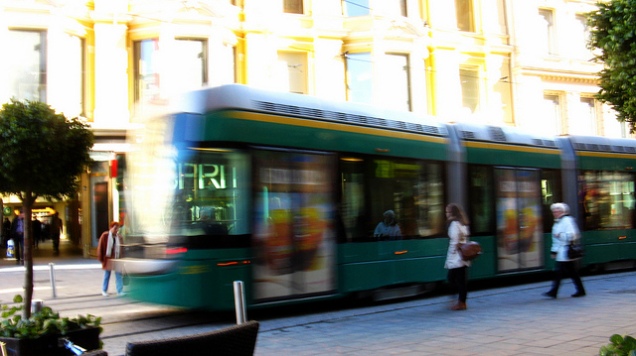
Some general information
The public transit network in the greater Helsinki area consists of local and regional buses, trams, commuter trains, subway (metro), and ferry. The system is managed by Helsinki Region Transport (in Finnish: Helsingin seudun liikenne or HSL; HSL on Wikipedia). Helsinki also provides city bikes for a fee (registration required).
Most lines operate between 5:30 a.m. and 11:30 p.m. or so. Nighttime lines, where they exist, are marked by letter N in the timetables (for example, 415 and 415N), and a higher night fare is charged between 2 a.m. and 4.30 a.m.
The metro sign is a white M in a red square.
Many Finns stay silent in public transit, although in large cities and/or with younger passengers this may not hold true. A Finn might also not ask someone blocking them to move; a wish to pass is often expressed only through body language.
Tickets, please
Always carry a valid ticket. Passengers without a ticket are charged a penalty fare of 80 euros.
There are several different kinds of tickets (single, day, travel card) and ways to get them (bus drivers, tram operators, text message, ticket machines / automats / kiosks).
The ticket machines operate in Finnish, Swedish, or English; payment is by coins, bills, or cards. Below is a how-to video:
Ticket machine. HSL/HRT. Helsinki by Den S
Note that despite what some information pages still say, train conductors no longer sell tickets; passengers need to buy a ticket before boarding.
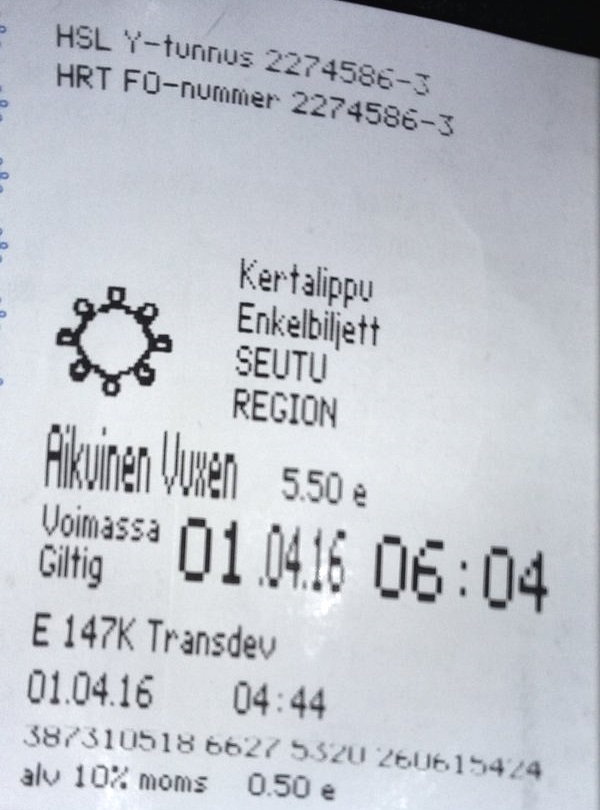
Ticket terminology
Paper tickets are Finnish-Swedish bilingual. Note that ticket validity is indicated with 24-hour clock and that dates are written out in day/month/year order.
- aikuinen (Fin) – adult, grown-up
- alv (Fin) – value-added tax (VAT)
- barn (Swe) – child
- dygnsbiljett (Swe) – day ticket
- enkelbiljett (Swe) – single ticket
- giltig (Swe) – valid
- hyvää matkaa (Fin) – Have a pleasant journey
- kertalippu (Fin) – single ticket
- lapsi (Fin) – child
- moms (Swe) – value-added tax (VAT)
- region, regionbiljett (Swe) – region, regional ticket
- seutu, seutulippu (Fin) – region(al), regional ticket
- trevlig resa (Swe) – Have a pleasant journey
- voimassa (Fin) – valid
- vuorokausilippu (Fin) – day ticket
- vuxen (Swe) – adult, grown-up
The cheapest per-trip option, a travel card, is available from 14 to 366 days—i.e., a minimum of two weeks—so they’re basically the local commuter option.
If planning to make only two trips in one day, a day ticket (valid for 24 hours) is more expensive than two single tickets. Three or more trips justify the cost of a day ticket.
Attending Worldcon 75 members get a free travel pass courtesy of the Helsinki Region Transport. At this writing there’s no more information, but it sounds like a Helsinki internal pass (cf. zones, below). After this post went live, we heard from W75 that it’s a regional pass. Yay!
Zoning out
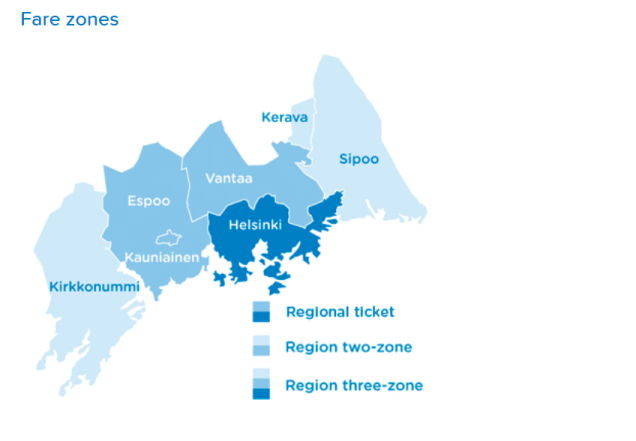
There are three zones: internal, regional (two zones) and the whole region (three zones). The internal tickets basically cover only one city (Helsinki; Espoo; Kauniainen; Vantaa) or municipality (Kirkkonummi) or transit zone unit (Kerava & Sipoo).
Helsinki central railway station is the biggest transportation hub in the greater Helsinki area. Other hubs include Pasila railway station, Sörnäinen, and Itäkeskus (literally, ‘east center’) in Helsinki, Espoon keskus (Espoo center) and Leppävaara in Espoo, and Myyrmäki and Tikkurila in Vantaa.
Unless your accommodations are in one of the adjoining cities, you should only need internal Helsinki tickets during the con.
Airport transit
At Helsinki-Vantaa airport, there are several local and regional buses in addition to train and taxi services. Trains stop between the two airport terminals and both at Pasila and the main railway station in Helsinki, with several stops in between.
Buses run between Helsinki-Vantaa and the city, ending in the vicinity of the Helsinki central railway station. Lines terminate either on Elielinaukio on the west or Rautatientori (railway station square) on the east side of the station.
For the city center, take either the HSL bus 415 or 615. The newest and fastest connection is the Ring Rail Line (I and P trains). Both the HSL buses and the airport train require a regional ticket (seutulippu). The private Finnair City Buses run between the airport and Elielinaukio.
Finding the spot
Bus and tram stops have both a unique 4-digit number and a name in both Finnish and Swedish. The stop number includes one or two preceding letters which indicate(s) the city or municipality of the stop (E for Espoo, H for Helsinki, etc.). For example, Pasilan asema / Böle station is H2100 in the photo below.
In practice, only the stop names are relevant, but you can use the stop numbers, too, with the Reittiopas route planner (see below).
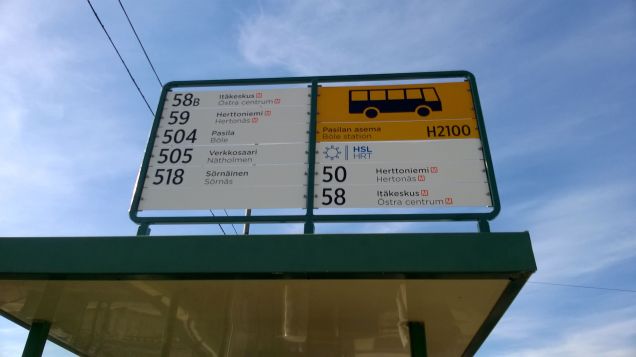
Stops and departure bays display a sign with the route number(s) and destination(s) for the line(s) that use that particular stop. A small metro sign (white M in a red square) indicates that that line feeds to the metro.
Many of the stops also have transit maps and printed schedules. They are good for basic route finding if you know where you’re headed.
Electronic timetable displays at stops and terminals show either real-time or scheduled arrival / departure times for the line(s) serving that stop. Inside vehicles they typically display the route number and the name of the next stop.
You can also check out possible routes and options ahead of time with the Journey Planner (Reittiopas) in Finnish, Swedish, or English. Plug in your destination street address or attraction name and choose your preferred method and route; you can also adjust the amount of walking required or number of transfers in the settings.
Pertinent destination or stop names for Worldcon 75 are Helsinki-Vantaa airport (for which the route finder uses terms lentoasema or Helsinki-Vantaa airport T1-T2 corridor or combinations thereof), Helsinki railway station, Pasila or Pasilan asema (for Pasila railway station), and Messukeskus.
The Google Maps public transit directions also seem ok to me, but I haven’t used them often enough to comment on their reliability.
Note that the old Pasila train station is being demolished and a new one being built during the con. I haven’t personally been there, but on the basis of every newspaper photo I’ve seen it looks like signage and information on where to find connections, platforms, etc., is plentiful.
How to put a stop to it
The metro and commuter trains stop at every station. Enter and exit through any open door.
However, buses and trams only stop when requested. It is customary to enter through the front and exit through the middle or back doors. (People with accessibility issues may use the front door or middle door on low-floor buses both to enter and exit.)
At a bus stop, give a clear sign to the driver by holding your arm out to the side. Keep holding your hand out until the driver signals to show that s/he is going to stop.
Trams typically stop when there are passengers waiting. If the stop is shared by several routes, however, raise a hand to request that your tram stops to pick you up.
To exit at your stop, press the Stop button on the grab bars. (Note: Tape strips like some American buses use, for example, do not exist in Finland.) Do it early enough to give the driver time to stop safely. In fact, it’s not unusual to see people signal for a stop almost as soon as the bus or tram has left the previous stop.
What if I want to talk to someone?
The city of Helsinki tourist guides, the Helsinki Helpers, stand ready to answer questions until the end of August. Find them in their distinctive lime green vests on the inner city streets and cruise harbors. There’s also the Info Container tourist info kiosk on Keskuskatu next to Ateneum Art Museum (link to a map).
At or near Messukeskus, where you’ll be dealing mainly with hospitality workers or fellow fen, you will be in the best of company and are bound to find help, but Helsinki residents in general are used to tourists, too. Do not hesitate to ask passers-by for help if you need it. Many Finns, even if they tend to be reticent or shy of their English skills, are well-informed, eager to help, and give practical advice.
An outsider’s perspective
Erik here. As a foreign visitor, I’ve always found Helsinki quite an easy city to get around. The city center is compact and easily walkable, if that’s your preferred mode of transportation. If not, there are many good public transit options, as Eppu has explained. As with other parts of Finnish culture, there are some local details about getting around that may confuse you or not be obvious if you’re used to American cities. Here are a few things to keep in mind when you visit Helsinki:
- Public transit has a bad reputation in some parts of the US. This does not apply in Finland. Finnish public transit is clean, modern, efficient, and easy to use. You’ll see everyone from parents with little children to business executives on their way to meetings riding the trains, buses, trams, and subway in Helsinki.
- Always cross the street at a marked crosswalk and always obey the Walk/Don’t Walk signs. Even if the street is empty, don’t cross against the lights. This isn’t just a matter of courtesy, it’s also for your safety. Finland is a very law-abiding nation and drivers expect pedestrians to follow traffic signals. If a driver has a green light, they may not look out for pedestrians crossing the road in front of them. In Helsinki, unlike in many American cities, the buttons for crosswalk signals actually work.
- In many places, you’ll find the sidewalk divided into two lanes, one for bicycles and the other for foot traffic. The lanes may be marked with painted symbols (a bicycle or a pair of walking figures), or the sidewalk may be partially paved, partially cobblestone (bicycles on the pavement, walkers on the cobble). Try to stay in the appropriate lane. This is also a matter of both courtesy and safety. There are a lot of bicycles in Helsinki and it’s both rude and dangerous to get in their way.
- If there isn’t a marked division on the sidewalk, it’s good manners to stay to the right so that other people have room to get by you.
- Turning right on a red light is not allowed anywhere in Finland, which is useful to know whether you’re driving or just walking around.
- Few stores in Helsinki have public toilets and those that do may charge a fee. But free public toilets are available around the city. Look for dark green metal sheds on sidewalks and in parks, about the size and shape of a newsstand. These are free, clean, and kept in good condition.
- As in many other European cities, look for street signs at the corners of buildings, not on free-standing posts.
- Because Finland is a bilingual country, all road signs and many informational signs are posted in both Finnish and Swedish. Many places and neighborhoods around Helsinki also have names in both languages. Sometimes it’s obvious—it’s not hard even for an English speaker to guess that Eerikinkatu and Eriksgatan are the same street. Others are not so easy to guess. Without a little linguistic knowledge it can be hard to know that Ruoholahti is the same as Gräsviken. The announcements in public transit are also bilingual (occasionally trilingual, with English following Finnish and Swedish).
Online information for getting around in Helsinki
- Accessibility (Helsingin seudun liikenne, HSL) – accessibility info for the greater Helsinki region
- “Every American Transportation Planner Should Spend a Week in Helsinki” – part 1 of 3, part 2 of 3, and part 3 of 3 – by Garrett Wollman at Occasionally Coherent describes the greater Helsinki transit system in detail through American eyes
- Getting around in Helsinki (Visithelsinki.fi) – links to basic descriptive articles, starting from “Arriving in Helsinki”
- Helsinki Airport: To and from – airport connections
- Helsinki City Transport (Helsingin kaupungin liikenne, HKL) – basic info on public transit in the city, including instructions for passengers
- Helsinki Region Transport (HSL) – route, timetable, service disruptions, and ticket information for the greater Helsinki region
- Journey Planner (Reittiopas) – plan your itinerary in Finnish, Swedish, or English
- Mobile Apps (HSL)
- Public Transport in Helsinki – Wikipedia
- Ring Rail Line (I and P trains) – to and from the Helsinki-Vantaa airport (basic info & route map; for timetables, see HSL)
- Route Maps (HSL) for the greater Helsinki region
- Transport Links to Harbors (HSL) – for cruise passengers
- Transport Links to Helsinki Airport (HSL) – airport connections
Any additional tips? Do share!
Images: Moving in Helsinki by J.Elliott on Flickr (CC BY-NC-ND 2.0). HSL seutulippu, detail, by luckyandangel on Twitter. Fare zones screencap from HSL “How to Use Public Transport”. Pasilan pysäkki by HSL.
This post has been edited to add resources by Worldcon 75 and correct the type of HSL pass given to W75 members.
In Live and Active Cultures we talk about cultures and cultural differences.







 Co-Geeking