Gnome Frost Mage Transmog Tweak

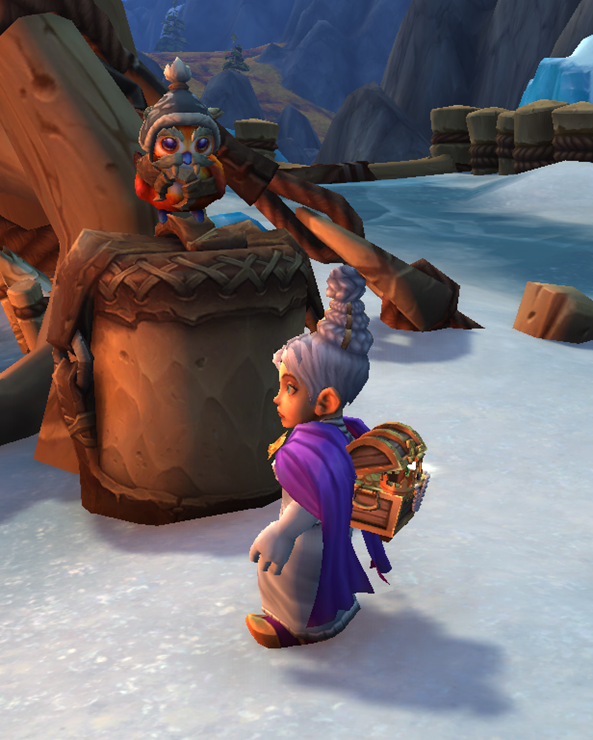
A lot of the time, the new trading post transmog items are a different, fun take on World of Warcraft gear. They’ve allowed me to tinker with my looks, including this cute version of a Gnome fortune-hunter.

WoW Dragonflight Frost Mage Transmog1

I made it for my frost mage, who in my head canon is very academic and very girly and very neat, ergo the polished, fancy outfit completely at odds with adventuring life. But, hey, she gets to carry a chest bursting with jewels on her back!

WoW Dragonflight Frost Mage Transmog2

The Love Witch’s Boots are rather, uh, extravagant on their own, but fortunately I only need their curly tips and a little of the magenta stripe to shop up from under the Mooncloth Robe hem.

Here is her set in Wowhead’s Dressing Room.

Images: World of Warcraft screencaps

Role-Playing Around the Campfire

In table-top role-playing, there are opportunities everywhere to let players role-play their characters and build the narrative of the group. Even the humble act of camping for the night in the wilderness can be rich with openings for some character work. Some players will seize these opportunities for themselves, but sometimes it helps to have the DM nudge the character-building along.

Stopping to camp for the night is usually downtime to be passed over quickly. If wilderness survival is an important part of your campaign, maybe you have everyone scratch a batch of rations off their inventory. The party decides who’s going to keep watch and in what order. You might have some nighttime encounters planned for them, but soon enough it’s time to refresh everyone’s daily powers, heal some hit points, and carry on with the next day’s adventure. But it can also be a low-stakes chance for players to think about and play with their characters, both as individuals and as a party.

If your players don’t naturally take the initiative to role-play, here are some ways you can encourage them.

Set the scene

Filling in the details of the world gives your players something to react to, and that’s equally true if it’s an angry dragon in a crumbling old stone tower or a patch of berry bushes by the side of a little woodland stream. When your party decides to stop for the night, take a moment to fill in the scene around them. Draw in as many sensory details as you can:

“You find a good spot to camp in a small clearing amidst old pine trees. The ground is covered in dry, rust-colored fallen needles that crunch under your feet. The roots of the trees spread across the clearing, making little pockets that each of you can curl up into. At the edge of the woods, you spot some buckberry bushes. You hear small nocturnal critters rustling in the underbrush in the woods, unbothered by big folks like you passing through. The smell of pine pitch is in the air, a sharp topnote over the earthy, mossy scent of the forest underneath. The rays of the setting sun fade from golden to red to purple as you settle in.”

You can encourage players to help fill in scene themselves, if you like. See if anyone wants to check out the area before settling in, and invite them to describe what they would like to find—within reason. Unexpected chests of gold hidden under leaves are probably out of the question (depending on what your campaign is like), but if the druid would like to turn up some edible mushrooms, or the ranger wants to hunt some small game, or the rogue would like to climb a tree and find a comfortable perch in the branches, those can be good things to add to the scene.

A simple but useful way to both build the scene and encourage some role-play is to ask every player: “Your character finds something at this campsite, something perfectly ordinary and normal to find in this environment, but that makes them happy. What do you find?”

Prompt some action

You don’t have to gloss over the business of setting up camp. Ask each player what they’re doing to help make camp for the night. Or maybe prompt them by asking: “Who’s going to make the campfire? Who’s making dinner, and what are you making? Who’s setting up the tents? Who’s fetching water? Who’s taking care of the horses? Everyone tell us how your task goes.”

It can be good to tie the small actions of making camp to the bigger actions of the adventures before. Was there a big fight? Maybe the barbarian is really starting to stink of old sweat and needs a wash. Did the wizard cast a big spell? Maybe channeling all that magical energy was rough on their robes and they need to do a little patching. Was there a lot of riding, hiking, or climbing? Everyone’s sore, someone is getting blisters on their feet or has cuts on their hands from scrambling over rocks—not the sort of thing that costs hit point or needs proper healing, but something to take care of once there’s a chance to sit down.

Ask some backstory questions

The downtime between adventuring days is a good opportunity to give everybody a chance to reflect on their character’s personality and backstory. You can help this along with a few leading questions, like:

  • “As you chew on your trail rations, you daydream about the best meal you ever had. What does your character wish they were eating right now?”
  • “You’ve settled in, and you’ve got time to kill. What’s a funny story your character could tell the group that they haven’t shared before?”
  • “What do you do to entertain yourselves and each other while waiting for sleep?”
  • “Darkness is falling, and you know you need sleep to face the dangers ahead, but what’s keeping your character awake? What are you afraid of or worrying about?”
  • “You fall asleep dreaming about what you’re going to do with your share of the treasure once this quest is over. What comes into your minds?”

Add some complications or events

Even if no big threats are coming the party’s way tonight, little things can still go wrong. You can throw one or two minor annoyances at the party and see how they react. Try something like:

  • The ground is wet from rain and it’s hard to get a fire going.
  • The underbrush is dry and parched, and your fire gets out of control and starts to burn some nearby bushes.
  • The water available nearby is mucky and foul-smelling. It’s safe to drink and wash with, but not pleasant.
  • A small critter is attracted by the smell of your food and tries to get into one character’s pack.
  • A large browsing herbivore comes wandering through your camp in the night, doing no harm but knocking over tents and scattering campfire ashes.
  • A pack of local carnivores goes rushing by in the night chasing some prey. One of them stops and sniffs around the camp, but doesn’t attack.
  • A thunderstorm develops in the night and drenches the party in cold rain.

On the other hand, characters can have interesting reactions to things that are good or neutral. Maybe give them something nice to respond to, like:

  • Even a cursory search around the campsite turns up enough wholesome mushrooms, sweet berries, edible roots, and other wild foods to make a tasty and filling meal for everyone.
  • A curious local critter comes upon your camp and investigates with some amusing but harmless antics like sniffing everyone’s food or hopping up on one character’s shoulder.
  • Strains of haunting music echo faintly through the wilderness. If the party goes looking for the source, it disappears.
  • Ribbons of beautiful aurora light dance in the starlit sky.
  • A thunderstorm passes by the night nearby but not over the party. Peals of thunder shake the air and flashes of light illuminate the night, but no harm comes to the encamped characters.
  • An ethereal spirit appears out of the darkness and comes to the edge of the firelight. After observing the party for a moment, it makes a simple gesture of blessing and vanishes.

You can set these events in motion as soon as the party makes camp, or you can let them play out over the course of the night. A couple of touches like this can help make even an ordinary night in camp memorable.

You may not want to role-play every nighttime camp in as much detail as this. It’s a bit of interstitial downtime to give players a chance to flesh out their characters in between battles and quests, but it can get tiring if you do it all the time.

Also, if you have a particularly threat-wary party (or if you have a habit of interrupting their downtime with danger), it might be a good idea to let everyone know up front that this is a role-playing opportunity, and it’s safe to let their guard down a bit. Otherwise everyone might just spend their time role-playing being very on edge and waiting for the next fight.

Enjoy your next camping scene!

Image: Campfire in NB by Martin Cathrae on Flickr (CC BY-SA 2.0)

Official Trailer for Renegade Nell

A new(ish) series on Disney+ caught my eye: Renegade Nell. Here’s an official trailer:

Renegade Nell | Official Trailer | Disney+ by Disney Plus on YouTube

Looks at least borderline interesting; even if 18th-century England or outlaws aren’t really my cup of tea, stories of women with unusual lives can be intriguing. Here there is also a hint of magic in the shape of a spirit called Billy (Billy? really, though?!?) that seems to grant Nell her extraordinary powers.

Other than the trailer, so far I’ve only the Frock Flicks post on the series to judge by. Have you seen Renegade Nell? What did you think—is it worth seeing?

First Trailer for Thunderbolts*, Plus Thoughts

Thunderbolts* has now the honor of the most recent movie trailer release within the Marvel Cinematic Universe:

Marvel Studios’ Thunderbolts* | Teaser Trailer | Only In Theaters May 2025 by Marvel Entertainment on YouTube

(I guess the asterisk is a thing? At least it is appended to the name not just on YouTube but also in IMDB.)

First thought: huh? I had thought a version of the Fantastic Four was coming next. I must’ve gotten my notes mixed up, or missed an update somewhere. Second thought: Thunderbolts? Huh? This says absolutely nothing to me. At least I can recognize most of the MCU characters in the trailer: from Black Widow, there’s Yelena Belova (faux-sister to Natasha Romanoff), the Red Guardian, and the Taskmaster (Dreykov’s daughter Antonia), then Ava / Ghost (from Ant-Man and the Wasp) plus Bucky Barnes.

I kinda love how at the 1:05 mark when the building explodes, Yelena just matter-of-factly turns and starts walking calmly away, almost a bored look on her face. Or maybe it’s a here-we-go-again face? Anyway. Also, that Bucky had his metal arm in the dishwasher.

It’s hard to grasp what’s supposed to go on other than these bad guys who are not necessarily bad guys entirely through faults of their own perhaps now trying to be good-ish guys are being hunted by even more bad guys? Maybe?

I don’t care for the character Valentina Allegra de Fontaine—the corporate suit lady towards the end (earlier seen in The Falcon and the Winter Soldier, Black Widow, and Black Panther: Wakanda Forever)—so I’m miffed we’ll see more of her. Meh.

Otherwise, this trailer has a little of the same feel I get from the early MCU ensemble stories. If we’re really lucky, the movie might capture some of the same magic.

At this writing, Thunderbolts* is set to release on May 02, 2025.

A Name for an Amazon

Amazons, the bold warrior women who figure in Greek myths, are imaginary, but the myths about them likely had their origin in Greek experiences with actual fighting women in the cultures around the shores of the Black Sea. Ethnographic and archaeological evidence shows that women who trained with weapons and fought in battle were known in many of the cultures in the region, and the association of mythic Greek Amazons with horses and bows also matches the realities of life on the Black Sea steppes.

Greek literature and art records numerous Amazon names. Most of these names are Greek, and they are descriptive of relevant Amazon traits, such as Hippolyta (“She who sets the horses loose”), Melanippe (“Black horse”) or Antiope (“She who confronts”). These names may have been simply invented by Greek writers in the same way that fantasy authors today concoct suitable names for their characters. There is evidence, however, that some of the Amazon names recorded in Greek art might be actual names from languages spoken around the Black Sea.


Greek vase fragment via the J. Paul Getty Museum (made Athens, currently Getty Museum, Malibu; c. 510 BCE; glazed pottery; painted by Oltos)

This Greek pottery fragment shows Amazons riding into battle against the Greek hero Heracles (who appears accompanied by the god Hermes on the other side of the cup). We can recognize the riders as Amazons from their clothing and the bowcases they carry. Text in Greek letters surrounds them, although it is painted in a dark color that is difficult to see. Most of the text is fragmentary and hard to reconstruct, but one word seems to be a complete name. The text PKPUPES can be read by the head of the leftmost rider, evidently her name.

“Pkpupes,” at first glance, may look like mere gibberish. It certainly isn’t Greek. Many scholars in the past dismissed this and similar texts as nonsense words written by semi-literate vase painters. Maybe “pkupupes” was just an attempt at an onomatopoeic for the pounding of a horse’s hooves. It may, however, be something more significant.

Dense clusters of hard consonants like “pkp” are a common feature of languages spoken today in the Caucasus Mountains east of the Black Sea. “Pkpupes” is, in fact, fairly easy to read as an attempt to render a name in Circassian, a cluster of closely related languages of the northwestern Caucasus, with the letters of ancient Greek, which did not perfectly match up to the sounds of the original language. English doesn’t have all the right letters to easily represent the sounds of Circassian either, but a reconstructed Circassian name that would be rendered in English something like “Pqp’upush” is perfectly intelligible. This name is composed of several elements, the first referring to the body, the next to covering, and the final one connoting worthiness. Altogether, the name would mean “Worthy to wear armor,” a suitable name for a warrior woman.

Greeks had extensive contact with peoples around the Black Sea. Many Greeks migrated to the region, and people from the area also settled in Greece. The painter of this vase signed his name “Oltos,” which is not a typical Greek name, and he may have been an immigrant himself. He and other ancient vase painters may well have known people who spoke foreign languages or had ancestors from the Black Sea region who could recommend appropriately authentic names for Amazon characters. It may even be that some of the obviously Greek Amazon names like Hippolyta or Antiope were not invented by Greeks but are Greek translations of authentic names, in the same way that the names of many indigenous Americans in recent history have been translated into English, like Sitting Bull or Red Cloud.

The Amazons of Greek myth remain mythical, but we have evidence for some history behind that myth, maybe even the names of some real warrior women from the edges of the world known to the Greeks.

Source

Adrienne Mayor, John Colarusso, and David Saunders, “Making Sense of Nonsense Inscriptions Associated with Amazons and Scythians on Athenian Vases,” Hesperia 83, no. 3 (July-September 2014): 447-93.

Living in the Science-Fictional Now: Smart Contact Lenses Powered by Solar Cells and Blinking

Move over, flying cars. Also, 3d-printing living cells onto internal organs, your moment in the limelight is over. For here come smart contact lenses.

Despite its unfortunate publishing date—Apr 1st—the article in IEEE Spectrum on smart contact lenses powered by solar cells and blinking seems to refer to a genuine invention.

An article in the journal Small on March 13, 2024, by Erfan Pourshaban et al. introduces a self-contained on-the-eye power source. Their device combines flexible silicon solar cells with an electrochemical harvester based on the principle of metal-air batteries. This harvester is activated by the blinking motion and uses tear electrolytes for the harvesting. Finally, the two energy generators were integrated with a power management circuit for a stable voltage and to compensate for weak solar cell performance under low-light conditions.

According to Pourshaban et al., their self-standing power pack could even power drug delivery systems, diabetic sensors, or readout sensors in smart contact lenses.

Wiley Online Library Pourshaban et al Fig4
Integrated power pack for a smart contact lens by Pourshaban et al.; a) Exploded view of the flexible power pack’s components, b) circuit diagram of the entire power pack, c) PDMS-encapsulated power management circuit and the flexible solar cell mounted on an eyeball replica, and d) power pack’s electrical status under natural eye blinking conditions.

I haven’t seen much mainstream reporting on this, but it sounds very exciting to me! The technology has so far been tested on a curved platform that emulates the human eyeball with a 3d-printed eyelid. A long way is still needed for any actual human use, I’d imagine, but the treatment of various eye-related complaints such as glaucoma, dryness, chronic ocular surface inflammation, and vision issues might become much easier. There may also be potential for more science-fictional uses, like in-eye displays.

What an amazing time we live in!

Image by Pourshaban et al. via Wiley Online Library