This post is a part of our Making Clothes series.
Clothing ranges from the very simplest (e.g. ponchos, saris) to very complex designs, including multi-piece, draped, shaped, pieced, pleated, ruched, lined—or a combination of them all.
There are whole books written on the construction and history of clothes. This post covers just the very basics with some examples, keeping our inspiration outfits in mind.
Origins of Sewn Clothing
It’s surmised that the first sewn clothes—made from leather or fur—were constructed with a two-step method: first the pieces were pierced with an awl near their edges, then the sewing material (likely sinew, catgut, or the like) was pushed through the holes by hand to connect the pieces.
Needles made it possible to string thread through the eye and pull the needle and thread through holes made with an awl as a unit, greatly speeding up the process. They were first made from bone, antler, ivory, or wood, later from various metals.
Copper, silver, and bronze needles have been found, for example from ancient Egypt and Bronze and Iron Age Europe. Thicker, larger, and blunter needles were also used to make knotted nets, especially fishing nets. On the other hand, in medieval York, for instance, fine and blunt needles were used on delicate silk fabrics, where parting the filaments was more desirable than splitting them with a sharp tip. Modern and medieval leather needles have a triangular point designed to pierce leather better.
The earliest extant example of complex woven clothing—a cut and fitted garment as opposed to a wrapped one—is the 4th millennium BCE Tarkhan Dress from Upper Egypt.

Other early examples include dresses from Late Archaic Caral culture in Peru, c. 3000-1800 BCE, and two pairs of pants from 2nd millennium BCE finds from Turfan in eastern Central Asia. (I blogged about the Turfan pants earlier.) The oldest inspiration piece for our post series, the Ukok woman dating to the 5th century BCE, is relatively new in comparison.
Basic Concepts of Sewing
Whether a sewn garment is made of leather or man-made material (woven, twined, or knitted fabric, faux leather, vinyl, etc.), certain basic similarities are found across a wide variety of garments, be they a hat or hose.
What is considered the front of the material is called the right side; wrong side is the opposite, often less showy or colorful. Some fabrics look exactly the same from both sides; either can be chosen as the right side. These days garment pieces are typically sewn right sides together, i.e., wrong side out, then turned right side out to get a neat finished item. There are some indications that this isn’t true in all cases, though by and large the concept seems valid for earlier periods as well.
Seams that serve a function—joining two or more pieces—are called construction seams. Sometimes garments can have faux seams (decorative seams) inserted purely for symmetry or looks, like some of the medieval textiles found at Herjolfsnes in Greenland.
When making construction seams, narrow bands of material (seam allowances) must be left at the cut fabric edges (raw edges) in order for the join not to unravel immediately. The width of seam allowances depends on the thickness and the propensity of the material to unravel. In modern sewing instructions, seam allowances tend to range between 6-25 mm, with 1 cm / approximately 0,5 inches being very common.

Wider seam allowances are used on thicker fabrics for pragmatic reasons (easier folding) and materials that fray easily like silk, loosely-woven fabrics, or hand-woven fabrics that need it (less inadvertent unraveling).
Another type of an allowance is required for treating various outer edges: hat rims or hood face openings; necklines; center-front openings in jackets, coats, or cloaks; edges of side or central slits; armholes (armscyes) in sleeveless garments; sleeve ends (hems or cuffs); bottom hems of trouser legs, skirts, dresses, shirts, tunics, and cloak or jacket-type garments; waists of skirts and trousers. A casing is a tube (which is essentially what a hem is) that is meant to contain a drawstring (or elastic in modern sewing), and can have a hole for operating the cord. These kinds of allowances tend to range from mere millimeters to several centimeters.
The reconstruction of the so-called Viborg Shirt ended up using seam allowances of 25 mm due to the linen’s excessive fraying. Slimmer seam allowances, even down to 3 mm, have been documented as well. They are mostly used in curved areas and with delicate materials. Allowances typically remain inside the finished garment.
Basic hem allowances consist of enough fabric to turn the edge in either once or twice. After turning, the edge or fold is sewn down. The double turn (double-fold) hem stays neater through multiple washes than a single turn one.
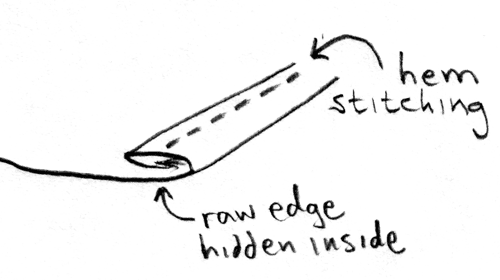
Often whether a hem is single or double folded depends on the weight of the fabric: light to medium weight (linen, lightweight wool, heavy silk) can be double-folded, and the heaviest wool gets a single fold. For example, a linen shirt’s neckline might be hemmed by turning the edge in twice and tacking it in place. A cord could be inserted inside the hem prior to stitching the neckline to reinforce it, like in some Iron Age finds from Carelia in modern day Finland and Russia. When hemming or neatening edges, the stitching can run alongside the fold or perpendicularly to it (think buttonholes, for example).
Hems are often finished in some way even when not strictly speaking necessary. Leather, fur, and felted or fulled wool don’t unravel; therefore, their cut edges don’t necessarily need to be finished or hemmed in any way. However, wearers may want them hemmed for durability or neatened with a decorative treatment.
Of course it’s also possible to leave any raw edges unhemmed—indeed, these days a distressed, unfinished edge can be a stylistic or a fashion choice—but the longevity of the garment typically suffers.
Types of Stitches
Not just clothing designs but also the technicalities of sewing (stitches, seams, seam allowances, hems, finishing, embellishments, etc.) can be specific to a culture, era, or current fashion, or vary according to material, especially the closer we come to modern era.
However, it’s often a matter of serendipity which parts of prehistoric or historical clothes from the earliest periods survive. There might not be any clear evidence of techniques characteristic of a particular site or culture at a particular time, and finds from neighboring areas (or nearby eras) need to be considered as suggestions. Furthermore, surviving pieces are often small or very small, especially the earlier the find, so enough details of a seam or hem structure might not survive to form a full picture.

Common stitches during the Bronze and Iron Ages include the super-simple running stitch (straight stitch) and its stronger cousin the back stitch. Overcast stitch (whip stitch) was used for tacking down seam allowances and hems, sometimes also for construction seams. Buttonhole stitches (blanket stitches) could also be used for various hems or edges, or to reinforce points where seams come together. Furs in Scandinavia were sewn largely with overcast stitches in the body of a long seam and running stitches in high-stress areas where the seam shouldn’t stretch or give. The woollen Orkney hood (radiocarbon dated to c. 250-615) was patched with chain stitches.

In European Bronze and Iron Ages, it was typical to sew wool with linen or wool thread, and it was pragmatic to use the same wool that the fabric was woven with, provided it’s not too loosely spun, too thick, or too rough for the purpose. (Long, uniform, and fine fibers make the best thread, because protruding fiber ends in coarser quality wool make sewing much more difficult.) Similarly, linen was sewn with linen, and silk with linen or silk thread. Linen for sewing might be treated with beeswax to smooth and slicken it.
Types of Seams
Sewing two pieces of material together simply (plain seam) will do if the goal is to get something wearable in a hurry. However, finishing off (neatening) the raw edges of seam allowances or in some way tacking down the seam allowances in their raw state lengthens the life of the garment.
A flat-felled seam (felled seam, run-and-fell seam) completely encases the raw edges of seam allowances. It can be executed with a running stitch for the seam proper plus overcast stitch (possibly also running stitch) to attach the folded edge of the seam allowance. They were used e.g. in Anglo-Scandinavian period England, and Bronze and Iron Age Scandinavia and Germany. Another, very similar seam doesn’t fold in the raw edges, merely presses them to one side and tacks them down.

In a spread seam, the seam allowances are pressed flat on both sides of the seam and their edges are sewn down with either overcast or running stitches.

Both seam types make a durable join. They also typically show on the right side of the fabric more clearly than a plain seam does (which could be turned into an advantage by using contrasting color thread). Small braids or cords could be used to cover the raw edges at hems or seam allowances, like in some Viking contexts in northern Germany and Ireland.

Typical Designs
Surviving textile fragments often range from very small to small, so even if we have details of a seam or hem structure, they might not reveal anything about the overall shape or dimensions of a garment.
For a lot of (pre)history, a simple T-style cut seems to have reigned in tunic and dress design, like ancient Roman tunicas, the wool tunic find from the Lendbreen glacier in Norway (dating from 230 to 390), or our example tunic from Egypt with dionysian ornament (from the 5th century). Exceptions clearly do occur, though. For instance, the Tarkhan dress shows distinct signs of pleating on the sleeves and top of the bodice. Also, from Hallstatt there are a number of finds that are shaped (tailored) to the body. A labor-saving technique is to cut the front and back pieces as one, poncho-style.

Ease (for movement) is required from any article of clothing that’s either narrow or tailored. One of the simplest ways to create ease is to use slits, for example at trouser ankles, or cuffs and side seams in shirts and dresses, like in the wool tunic (probably from between 70 and 320) found in the Thorsberg bog in northern Germany. Central seams or central lines at the front and back of a garment are another pragmatic place for slits.
Necklines can also include a slit. For instance, a keyhole-shaped neck opening—essentially a circle with a slit below—is common in historical tunics and shirts. Other common neckline shapes include V-neck, O-neck (crew neck, round neck), and a shallow elongated one that we would now call a boat neckline.
For comfort, many historical tunics insert into the underarms small squares of fabric that fold into triangles (gussets, gores) creating a little extra room.

Large triangular gussets or gores can also be inserted at side seams, sometimes also at the center front and back. An alternative way to avoid sewing underarm gores is to cut wider sleeves that taper towards the wrist, like the 11th-century Skjoldehamn tunic from northern Norway.

Pants or trousers are essentially two tubes running from the waist to the hem joined together by the crotch. Ease in pants is gained by fitting the shape to the wearer carefully, especially at the joints (crotch, knee, and ankle). An alternative is cutting a large enough circumference that ease is not needed, in which case the waist (if not the hems as well) needs to be gathered and either belted or cinched with a casing and cord.

Cloaks or mantles were typically either rectangular, circular, or semicircular. The former two types were apparently known already in ancient Egypt, while the so-called blue Kunigunde mantle (early 11th century Germany) is a gorgeous embroidered example of the latter. A well-attested outer garment in ancient Greece and Rome was the paenula, a poncho-like bell-shaped cape, that was worn for centuries.

As with other design features, clothing lengths vary from era to era, culture to culture, class to class, group to group, function to function. There are many cases where the basic shapes are the same and the decorative features, including color, separate types of wearers from each other. Male garments tend to be shorter than female ones, but not uniformly.
In cutting garment pieces from fabric, economy reigned and wastage was minimized. We have extant clothing remnants where selvage edges and raw edges have been combined side by side, so clearly a desire to use as much of the fabric as possible existed. (Modern sewing instructions advise cutting out selvages altogether.) Garment parts that remain invisible underneath the overlayers could be less fine and might have been made from rougher materials or reused from older clothes.
Sewing Speed
All sewing was done by hand until the sewing machine was invented around the middle of the 19th century. While not as labor-intensive as spinning and weaving, handsewing was still a significant investment of time, especially the more decorative types. It’s no wonder that clothes were often mended and reused until they were falling apart, and at the end of their lives put to use as modest utility textiles or rags.
It’s nearly impossible to find comprehensive information on how long sewing a garment took before there was an interest in collecting and publishing statistics (in the 1800s or so). Research and experimenting give the best insights we have.
In one experiment, during the reconstruction of the fur outfits (kaftan and cape) belonging to the 900s male and female burials from Bjerringhøj and Hvilehøj, Denmark, sewing a 10 cm seam with two different types of needles was compared. A modern steel needle was significantly faster at approx. 7 minutes, while a replica bronze one took 12 minutes. One meter of seam would, with these speeds, require between 1 hour 10 minutes and 2 hours.
In another experiment, the reconstruction of the 11th century Viborg Shirt in linen took just under 17 hours to sew. However, there are some complex features in its design: the body (shoulder to waist area) is lined both front and back, the square neckline is fairly involved, and there are several seams attaching the outer fabric and the lining together (quilting), so it would’ve taken much longer than a comparably-sized plain T-tunic to sew.
A modern re-enactor handsewing a Viking Age replica woman’s underdress estimated her speed to be about 1 meter per hour for a total of about 25 hours, entirely by hand. Another cited a Tudor era doublet for a 5-year-old boy, half sewn by hand and half by machine, having taken approx. 36 hours of work. The latter did require careful fitting and was lined, so an unlined, much simpler project should cut that time in half if not more.
A very rough estimate for sewing fabric tunics might therefore be 6-9 hours, and naturally more for dresses or anything else with long or complicated seams. Leather is a little slower to handle, but it might be possible to save time by skipping the hemming step, depending on the garment and its purpose. As always, rough-and-ready uses require much less effort and time investment than high-status items.
How It Happens looks at the inner workings of various creative efforts.
 Co-Geeking

2 thoughts on “Making Clothes 8: Sewing”
Comments are closed.