Quotes: The Dumb Countryside

It’s my stupid birthday again and—poor me!—I’m being dragged off

to the dumb countryside away from my Cerinthus.

Is there anything better than the city? Is the old farm

off by the lazy Arno and Arretium’s fields any place for a girl?

You’re making such a fuss over me, Mesalla, settle down!

Uncaring uncle, this is no time to hit the road!

My heart and mind will stay in Rome even if you take me away,

but you just won’t let me have my way.

– Sulpicia, Poems 2

(My own translation)

Sulpicia is one of the few women whose writings have come down to us from the Roman world. She lived around the late first century BCE. We know very little about her except that she lived with her uncle, Mesalla Corvinus, who was a close friend of the statesman and orator Cicero. In this poem, a teenaged Sulpicia complains about being dragged off to the family’s country estate to celebrate her birthday, leaving her lover Cerinthus behind in Rome.

Cerinthus may not, in fact, be a real person. It was common for Roman poets of the time to write poems to or about imaginary (or at least heavily fictionalized) lovers. The most famous may be Catullus, whose poems chart a tempestuous affair with a woman he calls Lesbia. Often, male poets wrote about their longing for absent lovers or complained about women who stayed away too long. Sulpicia takes that genre and turns it on its head, writing from the point of view of the absent lover and pointing out that it wasn’t her fault she had to be away. A young woman of her age in high Roman society, dependent on the charity of well-meaning but obtuse relatives, had very little control over her own movements.

Roman poetry also often voiced a nostalgic longing to escape the bustle and filth of Rome and return to an idealized country life. Sulpicia turns this convention upside-down as well, disparaging the countryside as dull and lifeless and longing to stay amidst the excitement of the city. And well she might—the charm of the countryside for rich men was in large part the idleness enabled by the labor of slaves, tenant farmers, and the women of the household. A young woman like her would have few opportunities for being on her own or doing what she liked there.

What reads at first glance like a spoiled teenager’s tantrum reveals itself as a clever critique of popular poetic conceits. It’s a shame that more of Sulpicia’s poetry hasn’t survived, but what we have provides a valuable alternative view to set alongside the work of her male contemporaries.

Serving exactly what it sounds like, the Quotes feature excerpts other people’s thoughts.

All-Female Ocean’s 8 Trailers

An all-female installation in the Ocean’s heist series opens this Friday, June 08, 2018! IMDB’s description is short and sweet:

“Debbie Ocean gathers a crew to attempt an impossible heist at New York City’s yearly Met Gala.”

Here are two trailers:

OCEAN’S 8 – Official 1st Trailer by Warner Bros. Pictures on YouTube

OCEAN’S 8 – Official Main Trailer by Warner Bros. Pictures on YouTube

Looks like so much fun! Not everyone in the cast is a favorite, but you never know, they might become a favorite after this… 🙂

And, OMG, Ocean’s 8 is so gonna bust the Bechdel test out of the water and use it as a flotation device!

Hey, look! We found a thing on the internet! We thought it was cool, and wanted to share it with you.

Visual Inspiration: Two Birds, a Snail, and a Mushroom

A few more possibilities for speculative writers and artists looking to break out of the Eurocentric worldbuilding mold, this time from among the Earth’s birds, snails, and mushrooms.

The male pink robin (Petroica rodinogaster) has a bright fuchsia chest and belly; the female looks drabber, with merely pinkish-tinged underparts. These small birds live in the cool temperate forests of southeastern Australia.

Flickr Dave Curtis Pink Robin

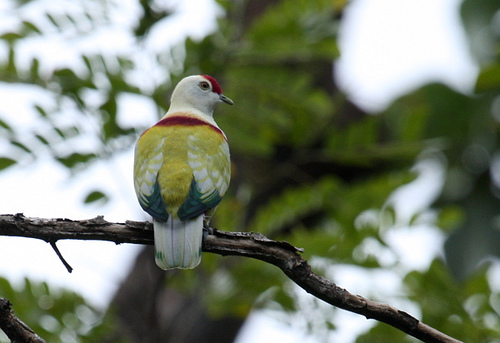
The many-colored fruit doves (Ptilinopus perousii) live on islands in the south-west Pacific Ocean (Fiji, the Samoan Islands, and Tonga). The male is yellow on the wings and back, red on the head and neck; the female is greener, darker on the back and greyer on the head and breast.

Flickr Tom Tarrant Many-colored Fruit Dove

The violet snail (Janthina janthina) is a small purple mollusk found floating on the surface in tropical and temperate seas worldwide.

Flickr Ian Jacobs Janthina janthina Cropped

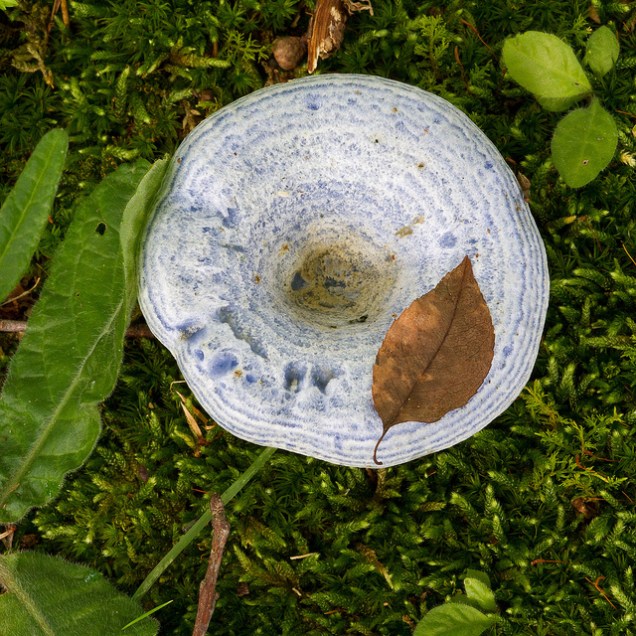
Indigo milk cap (Lactarius indigo) is a species of generally blue or blueish mushrooms found in eastern North America, East Asia, and Central America. The milk that oozes out of a cut or broken mushroom is also indigo blue, but slowly turns green upon exposure to air. According to Wikipedia, it’s edible and sold in rural markets in China, Guatemala, and Mexico.

Wikipedia Dan Molter Lactarius indigo
Flickr Arthur T LaBar Indigo Milk Cap

Aren’t they all incredible?

Images: Pink robin by Dave Curtis on Flickr (CC BY-NC-ND 2.0). Many-colored fruit dove by Tom Tarrant on Flickr (CC BY-NC-SA 2.0). Violet snail cropped from photo by Ian Jacobs on Flickr (CC BY-NC 2.0). Indigo milk cap by Arthur T. LaBar on Flickr (CC BY-NC 2.0) and by Dan Molter via Wikipedia.

The Visual Inspiration occasional feature pulls the unusual from our world to inspire design, story-telling, and worldbuilding. If stuff like this already exists, what else could we imagine?

Three Years of Co-Geeking

Three rings for the Elven-kings under the sky…

Third time pays for all…

Once the number three, being the third number be reached…

Dynamic Text- Monty Python: Holy Hand Grenade by Furnace1717 on YouTube


…it shall be heretowith known as the third anniversary of Co-Geeking.

Following are a few high points from the past year for us:

Favorite posts

Erik: My favorite post of the past year is What Makes a Fantasy World Feel European?, in which I tried to dig into some of the deeper elements of worldbuilding that keep imagined worlds tied to European models, even when some of the surface details are changed up. There is a great deal more that could be said on this subject, but I think the pattern I explored of cultural and economic integration combined with political fragmentation is useful for us to keep in mind when reading, writing, or thinking about secondary-world fantasy fiction.

Eppu: Like last year, I have a tie again. Firstly, Good Night, Cassini, Good Work, I’ll Most Likely Kill You in the Morning, for I continue to be flabbergasted over the amazing photos sent by the Cassini mission to Saturn. Secondly—and, interestingly, completely at the other end of human history—is the Ancient Clay Cup Animation of a scene laid out on a clay cup at the Bronze Age site of Shahr-e Sūkhté (or Shahr-e Sukhteh) in Sistan, southeastern Iran.

A Trio of Heroes

(a favorite geeky thing that happened this year)

Eppu: Black Panther the movie! It was visually beautiful and skillfully constructed (both storywise and with respect to the effects), but the absolute best thing about it was the humanity in the story. Like Erik said in our random thoughts post, “Black Panther feels like the movie we most need in 2018: a meditation on the temptations of division, resentment, and revenge and the hard choice of embracing a flawed and fractured world with hope.” Plus so. Many. Awesome. Women!

Erik: Superheroes aren’t just for white men any more. Although there have been non-white- and female-led superhero movies in the past, as aficionados will eagerly point out, the past year has felt like a corner being finally turned. Wonder Woman, Thor:Ragnarok, and Black Panther all showed that getting people who aren’t white and male into significant roles in front of and behind the camera can lead to superhero movies that are both artistically awesome and financially successful, and the follow-up to Infinity War looks set to hand the massive Marvel Cinematic Universe over to a cast that is, at the least, a bit less overwhelmingly white and male than we’ve had so far. We haven’t reached anything like parity yet, but this past year was a good step.

Announcements from your hosts.