Recently I’ve been thinking of Babylon 5 quite a bit from the storytelling point of view. When it first aired (1994-1998 in the U.S.), it was unique in my experience (which was, at the time, still quite limited) for a few things.
Firstly, I loved B5 for its complex, detailed, and consistent world. I hadn’t seen that level of commitment to worldbuilding on tv before. Also, the plot moved on several levels, from individual concerns to multi-species war, and involved political struggles, religious prophesies, racial tensions, social pressures, and personal rivalries of many kinds. At times it was heavy-handed, for instance in its discussion of authoritarianism vs. free will (“Who are you?” “What do you want?”), but not consistently across every plotline, if memory serves. (Note to self: It’s clearly time for a rewatch!)
What really sets B5 apart from other attempts, however, is that it’s carrying essentially one huge story arc over years of tv programming, not just one season’s worth. The creator, J. Michael Straczynski, conceived of the whole plotline before the series was written for tv. Apparently, it was specifically supposed to be a “novel for television,” with the core plot points figured out beforehand. (That’s my biggest beef with the current Doctor Who, for example: the writers are struggling to fold in new storylines into the existing canon—even very recently created canon—and it shows.)
Game of Thrones and The Expanse feel very similar to B5, being tv adaptations of stories already in existence, and I’ve really enjoyed those aspects of both. Before them, though, I can’t really remember seeing that many quality series that incorporate truly extended story arcs. Star Trek: Deep Space Nine, Buffy the Vampire Slayer, and the Battlestar Galactica reboot all tried, even though none of them really implement as overarching a story as B5 does.
I’ve been wanting to see (and not just read) long plots lately, so I’d really appreciate your input. I still haven’t looked into Straczynski’s new series sense8—does anyone know whether it has a similar structure? Or can you recommend any other genre shows with long-term payoff?
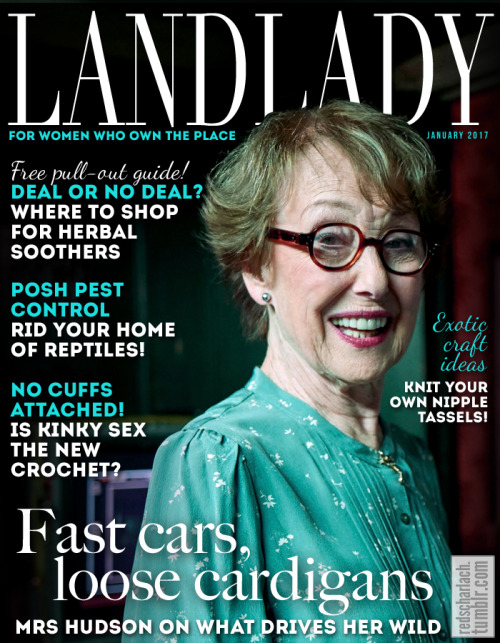
Such an arresting fan illustration by Red Scharlach of a magazine cover for the inimitable Mrs. Hudson from Mark Gatiss’s and Steven Moffat’s Sherlock, played by Una Stubb:
An awesome cover for an awesome character. Kudos!
In Making Stuff occasional feature, we share fun arts and crafts done by us and our fellow geeks and nerds.
I saw the first season well after it had broadcasted. It’s clear that it merely scraped the surface of the story, but I liked it enough to want more. The writing managed quite well to avoid infodumps while giving us enough to understand any given situation. Most of the cast was new to me, but I enjoyed their performances. Detective Miller was the most boring character of all; I liked the crew of the Rocinante, though, especially Nagata and Burton.
Season 2 will be out February 8, 2017.
Hey, look! We found a thing on the internet! We thought it was cool, and wanted to share it with you.
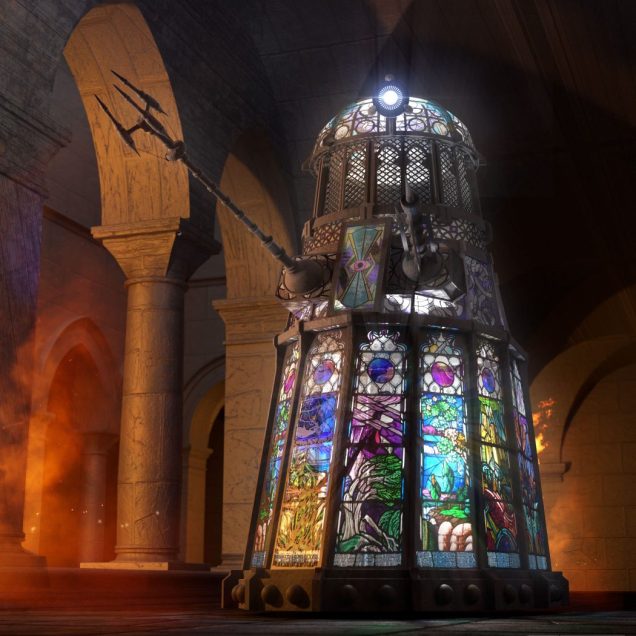
Did you see this amazing stained glass Dalek already?
Producer / director / writer Jamie Anderson worked with designer Chris Thompson to help make the lead and stained glass Dalek a reality. It’s based on a Doctor Who audio drama script by Mike Tucker called Order of the Daleks.
“My main thought process was to create a “Gothic” Dalek and replace all the flat surfaces with glass designs. My initial sketches had palisades, crowns, spikes and other gothic elements, but we decided to dial a lot of these back for story reasons. In the episode itself these Dalek casings are made by very primitive monks so the focus needed to be on the stained glass and not the metal elements.”
We’ve been watching The Shannara Chronicles. (We only watch series on DVD, so we’re still working our way through season 1). It’s some of the worst television I’ve seen in a while, and I can’t wait to see more.
One trailer park elf, one spoiled princess, and one edgy ex-bandit, coming right up. Image via IMDb.
Make no mistake, The Shannara Chronicles is terrible. The plot is a meandering soap opera mashed together from two parts Tolkien (a band of hobbits teenagers, occasionally aided by a grumpy wizard druid, must carry the magical ring seed to a distant place through a strange wilderness in order to save the world from a dark lord warlock who mostly just chills out in his tower henge being all evil and stuff) and one part Hunger Games (a tedious teenage love triangle between one girl half-elf boy and two boys girls—one rugged, the other sophisticated—in a vaguely-defined post-apocalyptic North America). Episode scripts are written Mad-Lib style: Dire warning about [peril] goes unheeded, recurring bandit guy threatens to [do something awful], someone explains [plot point] to the confused half-elf dude, princess has to be saved from [unheeded peril].
Yet despite its flaws, Shannara Chronicles manages the trick that most bad television doesn’t: to be both bad and enjoyable. More remarkably, it has managed this feat while remaining convinced of its own seriousness, instead of embracing its camp absurdity like most other beloved bad SFF shows, from Batman to Xena.
There are beautiful things under the layers of bad storytelling. Image via IMDb.
It’s hard to explain why I enjoy Shannara. Taste, of course, is subjective: one viewer’s guilty pleasure is another’s eye-roll marathon. I think there are three things about it that work for me:
The diamonds among the dross. Shannara is a kiwi production and I watch it in much the same spirit that I watch Peter Jackson’s Hobbit movies: for the moments of beauty buried in the failings of concept and writing. The visual design is inventive and sometimes startling. Among the actors there are some shining stars like John Rhys Davies, Jed Brophy, and Manu Bennett improving the lackluster scripts with their performances. Plus New Zealand scenery is always worth seeing.
We’re starved for good fantasy. I like classic fantasy. I like it better when it’s done well, but in the absence of that (or when showrunners think that doing fantasy well means adding as much torture, rape, and pointless death as possible), I’ll take it done badly. Plus, it’s refreshing to see a post-apocalyptic story in which the post-apocalypse is a quaint side note to the plot rather than a weight around its neck.
The straight line is funnier than the joke. Comedy is well and good, but sometimes the best laughs come from people who don’t know they’re funny, and if the creators of Shannara know how funny they’re being, they aren’t letting on. I enjoy groaning at the teenage drama, the princess who has to be saved from something once an episode, the elite Elven soldiers who get themselves clobbered by bandits in under ten seconds, and the rest of the show even more when there isn’t a wisecracking sidekick poking me in the ribs and saying Hey, didja see what we did there? Huh? Huh?
Because this is totally how you dress to save the world. Image via IMDb.
In 2016, this terrible year in which some disasters hit with the shock of a thunderbolt and others drag on like a cold you can’t shake, the small-scale disaster of a wonderfully bad tv show is just what I need to take my mind off the rest of the world for a few hours.
In the Seen on Screen occasional feature, we discuss movies and television shows of interest.
I’m most interested in Arrival (based on a story by Ted Chiang and out very soon now!), Altered Carbon by Richard K. Morgan, and Lilith’s Brood by Octavia E. Butler. It would also be great to see Ann Leckie’s Ancillary series, Red Mars by Kim Stanley Robinson, and Daniel José Older’s Bone Street books on screen.
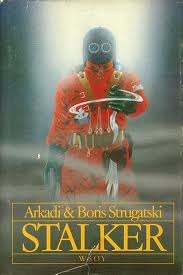
It was also intriguing to see Roadside Picnic by Arkady and Boris Strugatsky on the list, for I’m not used to seeing Eastern bloc SFF authors in the Anglo-American market. According to the all-knowing Internets, Roadside Picnic was turned into a Russian SFF art film Stalker in 1979. I never saw that, but did read the Finnish translation (Stalker: huviretki tienpientarelle) when I was too young to really understand it, so it would be nice to refresh my memory.
Besides works in progress mentioned in Zutter’s list, I’m looking forward to OtherLife. It’s adapted from Kelley Eskridge’s Solitaire (2002), which I read only this year and loved. Unfortunately, OtherLife seems currently to have paused in post-production. We live in hope, though! (I’ve been following the story of its development on Eskridge’s blog; do visit for a glimpse of indie movie projects from a writer’s perspective.)
Anything on your radar that especially tickles your fancy? Do share!
Monday is when I write, from a historian’s perspective, about some interesting or useful tidbit for writers, especially writers of genre fiction. I’m doing that again today, but from a different angle. Today I want to talk about representation, specifically the representation of people who are not straight white cis men in books, television, movies, games, and other media.
First things first: I’m a straight white cis man with no significant mental or physical challenges. I am a native-born citizen of the country in which I live and a native speaker of its majority language. I am financially secure and socially comfortable. I am not, as far as I know, heir to any titles of nobility, but other than that, if a privilege exists in the world, I’ve probably got it.
Yeah. I’m about to talk about representation. If anyone wants to get off this ride, now’s the time.
When creators and fans talk about adding representation to popular media, the refrain from people who look like me is often: “Why do we have to have X in this story? What do you mean you can’t identify with the characters? Why can’t all you Xes identify with people who aren’t exactly like yourselves?”
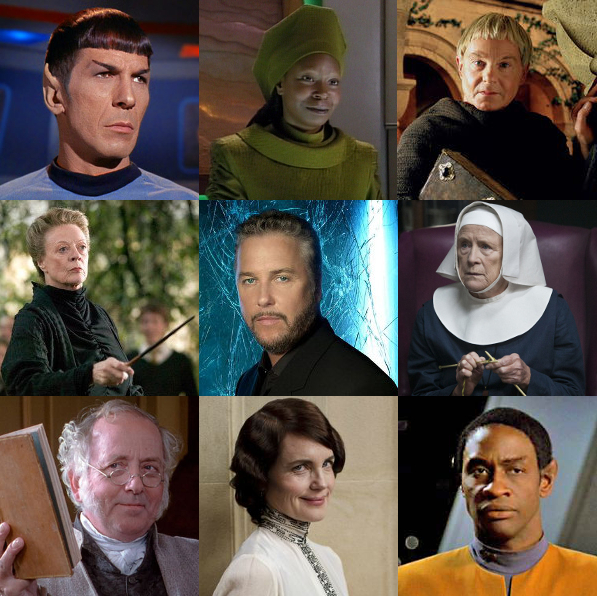
I understand where this response comes from. There are white guys all over the place in popular media, but I’ve never identified with a character just because he was a white guy. There are so many of them that I couldn’t identify with them all if I wanted to. When I look at a character and think Hey! That’s me! it comes from traits other than outward identities. Here are some of the characters I’ve felt connected to over the years:
Spock (Star Trek), Guinan (Star Trek: The Next Generation), Brother Cadfael (Cadfael novels and tv series), Minerva MacGonagall (Harry Potter novels and films), Gil Grissom (CSI), Sister Monica Joan (Call the Midwife), Mr. Bennet (Pride and Prejudice), Cora Crawley (Downton Abbey), Tuvok (Star Trek: Voyager)
They’re not all the same gender, race, age, or even species as I am. Two of them are members of a religious order, and I’m not religious at all. Most of them don’t even (fictionally) live in this century.
What can we learn from this collection? (Other than that I have a thing for Vulcans and a rather inflated sense of my ability to dole out wise advice to young ‘uns.) That representation is an aspect of privilege even when you’re not being represented. Having white guys all over the place frees me to look at the characters in my media and identify with them not based on the outward categories they fall into but because they’re thoughtful, introverted, curious, even-tempered, and passionate about knowledge.
On the other hand, I am a member of a very small minority who is rarely represented in media, and then usually in a dismissive, stereotyped, even offensive way: history professors. According to most books, movies, and tv shows, we are boring, joyless pedants in tweed jackets with elbow patches who obsess over minutiae and care only about names and dates.
“Easily the most boring class was History of Magic, which was the only one taught by a ghost. Professor Binns had been very old indeed when he fell asleep in front of the staff room fire and got up the next morning to teach, and left his body behind him. Binns droned on and on while they scribbled down names and dates, and got Emeric the Evil and Uric the Oddball mixed up.”
– J. K. Rowling, Harry Potter and the Philosopher’s / Sorcerer’s Stone Ch. 8
We always wear period clothes and are at best dimly aware of what century we actually live in, if not actively in denial about it.
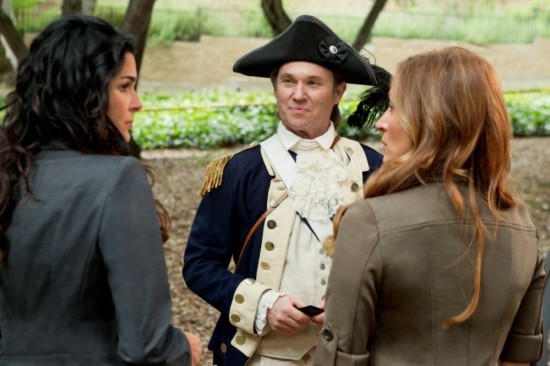
Professor Dwayne Cravitz from Rizzoli and Isles s. 2 ep. 6 “Rebel Without a Pause”
(Not to mention that we make our (black) graduate students do unpaid labor so that they can have the “authentic slave experience.”)
Oh, and if we’re medieval historians, we’re indistinguishable from renfaire performers. (I can’t find a link to it now, but the memory is seared in my mind of an NPR interview with a scholar attending the annual medieval studies conference in Kalamazoo which made it clear the interviewer thought it was basically a fantasy convention.)
Come on by my history class sometime. I won’t be wearing a costume or droning on about names and dates. I’ll be deep in conversation with my students about social structures, economic forces, multicultrual interactions, source analysis, and all the other interesting parts of history.
Now, history professors are not, by any stretch of the imagination, a historically oppressed or marginalized group. I know how aggravating it can be to be badly represented even as a comfortably privileged middle class white man, but I can’t really imagine what it must be like to be, say, a Native American woman, or a gay man who uses a wheelchair, or a Muslim teenager with Asperger’s, and have to deal with not only the weight of the social disadvantages that come with that and seeing people like myself so rarely and poorly portrayed in media.
Of course we can all identify with people who aren’t like us. That’s not the point. The point is that, no matter who we are, we all deserve to see enough people outwardly like ourselves in books, television, movies, and other media that we don’t have to identify with them just to feel like we’re there.
History for Writers is a weekly feature which looks at how history can be a fiction writer’s most useful tool. From worldbuilding to dialogue, history helps you write. Check out the introduction to History for Writers here.
Browsing Tumblr the other day, I ran into what looked like stills from a scifi series. My immediate reaction was “What is this? Who’s she? I wanna see it!!”
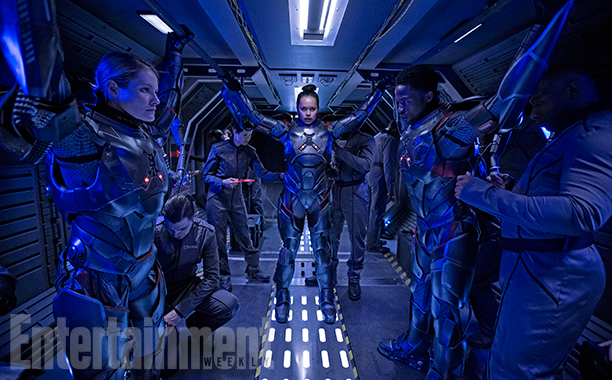
Turns out they were indeed scifi show stills. The pictures come from an article by Dalton Ross on Entertainment Weekly. He talked with The Expanse showrunner Naren Shankar about a new character introduced in season 2, and shared these photos.
The commanding presence that drew my eye is marine Roberta “Bobbie” Draper from Mars, played by New Zealand actress, model, and boxer Frankie Adams.
Mr. Shankar talked about casting Ms. Adams for the role:
“When you ask a casting director to find a 6-foot half-Polynesian, the response is usually one of stunned silence, like, ‘Really?’ And we were like, ‘Yeah, really.’ We’ve been very conscious about maintaining the ethnic identity of the characters in the book as much as humanly possible. And we were really intent on doing that with Bobbie.
“We actually looked in the U.K., Los Angeles, New York, Toronto, Hawaii, and New Zealand. And when [co-author] Ty Franck saw the first casting tape on her, he said, ‘That’s her, that’s her,’ right away. She’s a professional boxer, as well as being a model and so she had the physicality and a very interesting, unusual kind of face you rarely see on television. She’s awesome and we couldn’t be more delighted to have her on the show.”
I have to say that the third shot (above) reminds me a lot of the 2004 Galactica reboot. I’ve only seen the pilot for The Expanse, though, and that streamed over a very hiccupy connection. It looked interesting, but for some reason or another I never got back to it.
I seriously hope that Bobbie won’t just be another case of Strong Female Character syndrome. Kick-ass female characters can be awesome, and they are definitely an improvement over women as mothers or love interests. But I’m done with women written as one-dimensional beings, be it demure damsels in distress or forceful fighters.
I want the people in my entertainment to be complex and three-dimensional regardless of their gender. Whether The Expanse delivers or not will remain to be seen, though. (Haven’t read the books that it’s based on, so I’ve nothing to go on there.) Apparently I now must check out season 1 in order to see season 2 when it comes out. 🙂






.jpg)


