ESA’s Video Flying Over Xanthe Terra on Mars

The European Space Agency has released a new three-plus-minute Mars flyover video based on images transmitted by the Mars Express orbiter.

According to Phys.org,

ESA’s Mars Express takes viewers on a flight over Xanthe Terra, a highland region just north of the equator. The film is a mosaic created from images taken during single-orbit observations by Mars Express’s High Resolution Stereo Camera (HRSC). The images were combined with topography information from a digital terrain model (DTM) to create a three-dimensional view of the Martian landscape. The main feature in this video is Shalbatan Vallis, a 1300 km-long (~800 mi) outflow channel that transitions from the Southern Highlands to the Northern Lowlands.

ESA Xanthe Terra Mars Express Screencap

(Note: The image above is merely a screencap; follow the text links to see the video on ESA’s site.)

There are two amazing things about this video. First, as large as the area clearly is, compared to the rotating image of the planet in the very beginning, the features we see are completely dwarfed by Valles Marineris (the huge canyon south of Xanthe Terra). And second, the amount of detail is surprisingly ample. I wonder how much an exogeologist would be able to deduce?

I’ve said it before, and I’m sure I’ll say it again: it is a very good time to be a space geek. 🙂

(Also interesting to me, at least, is that since the video is silent, my brain started playing the main theme from the movie Gravity. Space imagery must be accompanied by majestic music now?)

Found via File 770.

Repurposing Old Wind Turbine Blades as Bike Shelters

Apparently, for a good long while, retired wind turbine blades were difficult to deal with. (Sounds like recyclable blades have since been created.) They were made of materials that can’t easily be recycled and are bulky to just dump.

Repurposing used blades has been an obvious solution. But as what? Among others, they’ve been turned into utility poles, playground equipment, bridge girders, and park benches, for example. In addition, in Aalborg, Denmark, sections of old, disused wind turbine blades have been set up as bike shelters.

WEF Siemens Gamesa Turbine Bike Shelter

This is an older project by now, but I thought it clever and worth noting. Also, it’s cool how the shape of the repurposed section nods just a tiny bit towards the Art Nouveau spirit.

Image by Siemens Gamesa, found via World Economic Forum

This Is What I Want an AI to Do

One of the most prominent topics currently is artificial intelligence. Of course everyone knows—or should know—it’s not real intelligence as we generally understand it. The term seems to have some real staying power, though.

Regardless of what one wants to call the current iterations, machine learning or algorithm-based systems appear to be here to stay. People are starting to figure out what they could be used for in everyday life, not just at the office or lab.

One popular sentiment among creatives goes along the lines of: I want AI to do the dishes for me so I can create, I don’t want AI to create for me so I can do the dishes. I hear you, fellow creatives, and agree! This post talks about what I’d want those systems to do for me. (Eventually. We still must solve several issues, e.g. how to program them without egregious copyright breaches, to mention just one.)

(Please also note: I do realize that computing takes a lot of energy and materials, and that energy production and extraction of minerals aren’t unproblematic processes. Also, the ethics of the current generative models need serious attention; I’m still fuming over Meta’s massive book pirating as revealed by The Atlantic. The point of my post is not to dwell on the problems, however. This is basically just a random, long-winded wish list.)

TL;DR: My preferences boil to complex tasks, specificity instead of generic sludge, and effective analysis of massive amounts of data.

Below is a non-comprehensive list of some specific tasks I want done better, whether by “AI” or not, in no particular order.

Continue reading

Quotes: Google Has Essentially Broken Its Key Product


The so-called artificial intelligence (AI) is a divisive topic. Abigail Nussbaum writing at Lawyers, Guns and Money argues:

“The companies that make AI—which is, to establish our terms right at the outset, large language models that generate text or images in response to natural language queries—have a problem. Their product is dubiously legal, prohibitively expensive […], and it objectively does not work. All of these problems are essentially intractable. […]

“That non-technology industries are falling for this spin [that AI is inevitable] is perhaps unsurprising […] What’s more interesting is that other Silicon Valley companies are doing the same, even though, again, the result is almost always to make their product worse. Google has essentially broken its key product, and Microsoft is threatening to spy on all its users and steal their data, all because a bunch of CEOs have been incepted into the idea that this technology is the future and they cannot afford to be left behind.”

Nussbaum is packing quite a bit into a relatively short post. With regard to the claim that Google’s search engine is broken, she refers to an article in The Verge by Elizabeth Lopatto. Lopatto in turn provides some examples that are truly hair-raising: apart from unusable—or plain wrong—data, Google has offered potentially life-threatening answers to user queries.

Personally, for at least a decade if not longer, I haven’t used Google unless I can’t get anything sensible out of other engines, so I’m not the best person to comment on Google specifically. However, I have noticed that pretty much every search engine I’ve tried has gotten worse.

(Please note that my opinion below is based on my experience as an information professional, and on the experiences of my friends and acquaintaces as well; I don’t want to repeat in my experience in every other sentence. Please also note that your experience may differ, and that I am aware of this possibility. And, finally, please note that this is an opinion post, so I will be selective with my point of view and using hyperbole.)

For one large problem, ads are rife among search results. It used to be possible to see a page of results with a couple of ads. Now it’s almost a page of ads with a couple of results sprinkled in for appearance’s sake. I understand the necessity of procuring funding. What I do not understand is destroying customer trust by no longer providing the service you claim to provide.

WTF Is This Cat

For another, advanced search is disappearing. (Here Google does seem to work slightly better than its competition, at least in some contexts, at least some of the time.) One example of a basic operation that’s stopped being reliable is excluding a word from your query by typing a minus in front of it; the term almost always if not always shows up in your results anyway. Another example is specifying a phrase by surrounding it with quotation marks. For example, at times I want to check a new-to-me multi-word term, or try to find a phrase I only hazily remember. But that only works if the search works. Even if it does work, an engine might offer other phrases containing your search terms, just in a different order. Obviously that isn’t helpful. A recent example is “price cliff”, for which Google offered the Instagram profile of one “Cliff Price” among the top results. Categorically not what I was looking for!

Your Decision Is Stupid-Ass

The results might also be interspersed not just by ads but other irrelevant blocks (People also ask” or Related Searches” or such). Granted, related searches do have their use; there are times when it is helpful to see adjacent topics or terminology. They definitely shouldn’t take space from the most relevant results, though, and the suggestions must actually be, you know, related to be relevant.

Further, search engines have stopped displaying the number of results for a query. (Remember when that was a thing?) These days it’s anyone’s guess whether you’re being served with a butt-load or a crap-ton of increasingly poor results.

Finally, at worst your search engine of choice will serve pop-ups in the margins (See all!” “More from source!”) or push their “mobile experience”. *sigh*

Inigo-Montoya-WORD-MEANS

These days, the search engine “experience” (WTH is that even supposed to be?!?) is like going to a restaurant and ordering pasta, but being served paste instead: not at all what was expected, entirely wasteful, and potentially harmful—and if you were to claim that the deliverable is “close” to the request, it is just insulting.

SATW Computer Technician Snippet

If this is what “smart” business people believe counts as quality output these days, I wouldn’t trust them to think their way out of a pillow case. (Yes, a pillow case, since the poor airbrains would probably hurt themselves with something as sharp as a paper bag.)

According to BBC, a Google spokesperson has defended AI-created overviews saying that “[t]he vast majority […] provide high quality information, with links to dig deeper on the web”. Speaking of vast majorities, most people are just not interested in digging and absolutely will not dig deeper; they want a clear-cut answer and they want it quickly. That means improving the quality of results, and neither the recent, pre-AI iterations nor the curret AI-“improved” engines deliver that.

I can’t think what the heck is up with the encrapification of search engines. Or why does it seem absolutely necessary to keep tweaking a good product what feels like every few months until it’s unrecognizeable.

Is it sunk cost fallacy? A form of mass hysteria spreading from Silicon Valley? Is maintaining a steady level of good service so moth-eaten a concept that it can’t attract resources anymore beyond the barest minimum? Are developers (or developers’ bosses) really that unable to comprehend that a change does not automatically mean an improvement? Is the only thing that matters the ceaseless chase after new features, regardless of whether they will shape up your service or shatter it?

Dog Chases Lead around Tree

It’s so frustrating, in any case. We, here, are nerds and do at times dig very deep. Sadly, these days search engines often hinder research instead of helping. Lately I’ve noticed that I’m turning more to bookmarks saved in my browser, or pick a specific site I’ve vetted earlier. It’s obviously not a foolproof answer, either, because I need to remember which entity has or might have the information I’m after in order to go and search their pages.

I’m quite ready to live in the most boring of times, with reliable basic services, please and thank you.

Images: Confused cat via Meme Binge on Flickr (CC BY 2.0). Your Decision Is Stupid-Ass via QuickMeme. Inigo Montoya via Imgur. Computer Technician, detail of a Scandinavia and the World comic by Humon. Dog chasing its lead via GifBin.

Living in the Science-Fictional Now: Smart Contact Lenses Powered by Solar Cells and Blinking

Move over, flying cars. Also, 3d-printing living cells onto internal organs, your moment in the limelight is over. For here come smart contact lenses.

Despite its unfortunate publishing date—Apr 1st—the article in IEEE Spectrum on smart contact lenses powered by solar cells and blinking seems to refer to a genuine invention.

An article in the journal Small on March 13, 2024, by Erfan Pourshaban et al. introduces a self-contained on-the-eye power source. Their device combines flexible silicon solar cells with an electrochemical harvester based on the principle of metal-air batteries. This harvester is activated by the blinking motion and uses tear electrolytes for the harvesting. Finally, the two energy generators were integrated with a power management circuit for a stable voltage and to compensate for weak solar cell performance under low-light conditions.

According to Pourshaban et al., their self-standing power pack could even power drug delivery systems, diabetic sensors, or readout sensors in smart contact lenses.

Wiley Online Library Pourshaban et al Fig4
Integrated power pack for a smart contact lens by Pourshaban et al.; a) Exploded view of the flexible power pack’s components, b) circuit diagram of the entire power pack, c) PDMS-encapsulated power management circuit and the flexible solar cell mounted on an eyeball replica, and d) power pack’s electrical status under natural eye blinking conditions.

I haven’t seen much mainstream reporting on this, but it sounds very exciting to me! The technology has so far been tested on a curved platform that emulates the human eyeball with a 3d-printed eyelid. A long way is still needed for any actual human use, I’d imagine, but the treatment of various eye-related complaints such as glaucoma, dryness, chronic ocular surface inflammation, and vision issues might become much easier. There may also be potential for more science-fictional uses, like in-eye displays.

What an amazing time we live in!

Image by Pourshaban et al. via Wiley Online Library

World’s First eVTOL Taxi Is Now on the Market

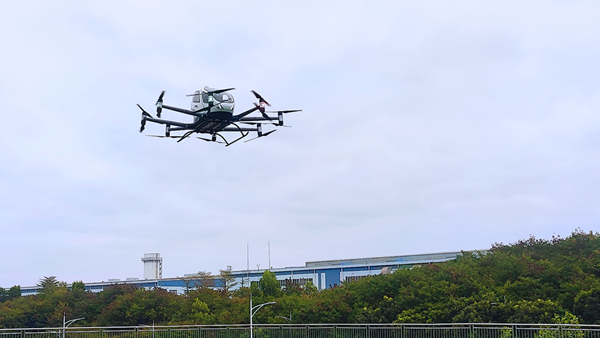
According to Reuters, Chinese drone maker E Hang Holdings has started selling an eVTOL taxi on Taobao, a Chinese online shopping platform. EHang was certified for traffic by China’s aviation authority in October 2023.

EHang 216-S Airborne

The model, EH216-S, is an unmanned vehicle with 16 rotors and capacity for two passengers. Its maximum speed is 130 kilometres per hour and range 30 kilometres. It retails for about €300,000 (depending on exchange rates).

At first glance, around 300,000 euros sounds quite steep. Then again, in the U.S. market at least, pickup trucks can go for almost $100,000. That’s not even mentioning exotic cars, sports cars, and other specialized vehicles.

The bottleneck at the moment surely is the combo of safety regulations and pragmatics (the lack of infra). It seems that charging points for electric vechicles are being built so slowly, I cannot imagine what it would take to try and fit the maintenance facilities and parking spaces for flying cars, let alone flying electric cars, into our cities in a larger scale. Plus, what it would take to figure out how, in practice, they would fit into existing traffic patterns. It looks, though, that we might have to resolve those questions sooner than I thought.

Image by EHang

Living in the Science-Fictional Now: 3d-Printing Living Cells onto Internal Organs Is Imminent

A team of University of New South Wales researchers have unveiled a small and flexible device for 3d-printing living cells onto internal organs. The experimental robot named F3DB could, according to the UNSW Sydney newsroom, “potentially be used as an all-in-one endoscopic surgical tool”.

YouTube UNSW Community F3DB

The UNSW Medical Robotics Lab team to pioneer this device is led by Dr. Thanh Nho Do and include among others Mai Thanh Thai, Dr. Hoang-Phuong Phan, and Professors Nigel Lovell and Jelena Rnjak-Kovacina. The device was demonstrated inside an artifical colon and on a pig’s intestine.

The technology isn’t yet commercially viable, but potentially within 5-7 years it could. You can access videos of F3DB in action via the UNSW Sydney newsroom.

Wow—3d-printing inside a human body. Not just within my lifetime, but plausibly in less than 10 years. Makes the various 3d-printed cultivated foods that are in development (e.g. fish fillets) sound like child’s play.

I’m flabbergasted.

Image: screencap from F3DB all-in-one endoscopic surgical tool by UNWS Community on YouTube

FYI: No More Automated Tweets

A book-keeping / back-end type of notification: There won’t be any more automated tweets for new posts.

We decided to disconnect the Co-Geeking Twitter account from WordPress. (To be specific, WordPress had to remove the automatic-posts-to-Twitter functionality due to Twitter changing their API on short notice.)

SATW Computer Technician Snippet

You can keep checking manually, or subscribe to be notified of new posts.

Image: Computer Technician, detail of a Scandinavia and the World comic by Humon

Announcements from your hosts.

James Webb Telescope’s Breathtaking Protostar Image

The James Webb Space Telescope has taken near-infrared images of the protostar within the dark cloud L1527, providing insight into the beginnings of a new star. Below is the most spectacular of the images that NASA released.

NASA James Webb Protostar L1527


Here’s NASA’s description of the image:

“The protostar itself is hidden from view within the ‘neck’ of this hourglass shape. An edge-on protoplanetary disk is seen as a dark line across the middle of the neck. Light from the protostar leaks above and below this disk, illuminating cavities within the surrounding gas and dust.
“The region’s most prevalent features, the clouds colored blue and orange in this representative-color infrared image, outline cavities created as material shoots away from the protostar and collides with surrounding matter. The colors themselves are due to layers of dust between Webb and the clouds. The blue areas are where the dust is thinnest. The thicker the layer of dust, the less blue light is able to escape, creating pockets of orange.”

Wow. It’s really stunning, isn’t it?

Considering how much incredible data the James Webb has already gotten in its first year (and I’m not even properly following its work), I cannot conceive how much more it’ll provide in its decade-long planned mission.

Image by NASA and the Space Telescope Science Institute

Out There highlights intriguing art, places, phenomena, flora, and fauna.

Living in the Science-Fictional Now: Flying Cars Are Closer than Ever

Flying cars have been dreamed of as long as cars have been around. If certain projects or companies are to be believed, flying cars will actually become available soon. For certain values of soon, anyway, and for certain values of car.

Current designs are as varied as the propulsion technologies and terminologies: flying cars, hovercars, gyrocopters, passenger drones, quadcopters, VTOL aircraft, eVTOL, maglev cars, personal air vehicles… Whatever you call them, aircraft that look less like airplanes and more like other small personal vehicles do seem be closer than ever to everyday reality.

Klein Vision AirCar in Flight Sm

For example, Volocopter’s air taxis have been demonstrated in Singapore (2019). The Dutch PAL-V Liberty gyroplane has not only test flown (2012) but also been approved for road use in Europe (2022). The AirCar by Klein Vision (pictured above) has completed a test flight between two cities(!) in Slovakia (2021) and received a certificate of airworthiness from the Slovak Transport Authority (2022). Reportedly, recent projects are also ongoing in Turkey and China. And, related to flying cars, a smart city and tourist destination being built in northwestern Saudi Arabia—dubbed Neom—has been planned for rail traffic and air taxis according to some reports.

Now, I’d assume all of the above is predicated on plentiful energy. How P*tin’s attempted extortion of Europe’s energy market (which has wider ripple effects, I’m sure) affects the development of flying cars will remain uncertain for some time yet.

I have to say, if flying cars do become common enough to be relatively easily available, I am tempted to get a pilot’s license (whatever kind might be required)—if I’m not too old by that time. (Planes are too high a hurdle, but small personal vehicles might just do for me.)

As a linguist, though, I’m mostly engaged with the question of a handy everyday name. That, too, is likely to be wrangled over at least as much as the technology side of their development.

Image: AirCar by Klein Vision

Hey, look! We found a thing on the internet! We thought it was cool, and wanted to share it with you.