The Oldest Active Library in the World

The library attached to al-Qarawiyyin mosque and university (alternate western spellings include Al Karaouin and Al Quaraouiyine, among others) in Fez, Morocco, is not just the oldest active library in the world, it’s also exceptionally beautiful.
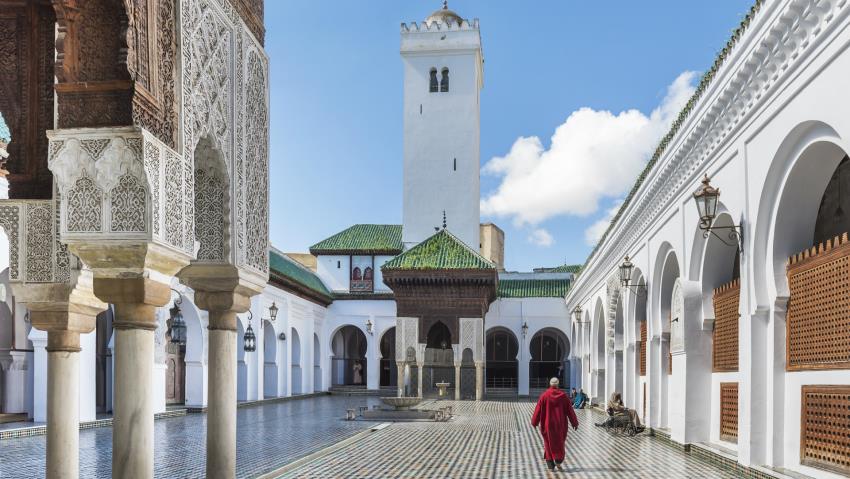
TheNewArab al-Qarawiyyin Library Courtyard 479

Al-Qarawiyyin was founded in 859 by Fatima Al Fihri. The architecture of the university reflects various past styles and ruling dynasties. The decorated interiors include calligraphic designs on the walls, ceramic patterns on the floors, and wooden carvings on the ceilings.

TEDcom al-Qarawiyyin Main Reading Room aziza_chaouni_img_2096

From 2012 to 2016, the library was completely renovated. The restoration was lead by architect Aziza Chaouni. She describes the starting point for her project at TED.com:

“When I first visited, I was shocked at the state of the place.

“In rooms containing precious manuscripts dating back to the 7th century, the temperature and moisture were uncontrolled, and there were cracks in the ceiling. […]

“Throughout the years, the library underwent many rehabilitations, but it still suffered from major structural problems, a lack of insulation, and infrastructural deficiencies like a blocked drainage system, broken tiles, cracked wood beams, exposed electric wires, and so on.”
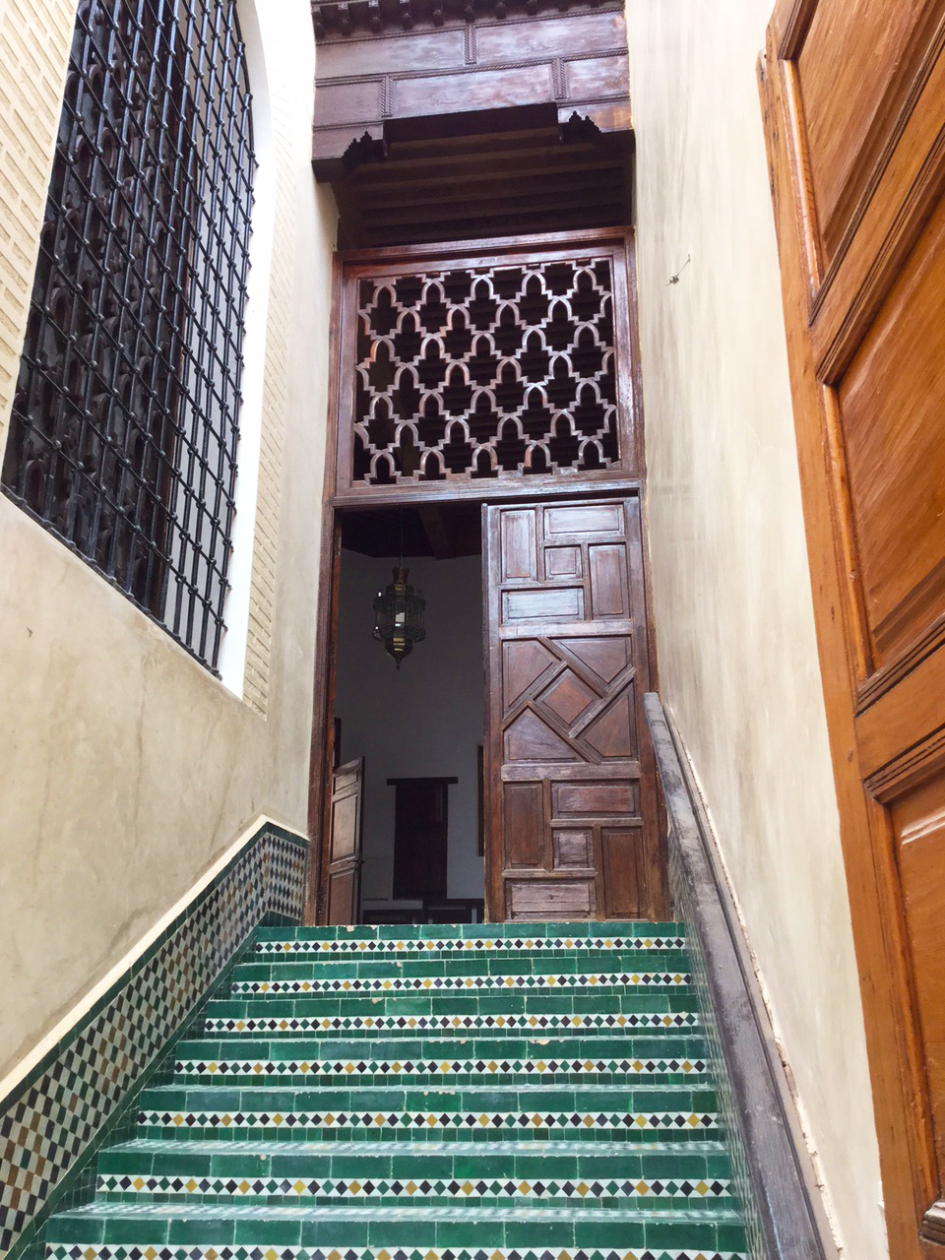
TEDcom al-Qarawiyyin Entrance Main Reading Room aziza_chaouni_img_2100

One of Chaouni’s leading principles was respect to its authenticity. Her restoration team preserved and salvaged what they could, but when it wasn’t possible, features and details were created from scratch. This included using local materials and construction systems, like furniture by local craftsmen who used native wood. Says Chaouni:

“There has to be a fine balance between keeping the original spaces, addressing the needs of current users, including students, researchers and visitors, and integrating new sustainable technologies — solar panels, water collection for garden irrigation, and so on.”
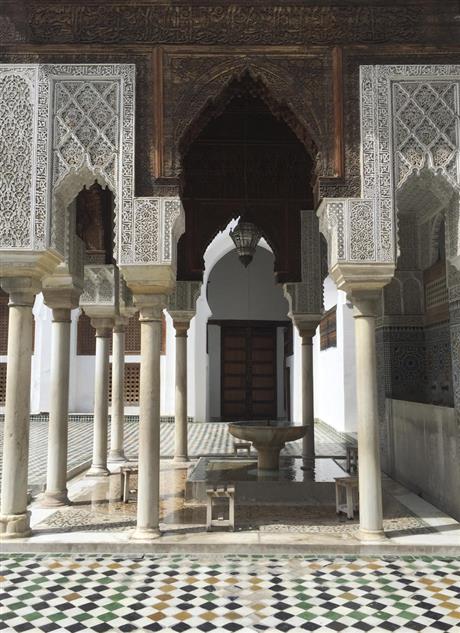
TheBigStory al-Qarawiyyin Fountain Samia Ezzarrouki 460x

Currently a part of Morocco’s state university system, the library is now open to the public in addition to historians and students.

(Incidentally, the university’s famous alumni include the 16th-century Andalusian adventurer known as Leo Africanus, whose book Description of Africa was considered the most authoritative source for northern Africa until the beginning of European exploration and expansion in the African continent.)

More photos at The New Arab, TED.com, The Big Story, Tor.com and BookRiot.

Images: Courtyard via TheNewArab; main reading room and entrance to main reading room by Aziza Chaouni via TED.com; fountain by Samia Errazzouki via The Big Story.

The Visual Inspiration occasional feature pulls the unusual from our world to inspire design, story-telling, and worldbuilding. If stuff like this already exists, what else could we imagine?
Quality Research Resources by Private Individuals

I wrote last week about what a fantastic thing it is to have a wealth of primary sources stored in libraries and museums, nowadays increasingly being made available online. For completeness’s sake, it needs to be mentioned that it’s not only library and museum professionals that share quality research or materials online.

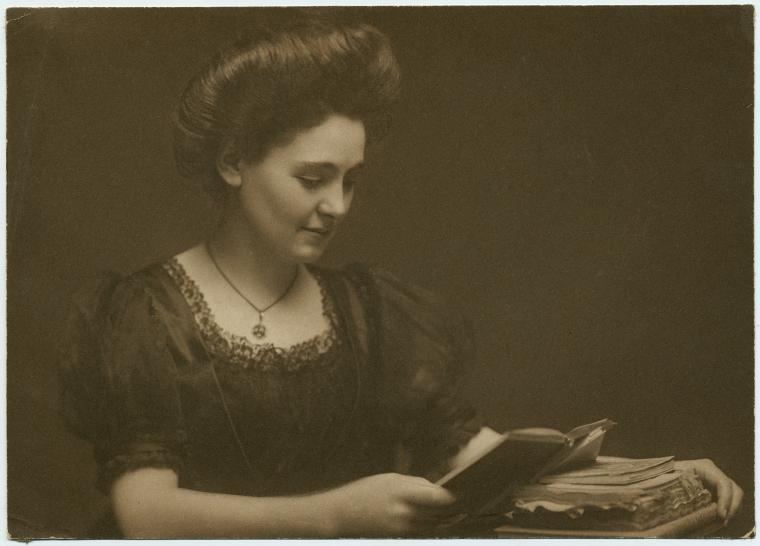
nypl-unidentified-woman-reading-a-book
Unidentified woman reading a book via NYPL, Manuscripts and Archives Division (1913; photograph)

Below I list a (very) few linguistic and historical resources put together by dedicated private individuals. They’re all diligent in documenting their steps and sources, and providing info and links for those interested in finding more. Thorough documentation is, again, not a surefire way to avoid mistakes, but it does allow tracking sources and re-creating the research.

A short list, to be sure, but what better than that to add to. 🙂

Out There is an occasional feature highlighting intriguing art, spaces, places, phenomena, flora, and fauna.

The Glory of Library and Museum Materials

I really love the Internet for research. It connects us to materials and people around the world. As a visual person, I find the availability of photographs and other visualizations on just about any subject especially gratifying. You can visit places and eras that you physically may not be able to.

NYPL Digital The Drawbridge

One of the invaluable services libraries and museums provide, especially now that more of their collections are being digitized, is access to historical periods and obscure topics. (Like the Peter Parker collection of 80 paintings of Chinese patients with large tumors or other major deformities – that’s not a joke!)

And that’s only the beginning – using library and museum websites and digital collections to find primary sources for research has other benefits as well:

  • Copious metadata: the provenance (origins and history) of documents or items, including details like dates, original creators, owners, and chain of custody, are clearly marked when known, and when unknown, that is clearly stated, too.
  • Materials that physical items were made of are also given, often with information on the techniques involved or links to further reading in connection with museum exhibits.
  • Many libraries and museums group items in their digital collections into more easily browsable subgroups, for example by era, style, type, or topic.
  • Copyright information is easily available: any limitations to re-using the materials are clearly given. There are also collections that concentrate on items that are in public domain.
  • If digital materials are made available for re-using, often there are multiple formats, sizes, or resolutions. That’s great service!
  • Sets of search results are often smaller than online in general. Finding an answer is faster!
  • Digital collections are created by professionals. While this doesn’t completely eliminate the possibility of errors, online materials at libraries and museums are researched, curated, and checked, which increases the reliability of the information provided.
  • If additional information or clarification is needed, it’s the job of museums and libraries to at least try to help. That’s literally why they’re there!

Below are just some amazing digital collections from museums and libraries around the world:

Must. Resist. Internet. Rabbit. Holes!

Image: The Drawbridge via NYPL (The Miriam and Ira D. Wallach Division of Art, Prints and Photographs: Print Collection, The New York Public Library, New York Public Library Digital Collections; 1748-1751; etching; by Giovanni Battista Piranesi)

Out There is an occasional feature highlighting intriguing art, spaces, places, phenomena, flora, and fauna.

NYPL Releases Thousands of High-Res Public Domain Images

The New York Public Library released a treasure trove of 180,000 high-resolution scans of public domain images. They include photographs, etchings, watercolors, sheet music, maps, illuminated manuscript images and other pages from books, stereoscopic views, and more. The oldest materials date back as far as the 11th century. With their visual search you can browse by century, genre, collection, and even color.

NYPL Public Domain Img Collection
Visual browse tool’s color view via NYPL Manuscripts and Archives Division

According to the NYPL:

“Did you know that more than 180,000 of the items in our Digital Collections are in the public domain?

“That means everyone has the freedom to enjoy and reuse these materials in almost limitless ways. The Library now makes it possible to download such items in the highest resolution available directly from the Digital Collections website.

“No permission required. No restrictions on use.

“Below you’ll find tools, projects, and explorations designed to inspire your own creations—go forth and reuse!”

I know I’m going to be using the collection a lot!

Out There is an occasional feature highlighting intriguing art, spaces, places, phenomena, flora, and fauna.

Fantastic Worlds Exhibit at The Smithsonian

The Smithsonian’s new exhibit Fantastic Worlds: Science and Fiction, 1780-1910 opened on July 01, 2015. In addition to the physical exhibit, the Smithsonian Libraries provide an online version.

The Smithsonian Libraries online exhibit Fantastic Worlds.

From the online exhibit description:

“Travel with us to the surface of the moon, the center of the earth, and the depths of the ocean — to the fantastic worlds of fiction inspired by 19th-century discovery and invention.

“New frontiers of science were emerging. We took to the air, charted remote corners of the earth, and harnessed the power of steam and electricity. We began unlocking the secrets of the natural world. The growing literate middle class gave science a new and avid public audience. Writers explored the farther reaches of the new scientific landscape to craft novels, hoaxes, and satires.”

The online exhibit reveals a new thematic component (or chapter) each Tuesday. So far we’ve seen “Terra Incognita” and The Age of the Aeronaut”. The chapters include images, maps, and videos, plus intriguing curator’s notes. Sounds great for early science fiction and fantasy enthusiasts, as well as people interested in the history of exploration or late 1700s to 1800s.

Found via Smithsonian Libraries on Tumblr.

Out There is an occasional feature highlighting intriguing art, spaces, places, phenomena, flora, and fauna.