A New Version of Sense and Sensibility Is Coming

2025 saw the beginning of production on another new screen adaptation of a Jane Austen story besides Netflix’s Pride and Prejudicea remake of Sense and Sensibility is also in the works.

The film is directed by Georgia Oakley (who is, sadly, completely unfamiliar to me both as director and writer), and bestselling author Diana Reid wrote the screenplay (ditto).

Elinor is played by Daisy Edgar-Jones, Marianne by Esmé Creed-Miles, Margaret by Bodhi Rae Breathnach, and Mrs. Dashwood by Caitríona Balfe. Outside the Dashwood family, we’ll have George MacKay as Edward Ferrars, Frank Dillane as John Willoughby, and Herbert Nordrum as Colonel Brandon.

2026 Adaptation SnS Mashup

I’ve seen Balfe in a few random episodes of Outlander, but otherwise the core cast is unknown to me. (Well, technically I have seen Dillane as a 16-year-old version of Tom Riddle in Harry Potter and the Half-Blood Prince 15+ years ago, but don’t remember a thing of such a fleeting experience.) It’s actually rather refreshing to get to see a production without preconceptions.

Also starring will be Fiona Shaw as Mrs. Jennings, whom I really like as Mrs. Croft in the 1995 Persuasion and as Maarva in Andor. (I always forget her truly excellent performance as Aunt Petunia in the Harry Potter adaptations because the character is so repulsive.) The funny marvelous thing is that Shaw has also been cast in Netflix’s Pride and Prejudice as Lady Catherine de Bourgh. Her performances alone should be worth seeing both new versions!

The new S&S adaptation by Focus Features and Working Title Films is in post-production at this writing. The shooting started in July 2025 and, according to IMDB, the U.S. and U.K. release dates are set in September 2026.

Yay! Good times for us Jane Austen fans. 🙂

Images via IMDB, mashup by Eppu Jensen: Esmé Creed-Miles. Frank Dillane by Jesse Grant / Getty Images. Daisy Edgar-Jones by Faye Thomas. George MacKay by David M. Bennett / Getty Images.

Tell, Don’t Show

“Show, don’t tell” is one of the old chestnuts of writing advice. Like most such nuggets of wisdom, it has value, but there are also good cases for ignoring it, even sometimes doing the exact opposite.

Telling, as a writer, means giving the reader a direct and straightforward description of a character’s thoughts, emotions, or personality. Showing means providing the reader with tangible evidence of the same things without stating them outright. “She was nervous” is telling. “She fidgeted and took hesitant, aimless steps while her eyes darted about, refusing to focus on anything in the room” is showing.

Showing is valuable in writing because it engages the reader’s imagination. It makes the characters’ experiences more relatable, but also requires the reader to pay attention and figure things out for themselves. When we read about a character fidgeting and taking hesitant steps, we discover her nervousness for ourselves rather than have it served to us. Making little discoveries like this is part of the joy of reading, and that joy is diminished if we have nothing to figure out.

While it’s useful to show your readers things, there is also a good case for telling things sometimes. You don’t want your readers to have to figure out everything for themselves. For one thing, that’s exhausting. For another, it divides your readers’ attention and keeps them from focusing on the elements of the story that you want them to pay attention to. It’s perfectly fine to write “She was nervous,” if the character’s nervousness isn’t the point of the scene.

Jane Austen uses telling rather than showing to excellent effect in her novel Emma. The very first line of the novel tells us exactly who Emma is:

Emma Woodhouse, handsome, clever, and rich, with a comfortable home and a happy disposition, seemed to unite some of the best blessings of existence; and had lived nearly twenty-one years in the world with very little to distress or vex her.

As the novel goes on, we get plenty of chances to observe these qualities in Emma for ourselves, but Austen starts by telling us straight out who her heroine is. By giving us this portrait of Emma up front, Austen frees us from having to figure her out for ourselves and allows us to focus our attention on the world around her, discovering the characters who make up her life bit by bit through their own interactions with handsome, clever, rich Emma.

At the same time, the straightforward way Austen introduces Emma may trip us up. As the novel unfolds, Emma discovers that she has misunderstood who her friends and neighbors in Highbury really are. By telling us about Emma instead of showing her to us, Austen lulls us as readers into expecting similarly straightforward introductions to the other characters, and so we get to go along with Emma’s own discoveries rather than getting ahead of her.

Showing is a skill you need as a fiction writer, but knowing when to tell is a valuable skill, too.

A New Version of Pride and Prejudice Is in Preproduction

Ooh! A new version of Jane Austen’s Pride and Prejudice is in the works!

Netflix is producing the 6-episode adaptation. Author Dolly Alderton will adapt and Euros Lyn direct. Of the cast so far announced are Olivia Colman as Mrs. Bennet—which will be a fantastic performance, I’m sure—plus Emma Corrin as Elizabeth Bennet and Jack Lowden as Mr. Darcy.

Netflix PnP Mashup

At this writing the new P&P series is only in preproduction, so lots of unknowns remain, including release date. According to Netflix, production is slated to start in the UK this year, but that’s all so far.

Wow, I’ve been wanting another Jane Austen adaptation for a while, so this is great! Not necessarily P&P, though, it’s been done so many times, but I’ll take it. 🙂

As I said, I firmly believe Colman will be great, and I seem to remember good things about Corrin (Princess Diana in The Crown and Cassandra Nova in Deadpool & Wolverine). Lowden, however, is completely new to me; I have no idea what kind of an actor he might be.

Another complete unknown to me is writer Dolly Alderton. However, I’ve seen the work of director Euros Lyn in Doctor Who and Torchwood as well as Broadchurch and Sherlock (the latter with Martin Freeman and Benedict Cumberbatch). Broadchurch, especially, was fantastic, and he and Colman worked together in that.

Very promising! Looking forward to hearing more about this adaptation.

Images via IMDB, mashup by Eppu Jensen: Olivia Colman. Emma Corrin. Jack Lowden.

Trailer for Sanditon

Emmy Award winning screenwriter Andrew Davies has adapted Jane Austen’s last, unfinished work Sanditon into an 8-episode series. To my knowledge it hasn’t been adapted for the big screen before, so this is rather a big thing!

Here’s the trailer:

Sanditon Preview by Masterpiece PBS on YouTube

Among the big names in the production are Rose Williams as Charlotte Heywood (e.g. in Medici) and Theo James as Sidney Parker (the Divergent movies, The Dark Crystal: Age of Resistance, among others). Anne Reid as Lady Denham is also a well-known career actor (I mostly remember her from Doctor Who “Smith and Jones”—the Judoon on the moon episode).

I heard through the grapevine that Davies will move entirely away from Austen’s material after the first half of the first episode. Wow, that’s soon! I did already notice a number of character names not found in the book in the IMDB listing. I hope Davies will not go overboard, though; I’ve seen a number of his adaptations, and he can be a bit of a hit or miss for me.

The U.S. release set to 2020. Can’t wait!

Found via Frock Flicks.

This post has been edited to update a removed link to video.

Hey, look! We found a thing on the internet! We thought it was cool, and wanted to share it with you.

Jane Austen, Mystery Writer

The great mystery novelist P. D. James has noted that Jane Austen’s novel Emma has all the essential elements of a mystery novel: the plot revolves around secrets which are revealed at the climax but to which the heroine and the readers have been given clues all along. I think we can extend that idea further and say that most of Austen’s novels are, in spirit, mysteries.

The plots of most of Austen’s completed novels are about heroines becoming wiser about themselves and the world, usually by discovering things that make them reevaluate the people around them. Elizabeth Bennet discovers that Wickham is a scoundrel and Mr. Darcy has an honorable soul under his proud manner. Marianne Dashwood discovers that Willoughby is a scoundrel and her sister Elinor has feelings as deep as her own. Catherine Morland discovers that Northanger Abbey is not a Gothic haunted house. Other discoveries and reevaluations made by the heroines and other characters also propel the plots along. Darcy learns that Jane Bennet was actually in love with Bingley all along. John Thorpe learns that Catherine was not in line for a fortune after all. Anne Elliot learns that William Elliot is responsible for her friend’s financial difficulties.

Austen also leaves some clues hidden in plain sight, unremarked upon in the novels but waiting for the clever reader to put together for themselves. Why is Mr. Darcy in such an ill humor when Lizzie first meets him at the Meryton ball? Austen never lays it out for us, but once you know his history it becomes clear that only a few months have passed since his beloved younger sister Georgiana nearly eloped with the scheming Mr. Wickham. Of course the sight of young women his sister’s age freely dancing with men they have barely met puts him in a sullen mood, and it is this mood rather than his natural character on which Lizzie first judges him.

Austen’s great literary innovation, the “free indirect style” in which the narrator stands apart from the point of view character but reflects their judgments and perceptions in the narration, represents a careful balance between objectivity and subjectivity that is important in mystery writing. The job of a mystery author working in the classic style is to present the reader with all the necessary facts to resolve the mystery themselves, but to obscure those facts in such a way that the reader does not get ahead of the detective in working out what happened. Austen’s free indirect style achieves precisely this goal, letting the readers in on what is going on in the world around her characters but coloring the facts with the main characters’ own perceptions and biases.

Austen framed her social satires and ethical critiques in the genre of romantic novels since those were popular in her day. I sometimes wonder, if she were alive and writing today, would she have chosen to write mysteries instead?

Image: Portrait of Jane Austen via Wikimedia (National Portrait Gallery, London; c. 1810; pencil and watercolor; by Cassandra Austen)

Story Time is an occasional feature all about stories and story-telling. Whether it’s on the page or on the screen, this is about how stories work and what makes us love the ones we love.

Secondary Characters in Love

I realized something recently.

There are lot of books, movies, television series, and so on about people falling in love, or whose main characters end up in a relationship. (No, that’s not the thing I realized.) Mulder and Scully. Lizzie and Darcy. Aragorn and Arwen. For a lot of people, these pairings are a big deal. Fans of these works love watching the characters fall in love (or arguing endlessly on the internet about it) and creators tease us with will-they-or-won’t-they flirtation and big payoff wedding days.

All of this is perfectly fine, but it’s not for me. I don’t mind that Mulder and Scully end up together, but that was never what I watched X Files for. I love Pride and Prejudice for the witty dialogue, expertly crafted story, and deliciously wicked satires of social pretension, not for the Darcy-Bennet nuptials.

Now here’s the thing I realized: even though I have no investment in main character romances, I adore secondary character romances. I love watching side and background characters fall in love and get down to happily-ever-after-ing. I don’t care one way or another if Phryne Fisher and Jack Robinson end up together, but I’m all in for Dot and Hugh. To me, the climax of Pride and Prejudice is not when Mr. Darcy proposes (for the second time) to Elizabeth Bennet, but when Mr. Bingley proposes to Jane Bennet.

I think there are some reasons for this. Side characters’ romances are not generally made to carry the same dramatic weight as main characters’. That means they don’t usually get saddled with tedious will-they-or-won’t-they teases or artificial roadblocks to “build drama.” More often they get to be sweet, silly, stories of love. In longer-form works, like television series, secondary characters also often get to make progress in their romance, moving on from flirtation to dating to marriage to wedded life while main characters tend to get stuck in stasis.

Then again, maybe I just love secondary characters.

Anybody else feel this way? Or am I just peculiar?

Image: Jane and Charles via Giphy

In Character is an occasional feature looking at some of our favorite characters from written works and media to see what drives them, what makes them work, and what makes us love them so much.

Three Favorite Jane Austen Screen Adaptations

July 18, 2017, marked the 200th anniversary of the death of Jane Austen, my favorite (deceased) author.

JASNA Truth Universally Acknowledged Book Always Better

To honor her work, we rewatched all of the screen adaptations that we could easily get our hands on.

Jane Austen Rewatch Owned Adaptations

Here, in short, are three of my absolute favorites. (For links to the complete reviews, visit my post A Jane Austen Rewatch Project for the 200th Anniversary of Her Passing.)

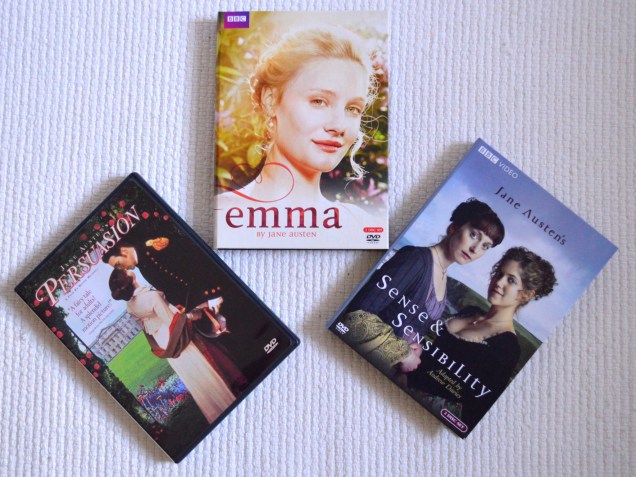
Sense and Sensibility (anonymously published in 1811) is by far my favorite Austen novel, and my favorite adaptation is the Andrew Davies miniseries (directed by John Alexander; 2008). It stars Hattie Morahan and Charity Wakefield as Elinor and Marianne. Both were new to me, but I was familiar with the significant male actors: Dan Stevens (Mr. Edward Ferrars) is in the first few seasons of Downton Abbey, David Morrissey (Colonel Brandon) portrays the confused faux-Doctor in the Doctor Who Christmas special “The Next Doctor”, and Dominic Cooper (Mr. Willoughby) as young Howard Stark scratches science to see if it bleeds in Marvel Cinematic Universe’s Captain America: The First Avenger and Agent Carter (and rules as King Llane Wrynn in the Warcraft movie).

It was a gutsy choice of Davies to begin the series with Willoughby’s explicit seduction of a 15-year-old girl, an event which happens very much off-screen in the novel and most adaptations, but becomes the crux of the plot.

The series does have some issues. For example, the Devonshire “cottage” that the financially strained Dashwood ladies had to accept was turned into a literal cottage instead of a good, solid house from the novel. The events are condensed, sure, but their pace doesn’t feel rushed like in the movie versions. Most of the writing, acting, propping, and costuming are solid to excellent.
Jane Austen Rewatch Three Favorites

Emma (1815) was the fourth and last of Austen’s works to be published during her lifetime, and the Emma miniseries from 2009 (adapted by Sandy Welch, directed by Jim O’Hanlon) outshines the other adaptations. (Unsuprisingly, the miniseries format serves Austen’s nuance much better than the movie length.)

The version has several strengths, starting with excellent casting. Romola Garai stars as Emma Woodhouse, and Jonny Lee Miller (who has more recently – and deservedly – starred as Sherlock Holmes in the series Elementary) as Mr. Knightley. Miller’s is by far the most enjoyable Mr. Knightley performance I’ve seen. Mr. Knightley is often played as rather curt and strict, which I find not just offputting but a mistake.

All major characters are introduced at the beginning of episode 1, which helps people new to Austen. Moreover, this version does the epilogue clearly and succinctly, without massive infodumping. In addition, I immensely enjoy the music, the set dressing, costuming and propping, and other visuals. It’s a thoroughly, thoroughly enjoyable Emma. In fact, if the same team were to make other Austen adaptations, I’d go to great lenghts to see them.

Finally, Persuasion is a novel of pressures, choices, and second chances, posthumously published in 1817. The 1995 movie version of Persuasion is excellent. The screenplay is by Nick Dear, and Roger Mitchell directed Amanda Root as Anne Elliot and Ciarán Hinds as Captain Wentworth. I really like Root’s understated and considerate version of Anne; Hinds works well enough even if a few scenes tend towards hammy.

Although the picture quality is grainy, the soundtrack is nice and there are subtitles (not a given on older DVDs). The props, locations, and costuming are also great. This is my favorite version so far—in an ideal world, of course, we would be due another adaptation.

For links to the complete mini-reviews of these and all of the other adaptations, visit my post A Jane Austen Rewatch Project for the 200th Anniversary of Her Passing.

Images: Book is always better screencap from JASNA website. Both DVD images by Eppu Jensen.

In the Seen on Screen occasional feature, we discuss movies and television shows of interest.

Quotes: My dear admiral, that post!

Admiral and Mrs. Croft, out driving in their one-horse chaise have come across a group of their acquaintances walking and offered to give a ride to one of them. Anne Elliot joins them.

“Very good-humoured, unaffected girls, indeed,” said Mrs. Croft… “and a very respectable family. One could not be connected with better people.—My dear admiral, that post!—we shall certainly take that post!”

But by coolly giving the reins a better direction herself, they happily passed the danger; and by once after judiciously putting out her hand, they neither fell into a rut nor ran foul of a dung-cart; and Anne, with some amusement at their style of driving, which she imagined not a bad representation of the general guidance of their affairs, found herself safely deposited by them at the cottage.

– Jane Austen, Persuasion


One of the loveliest descriptions of marriage I have ever read: we make up for one another’s eccentricities and, however strange we may look to anyone else, we get where we’re going in the end.

Austen may be famous for her romantic pairings like Elizabeth Bennet and Mr. Darcy, or Marianne Dashwood and Colonel Brandon, but I think Admiral and Mrs. Croft are one of her best images of real marital happiness.

Serving exactly what it sounds like, the Quotes feature excerpts other people’s thoughts.

Love & Friendship Trailer

A movie version of Jane Austen’s never-before-adapted epistolary novel Lady Susan is coming out in a few weeks (released on May 13), and the trailer is finally here.

Love & Friendship TRAILER 1 (2016) – Chloë Sevigny, Xavier Samuel Movie HD via Movieclips Coming Soon

I’ve been waiting for it for a long time without any real idea of what it’ll be like, as I’ve never even heard of the writer / director Whit Stillman before. It looks absolutely hilarious! Kate Beckinsale as Lady Susan seems perfect in every way; I’m also looking forward to seeing more of Jemma Redgrave, James Fleet, and Stephen Fry. Can’t wait! Fansquee!

Hey, look! We found a thing on the internet! We thought it was cool, and wanted to share it with you.

Proud and Prejudiced Zombies

160212ppzI’m really the wrong person to say anything about Pride and Prejudice and Zombies, since I am not a fan of zombie stories to begin with, but having a fondness for Jane Austen I went to the movie hoping for something entertaining. I was not entirely disappointed, but something about the movie bothers me.

It’s not just that it feels like a joke that has gone on too long without getting to a punchline. It is Pride and Prejudice with zombies added, exactly as advertised. The confined and unvarying quality of the movie is a feature, not a bug, and I can live with that. What bothers me about it is what it does to Austen’s characters and in particular the female characters.

Continue reading