Tomyris: Standing for Women

The Greek historian Herodotus tells us a story about the death of the Persian king Cyrus that centers a fascinating female character, Queen Tomyris of the Massagetae.

Cyrus, king of Persia, wanted to expand his empire eastward into the lands of the Massagetae, a nomadic people ruled by their widowed queen Tomyris. Cyrus at first proposed marriage to Tomyris as a ruse for conquest, but she refused him. He then mustered his army and prepared to invade.

Cyrus’ adviser Croesus cautioned Cyrus against trying to fight the wild Massagetae, but since Cyrus was determined to proceed, Croesus proposed a stratagem to overcome them. Following Croesus’ advice, Cyrus led his army into Massagetae territory, then had them make camp and prepare a sumptuous feast with plenty of wine, but they did not eat it. He then withdrew with most of his army, leaving behind his weakest soldiers.

When a part of the Massagetae army led by Tomyris’ son Spargapises came upon the Persian camp, they easily defeated the Persian troops there. Then they saw the feast. Being used to living rough, they had never seen such an amazing spread of food before, so they immediately sat down and filled their bellies. When the feast had made them all drunk and sleepy, Cyrus led the rest of his army back to attack them, easily defeating the Massagetae warriors and capturing Spargapises.

When Tomyris learned of her people’s defeat and her son’s capture, she sent a message to Cyrus proposing a peaceful end to the conflict: if Cyrus returned Spargapises safe, Tomyris would allow the rest of Cyrus’ army to retreat from her lands unharmed. If he refused, Tomyris promised to satisfy his desire for blood. Cyrus refused, and when Spargapises came to his senses and found himself a prisoner, he killed himself.

Tomyris then marshaled the rest of her people and fell upon the Persians. The fighting was intense, but at the end of the day the Persians were routed and Cyrus himself was killed. Tomyris found the body of Cyrus and thrust his head into a wineskin full of blood, fulfilling her promise to slake his thirst for blood.

It’s a good story, as many of Herodotus’ are, but what are we to do with this as historical evidence? Did any of these events happen? Did Tomyris even exist?

We have reasons to be skeptical. No other historian mentions Tomyris, not even other historians who wrote about the life of Cyrus. The story Herodotus tells is full of dramatic moments that sound like they come from a Greek tragedy rather than from history. Cyrus figures as the tragic hero, a noble leader driven by ambition to attempt something that wiser men warn against and meeting an ironically fitting end. Tomyris’ line about sating his thirst for blood is a bit too on-the-nose to be real. Does anything in this story hold up?

The Massagetae at least were a real people, known from plenty of other sources, one of many nomadic cultures of the Central Asia steppes. Ancient sources are uncertain about their location, placing them anywhere between the Caspian Sea and the Altai Mountains, although whether this variation reflects the migrations of a mobile people, smaller sub-groups joining and leaving a tribal coalition, or just the ignorance of Mediterranean writers about the geography of Central Asia is hard to say. Among many ancient steppe cultures, women could wield both weapons and power. The idea that Cyrus died while leading an unsuccessful campaign against steppe nomads is likely to be true, and it is plausible that those people might have been ruled by a woman.

The rest of Herodotus’ narrative has more to do with Greek literature and oral tradition than with historical events, but that narrative also serves a larger point for Herodotus. Many powerful and wise women feature in Herodotus’ account of history. Tomyris is the first whose story he tells in detail, but she is followed by many others in both large roles and small, with Artemisia of Halicarnassus, who commanded her own ships in Xerxes’ invasion of mainland Greece, among the most prominent. Tomyris in some ways prefigures Artemisia: a wise warrior queen who gives the Persian king a chance to save himself from defeat and embarrassment, though he fails to heed her.

Tomyris appears near the beginning of Herodotus’ history, playing a role in the life of the first Persian king; Artemisia comes in at the end, taking her place next to the last Persian king to feature in Herodotus’ text. The repetition of the theme of the wise warrior woman at both the beginning of Herodotus’ history and at the end gives it a particular weight and prompts us to consider what point the historian was making. Herodotus’ text is layered with subtle messages, and many of the stories he tells have some applicability to the audience he was writing for. Herodotus lived and worked in Classical Athens, a society in which the status of women was low.

Women’s participation in Athenian social and political life was a casualty of democracy: since Athenian democracy was based on solidarity between citizen men across class lines, as manifested in all-male institutions like the voting assembly and the hoplite militia, the stronger the democracy was, the more women were pushed aside. Herodotus was a fan of democracy. His text points out how democracy, and especially the Athenian version of it, gave the Greek allies the strength and resilience to resist invasion by the monarchic Persian Empire. At the same time, he also seems to have been warning his Athenian audience that by leaving women out of public life, they were squandering one of their most valuable resources.

While contemporary Greek philosophers and playwrights were denigrating women’s capacity for rational thought and scoffing at the idea of them playing a role in politics, Herodotus had a different message. In his narrative, women can both lead military forces to victory and give sound advice on political matters, two areas of life that Athenian women were barred from. Herodotus’ women keep their heads in a crisis, and powerful men would be better off if they listened to what women told them.

Tomyris may be a fictional or heavily fictionalized character, but she helps us understand a critique of Athenian democracy as framed by someone who both lived with and admired it.

Image: “Head of Cyrus Brought to Queen Tomyris” via Wikimedia (Museum of Fine Arts, Boston; c. 1622-1623; oil on canvas, by Peter Paul Rubens)

A Cat to Keep You Safe at Sea

Cats (or at least most cats) may not like water, but this one might have kept an ancient sailor safe on the waves.

Scaraboid, photograph by The Trustees of the British Museum. Outline illustration and collage by Erik Jensen. (Found Naukratis, currently British Museum; 600-570 BCE; glazed composition)
(CC BY-NC-SA 4.0)

The cat is part of the decoration on the underside of a small talisman found at the site of the ancient city of Naukratis in Egypt. Talismans of this type are called scaraboids because they are similar in shape and size to scarabs, but do not have the traditional scarab markings on their domed top.

The cat is a hieroglyph, one of three on the bottom of the object. Reading from right to left, the feather represents the sound i, the cat represents m (from the Egyptian word for cat, miu), and the sun disc represents n (from the word niut, meaning town or city, which the sun disc sometimes stood for). Put together, these hieroglyphs spell imn, a form of the name of the Egyptian god Amun. Many other scarabs and similar talismans from Naukratis contain forms of the name of Amun.

Amun was an important god in ancient Egypt, at times regarded as the king of the gods. Among his other functions, he was worshiped as a god of air and winds who protected sailors and other travelers on the sea. A talisman of Amun was an appropriate thing for an ancient sailor to carry around.

Naukratis is an interesting place to find a talisman like this. Naukratis was a Greek city founded inside Egypt by permission of the Egyptian kings. It was originally built as a home for Greek mercenaries serving in Egypt, but it quickly became a port for Greek and other foreign merchants who wanted to trade in Egypt. Most of the sailors who came through Naukratis were not Egyptians, yet there seems to have been a thriving trade in Egyptian and Egyptian-themed talismans, many produced in local workshops. It is likely that the intended customer for this scaraboid was not an Egyptian but a visiting Greek.

On one hand, the prominence of the cat on this talisman makes it seem like a bit of tourist kitsch designed to appeal to foreigners. Domestic cats were not yet common in most of the ancient Mediterranean, and Greeks associated them with Egypt. Including a cat in the talisman made it extra Egypt-y for a Greek audience. On the other hand, Naukratis amulets include many different hieroglyphic ways of spelling names of Amun, not all of which use cats or other specifically Egyptian symbols. Even if some pieces were made as tourist souvenirs, there also seems to have been a market for talismans referencing the Egyptian sailors’ god, even in a place where most of the sailors were not Egyptian.

This talisman and others like it are an interesting window into the multicultural world of Naukratis, where Greek sailors hoped for protection from an Egyptian god and cats were good protectors against the dangers of the sea.

The Song of Seikilos

We know that the ancient world was full of music. Some of the earliest texts to survive from antiquity are songs, and ancient art is full of musical performances. Sadly, we know very little about what that music sounded like. The texts of many songs survive, but not the melodies that went with them.

It’s a rare treat, therefore, when we find evidence for the music that went along with a text. The modern form of musical notation developed only in the past several centuries, but ancient people had their own forms of musical notation. The earliest complete song preserved without gaps or fragmentation is known as the Song of Seikilos, from the name on the dedicatory inscription that included it.

The text and its notation are preserved on a stone stele found at Ephesus in 1883. It was set up in the first or second century CE. The stele itself has had an interesting life since then, being at one time used as a stand for a flower pot, before ending up in the National Museum of Denmark in Copenhagen. It is generally thought that the stele was set up as a gravestone, but the original context of the find has long since been lost, so it is no longer possible to be certain. The text of the song inscribed on the stone would certainly fit:

For as long as you have to live, shine out.

Be entirely free of any pain.

There’s not much to life.

Time demands its due.

(My own translation)

Since this text is preserved with its musical notation, the song can still be performed today, and we can hear what the music of the ancient Greeks sounded like. Here’s an interpretation performed with lyre, flute, and drum.


Seikilos Epitaph (the earliest complete tune) Greek 200BC [sic] via YouTube

Image: Seikilos Stele, photograph by Artem G via Wikimedia (found Ephesus; currently National Museum, Copenhagen; 1st-2nd c. CE; marble)

Ancient Greek Clay Cooker for Multiple Dishes

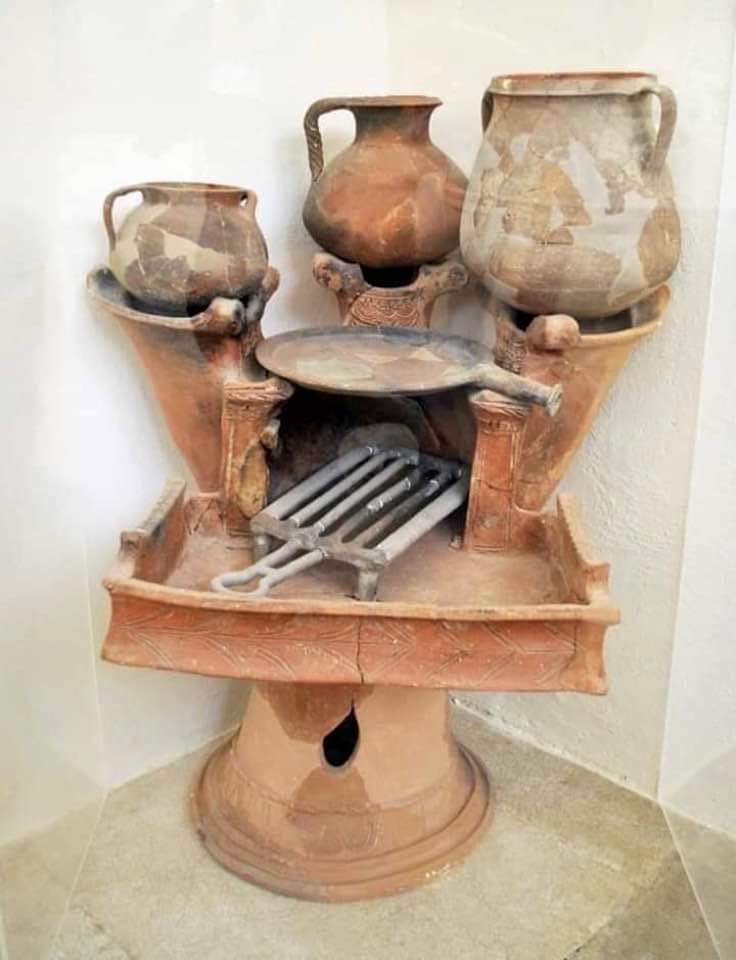
Look at this amazing ancient multi-tier clay cooker:

Imgur TheRainbowegoSweet007 Delos Cooker

There seems to be frustratingly little information available online. I haven’t been been able to track down full details for this apparatus, but some sources call it an anthrakia. Considering that anthrakia means ‘a heap of burning coals’ it sounds at least plausible (but as I said I don’t know). Apparently it’s from 500 BCE or so (although one source says 2nd c. BCE), and was found on the island of Delos, Greece.

Delos was one of the most sacred places of ancient Greece—claimed to be the birthplace of Artemis and Apollo—and a busy trade center for centuries if not millenia. It looks like the only images of this cooker come from the Archaeological Museum of Delos. No-one seems to have posted the associated text, though, so I still don’t know quite as much as I’d like.

Such an ingenious arrangement, though, isn’t it? The oven has space for a hand-held grill and an area at the front for raking coals into (I assume). Above the oven, there is an opening to rest a frying pan on. As if that’s not enough, above that to the back of the cooker there are tube-like stands for three cooking pots, through which the pots also have access to heat from the oven. You could have five dishes cooking at the same time. And it looks like the cooker is also portable.

It’s impressive both from the point of view of functionality and design—the oven-stove-grill combo seems to have been made as one piece. (Or possibly two pieces, if the pedestal that looks like an upside-down plant pot was made separately.)

Not bad for a 2,000+ year-old kitchen gadget, right? I can almost hear the sizzling of frying food.

With that, I’ll wish our readers in the U.S. a Happy Thanksgiving! 🙂

Image via TheRainbowegoSweet007 on Imgur

A Name for an Amazon

Amazons, the bold warrior women who figure in Greek myths, are imaginary, but the myths about them likely had their origin in Greek experiences with actual fighting women in the cultures around the shores of the Black Sea. Ethnographic and archaeological evidence shows that women who trained with weapons and fought in battle were known in many of the cultures in the region, and the association of mythic Greek Amazons with horses and bows also matches the realities of life on the Black Sea steppes.

Greek literature and art records numerous Amazon names. Most of these names are Greek, and they are descriptive of relevant Amazon traits, such as Hippolyta (“She who sets the horses loose”), Melanippe (“Black horse”) or Antiope (“She who confronts”). These names may have been simply invented by Greek writers in the same way that fantasy authors today concoct suitable names for their characters. There is evidence, however, that some of the Amazon names recorded in Greek art might be actual names from languages spoken around the Black Sea.


Greek vase fragment via the J. Paul Getty Museum (made Athens, currently Getty Museum, Malibu; c. 510 BCE; glazed pottery; painted by Oltos)

This Greek pottery fragment shows Amazons riding into battle against the Greek hero Heracles (who appears accompanied by the god Hermes on the other side of the cup). We can recognize the riders as Amazons from their clothing and the bowcases they carry. Text in Greek letters surrounds them, although it is painted in a dark color that is difficult to see. Most of the text is fragmentary and hard to reconstruct, but one word seems to be a complete name. The text PKPUPES can be read by the head of the leftmost rider, evidently her name.

“Pkpupes,” at first glance, may look like mere gibberish. It certainly isn’t Greek. Many scholars in the past dismissed this and similar texts as nonsense words written by semi-literate vase painters. Maybe “pkupupes” was just an attempt at an onomatopoeic for the pounding of a horse’s hooves. It may, however, be something more significant.

Dense clusters of hard consonants like “pkp” are a common feature of languages spoken today in the Caucasus Mountains east of the Black Sea. “Pkpupes” is, in fact, fairly easy to read as an attempt to render a name in Circassian, a cluster of closely related languages of the northwestern Caucasus, with the letters of ancient Greek, which did not perfectly match up to the sounds of the original language. English doesn’t have all the right letters to easily represent the sounds of Circassian either, but a reconstructed Circassian name that would be rendered in English something like “Pqp’upush” is perfectly intelligible. This name is composed of several elements, the first referring to the body, the next to covering, and the final one connoting worthiness. Altogether, the name would mean “Worthy to wear armor,” a suitable name for a warrior woman.

Greeks had extensive contact with peoples around the Black Sea. Many Greeks migrated to the region, and people from the area also settled in Greece. The painter of this vase signed his name “Oltos,” which is not a typical Greek name, and he may have been an immigrant himself. He and other ancient vase painters may well have known people who spoke foreign languages or had ancestors from the Black Sea region who could recommend appropriately authentic names for Amazon characters. It may even be that some of the obviously Greek Amazon names like Hippolyta or Antiope were not invented by Greeks but are Greek translations of authentic names, in the same way that the names of many indigenous Americans in recent history have been translated into English, like Sitting Bull or Red Cloud.

The Amazons of Greek myth remain mythical, but we have evidence for some history behind that myth, maybe even the names of some real warrior women from the edges of the world known to the Greeks.

Source

Adrienne Mayor, John Colarusso, and David Saunders, “Making Sense of Nonsense Inscriptions Associated with Amazons and Scythians on Athenian Vases,” Hesperia 83, no. 3 (July-September 2014): 447-93.

Quotes: Women Have Also Painted

The ancient Roman naturalist Pliny the Elder wrote a good deal about painting. His interest stemmed from curiosity about which plants and minerals were used to make make pigments, but he also recorded the names of famous artists and some details about their paintings.

Unlike the stretched canvases we are used to today, ancient painters worked on wooden panels, of which extremely few survive, or on plastered walls, a few of which have survived in places like Pompeii and Dura-Europus. Most of the famous painters of antiquity were men, but Pliny makes sure to note that women also took up the brush.

Women have also painted. Timarete, daughter of Micon, created the very old panel painting of Artemis of Ephesus. Irene, daughter and student of the painter Cratinus, painted an Eleusinian maiden, Calypso, Theodorus the juggler, and Alcisthenes the dancer. Aristarete, daughter and student of Nearchus, painted Aesculapius. Iaia of Cyzicus, who was a lifelong virgin, painted and engraved ivory at Rome during the youth of Marcus Varro [late second century BCE]. She mostly made images of women, including a large panel painting of an old woman at Naples, as well as a self-portrait made using a mirror. Nobody had a faster hand for painting than she did, and in fact she was so accomplished an artist that the prices for her works far exceeded those commanded by Sopolis and Dionysius, who were the most celebrated portrait painters of the time and whose paintings fill the galleries. A certain Olympias was also a painter, but all that is recorded about her is that Autobulus was her student.


Pliny the Elder, Natural History 35.147-48 (=35.40)

(My own translation)

Women created famous works, were paid well for their craft, and taught others. It is unsurprising that some of these women were daughters of well-known male painters, since art was often a family business in the ancient Mediterranean.

Wooden panel paintings were among the most highly-prized forms of art in ancient Greece and Rome. Thanks to writers like Pliny, we know more about the famous painters of antiquity and their paintings than we would ever know from the few examples that survive today. It is good to have evidence that women, too, took part in this prestigious art form.

Image: Women preparing for a ritual, cropped from a photograph by WolfgangRieger via Wikimedia (Pompeii, Villa of the Mysteries; 1st c. BCE; fresco)

Train Like a Spartan

There are some folks who are very into bodybuilding, weightlifting, and other such activities and who like to fancy themselves as the heirs of the ancient Greeks, especially the Spartans. Now, there’s nothing at all wrong with having hobbies like these. Do what makes you happy, and don’t let anyone tell you otherwise! But the ancient Spartans wouldn’t want modern bodybuilders among their number.

The details of ancient Spartan training are not easy to be certain about, since many of the sources that describe them were written by non-Spartans, often those who held unrealistically admiring attitudes toward Sparta. Yet even these sources are of some interest, because they were written by people familiar with the conditions of ancient warfare trying to imagine what kind of training a nation of perfect warriors would institute for themselves. Among these descriptions we find very little focus on getting big muscles or sculpted abs. Spartan training instead focused on two things: the endurance of hardship and camaraderie among the Spartiate elite.

A Spartan character by the name of Megillus in conversation with an Athenian interlocutor in Plato’s dialogue The Laws gives this account of the most important institutions in Spartan life:

Athenian: […] Should we say that the eating clubs and exercise grounds were established by the lawgiver for the sake of war?

Megillus: Indeed.

Athenian: Is there a third and fourth thing? […]

Megillus: The third thing he instituted is hunting, as I and any Lacedaimonian will tell you.

Athenian: Let us try to state the fourth thing, if we can.

Megillus: I will try to explain the fourth thing as well: we train ourselves to endure pain, both by fighting each other hand-to-hand and by stealing at the risk of a sound beating every time. Also the “Crypteia,” as some call it, is an astonishingly painful thing to endure, as they go barefoot in winter, sleep rough, attend to themselves without servants, and wander the whole countryside both by day and night. In our Gymnopaideia festival we face awful sufferings as we contend with the stifling summer heat, and there are so many more examples that listing them all off would nearly take forever.

Plato, Laws 633a-c

(My own translations)

There are good reasons why Spartan training focused on these areas rather than building muscle or cutting fat. Fighting makes up a very small part of what soldiers do in war. Most of an ancient soldier’s activity was marching, setting up and taking down camps, marauding for food and supplies, standing watch, and carrying out maneuvers. Even when the moment to fight came, big masses of muscle were of less use than the willingness to stand and fight and risk one’s life for one’s fellow soldiers.

In these conditions, physical endurance and a commitment to the one’s comrades were what mattered. Soldiers who could march for days on little food and no sleep were worth far more than those with low body fat. Maintaining big muscles and a sculpted physique takes time, food, and sleep that soldiers on the march couldn’t afford. Such fighters would be dead weight on their comrades, not an asset on the battlefield.

The poet Archilochus, who had experience as a mercenary soldier, gave his own opinion about soldiers who liked to show off their bodies:

I don’t like a general who is big or who likes to run,

nor one who is vain about his curly locks or sculpts his beard.

Give me a little bandy-legged-looking one

who’s steady on his feet and full of guts.

Archilochus, quoted/paraphrased in Dio Chrysostom, Orations 33.17

Now, while bodybuilding was not a favorite Spartan pastime, there were two activities for which Spartans were famous that trained both endurance and the ability to work well with the people around you: dancing and choral singing. Spartans were renowned for their skills in both coordinated group dances and singing together.

So, if you really want to train like a Spartan, leave the gym and the weights behind and go join a choir or take a ballet class. That will make a true Spartan out of you.

Image: Gerard Butler as Leonidas in 300 via IMDb

History for Writers looks at how history can be a fiction writer’s most useful tool, from worldbuilding to dialogue.
Ghosts of Marathon

Tales of haunted places are a nearly universal part of human experience. Ghost stories can be one of the ways in which we remember the past, especially traumatic or painful parts of it. Even in ancient Greece there were legends of hauntings connected with the site of the battle of Marathon.

Normally, in ancient Greece, the bodies of fallen soldiers were brought back to their home city after the battle and buried wherever their families buried their dead, but an exception was made for the fallen of Marathon in recognition of the exceptional nature of the battle. The dead of Marathon were buried on the site of the battle and an enormous earthen mound raised over their tomb.

The travel writer Pausanias reported local legends about ghostly apparitions around the tomb mound some six centuries after the event (and a warning to any would-be ghost hunters):

Every night there can be heard the sound of horses neighing and men fighting. It has never done anyone any good to go looking for these manifestations on purpose, but those who happen upon the scene by chance do not suffer the spirits’ wrath.


Pausanias, Description of Greece 1.32.4

(My own translation)

If you’re enjoying some ghost stories this Halloween, know that you’re in good company and part of a long tradition.

History for Writers looks at how history can be a fiction writer’s most useful tool, from worldbuilding to dialogue.

I Know You’re a Barbarian, But What Am I?

The ancient Greeks had certain stereotypes about the people they called barbaroi: Romans were brutes; Scythians were drunkards; Persians were perverts, and so on. Like all ethnic stereotypes, these conventional views were based on prejudices and assumptions rather than truth. Not everyone necessarily believed in or agreed with these stereotypes, but they were recognizable elements of Greek culture in the same way that “French are cowards” or “Italians are reckless drivers” are recognizable stereotypes today. But what stereotypes did other peoples have for the Greeks? We don’t have very many sources that offer non-Greek views of the Greeks, but there are some hints that suggest that the common view of the Greeks, and Athenians in particular, is that they talked too much.

The Greek historian Herodotus reports a story that a Scythian named Anacharsis had traveled in Greece and come home to Scythia with a pointed opinion on the Greeks:

In fact, I have heard a story told by the Peloponnesians about Anacharsis, who was sent by the king of the Scythians to Greece to learn about our ways. When he returned, he told the king that all the Greeks strive for wisdom except the Spartans, but the Spartans are the only one who talk and listen thoughtfully.


Herodotus, Histories 4.77

Since the Spartans were famous for being people of few but well-chosen words, the point of the anecdote is that other Greeks talked to much and said too little. We can compare the story of Anacharsis visiting Greece with Herodotus’ account of the Greek scholar Hecataeus visiting Egypt and getting a lesson from the priests there about Greek pretensions:

The scholar Hecataeus was once in Thebes and recounted his genealogy back to the sixteenth ancestor, which he made out to be a god. The priests of Zeus did the same thing for him that they also did for me, though I made no such claims about my ancestry. They led me into the hall of the temple and counted out the wooden statues that were there, which equaled the number they had already told me. Every high priests erects a statue of himself there during his lifetime. Pointing to these statues and counting as they went, the priests showed me that each was the son of the man before him, from the one who most recently passed away back to the earliest of them all. When Hecataeus claimed to be descended from a god in the sixteenth generation, they did not believe that was possible. They instead traced the ancestry of the priests by counting the statues, each one a piromis, the son of a piromis (piromis being their word for a gentleman), counting back three hundred and forty-five statues, and not a one of them a god or demigod.


Herodotus 2.143

The stories of Anacharsis and Hecataeus both come to us from a Greek source, so neither is a direct report of a foreign view of the Greeks, but it is interesting that they seem to have the same point. Anacharsis approved of the Spartans because they were careful with their words. Hecataeus got put in his place by the Egyptian priests because he had made an outrageous claim before listening to people who knew better. In both cases, the Greeks would have been better off if they talked less and paid attention more. Since Herodotus was widely-traveled and had spoken with people of many different cultures, he may be giving us something reflecting an authentic perception of the Greeks by outsiders.

The richest source we have for outside views of the Greeks is the Romans. The Roman perspective is complicated because so many Romans admired and identified with Greek culture, but when we hear negative views of the Greeks from Roman sources, they often tend the same way: Greeks, and Athenians in particular, talk too much.

The Greek antiquarian Plutarch, in his life of the Roman politician Cato the Elder, reports that Cato’s opinion of the Greeks as long-winded and superficial:

He dealt with the Athenians through an interpreter, although he could have spoken to them himself […] He said that the Athenians were astonished at the speed and punch of his [Latin] words, for what he said briefly [in Latin] took the interpreter many words to say [in Greek]. It was his opinion that on the whole, the words of Greeks came from their lips, those of Romans from their hearts.


Plutarch, Life of Cato the Elder 1.12

The Roman satirist Juvenal gives a similar anti-Greek attitude to his character Umbricius:

Quick-witted, damned audacious, always ready with a

speech, and they can out-talk Isaeus [a famous orator]. What do you

suppose that one is? He’s brought us a bit of everything:

schoolteacher, professor, surveyor, painter, wrestling coach,

seer, tight-rope walker, doctor, magician—your hungry little Greek

does it all! Tell him to fly and up he goes!


Juvenal, Satires 3.73-78

While we don’t know what words non-Greeks would have used for the Greeks, parallel to the Greek word barbaros for non-Greek-speakers, there’s a good chance it was something along the lines of “blabbermouth” or “bore.”

History for Writers looks at how history can be a fiction writer’s most useful tool, from worldbuilding to dialogue.

A Greco-Scythian Gorytos

Here’s a beautiful work of art. This is a golden decorative panel from a gorytos, a combination quiver and bowcase that was used widely among ancient peoples of the steppes and the Iranian plateau. This example was found in Melitopol in southeastern Ukraine.

Gorytos, photograph by VoidWanderer via Wikimedia (found Melitopol, currently Kyiv; 4th c. BCE; gold)

Scythian artisans were expert metalworkers, and the Scythian elite valued high-quality metalwork, especially in gold, as emblems of status. This panel was made by Greek crafters serving the Scythian market. The central panel shows scenes from the life of Achilles, a Greek hero whose legends were sometimes associated with Scythia and whose warrior prowess was appealing to Scythian tastes. The outer panels feature decorative scenes of animals hunting, a popular motif in Scythian metalwork.

This piece is not just a beautiful work of art, it’s also an example of how art and artisans in antiquity crossed boundaries and bridged cultures.

Out There highlights intriguing art, places, phenomena, flora, and fauna.