A Cat to Keep You Safe at Sea

Cats (or at least most cats) may not like water, but this one might have kept an ancient sailor safe on the waves.

Scaraboid, photograph by The Trustees of the British Museum. Outline illustration and collage by Erik Jensen. (Found Naukratis, currently British Museum; 600-570 BCE; glazed composition)
(CC BY-NC-SA 4.0)

The cat is part of the decoration on the underside of a small talisman found at the site of the ancient city of Naukratis in Egypt. Talismans of this type are called scaraboids because they are similar in shape and size to scarabs, but do not have the traditional scarab markings on their domed top.

The cat is a hieroglyph, one of three on the bottom of the object. Reading from right to left, the feather represents the sound i, the cat represents m (from the Egyptian word for cat, miu), and the sun disc represents n (from the word niut, meaning town or city, which the sun disc sometimes stood for). Put together, these hieroglyphs spell imn, a form of the name of the Egyptian god Amun. Many other scarabs and similar talismans from Naukratis contain forms of the name of Amun.

Amun was an important god in ancient Egypt, at times regarded as the king of the gods. Among his other functions, he was worshiped as a god of air and winds who protected sailors and other travelers on the sea. A talisman of Amun was an appropriate thing for an ancient sailor to carry around.

Naukratis is an interesting place to find a talisman like this. Naukratis was a Greek city founded inside Egypt by permission of the Egyptian kings. It was originally built as a home for Greek mercenaries serving in Egypt, but it quickly became a port for Greek and other foreign merchants who wanted to trade in Egypt. Most of the sailors who came through Naukratis were not Egyptians, yet there seems to have been a thriving trade in Egyptian and Egyptian-themed talismans, many produced in local workshops. It is likely that the intended customer for this scaraboid was not an Egyptian but a visiting Greek.

On one hand, the prominence of the cat on this talisman makes it seem like a bit of tourist kitsch designed to appeal to foreigners. Domestic cats were not yet common in most of the ancient Mediterranean, and Greeks associated them with Egypt. Including a cat in the talisman made it extra Egypt-y for a Greek audience. On the other hand, Naukratis amulets include many different hieroglyphic ways of spelling names of Amun, not all of which use cats or other specifically Egyptian symbols. Even if some pieces were made as tourist souvenirs, there also seems to have been a market for talismans referencing the Egyptian sailors’ god, even in a place where most of the sailors were not Egyptian.

This talisman and others like it are an interesting window into the multicultural world of Naukratis, where Greek sailors hoped for protection from an Egyptian god and cats were good protectors against the dangers of the sea.

A Roman Holiday (with Crocodiles)

When you go on vacation, you want to make sure you get the best experience. If you’re rich enough, other people will do it for you. That was just as true in the past as it is today. Here’s a fragment of a letter that has survived on papyrus from the Ptolemaic period in Egypt about preparations for a tour of the Faiyum oasis.

A Roman senator, Lucius Memmius, was touring Egypt in the late second century BCE. Someone in Alexandria wanted to make sure that Memmius had a good trip, so instructions were sent on ahead to make sure everything was ready for the important guest.

From Hermias to Horos, greetings. Attached is a letter to Asclepiades. Make sure that these instructions are followed. Be well. Year 5, 17th of Xantikos, 17th of Meikheir (March 5, 112 BCE)

To Asclepiades.

Lucius Memmius, a Roman senator who holds a position of great worth and honor, is making a grand expedition from the city [of Alexandria] to the Arsinoite nome to see the sights. See that he is properly welcomed, and take special care to see that lodgings are furnished along with landing places at the proper locations […] Make sure that the welcoming gifts listed below are ready to be handed over to him at the landing places, and that the furnishings for the lodgings, the usual morsels for Petesouchus and the crocodiles, the equipment for visiting the Labyrinth, the […] and the offerings and supplies for the household sacrifice are provided. In all respects, take the greatest care that everything should be prepared for his enjoyment, and be zealous […]

P. Tebt. (Papyri from Tebtunis) 1.33

(My own translation)

It looks like Memmius’ itinerary included watching crocodiles being fed and visiting the Labyrinth, a sprawling ancient temple complex whose walls and passageways were famous in antiquity.

It’s also interesting to note that, although Hermias wanted to make sure that special care was taken for Memmius’ visit, Memmius was evidently following an established tourist route. Hermias does not need specify where lodgings should be prepared for him or what equipment is needed for visiting the Labyrinth. The crocodile feeding was apparently a customary spectacle. Asclepiades clearly knew what to do to receive an important visitor, Hermias just wanted to make sure he did it. Faiyum tourism was evidently an established practice at the time.

History for Writers looks at how history can be a fiction writer’s most useful tool, from worldbuilding to dialogue.

Herodotus and the Upside-Down World of Egypt

The ancient Greek traveler and historian Herodotus was impressed by many of the things he saw in his visit to Egypt. He wrote about ancient monuments like the pyramids (already thousands of years old by the time he saw them), great temples, and the works of kings. But he was equally interested in the habits and daily life of the people around him. He noted a number of things in the daily life of Egyptians that struck him as unusual.

Just as the Egyptians have a unique climate, and the nature of their river is unlike any other, they have established customs and norms that are different from any other people. Among them, the women haggle in the market while the men stay home weaving. While other peoples weave by pushing the weft up, the Egyptians push it down. Men always carry burdens on their heads, women on their shoulders. Women pee standing up, men sitting down. They relieve themselves in their homes but eat outside in the street, saying that what is embarrassing but necessary should be hidden away, but what is not shameful may be done in the open. No woman serves as priest either for a male or a female deity; men serve each and every god. No son is obliged to care for his parents if he does not wish to, but daughters must whether they wish to or not.

Herodotus, Histories 2.35

(My own translation)

Herodotus’ perspective on Egypt was shaped by his background as a Greek. These details he lists are things that were the reverse of typical Greek habits: in Greece, men usually went out to the market while many women stayed in the home doing textile work. Greeks customarily ate their meals inside their homes but went outside to relieve themselves. In the Greek world, women served as priests of female gods while men served as priests of male gods.

Two factors are at work in Herodotus’ perception of the Egyptians, factors familiar to anyone who has spent time in a foreign culture. In the first place, we tend to notice things that are different more than things that are the same. When you visit a new place, you tend to notice that people speak differently than you are used to or eat foods you haven’t tried before, not all the little things that are just like at home. Secondly, when we notice these differences, they tend to blow up to exaggerated proportions in our minds. We may come home from a vacation thinking “Wow, everybody there likes to sing a lot,” when the reality was that it was one or two people who busted out a song at a time you just weren’t expecting it.

Some of Herodotus’ observations actually do align with our evidence for ancient Egyptian culture in the period when he visited. For example, it seems it was not unusual for Egyptian women to do business outside the home or for men to work as weavers. Some are simply false: at least some Egyptian women did serve as priestesses. Others are harder to pin down—no one has yet come up with evidence for Egyptian women habitually standing up at the toilet, but it’s not the sort of thing we have much documentation for at all.

Herodotus was a sharp-eyed observer of culture, but even so he wrote from a partial and biased perspective, not just as a foreign visitor trying to make sense of an unfamiliar world, but as an educated Greek who knew something about history and literature. Greeks had a long tradition of writing about Egypt as an alien world, a kind of magical Neverland where nothing was as it was in Greece. We credit Herodotus with inventing the genre of history in the Western tradition, but he saw himself as following in the footsteps of epic poets like Homer. In the details he provides about his time in Egypt, we see how he both tried to ground his account in the facts he observed and also fill out an existing Greek picture of Egypt as an upside-down world where everything was different.

History for Writers is a weekly feature which looks at how history can be a fiction writer’s most useful tool. From worldbuilding to dialogue, history helps you write.

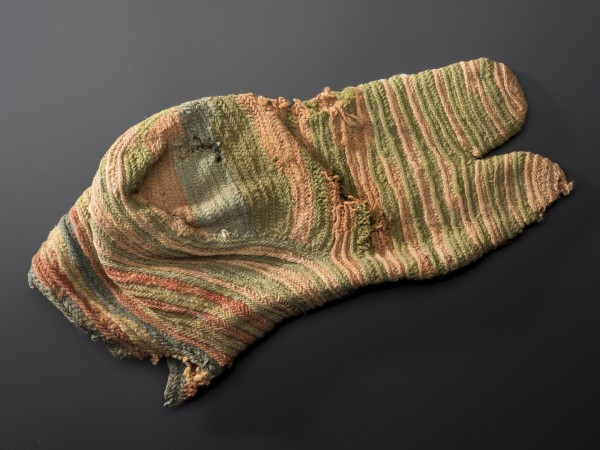
Socks with Sandals, Ancient Egyptian Style

This amazingly preserved sock comes from the late Roman period of ancient Egypt. The colors of the stripes give us some idea of how bright and cheerful this sock must have been when it was new.

The notch at the end separated the big toe for wearing thong sandals. The question of whether this means “wearing socks with sandals has an ancient and honorable pedigree” or “ancient Egyptians could be huge dorks, too” is left as an exercise for the reader.

Image: Sock via National Museum of Scotland (currently National Museum of Scotland, Edinburgh; 4th-5th c. CE; wool)

Out There is an occasional feature highlighting intriguing art, spaces, places, phenomena, flora, and fauna.

Ancient Egyptians Knew How to Party

Here’s how the ancient Greek traveler and historian Herodotus describes the festivities surrounding a great festival held every year in honor of the goddess Bast, popular with both native Egyptians and foreign residents like Greek mercenaries and traders:

When they celebrate the festival in Bubastis, they do these things. Men and women sail there together, huge numbers of them in every boat. Some of the women shake rattles and some play flutes the whole way there; the rest sing and clap their hands. Whenever they sail by a city, they put in to shore and do the following: some of the women keep doing what I described, some call out tauntingly at the women in the city, some dance, and some stand up and hoist up their dresses. They do this at every city along the river.

– Herodotus, Histories 2.60

(My own translation)

Now, Herodotus was an outsider describing customs he didn’t entirely understand, and he certainly got some of his facts wrong. Still, many of the details he recounts of daily life in Egypt seem to have come from his own observations, and more than a few hold up on comparison with Egyptian literature and art. In any case it sure sounds like the ancient Egyptians knew how to have a good time!

Serving exactly what it sounds like, the Quotes feature excerpts other people’s thoughts.

The Valley of the Whales

In the western desert of Egypt is a valley known as Wadi al-Hitan. Like some of the other famous valleys in Egypt, such as the Valley of the Kings and the Valley of the Queens, this valley is a kind of graveyard, but this one is for whales. Not that people buried whales here; rather, the desert preserves the fossils of a wide variety of sea life from millions of years ago, when this region was under a shallow sea. Among the most striking and important fossils at the site are the remains of several different species showing different stages of the evolution of ancient land mammals into the whales we know today.

Wadi al-Hitan is today preserved as a UNESCO site in recognition of both its stark natural beauty and its paleontological significance.

Images: An excavated fossil skeleton of a prehistoric whale, photograph by AhmedMosaad via Wikimedia. Spine and skull of a Dorudon atrox, photograph by Christoph Rohner via Wikimedia. Vertebrae on the desert sands, photograph by Jolybook via Wikimedia.

Out There is an occasional feature highlighting intriguing art, spaces, places, phenomena, flora, and fauna.

How Not to Study Linguistics

The Greek historian Herodotus recounts a tale about a rather dubious experiment in linguistics supposedly carried out by the Egyptian king Psammetichus.

The point of the experiment was to find out what people or nation in the world was the oldest. It was based on the assumption that the oldest culture’s language would be the language that people who had never heard spoken language before would speak. Further, Psammetichus assumed that the invention of this original language could be artificially recreated. The result of these mistaken assumptions is a bit of a comedy of errors. Here’s how Herodotus tells the tale:

When Psammetichus could not find out by inquiry what people were the oldest, he devised the following plan. He took two newborn children at random and gave them to a shepherd to bring up among his flocks, with orders that they be raised in such a way that no one should make any sound in their presence, that they stay in a lonely hut, and that he should regularly bring his goats there so they could drink their fill, and attend to their other needs. He did these things, and Psammetichus commanded him to notify him at once what word first burst forth from the children, once they had left behind the meaningless babble of infants. And it did indeed happen. When the shepherd had been taking care of the children for two years, once when he opened the door of the hut and went in, both of them fell upon him stretching out their hands and crying: “Bekos!” At first, the shepherd took no notice of what he had heard, but when he kept hearing the same word on his repeated visits, he began to pay attention to it. He sent word to the king, and when ordered, brought the children before him. When Psammetichus heard it for himself, he investigated what people called something “bekos,” and from his investigations he learned that it was the Phrygian word for bread. Taking this fact into consideration, the Egyptians acknowledged that the Phrygians are older than they are.

– Herodotus, Histories 2.2

(My own translation)

As should be obvious (and probably was to Herodotus’ audience), the experiment was in fact a failure. When the children exclaimed “bekos” at the shepherd’s arrival, they were not producing an actual word but simply imitating the bleating of his goats, the only sound they had heard another living creature produce. The fact that Psammetichus did not realize this (and had not accounted for it in designing the experiment) makes this whole story a joke at his expense. The punch line of the joke may be a little lost on a modern audience: the Phrygians were a people who lived in inland Anatolia and spoke a language related to Greek. Phrygians were stereotyped by the ancient Greeks as ignorant country bumpkins. For the Egyptians—proud of the antiquity and sophistication of their culture—to be forced to yield the title of “most ancient people” to the Phrygians was a deflation of their cultural pretension.

Although Herodotus claims to have heard this story from Egyptian priests, like more than a few of the stories he tells about Egypt it sounds more Greek than Egyptian. Specifically, it sounds like a Greek joke told at the Egyptians’ expense. Greeks and Egyptians had close and friendly relations in Herodotus’ day, but it was a relationship in which the Greeks were definitely the junior partners. Egyptians liked to celebrate the antiquity and wisdom of their culture, and we can understand if Greeks occasionally got a bit fed up with being looked down on. This story uses language was a way of turning the tables to suggest that not only were the Egyptians not as ancient a culture as they liked to claim, perhaps they were not as wise, either.

On, of, and about languages.

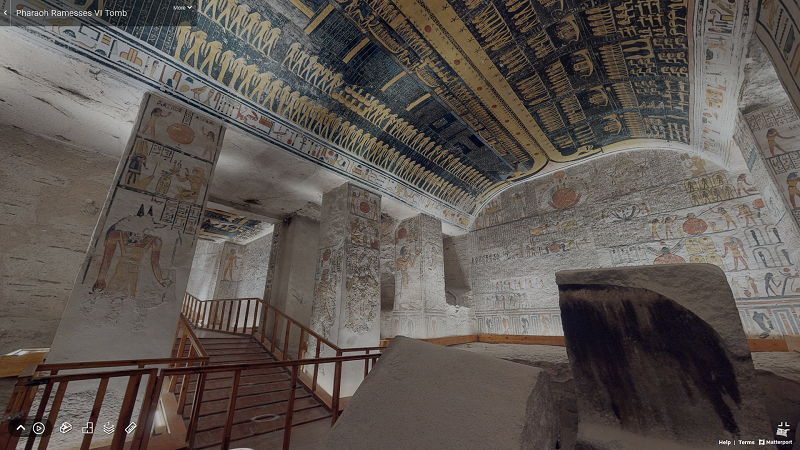
Virtual 3D Tour of the Tomb of Pharaoh Ramesses VI

The Egyptian Tourism Authority has released an amazing virtual 3D tour of the tomb of Pharaoh Ramesses VI. Known as Tomb KV9 or Tomb of Memnon, it’s located in the east Valley of the Kings. Ramesses VI ruled during the 20th dynasty (mid to late 12th century BCE).

Matterport Ramesses VI Tomb KV9 Corridor

There are a couple of different views to play with, plus a highlights tour.

Matterport Ramesses VI Tomb KV9 Dollhouse View

Some modern amenities like wooden walkboards, handrails, and electric lights are visible, but the additions are reasonably unintrusive. You start on floor 3 and make your way down the long ramp to floor 1.

Matterport Ramesses VI Tomb KV9 Burial Chamber

It really is quite breathtaking! The screencaps above can’t really adequately capture the ambience.

Visit the tour for the full experience!

Found via Colossal.

Images: screencaps of the virtual 3D tour via Matterport

Out There is an occasional feature highlighting intriguing art, spaces, places, phenomena, flora, and fauna.

A Bird in the Hand

The fall is coming, and for a lot of us this fall will be bringing anxiety and stress. So, for a moment of relaxation, enjoy this scene of hunting wildfowl in the marshes, from the tomb of Nebamun, a scribe who lived around 1350 BCE in Egypt.

Hunting scene from the tomb of Nebamun, photograph by Marcus Cyron via Wikimedia (currently British Museum, London; c. 1350 BCE; paint on plaster)

And for added joy, just look at that cat! Have you ever seen a cat so happy as when it has two birds in its claws and a third in its teeth?

Out There is an occasional feature highlighting intriguing art, spaces, places, phenomena, flora, and fauna.

Doricha: Mastering the Art of Cosmopolitanism

There is little we can say for sure about the life of Doricha (sixth century BCE, approximately contemporary with the poet Sappho). Most of what we know about her comes from legends and tales that make her larger than life. Even so, those legends in themselves tell us something important about the world of the Mediterranean in the Greek archaic age.
Doricha was a courtesan (hetaira in Greek) who worked in the city of Naucratis in Egypt. Courtesans were a class of sex workers in the ancient world, but unlike lower classes of sex workers, who provided sexual services in return for fairly standard rates of pay, courtesans offered and expected much more. A courtesan would do more than have sex with a client (although that was part of what she offered); she offered companionship, conversation, artistic performance, and social grace. What she received in return was often not so clearly specified. It could include money, but also gifts of jewelry, clothing, furniture, and food. She might enjoy a house paid for by a client, or even live with him long term. Courtesans often had ongoing relationships with a select few clients, and part of their work was to build the illusion of a purely romantic and emotional relationship around what was at base an economic transaction of pay for services. This was demanding work, and not everyone could do it well. A successful courtesan had to cultivate an aura of mystery and glamour. At the same time, courtesans were exposed to all the same pressures and dangers that women offering sex in exchange for money have always faced in male-dominated societies. Yet for some women, those who were lucky and who were good at their jobs, work as a courtesan offered a path to personal independence and financial security that few other women in the Greek world could claim.

Doricha was both lucky and good at her job. Originally from Thrace, she arrived in Naucratis as a slave being put to sex work by her owner, a Greek merchant from Samos named Xanthes. While working in Naucratis, she met Charaxus, brother of the poet Sappho, who was trading wine from the family’s home on Lesbos to Egypt. Charaxus was so smitten with Doricha that he bought her freedom from Xanthes. (When he got home, Sappho had some choice things to say about how he had spent the family’s hard-earned money on his business trip, bits of which survive in some of the fragments of her poems.) She then chose to remain in Naucratis and keep working as a free woman the trade she had begun as a slave. She became so successful that at the end of her life she wanted to leave a lasting memorial of her wealth. According to a story told by Herodotus, she spent one tenth of her fortune to make a massive pile of iron roasting spits and deposited them at Delphi, the site of the famous oracle, where Herodotus reports that they were still to be seen in his day. (Herodotus, Histories 2.135)

Like other courtesans, she cultivated an intriguing persona to appeal to her clients. This persona included an alias, Rhodopis, meaning rosy-cheeked in Greek, by which name she is better known. (It was not unusual for ancient courtesans to use aliases, for all the same reasons that women today performing as strippers or porn stars do.) This mysterious persona influenced how her life was told and retold in later generations, and a number of folktales became attached to her story. One claims that while she was a slave in Samos, the fable-writer Aesop was at the same time a slave in the same household. While this one is not impossible, the coincidence stretches belief (and it is not even certain among scholars today that Aesop was ever a real person). Other stories are attached to Doricha’s later life and are even more unbelievable.

One popular tale is the earliest known version of the Cinderella story:

They say that one day, when Rhodopis was bathing, an eagle snatched her sandal from her serving maid and carried it away to Memphis. There the king was administering justice in the open air and the eagle, flying over his head, dropped the sandal in his lap. The king, moved by the beauty of the sandal and the extraordinary nature of the event, sent all through the country to find out whose it was. She was found in Naucratis and conducted to the king, who made her his wife.
– Strabo, Geography 17.1.33

(My own translation)

Another popular myth among Greeks held that one of the three great pyramids at Giza was Doricha’s tomb, built for her by the king after her death. (Herodotus correctly points out that this story was impossible as the pyramid actually belonged to the king Mycerinus, who ruled Egypt some two thousand years before Doricha ever got there, but he also documents that it was a tale widely known among Greeks. Herodotus 2.134) Doricha’s life was one that seemed fabulous, bordering on the mythic. Some of that wonder is down to Doricha herself, who certainly seems like she would have been an interesting person to know, but the tales about Doricha also reflect the wider Greek experience in Naucratis.

In Doricha’s day, Naucratis was a newly-founded Greek colony, and a unique one. Over the course of the archaic age (roughly 750-480 BCE), Greek cities founded numerous colonies around the shores of the Mediterranean and Black Seas. Some of these colonies were large settlements devoted to controlling farmland and producing food, which was a scarce resource back home in Greece, and some colonies either began with or in time acquired a military might that was able to dominate and subjugate the local peoples, but not all colonies were of that kind. Many were small, fairly humble trading posts or Greek immigrant neighborhoods already busy foreign cities and ports. In these colonies, good relations with local people as hosts and trading partners were essential. Naucratis was in some respects like these trading colonies, and one of its important functions was as the official port of trade for Greeks in Egypt. (Herodotus 2.178-9)

Naucratis was also different. It was the only foreign settlement in Egypt officially sanctioned by indigenous kings, and it had begun not as a trading post but as a settlement of Greek and Carian mercenaries in Egyptian service. The kings of Egypt found the Aegean world to be useful recruiting ground for professional soldiers. Greece had all the qualities that powerful states have historically looked for to find mercenaries: it was poor, politically disorganized, and wracked by violence. The result was a large population of experienced fighters who had no stable home or livelihood. Naucratis became not only a place where Greek merchants could bring goods that were in demand in Egypt, like iron, wine, and olive oil, but also a place where Greek soldiers who fell on hard times could go to find ready employment in the Egyptian army.

For the Greeks, Naucratis was the gateway to Egypt and to the possibility of striking it rich, whether as a courtesan, merchant, or mercenary. The tales told about Doricha reflect this sense that Naucratis was a place where amazing things could happen, where one could imagine starting out as a slave and ending up the rich and beloved consort of the king. Most people who came to Naucratis, of course, never had such success, but Doricha is evidence of what was possible there for the talented and lucky. While her story may have been exaggerated over time, it is clear that she managed an enviable rise from low status to exceptional wealth.

Opportunities of this kind were available in the Greek colonies for those lucky enough and determined enough to make the most of them, but making it big in a place like Naucratis required one skill above all: the ability to work across cultural boundaries. Doricha was originally from Thrace. She made her name by serving Greek merchants in Egypt, and at the end of her life she proudly proclaimed her success by making a dedication in the international sanctuary at Delphi, a place frequented not only Greeks but by people of many cultures around the Aegean and eastern Mediterranean. The legends about her life imagine her becoming the beloved of the Egyptian king and being commemorated with an Egyptian tomb. All of the other merchants and mercenaries who sought their fortune in Naucratis had to negotiate similar boundaries. Doricha’s life is an example of what could be achieved by those who mastered the art of cosmopolitanism.

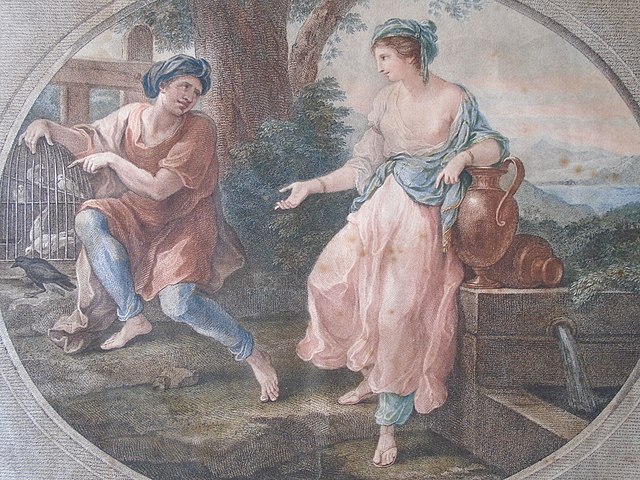
Image: “The Beautiful Rhodope in Love with Aesop” via Wikimedia (1780; engraving by Bartolozzi after a painting by Angelica Kauffman)

History for Writers looks at how history can be a fiction writer’s most useful tool. From worldbuilding to dialogue, history helps you write.