Quotes: Bottles Rattling with Explosive Sneezes

I gather that Becky Chambers’s new Monk & Robot series has gotten a mixed reception. Broadly speaking people either love it or are frustrated by it. Since I love Chambers’s Wayfarers series, I thought I’d check the new series out.

Current Reading A Psalm for the Wild-Built

I’m still not yet sure what, exactly, to think except to say I see why the dichotomy has arisen. Here’s one section that I found simply mind-boggling:

“The wagon’s lower deck quickly lost any semblance of organization, evolving rapid-fire into a hodgepodge laboratory. Planters and sunlamps filled every conceivable nook, their leaves and shoots constantly pushing the limits of how far their steward would let them creep. Stacks of used mugs containing the dregs of experiments both promising and pointless teetered on the table, awaiting the moment in which Dex had the brainspace to do the washing-up. A hanging rack took up residence on the ceiling and wasted no time in becoming laden to capacity with bundles of confettied flowers and fragrant leaves drying crisp. A fine dust of ground spices coated everything from the couch to the ladder to the inside of Dex’s nostrils, which regularly set bottles rattling with explosive sneezes.”

– Becky Chambers: A Psalm for the Wild-Built

The section starts quite well, and I see why the word cozy is applied to the series. Then, sadly, it gets worse. I don’t even terribly mind the mess in a food-prep space (dirty dishes to the ceiling and a coating of dust), as it could conceivably be just eccentric. (I mean, I prefer a clean home myself since I’m allergic to dust, and plant dust doesn’t help, but to each their own.)

But. Dex is “regularly” sneezing “explosive[ly]” all over the space where they mix the teas they’re offering to people they serve as a tea-monk.

Excuse me? SNEEZING—REGULARLY—ON DRINKS THEY SERVE TO OTHERS?!?

Disgusting is an understatement! The exact opposite to cozy. Ew! Ew, ew, ew, eww!

I do get that getting a book to print takes a good long while (a highly technical term, that). I wasn’t able to find out when Chambers started to write A Psalm for the Wild-Built, but the publishing deal was announced in July 2018 and the first book published in July 2021. In the acknowledgments for the sequel, A Prayer for the Crown-Shy, she writes that she finished book 1 “just before lock-down started” and handed in book 2 “three months before I was eligible for my first [covid vaccination] jab”. It is therefore possible that it was not feasible to change the text.

Still, I should think that it’s not too much of a stretch to NOT SNEEZE ON FOODS AND DRINKS. In real life or in fiction. With or without a pandemic behind you (i.e., having been filled to the gills with information about cough etiquette and sneezing hygiene).

EWWWWWWWWW!!!

Chambers, Becky. A Psalm for the Wild-Built. New York: Tordotcom, 2021, p. 22-23.

Image by Eppu Jensen

Serving exactly what it sounds like, the Quotes feature excerpts other people’s thoughts.

Star Wars: A Personal Reflection

Star Wars Day is coming soon (May the Fourth be with you!), so I’ve been thinking about how I got into that universe. My route in was a bit odd.

I’m a little bit too young to have been caught up by the original movies. I wasn’t even born yet for the first one. I vaguely remember when The Empire Strikes Back was a thing. Return of the Jedi is the first movie trailer I can actually remember seeing on tv. Even if I had been old enough to go to the movies, though, I wouldn’t have gone to see Star Wars then. It just wasn’t a thing I was interested in.

That doesn’t mean I wasn’t aware of Star Wars. Star Wars merchandise was all over my childhood. Friends had Star Wars lunchboxes and t-shirts. I saw the posters and the toys. Before I was reading on my own, I could recognize Darth Vader and Yoda. Some of the neighborhood kids staged a recreation of a scene from Return of the Jedi. (As the youngest of the group, I was cast as an Ewok. I had no idea what that meant, but all it required me to to was run around and scream unintelligibly, which was about the limit of my acting ability at that age.)

Star Wars lunch box (not mine). Photograph by jeffisageek via Flickr under Creative Commons

When I did discover science fiction, it wasn’t Star Wars but old reruns of the original Star Trek that lit up my young brain. I was completely hooked on Star Trek and, with the stubborn, stupid loyalty of the very young, decided that there was only room in my life for one Star franchise. For years I scoffed at the Star Wars memorabilia around me and snootily dismissed anyone else’s interest in the movies.

I was nearly in junior high before I finally decided to give Star Wars a try. Oddly enough, though, my first experience of Star Wars was not with the movies themselves. In my school library I found a set of picture books that told the story of the original trilogy movies (the only movies there were at the time) illustrated with stills from the films. My memory of the books is hazy, but at a best guess they were The Star Wars Storybook, The Empire Strikes Back Storybook, and the Return of the Jedi Storybook. I decided to give them a shot.

To my surprise, I enjoyed them, enough to hop on my bike, ride over to the local video rental shop, and check out the movies themselves. It was a weird experience. In a sense, I felt like I had always known these stories. I certainly couldn’t remember a time when I hadn’t known that there were heroes named Luke and Leia who fought a villain in a black helmet while accompanied by a couple of shiny droids. Reading the books filled in the details of a story that already felt familiar. By the time I actually saw Star Wars on screen, I knew who the characters were and what was going to happen. Watching those movies for the first time already felt like revisiting old friends.

Weirdly, one thing that wasn’t spoiled for me until I read the books was the Skywalker family tree. I can still remember the shock of finding out that Darth Vader was Luke’s father and then that Leia was his sister. That may be hard to believe in today’s world of fan sites and social media, but I made it through more than a decade of knowing who those characters were without knowing how they were related. Somehow, in all the years of my childhood, I never heard any of my friends who were into Star Wars put on a deep voice and say “Luke, I am you father.”

Star Wars has a special place in modern pop culture because it is special. It is one of the few stories we all know, even if we’ve never seen it. Whether you love it or not, and however you may feel about the prequel and sequel trilogies or any of the vast outpouring of other media in the Star Wars universe, it’s a story that we all have our own stories about.

In Seen on Screen, we discuss movies and television shows of interest.

Tolkien Reading for Tolkien Reading Day

Saturday of this week, March 25th, is Tolkien Reading Day, and what better way to celebrate than with Tolkien himself reading one of his favorite passages from The Lord of the Rings?

Before The Lord of the Rings had a publisher, Tolkien was visiting a friend who had a tape recorder and encouraged him to record himself reading a selection from his work. Tolkien chose to read one of the most powerful moments from the novel, the charge of the Rohirrim against the Orcs of Mordor at Minas Tirith. Here that recording plays over the same scene from Peter Jackson’s movie version of The Return of the King, for extra powerful effect.

Tolkien narrates the Ride of the Rohirrim by Sîdh Aníron on YouTube

This moment is one of my favorite pieces from both the novel and the film. What a rare treat to hear it in Tolkien’s own voice!

Story Time is all about story-telling and how stories work, and what makes us love our favorites.

Dark Academia: A Moody Celebration of Higher Ed and Cultivation

Have you heard of the style dubbed dark academia? According to Wikipedia, dark academia is “a literary and social media aesthetic and subculture concerned with higher education, writing/poetry, the arts, and classic Greek and Gothic architecture.”

Sounds very geeky and nerdy, doesn’t it? (Apparently, again according to Wikipedia, a number of genre novels are, indeed, cited either as inspiration for or popular among the subculture.)

Well, it seems dark academia is now sufficiently popular that mainstream sites have started catering to its fans. While digging into it, I’ve seen clothing, books (of course), movies (ditto), and PC wallpapers for sale. There are also beginner’s guides, playlists for studying, recommended emoji combos, mood guides, critiques, and opinion pieces. (You know a thing has made it when opinion pieces appear!)

I found dark academia when a DIY / thrifting / home decorating blogger I follow and admire, Sarah Ramberg, published her own take on it for the October 2022 challenge in their Thrift the Look series. Here’s one view of her vignette:

Sadie Seasongoods Dark Academia Challenge

Ramberg used mostly thrift store items to outstanding effect. The crystal skull is in fact a thrifted vodka bottle, and it looks stunning. (It’s my favorite element in her recreation, in fact.)

While dark academia (like its kissing cousin steampunk) is not quite my cup of tea, I found it an interesting version of literary appreciation.

Image by Sarah Ramberg at Sadie Seasongoods

In Here highlights interesting spaces created by our fellow geeks all over the world.

Quotes: No Man’s Faculties Could Be Developed without an Extensive Acquaintance with Books

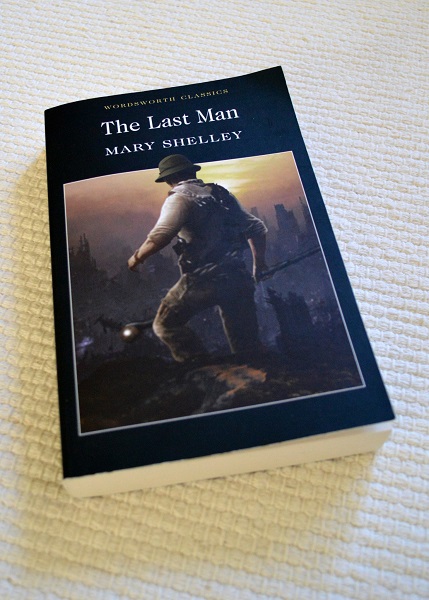
Mary Wollstonecraft Shelley’s speculative work The Last Man starts very much like a run-of-the-mill regency-era novel with its three-book structure. You even start to wonder whether much of interest is ever going to happen.

And then a plague hits. Book three, especially, where people drop off like flies, felt rather grim even before living through a pandemic myself. (I read it a few years ago.)

Shelley The Last Man

Since the plague aspect is a little too on the nose, I’m going to skip all of that for now. Instead, below is what the protagonist thought about reading:

“I felt convinced that however it might have been in former times, in the present stage of the world, no man’s faculties could be developed, no man’s moral principle be enlarged and liberal, without an extensive acquaintance with books. To me they stood in the place of an active career, of ambition, and those palpable excitements necessary to the multitude.”


– Lionel Verney in Mary Shelley’s The Last Man

Sounds astonishingly like Mr. Darcy’s line about a truly accomplished woman who must improve “her mind by extensive reading” in Jane Austen’s Pride and Prejudice, doesn’t it? It must’ve been very much in the air in the early 19th century.

If you’re interested, a free e-version of The Last Man is available on Project Gutenberg.

Shelley, Mary. The Last Man. Ware, Hertfordshire: Wordsworth, 2004 [originally published 1826], p. 124.

Image by Eppu Jensen

Serving exactly what it sounds like, the Quotes feature excerpts other people’s thoughts.

Hide a Gaming Room behind a Swinging Bookcase

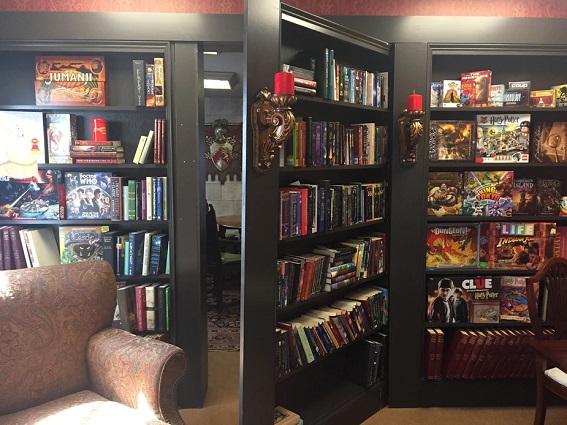
Lisa Natcharian at The Storyteller’s Cottage transformed a long, narrow room into two smaller ones, namely a library and a gaming room with entry through a swinging bookcase.

The house is Victorian, built circa 1891, and located in Simsbury, Connecticut. Before the covid pandemic, Natcharian and her crew organized various book-themed events: author talks, writing classes, poetry slams, summer camps, book clubs, D&D game nights, tea or cocktail parties, live murder mysteries, even escape rooms.

Lisa Natcharian Secret Castle Room

The door into the gaming den opens when you pull a candle sconce attached to the bookcase:

Lisa Natcharian Secret Castle Room Door

The new secret room is papered with stone-block-look wallpaper and equipped with various furnishings that nod towards medieval castles: a round table with ornate wood chairs, a small suit of armor in the corner, and wall textiles, for example.

I’m flabbergasted that she was able to source so much of the furnishings second hand. I mean, who has a miniature suit of armor just lying around until you decide to sell it off on Craigslist?

Lisa Natcharian Secret Castle Room Decor

The results are well worth the effort, and surely will be enjoyed by all event visitors. For more images, visit her site, or, should you prefer to watch a video about the build process instead, you can see it on YouTube.

Images by Lisa Natcharian at The Storyteller’s Cottage

In Making Stuff occasional feature, we share fun arts and crafts done by us and our fellow geeks and nerds.

Quotes: Even Just One New Language Infects You with a Radically Different Way of Thinking

The embodiment of the Enemy in The City We Became by N.K. Jemisin, the Woman in White, says of the catalytic effect of human cities:

“You eat each other’s cuisines and learn new techniques, new spice combinations, trade for new ingredients; you grow stronger. You wear each other’s fashions and learn new patterns to apply to your lives, and because of it you grow stronger. Even just one new language infects you with a radically different way of thinking! Why, in just a few thousand years you’ve gone from being unable to count to understanding the quantum universe—and you’d have made it there faster if you didn’t keep destroying each other’s cultures and having to start over from scratch.” [original emphasis]

To me, one of the most fascinating features of my native Finnish is that the negator ei (‘no’) can be conjugated in personal forms, as if it were a verb: en, et, ei, emme, ette, eivät. For example, a one-word answer “En” to a question (e.g. “Would you like some tea?”) translates as ‘[I do] No[t]’, while “Emme” means ‘[We do] No[t]’, etc. And this is just one little, tiny detail of the amazing linguistic variety that exists on Earth. There are times I wish I had studided linguistics even further.

Anyway.

Obviously for the Enemy us petty humans had better stay petty and not learn anything new ever. She’s not wrong, though: we’ve come a long way, and human ingenuity can be astounding. Unfortunately, so can the human cruelty. If only we could stop the needless hate and reach for more amazing heights…

Jemisin, N.K. The City We Became. New York: Orbit, 2020, p. 342.

Serving exactly what it sounds like, the Quotes feature excerpts other people’s thoughts.
Murderbot Mayhem Music: Fan Playlist for Network Effect

For the pure joy of having our sea container finally arrive with our moving goods, I’ve been re-reading all of Martha Wells’ Murderbot books in the past few weeks. That reminded me of a playlist Meghan Ball made to accompany the Murderbot novel Network Effect. I gave it a listen, and found it conveyed a very different idea of Murderbot than my impression.

So, I made my own playlist. It starts with a concert version of Darude’s “Sandstorm”, which I thought appropriate due to the reference of Murderbot visiting the Preservation planet for a cultural festival with concerts and operas in the beginning of the book.

  • Darude: “Sandstorm”, performed by Synthony and the Auckland Symphony Orchestra
  • Armin van Buuren: “Blah Blah Blah”
  • Paul Ruskay featuring Kokia: “Strike Suit Zero Main Theme”
  • Linkin Park: “Numb”
  • Darude’s “Sandstorm” and Rammstein’s “Du Hast” mashup by Monsterovich
  • Clint Mansell: “Lux Aeterna” (soundtrack from Requiem for a Dream, directed by Darren Aronofsky)

The “Blah Blah Blah” and “Numb” lyrics remind me of the doubts some humans (especially Thiago in this story) have about Murderbot, and Murderbot’s attitude towards those kinds of humans. The mashup of “Sandstorm” and “Du Hast” nicely marries action-paced music with the weirdness that comes with Murderbot finally finding targetControlSystem and the thread of targetContact contamination and the crystalline growth / alien hivemind taking over Murderbot. Ending the list with a piano piece brings some calm again.

Below are videos for your listening convenience.

Darude’s Sandstorm performed by Synthony and the Auckland Symphony Orchestra by Auckland Symphony Orchestra on YouTube

Armin van Buuren – Blah Blah Blah (Official Lyric Video) by Armin van Buuren on YouTube

Strike Suit Zero Main Theme via Paul Ruskay – Topic on YouTube

Linkin Park – Numb [Lyrics on screen] HD via LinkinParkLyrics100 on YouTube

Durude [sic] Haststorm (Du hast remix) by Monsterovich’s Music on YouTube

Requiem for a Dream – Lux Aeterna (Piano Version) by Patrik Pietschmann on YouTube

What would you add or subtract? Do you have your own playlist?

An occasional feature on music and sound-related notions.

Quotes: Time Belonged to a Higher Realm

There’s a lot (a lot!) I liked about Karen Lord’s scifi novel The Best of All Possible Worlds. This snippet, for instance, puts words to a childhood wonder I remember from elementary school when learning math:

Karen Lord The Best of All Possible Worlds

“Standard Time was invented by Sadiri pilots. Most Sadiri procedures and quantification followed straight lines and linear progressions, created for the convenience of the ten-fingered. But Time… Time belonged to a higher realm. It could not be carried in human hands, not while it constantly carried human minds. It was all circles, wheels within wheels, a Standard year of three hundred sixty Standard days coiled up in twelve months, which in turn were composed of the small whirlings of twelve hours day and twelve hours night, tiny spinning minutes and seconds, ever-cycling breaths and blinks and beats.

“To be described as having a pilot’s mind was both curse and compliment; it could mean being unable to tell the difference between prophecy, memory, and mere déjà vu.”

– Karen Lord, The Best of All Possible Worlds

I just couldn’t fathom why the decimal system is different from time measurements, and remember that for a time trying to reconcile them was very confusing. But time—heh, heh—helped with that, of course, along with more advanced classes, in addition to a certain amount of shrugging and just getting on with life.

It’s intriguing when a book serendipitously reminds you of thoughts you thought were long buried, isn’t it?

Lord, Karen. The Best of All Possible Worlds. New York: Ballantine Books, 2013, p. 40.

Serving exactly what it sounds like, the Quotes feature excerpts other people’s thoughts.
Quotes: Infohistory Is a Mess

Elizabeth Bear’s scifi novel Machine has a succinct sum-up of just some of the problems concerning information retrieval:

“Wait,” I said. “How can information decay?”

“They used to call it bit rot. Servers get taken down, data falls through the cracks and doesn’t get backed up. Physical substrates are destroyed or damaged, or degrade over time—especially the primitive ones. A holographic diamond is very durable but can’t be changed once it’s written to, and magnetic media only lasted a decan or so under ideal conditions.

“And even if the data is preserved somewhere, that somewhere might not be networked. If it’s networked, it might not be indexed. Even if it’s indexed, it might be half the galaxy away and take two or three ans for the file request to get there, be fulfilled, turn around, and come back. And then you might find out that you needed different files entirely.” He huffed with great satisfaction. “Infohistory is a mess.”

– from a discussion between Dr. Brookllyn Jens and the medical librarian AI Mercy in Machine by Elizabeth Bear [original emphasis]

Despite this being from a fictional work, it rings very true. My librarian heart was delighted to read an account that acknowledges not just the physical difficulties of dealing with old media—whatever shape that media might take, from cuneiform to CDs—but also the search-related problems. Metadata, or in case of libraries, the information about the items in the collection, doesn’t feature in stories very often. Also, it is why good reasearch librarians and archivists are worth their weight in gold.

Bear, Elizabeth. Machine. London: Saga Press, 2020, p. 203.

Serving exactly what it sounds like, the Quotes feature excerpts other people’s thoughts.