Theatrical Adaptation of LotR in Tampere

Our fall is forming up to include a bit more J.R.R. Tolkien than usual: besides seeing The Art of John Howe in Tampere, we have tickets to see a theatrical adaptation of Taru sormusten herrasta (The Lord of the Rings)—also in Tampere.

There is a short but handsome trailer:

Taru Sormusten herrasta – Tampereen Teatteri & Tampere-talo by TampereenTeatteriTT on YouTube

(Note: There’s no captioning, and it’s only in Finnish, but mostly the trailer is non-verbal. In the beginning, the text reads Experience the world’s best-known adventure. At the end, while raising his staff Gandal says You cannot pass!)

Tampere Theatre, Tampere Hall, and Tampere Philharmonic Orchestra, among others, have worked for four years to create the adaptation. I haven’t heard the reason why the play runs only about two months (Aug 22 to Sept 21, 2024 and Dec 18, 2024 to Jan 11, 2025); you’d think a slightly longer run might be warranted for such a large production. I do know it’s staged at Tampere Hall instead of Tampere Theatre’s own, beautiful historical building because the latter is under renovations. I also know that the production team had to make their own Finnish translation from scratch and that no songs were allowed due to limitations posed by The Tolkien Estate.

The sets and props look fantastic, as does the lighting and video projections. I’m not sure I agree with the Elven costuming, though; their profiles look a little too much like the female Hobbit / villager Hobbit profiles. Otherwise the wardrobe looks fabulous. You can’t tell about the soundscape on the basis of the trailer alone, but I have high hopes. I hope the Hall also works for the adaptation as a performance space.

We can’t wait to see it!

The Art of John Howe in Tampere

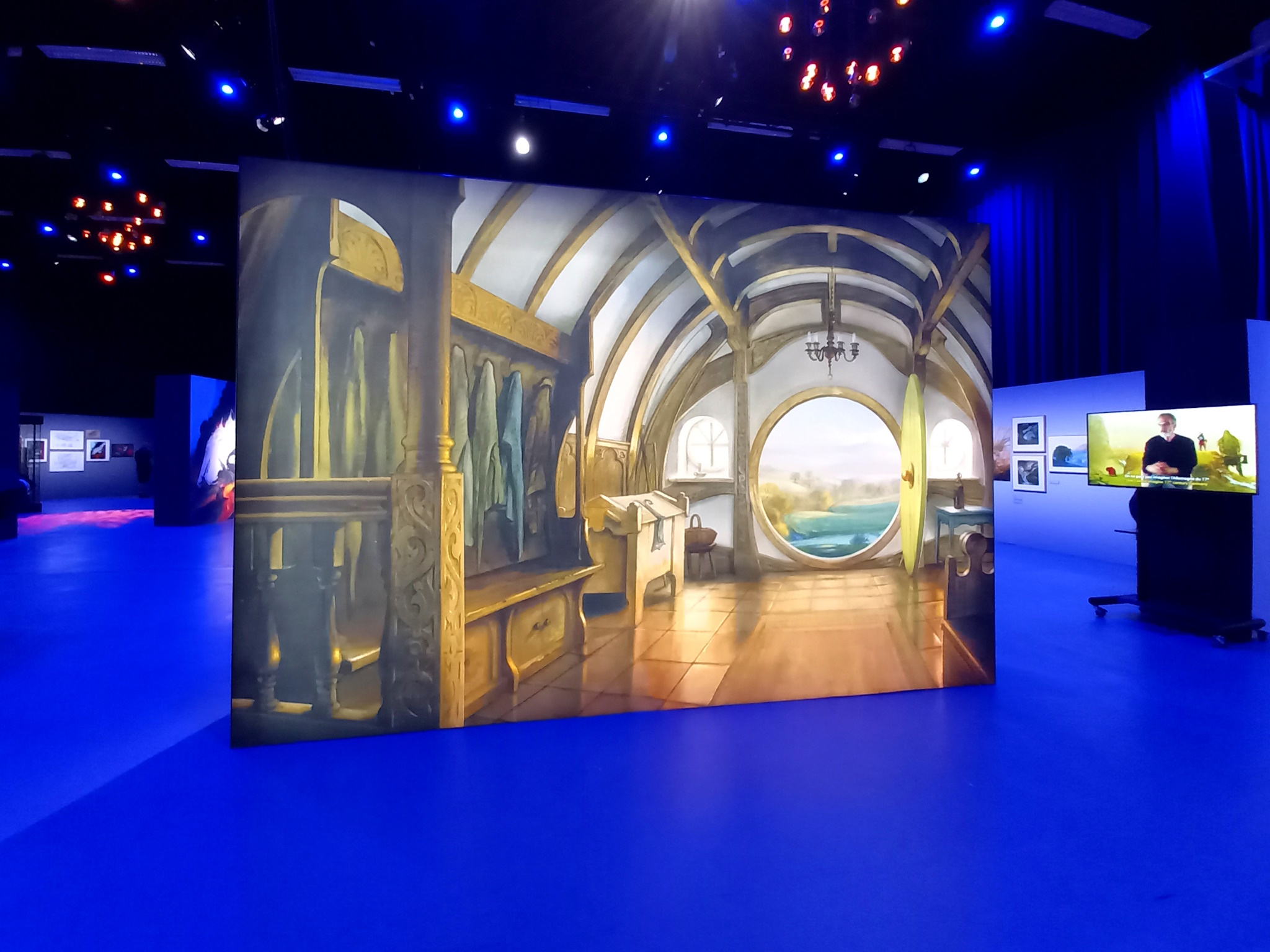
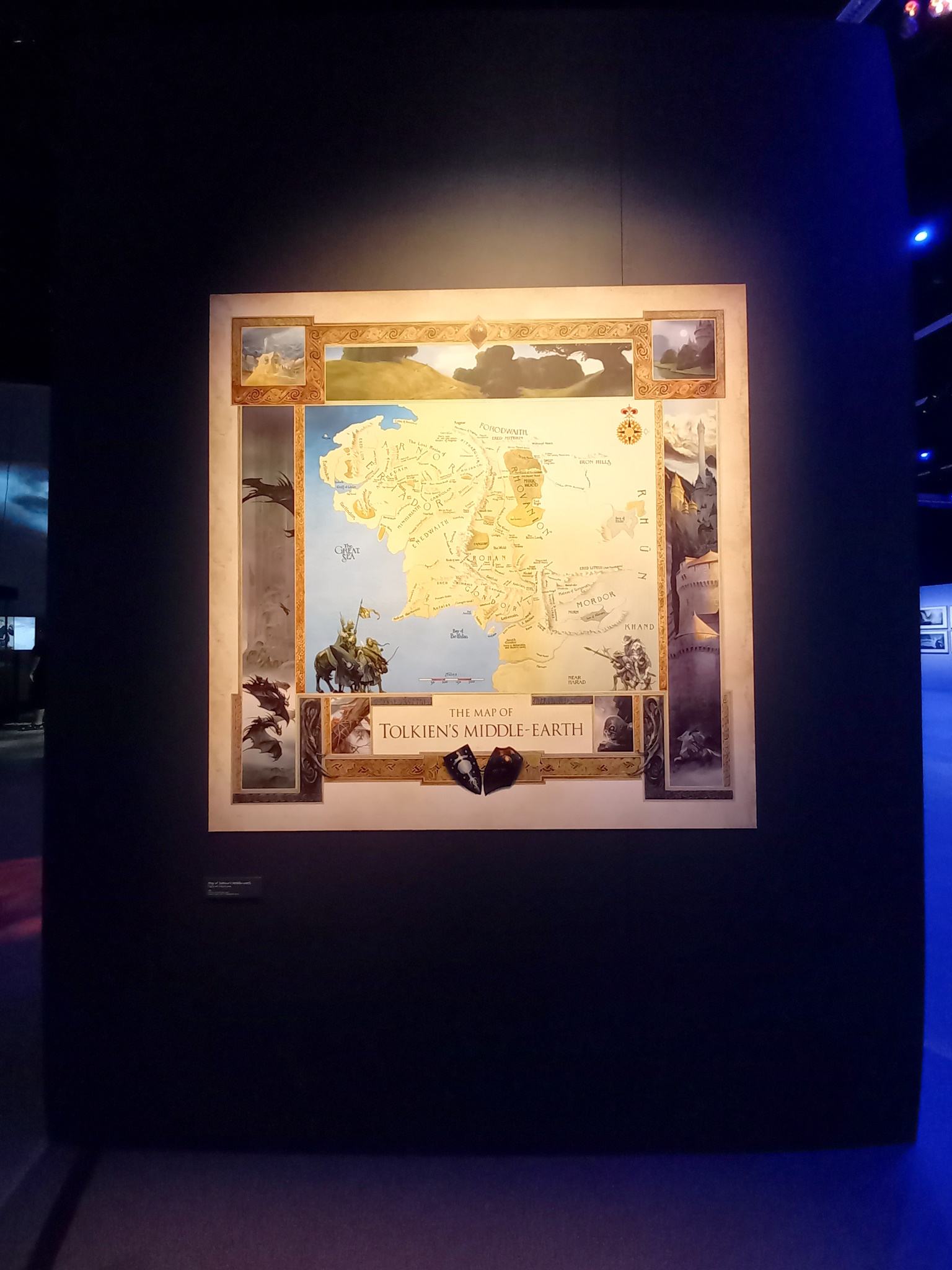
Last month we saw an exhibit of fantasy art by John Howe in Tampere-talo, Tampere, Finland. Titled The Art of John Howe: Journeys through the worlds of J.R.R. Tolkien, the exhibit is the first time that Howe’s work has been comprehensively displayed in Finland.

2024 08 13 Howe Exhibit1

Over 250 original works were presented, from pencil drafts to finished color paintings and sculpture, along with sketchbooks and even some metal armor belonging to Howe. Some images were also enlarged into murals or banners, and a number of video screens scattered around the exhibit looped captioned interviews.

2024 08 13 Howe Exhibit2
2024 08 13 Howe Exhibit3

Apart from various illustrations of The Lord of the Rings and The Hobbit, on display were for example works on mythical topics or sagas, like Beowulf and Arthurian legends. Also various architectural or creature studies were included.

2024 08 13 Howe Exhibit4

The exhibit space was partitioned into irregular areas. Walls framed your route in interesting ways, and the murals created striking views. In one corner there was even a video with flying dragons projected up on the wall high above the framed artworks so that the dragons were visible from a distance. The art pieces had enough room, and no area was too small—clearly accessibility was planned in.

2024 08 13 Howe Exhibit5

There was no predetermined loop, merely a path suggested by the layout, which made it easy to pick your preferred viewing order and to avoid the occasional crowd. It was also easy to double back without first having to finish the whole route.

Color and lighting were used in a fascinating way. Most spot lights were warm orangey-brown or in the blue-purple range. Otherwise the hall was surprisingly dark, but not unsafely so. It was very interesting from a mood point of view.

2024 08 13 Howe Exhibit6
2024 08 13 Howe Exhibit7

Visitors were encouraged to take photos. Unfortunately, the ceiling lights reflected on the glass, which made photographing individual framed artworks difficult.

2024 08 13 Howe Exhibit8

It was great seeing the complexity, detail, and vividness of Howe’s art in person, not to mention the variety of his work. We were absolutely delighted to be able to visit!

Images by Eppu Jensen

The Amazing Colors of an Ancient Perfume Bottle

So much of what survives of ancient art has lost the colors it originally held—statues have lost their paint, pigments have faded, textiles have weathered. One of the few materials that holds its color well over time is glass. Just look at this ancient Greek glass perfume bottle and see!

This type of bottle, called an alabastron, was used to store small quantities of valuable liquids like perfumed oil. Like this one, they typically had pointed or rounded bottoms and were kept in wooden or metal stands or hung from loops. The bright colors of this bottle are made from layers of colored glass and gold, bent around one another and blown into shape.

The swirling colors of this bottle almost make me think of 1960s psychedelia. It can be startling to find an ancient object that has kept its color and be reminded that it was created and used in a world that was equally colorful.

Image: Alabastron via Metropolitan Museum of Art (found Greece, currently Metropolitan Museum, New York; 1st c. BCE; glass)

Quotes: Women Have Also Painted

The ancient Roman naturalist Pliny the Elder wrote a good deal about painting. His interest stemmed from curiosity about which plants and minerals were used to make make pigments, but he also recorded the names of famous artists and some details about their paintings.

Unlike the stretched canvases we are used to today, ancient painters worked on wooden panels, of which extremely few survive, or on plastered walls, a few of which have survived in places like Pompeii and Dura-Europus. Most of the famous painters of antiquity were men, but Pliny makes sure to note that women also took up the brush.

Women have also painted. Timarete, daughter of Micon, created the very old panel painting of Artemis of Ephesus. Irene, daughter and student of the painter Cratinus, painted an Eleusinian maiden, Calypso, Theodorus the juggler, and Alcisthenes the dancer. Aristarete, daughter and student of Nearchus, painted Aesculapius. Iaia of Cyzicus, who was a lifelong virgin, painted and engraved ivory at Rome during the youth of Marcus Varro [late second century BCE]. She mostly made images of women, including a large panel painting of an old woman at Naples, as well as a self-portrait made using a mirror. Nobody had a faster hand for painting than she did, and in fact she was so accomplished an artist that the prices for her works far exceeded those commanded by Sopolis and Dionysius, who were the most celebrated portrait painters of the time and whose paintings fill the galleries. A certain Olympias was also a painter, but all that is recorded about her is that Autobulus was her student.


Pliny the Elder, Natural History 35.147-48 (=35.40)

(My own translation)

Women created famous works, were paid well for their craft, and taught others. It is unsurprising that some of these women were daughters of well-known male painters, since art was often a family business in the ancient Mediterranean.

Wooden panel paintings were among the most highly-prized forms of art in ancient Greece and Rome. Thanks to writers like Pliny, we know more about the famous painters of antiquity and their paintings than we would ever know from the few examples that survive today. It is good to have evidence that women, too, took part in this prestigious art form.

Image: Women preparing for a ritual, cropped from a photograph by WolfgangRieger via Wikimedia (Pompeii, Villa of the Mysteries; 1st c. BCE; fresco)

Living Vicariously Through Social Media: Streetpatching with Mosaics

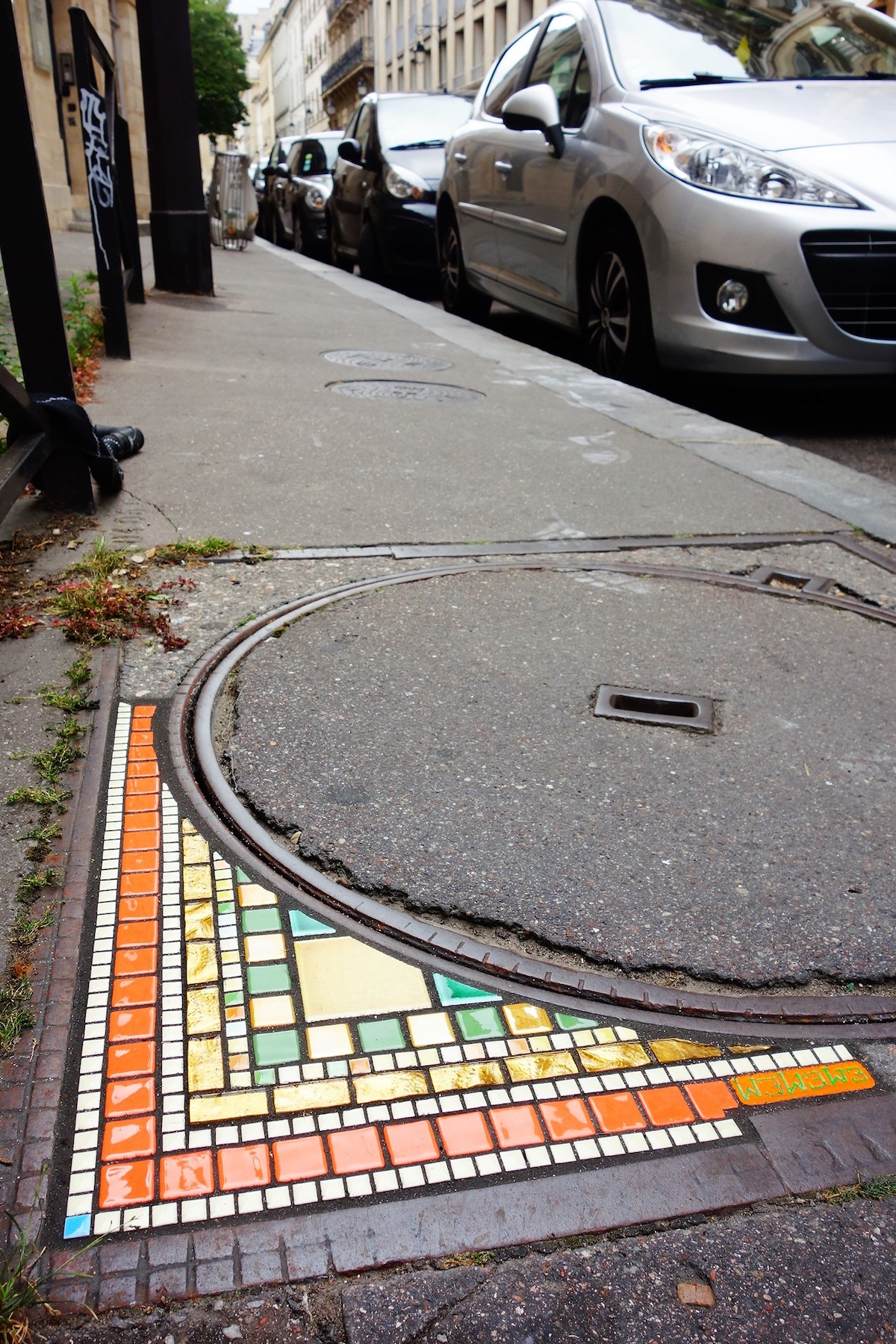
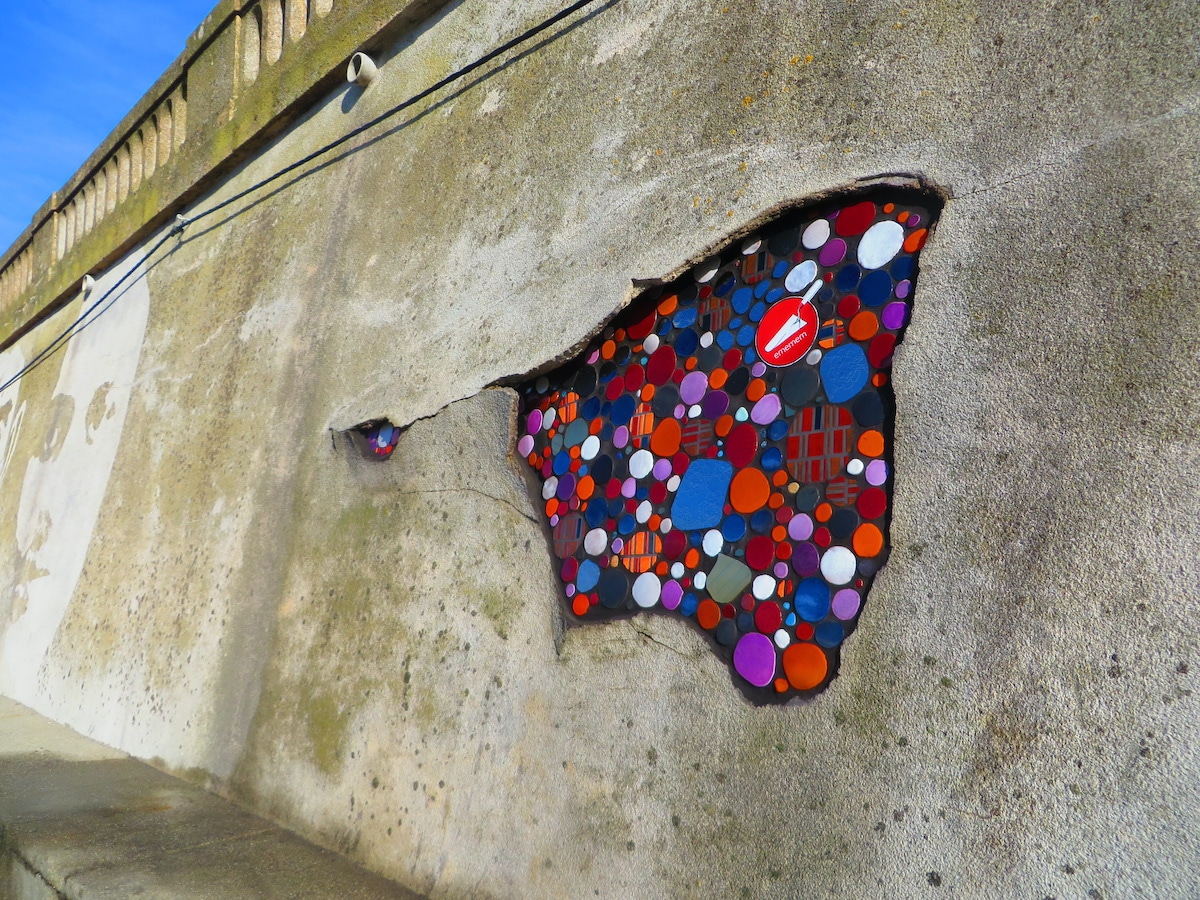
Ememem is a France-based visual artist known for repairing small areas in urban environments with colorful mosaics. He calls his technique flacking.

Wikimedia Edwige redige Flacking in Lyon

Since 2016 he’s been anonymously patching cracks in Lyon and Paris, and other European cities for instance in Norway, Scotland, Germany, Italy, and Spain.

My Modern Met ememem-street-mosaic-art-4

He typically works at night. His efforts are usually discovered in the morning as people start their day. Most of his efforts seem to focus on street surfaces, but some retaining walls or building walls also get some Ememem love.

My Modern Met ememem-street-mosaic-art-2

Ememem’s repairs are absolutely delightful! They remind me a lot of visible mending or quilting. I wish this type of repair were more common, but I understand the financial realities of why not.

Note: According to Wikipedia, Ememem has refused to confirm his age and gender. However, on his own site, the Ememem English-language press kit consistently uses the pronoun he, so I have therefore adopted that usage.

Images: Mosaic in blues by Edwige rédige via Wikimedia (CC BY-SA 4.0). Orange-green mosaic and wall repair both via My Modern Met.

Love Beyond Death

It is a beautiful thing to imagine that the love we feel in life might last beyond death. This Etruscan sarcophagus lid expresses that hope.


Sarcophagus lid via Museum of Fine Arts, Boston (found Vulci, currently Museum of Fine Arts, Boston; 350-300 BCE; marble)

This fine piece of sculpture adorns the top of a sarcophagus inscribed with the names of Thanchvil Tarnai and her husband Larth Tetnies. The couple are shown together, nude under a sheet, facing one another in a loving embrace. This is not the only Etruscan sarcophagus to depict the deceased as a loving couple sharing a couch, but it is one of the most intimate.

Sometimes, it may be hard to imagine finding someone you could even share a lifetime with, let alone someone you would want to spend eternity beside. If you find the right person, though, it’s sweet to think that your love could last that long.

A Greco-Scythian Gorytos

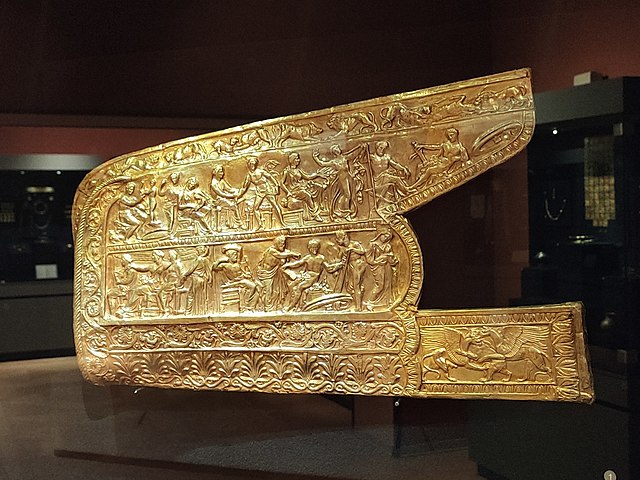
Here’s a beautiful work of art. This is a golden decorative panel from a gorytos, a combination quiver and bowcase that was used widely among ancient peoples of the steppes and the Iranian plateau. This example was found in Melitopol in southeastern Ukraine.

Gorytos, photograph by VoidWanderer via Wikimedia (found Melitopol, currently Kyiv; 4th c. BCE; gold)

Scythian artisans were expert metalworkers, and the Scythian elite valued high-quality metalwork, especially in gold, as emblems of status. This panel was made by Greek crafters serving the Scythian market. The central panel shows scenes from the life of Achilles, a Greek hero whose legends were sometimes associated with Scythia and whose warrior prowess was appealing to Scythian tastes. The outer panels feature decorative scenes of animals hunting, a popular motif in Scythian metalwork.

This piece is not just a beautiful work of art, it’s also an example of how art and artisans in antiquity crossed boundaries and bridged cultures.

Out There highlights intriguing art, places, phenomena, flora, and fauna.

A Writing Rabbit

There’s an interesting character in this scene from a Classic Maya vase. In the main scene, an aged underworld god is enjoying the company of a bevy of young women, but below him a rabbit scribe is keeping its eyes out and its ears perked while taking notes.

Scene from the “Princeton Vase” via Princeton University Art Museum (found Nakbe, Guatemala, currently Princeton Art Museum; 670-705 CE; ceramic with painted stucco)

None of the rabbits I’ve ever known in my life have been so practical!

Out There highlights intriguing art, places, phenomena, flora, and fauna.

A Viking-age Version of Spider-Man by Madeleine Fjäll

This piece of original artwork by Swedish illustrator and concept artist Madeleine Fjäll captures the essence of Spider-Man but transports him into Viking age:

Madeleine Fjall Viking-Age Spider-Man

Neat, isn’t it?

According to her website, Fjäll is also historical reenactor who sews some of her own clothes. That explains why Spidey’s Viking version looks so authentic. (As far as I can tell, the only piece where artistic license was taken is the lower head covering inside the hood and the spiderweb decoration on the red fabric.) Kudos all round!

In Making Stuff we share fun arts and crafts done by us and our fellow geeks and nerds.

Inkarnate for Gaming Maps

A good-looking map for a tabletop role-playing session can not only help your players figure out where they are and where to go, it can also give atmosphere to the adventure. As someone with no artistic skills to speak of, I’ve never been able to make nice maps on my own, but fortunately there are services for that now.

One I’ve been playing around with lately is Inkarnate. Inkarnate can produce maps in several different styles, including large-scale geographic maps, regional brid’s-eye views, and maps for individual buildings and dungeons. You can define coastlines and paint in ground and water textures. Then you can add individual items like mountains and towns on larger maps, or walls, chairs, and treasure chests on smaller-scale ones, each of which can be individually scaled and rotated.

There’s a good free version you can try out if you want to see how it works. It has only a limited set of assets to use, but there’s plenty you can do with just these. I made these maps below for a game earlier this year just using the free assets.

Brass Bay
Windward Shore House, first floor

I like Inkarnate enough that I’m considering paying for a full membership. I really like what it is helping me produce. If you’re looking for an easy way to make your own game maps, you might want to check it out.

Images created by Erik Jensen using Inkarnate

Of Dice and Dragons talks about games and gaming.