A Cat to Keep You Safe at Sea

Cats (or at least most cats) may not like water, but this one might have kept an ancient sailor safe on the waves.

Scaraboid, photograph by The Trustees of the British Museum. Outline illustration and collage by Erik Jensen. (Found Naukratis, currently British Museum; 600-570 BCE; glazed composition)
(CC BY-NC-SA 4.0)

The cat is part of the decoration on the underside of a small talisman found at the site of the ancient city of Naukratis in Egypt. Talismans of this type are called scaraboids because they are similar in shape and size to scarabs, but do not have the traditional scarab markings on their domed top.

The cat is a hieroglyph, one of three on the bottom of the object. Reading from right to left, the feather represents the sound i, the cat represents m (from the Egyptian word for cat, miu), and the sun disc represents n (from the word niut, meaning town or city, which the sun disc sometimes stood for). Put together, these hieroglyphs spell imn, a form of the name of the Egyptian god Amun. Many other scarabs and similar talismans from Naukratis contain forms of the name of Amun.

Amun was an important god in ancient Egypt, at times regarded as the king of the gods. Among his other functions, he was worshiped as a god of air and winds who protected sailors and other travelers on the sea. A talisman of Amun was an appropriate thing for an ancient sailor to carry around.

Naukratis is an interesting place to find a talisman like this. Naukratis was a Greek city founded inside Egypt by permission of the Egyptian kings. It was originally built as a home for Greek mercenaries serving in Egypt, but it quickly became a port for Greek and other foreign merchants who wanted to trade in Egypt. Most of the sailors who came through Naukratis were not Egyptians, yet there seems to have been a thriving trade in Egyptian and Egyptian-themed talismans, many produced in local workshops. It is likely that the intended customer for this scaraboid was not an Egyptian but a visiting Greek.

On one hand, the prominence of the cat on this talisman makes it seem like a bit of tourist kitsch designed to appeal to foreigners. Domestic cats were not yet common in most of the ancient Mediterranean, and Greeks associated them with Egypt. Including a cat in the talisman made it extra Egypt-y for a Greek audience. On the other hand, Naukratis amulets include many different hieroglyphic ways of spelling names of Amun, not all of which use cats or other specifically Egyptian symbols. Even if some pieces were made as tourist souvenirs, there also seems to have been a market for talismans referencing the Egyptian sailors’ god, even in a place where most of the sailors were not Egyptian.

This talisman and others like it are an interesting window into the multicultural world of Naukratis, where Greek sailors hoped for protection from an Egyptian god and cats were good protectors against the dangers of the sea.

Visual Inspiration: Indian Black Narrowmouth Frog

The Indian black narrowmouth frog (Melanobatrachus indicus) is a vulnerable species endemic to wet evergreen forests in southern India.

Wikimedia Davidvraju Melanobatrachus indicus

Not much is known about them outside of academia and/or research circles (and I’m currently too sick to start combing through more in-depth sources). They seem to be quite small, though. And how cute are those tiny blue polka dots! And its face, too! At least this individual looks so smart it could easily be the model for a dungeon boss for a computer game.

Image by Davidvraju via Wikimedia Commons (CC BY-SA 4.0)

When a Walrus Shows up at Your Door

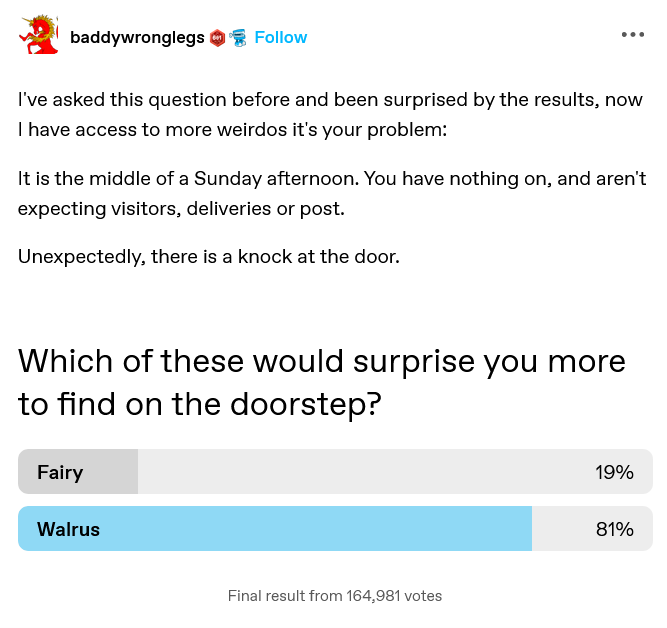
There’s been a thing going on in the past month on the Internet about fairies and walruses. If you’re not in the loop, it all started with a poll posted on tumblr by user baddywronglegs that asked respondents to consider which one they would be more surprised to find at their front door, a fairy or a walrus?

The fun of this poll is that it pits two very surprising (in most parts of the world) things against one another, but those things are surprising in two different ways. Fairies don’t exist, but if they did, it would be perfectly plausible for one to knock on your door. Walruses do exist, but the idea that one would survive the trip out of the Arctic, make it to your front door, and knock is beyond belief. What’s more surprising: the most unsurprising surprising thing or the most surprising unsurprising thing?

But, then, surprising things do happen sometimes. Like walruses showing up where they have no business being. A lost walrus found itself on the shores of southeastern Finland in the summer of 2022. It didn’t knock on any doors, but it did take a nap between some beached rowing boats, literally rolled around on someone’s yard in the grass, and posed in front of an emergency vehicle.

Yes, Finland is an Arctic country in the sense that we straddle the Arctic Circle, even though most of our land area is south of it. We do not, however, currently have any coastline in the north; all of our salt water access is to the south and west, i.e., to the Baltic Sea. Visits like this are, therefore, extremely rare. The walrus had to travel all the way around Scandinavia, through the Danish Straits (Kattegat and Skagerrak), and east along the Gulf of Finland to reach Hamina and Kotka.

(Alas, the poor thing turned out to be famished, and died in the middle of an attempted rescue en route to the Wildlife Hospital of Korkeasaari Zoo in Helsinki. It’s since been preserved and it’s on display at the Finnish Museum of Natural History.)

Wikimedia Antti Leppanen Haminan mursu

It’s quite staggering that we live in a place where, theoretically—very much in theory, but nevertheless—a walrus could turn up on the yard! (No sign of fairies, though.)

Images: Screenshot of tumblr post by baddywronglegs. Stuffed walrus in the Natural History Museum of Helsinki by Antti Leppänen via Wikimedia (CC BY 4.0).

Living Vicariously Through Social Media: Ringneck Snakes

I’m not a great friend of cold-blooded critters in general. The ringneck snake (Diadophis punctatus), however, does fall close enough to my sense of cute to bring up. Especially the juveniles—soooo small!

Flickr Tony Iwane Pacific Ringneck Snake

Even the adult ringnecks are quite small and slender, about 21-36 cm (8″-14″) long. The belly and underside are bright yellow, orange, or red, and there often is a ring of the same color around the neck. The 14 non-poisonous subspecies are found in much of the United States, central Mexico, and south-eastern Canada in a wide variety of habitats.

Apparently, the coloring can also shift along the length of the body, like on the prairie ringneck snake in the photo below.

Flickr Peter Paplanus Prairie Ringneck Snake

This type would be especially handsome as a ginormous fantasy version, perhaps even as a rideable creature, a little like the sandworms on Dune or oliphaunts in The Lord of the Rings with war-towers on their backs.

Images: Pacific ringneck snake by Tony Iwane on Flickr (CC BY-NC 2.0). Prairie ringneck snake by Peter Paplanus on Flickr (CC BY 2.0).

How to Get Away With Murder, In Ancient Rome, With a Bear

If someone out there is looking for a good plot for an ancient Roman mystery thriller, here’s a tip. There’s a famous case in classical Roman law according to which it is possible to get someone killed and face no legal consequences. The catch is: you have to get lucky, and you have to use a wild animal like a bear.

To start with, we have to lay down a few fundamentals of Roman law: dominium and possessio. Dominium means ownership, the absolute right to control a particular piece of property. Possessio, unsurprisingly, means possession, the direct control of property.

In most cases, people have both dominium and possessio at the same time. You own a vase, which you keep in your house as decoration on a table—you have both the legal right to that vase (dominium) and direct physical control over it (possessio). It is also possible to have one without the other. If you lend that vase to a friend so they can decorate their house for a party, you still own the vase (dominium) even without possessio; as long as your friend has it in their house, they have possessio, but that doesn’t give them dominium.

Now, if someone uses that vase to smash someone over the head and kill them, it doesn’t matter who owned or possessed the vase. Inanimate objects are not responsible for what people do with them. The person who did the smashing is liable for the results of their actions. Neither an owner nor a lawful possessor is liable for what other people do with their property.

With animals, though, we get into a more complicated area. Sometimes people can directly provoke animals to cause harm, like spooking a herd of cattle into a stampede or siccing a dog on another person. In those cases, Roman law recognizes that the person who provoked the animals is responsible for the harm they caused, in the same way that someone who picks up a vase and smashes it over someone else’s head is responsible for the damage done by the vase. Yet animals can also act on their own initiative. A charging bull or biting dog can ruin someone’s day without a person directly commanding it, and you can’t sue an animal for the damage it causes.

To deal with cases where animals caused harm without direct human intervention, Roman law provided the action of pauperies. In a lawsuit for pauperies, the owner of an animal was held legally liable for harm the animal did when acting on its own nature. It didn’t matter whether the owner caused the animal to act, or was even present when the damage was done. The person who had dominium of an animal was responsible for what that animal did. (There was a limit, however: if a person was sued for damages done by their animal, they could escape all liability by handing over the animal in question to the wronged party. In this way, the limit of liability was the value of the animal itself.)

For domesticated animals, pauperies provided a degree of legal recourse, because a domestic animal always belongs to someone. Even if your bull breaks out of its paddock and goes on a rampage through town, it’s still your bull. Once the bull is off your property, it is no long in your possessio, but you still have dominium and the legal liability that goes with it.

Wild animals are a different case. Under Roman law, you can have dominium over a wild animal only so long as you have possessio of it. If you are hunting a deer and catch it in a trap, the deer belongs to you as long as it is in your trap or if you can get a rope on it to wrangle it back to your property, but if it breaks free and runs off through the woods, you loose your claim to it unless you catch it again. If another hunter kills the deer while it is running from you, you have no recourse against them, because as soon as the deer is out of your possessio, it is also out of your dominium.

So far so good. All of these legal principles have a sound practical purpose and make logical sense. When we put them together, though, an unexpected result emerges.

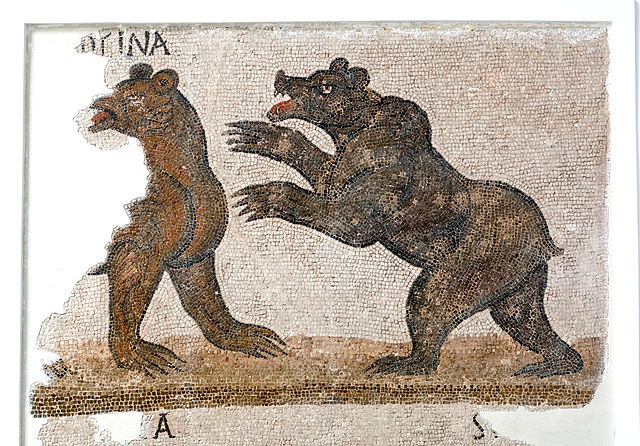
Suppose you have a bear in a cage. A bear is a wild animal, like a deer, so as long as it is in your direct physical control, it belongs to you. If the bear reaches out of its cage and mauls someone, you are legally on the hook for damage because it is an animal in your dominium. But what if it gets out? Once the bear escapes its cage and is running free, you no longer have direct physical over it, so you lose possessio. Because it is a wild animal, not a domestic one, as soon as you lose possessio, you also lose dominium. On one hand, that means that if someone else captures or kills the bear, you have no legal right to sue them or demand they return it to you. On the other hand, you also have no legal liability for any damage the bear does.

It would take a lot of luck to pull off, but if you can concoct the right scenario where a dangerous animal gets loose at the right time and kills the person you want to target, under Roman law, you would be free and clear.

Image: Roman mosaic of a bear, photograph by Jerzystrzelecki via Wikimedia (currently Bardo Museum, Tunisia; Roman period; tile mosaic)

History for Writers looks at how history can be a fiction writer’s most useful tool, from worldbuilding to dialogue.

Visual Inspiration: Whiskered Treeswifts

Whiskered treeswifts (Hemiprocne comata) live in various subtropical or tropical forests in Southeast Asia.

Macaulay Library David Cathy Cook Whiskered Treeswift

They remind me of swallows, but are more colorful. Especially the combination of grey plus blue in the wings and back appeals to me.

Setting personal color preferences aside, wouldn’t it be so much more interesting to read a secondary world fantasy story with, say, messenger birds that look like whiskered treeswifts rather than the uninspired and unoriginal corvids?

Yes, corvids are AMAZING birds, but they’re used EVERYWHERE. Could they not be replaced by something else in a fantasy story? Or at least made vibrantly colored?

Image by David and Cathy Cook via The Cornell Lab of Ornithology, Macaulay Library

The Visual Inspiration occasional feature pulls the unusual from our world to inspire design, story-telling, and worldbuilding. If stuff like this already exists, what else could we imagine?

Visual Inspiration: Steller’s Sea Eagle

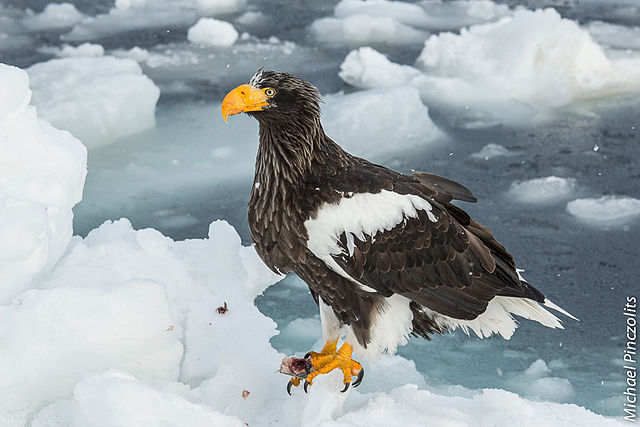
Here’s a bird of prey with a different look. The Steller’s sea eagle has white bands at the front of its wings, on its legs, and on its tail. It also has a short, thick yellow-orange beak.

Steller’s sea eagle at rest on ice, photograph by Michael Pinczlits via Wikimedia

The normal range of this eagle is along the coasts of northeast Asia from the arctic to Japan, but in recent years there have been sightings as far away as Texas and Nova Scotia.

Steller’s sea eagle hunting, photograph by Julie Edgley via Wikimedia

I’d love to see more birds like this in media, not just the usual suspects like the bald eagle and red-tailed hawk.

Visual Inspiration pulls the unusual from our world to inspire design, story-telling, and worldbuilding. If stuff like this already exists, what else could we imagine?

A Writing Rabbit

There’s an interesting character in this scene from a Classic Maya vase. In the main scene, an aged underworld god is enjoying the company of a bevy of young women, but below him a rabbit scribe is keeping its eyes out and its ears perked while taking notes.

Scene from the “Princeton Vase” via Princeton University Art Museum (found Nakbe, Guatemala, currently Princeton Art Museum; 670-705 CE; ceramic with painted stucco)

None of the rabbits I’ve ever known in my life have been so practical!

Out There highlights intriguing art, places, phenomena, flora, and fauna.

Visual Inspiration: Bohemian Waxwing in White

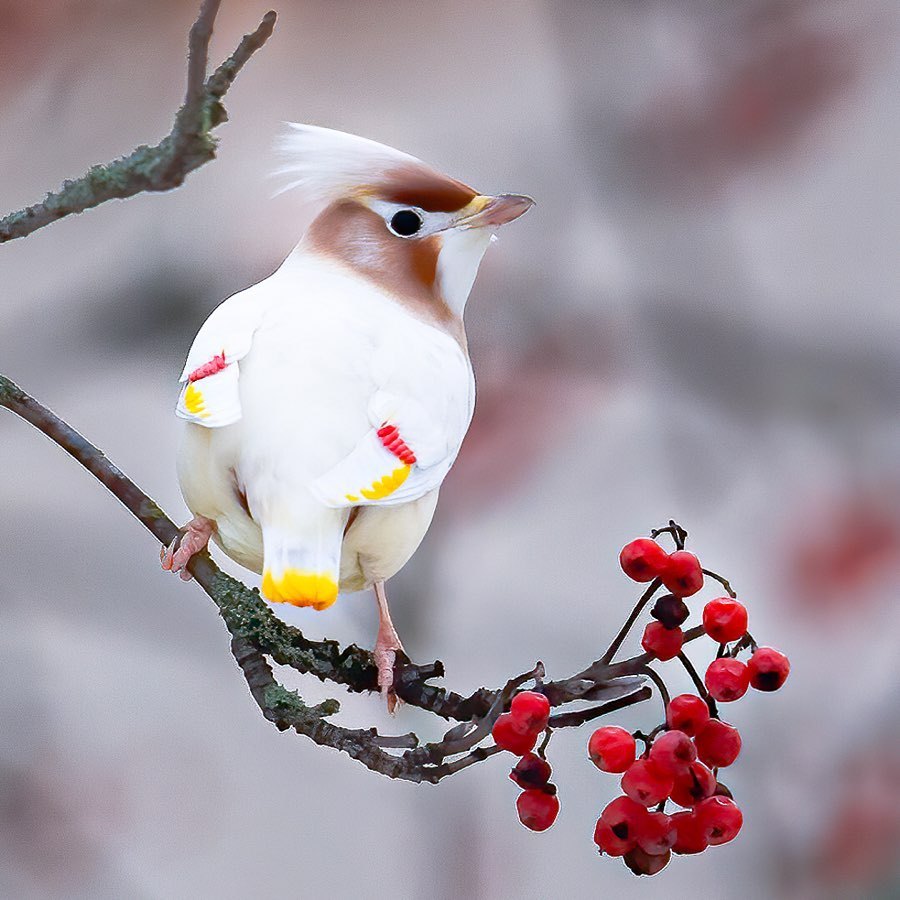
Leucism or pigmentation loss results in partial coloring in individuals, like this amazing Bohemian waxwing:

Tumblr Make Rantala Leucistic Bohemian Waxwing

Very striking, isn’t it! A white waxwing would catch your eye anyway, but the red and yellow wing and tail tips are the truly arresting parts. Wow.

I just can’t but wonder how well one would do in nature. In northern Fennoscandia it would be okay in the winter, because even with the climate change the northern Nordic areas get snow, but summer might be tough.

Image by Make Rantala on Instagram, found via Beauty in All Things on Tumblr.

Out There highlights intriguing art, places, phenomena, flora, and fauna.

Visual Inspiration: Frog Lives up to Its Name

The mossy frog or Vietnamese mossy frog (Theloderma corticale) comes from Southeast Asia. (Apparently it’s known by many other names, too, like Tonkin bug-eyed frog, but that just sounds offputting, doesn’t it?)

Flickr Smithsonian National Zoo Mossy Frog

Not the only animal with camouflage to play dead when threatened, the mossy frog does it cuter than others, if you ask me. Very effectively, too, if the photo below is any indication:

Flickr mamojo Vietnamese Mossy Frog

Just think if your fantasy role-playing game had a party of player characters traveling through a clearing in a wild, overgrown forest dotted with mossy boulders, which suddenly started moving… and turned out to be huge frogs! Or a secondary world story with villagers somewhere in the boonies struggling to catch and cook these abnormally large frogs before they eat the village’s harvest.

As a total side note: while writing this post I learned that one of the synonyms for camouflage is the phrase plain brown wrapper. I’ve no idea how I’ve never come across that before, but now I know it. It’s one of the joys of language learning to me: you never really stop picking up new words and expressions. 🙂

Images: On a stick by Smithsonian’s National Zoo and Rawpixel via Flickr (CC BY 4.0). Camouflaged by mamojo via Flickr (CC BY-SA 2.0).

Visual Inspiration pulls the unusual from our world to inspire design, story-telling, and worldbuilding. If stuff like this already exists, what else could we imagine?